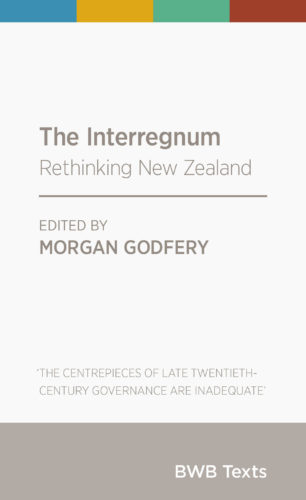
VJMP Reads: The Interregnum: Rethinking New Zealand I

The Interregnum: Rethinking New Zealand is a small book of essays that is for sale at the Volume bookstore in Nelson, by Bridget Williams Books. The blurb on the back asks the question of whether New Zealand’s political settlement is beginning to fray, and purports to “interrogate” the future from a youth perspective.

The first essay, by editor Morgan Godfery, is called “The Voices of A New Generation” and opens by relating an anti-TPPA demonstration in Auckland. It breathlessly describes the excitement of thousands of diverse people coming together to oppose the signing of the multilateral trade agreement.

Reading this piece, something about it speaks to the lack of purpose that the young generation now has. The fight against apartheid seemed meaningful at the time; it seemed a great evil was being fought. A law that says that a large section of the population are second-class humans, for no other reason than skin colour, seems like the sort of arbitrary and cruel treatment that everyone should be against.

But can the same be said of international trade? Who really understands it well enough to decide? And so what if “trade agreements are signed”?

By the fourth page of this essay there is already a Marx quote, which bodes poorly. The reader gets the sentiment that the new voice here is going to be an echo of the same social justice warriors seen overseas. If not, why oppose something as vague and nebulous as the TPPA, instead of protesting about poor wages, poor housing, poor mental health outcomes?

The essay finds its feet when it hones in on the real enemy: neoliberalism. Godfery mentions the damage done to the national psyche by the Mother of All Budgets, and it feels like he speaks for many when he says that the children condemned to poverty by Richardson’s Budget are now adults, some of us with our own children.

But again, this speaks to the confusion in the New Zealand Left. What to make of the fact that the signing of the TPPA was protested under a National Government, with many prominent Labour supporters in attendance, and then the Labour Government went and signed it anyway? No-one knows yet if Labour will get criticised for their evident support of neoliberalism, or whether people will let it pass.

This introductory essay declares that the book is for those who have “a fierce desire to radically reshape politics.” It proposes that instead of focusing on “returns on investment”, that we return to a politics of “higher principles and values”.

This is all very well, but the question that strikes one is: whose higher principles and values? Because usually when the working class votes for people promising to govern by higher principles, it turns out that those principles only apply to a chosen few groups, and if you’re not one of them then you’re “privileged” (“privileged” means “untermensch” in social justice speak”.

We can see this now with Jacinda Ardern’s decision to give Manus Island “refugees” her highest priority, while saying nothing about the Kiwis suffering from the illegal status of medicinal cannabis. Unfortunately for medicinal cannabis users, official victim status has so far eluded them, and so they continue to be ignored.

Concluding with half a dozen mentions of the word “love”, this essay promises that the book will make for interesting reading for the sake of political philosophy. However, it’s not possible to believe that a book that opens by quoting several Marxists could be entirely trustworthy or honest, even if it is earnest.

It remains to see what these higher principles are.
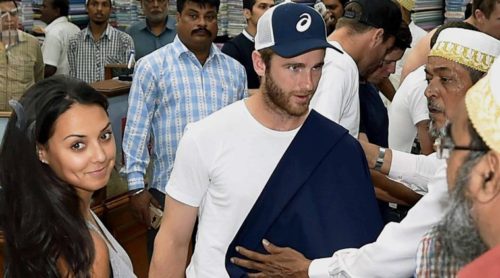
Why New Zealand Should Make Cricket Our National Sport

Kane Williamson is ten times more famous on the world stage than any All Black realistically ever could be – and a hundred times less at risk for head injury

It’s over. The Scots have beaten us for the first time in rugby history. It didn’t turn out quite like that, of course, as Beauden Barrett’s covering tackle forced a knock on from the Scottish fullback, but when Stuart Hogg broke the line and then defeated TJ Perenara’s ankletap, it looked like the Scots were going to score, making it 22-22 with a kick to come.

If Finn Russell had slotted that, Scotland would have beaten the All Blacks for the first time in over a century of trying. It would be a dark day for New Zealand rugby, especially having conceded a first-ever loss to Ireland only a few years beforehand.

Considering that the Kiwis were bundled out of the RLWC at the quarterfinal stage, it would be an incredible dual blow to the country’s self image within 24 hours. Our aura of rugby invincibility would be shattered. It would be emasculating. Kiwi men wouldn’t be able to look their wives in the eye for weeks.

Hell, it was bad enough for the Kiwis to lose to Fiji and for Scotland to not get thrashed. We might do well to see the writing on the wall now and realise that our historical advantages have been eroded, and that there is every chance of us being just one of the pack from now on.

All these are just superficial reasons for questioning the primacy of rugby as the national sport, though. They are fashions, that come and go.

What will mark a permanent change is our ever-increasing awareness of the severity of brain trauma endured by constant heavy collisions. Fifty years from now, it’s possible that no-one will be playing rugby at all, whether league or union, for the same reasons that other extremely violent things don’t happen anymore. We became aware of the actual consequences.

Rugby is fun as all hell to play. Maybe it’s because of the danger inherent in the game. Tackling is dangerous, because if you go too low you can take a knee to the head, and if you go too high you can talk an elbow to the head, and the ruck is dangerous because someone might drop a knee or elbow on your head, and the high ball is dangerous because you might land on your head, and so on.

It’s hard to avoid playing rugby without head injuries. Richie McCaw said, shortly after his retirement, that “I don’t miss getting smashed,” and Kieran Read is on record as saying that he will raise his son to play cricket instead of rugby because of the risk of head injury makes rugby a poor choice.

This latter point regarding Read is something to think about. If a man as brave and mean and big and athletic as Kieran Read is going to steer his sons away from rugby because of the risk of head injury, what hope do the rest of us have?

The lifelong effects of repetitive brain trauma on NFL players are increasingly becoming known. Mounting evidence suggests that the brain trauma from tackling and being tackled is strongly correlated with future neural disorders, early dementia, strokes etc. There must be tens of thousands of young mothers who are now aware of this risk from playing collision sports and we shouldn’t be surprised if rugby went the way of bullrush and got banned in all schools on account of the risk to developing brains.

Already the international game is being affected by the head to send players off for head injury assessments, and the more this happens the more people realise that head injury is really an ever-present risk for rugby players.

From a cultural perspective, the risk here is that these mothers steer their children away from rugby and into a shit sport like soccer, thereby exposing them to moral and physical degeneration and teaching them to glorify cheating and disrespecting the referee.

For this reason, it’s imperative that cricket steps into the gap left by the impending withdrawal of children from the rugby paddocks and fills a national need for a sport that allows for competition in a high-trust environment. Furthermore, cricket will soon become a much more realistic career path than rugby for talented Kiwi athletes on account of the IPL and other international T20 cricket leagues.

A switch to cricket as our national sport might be a wise move now, because it may be forced on us in the future by an increasing appreciation of the risk of brain damage.

Are Muslims Bigots, According to the Left?

The acid test for not being a bigot has, for decades, been one’s attitude to homosexuality – but most Muslims fail here

Throughout the Australia same-sex marriage referendum there was a constant refrain: Don’t be a stupid, vicious, hateful bigot, and make sure you vote Yes. Only through sheer bigotry could a person vote No. Only by way of an unprincipled, mindless, unforgivable hate of gay people could a person possibly be inspired to vote against love.

The entire Yes campaign was driven by a fear of far-right extremism. The spectre of white supremacism was even raised. Apparently skinheads and Nazis were ready to storm the streets to give marginalised homosexuals a kicking, cheered on by the same rich old white Christian people who have oppressed everyone else going back to the dawn of time.

But all of this “Love trumps hate”-style rhetoric backfired when it turned out that there were very strong correlations, measured at the electoral level, between being Muslim and voting against same-sex marriage. Notably, the West Sydney electorates with the largest numbers of Muslims were the same electorates to record the highest proportion of No votes.

Statistics showed us that Muslims hate gay people and don’t consider them worthy of equal rights. It’s as simple as that. After all, in Muslim countries they often hate them so much they kill them, so there’s no surprise whatsoever that in a multicultural Australia that grants religious freedom to Islam, some Australians will use that freedom to hate gay people.

This raises an obvious question: are Muslims bigots?

After all, we have just spent months being told that people who were against same-sex marriage were bigots, and that the bigotry of homophobia has to be exterminated from modern Australia at any cost.

Over and over, we are told that bigots have no place in modern society, that all political views considered bigotry will have to be relinquished, that if a person doesn’t relinquish a bigoted opinion they are evil, and can be considered identical to Hitler in kind if not in degree.

Moreover, any person holding a bigoted viewpoint is automatically so evil that it’s legitimate to abuse them, to shun them, to lie about them, and to altogether treat them as if they are subhuman for having committed an unforgivable moral failure out of no motivation but pure malice.

So what do we make of the fact that, as per the definition of bigot that the Left has been using up until now, Muslims are extremely bigoted?

The obvious response is to say that gay people knew that already. Muslims are, after all, Abrahamists, and Abrahamism has a scriptural command to murder homosexuals in the Book of Leviticus of the Hebrew Bible, the same place that most Christian anti-gay hate arises from.

The less obvious response is to be quietly grateful that the Muslims of West Sydney are not ten times greater in number, because that might have shifted the balance of the referendum to 49-51 against.

These West Sydney suburbs are, ironically, Leftist strongholds, so the hate that the Left is always accusing the working class of – of being exclusive, discriminatory, bigoted, cruel and malicious – is present in greatest concentrations within their own territories!

VJMP Reads: Anders Breivik’s Manifesto XVII (End and Summary)

This reading is the final one in this section, and completes our reading of 2083: A Declaration of European Independence. It carries on from here.

This final section of the document (pages 1414-end) is mostly given over to a diary-style account that Breivik wrote when he was planning his operation. It describes in detail his thoughts leading up to the event and the caution he took in order to go undetected until the final moment.

It reads eerily because of a combination of a few things, especially the ordinariness of the vast majority of Breivik’s thoughts when contrasted with the murderous intent and fanatical devotion with which his deed was planned. Hannah Arendt’s comment about “the banality of evil” comes frequently to mind.

Most of the concerns and anxieties that he describes here are simply everyday concerns. One passage about the tediousness of email farming could have been written by any non-violent person, and another passage about Breivik being forced to overcome his fear of spiders might even be endearing if the reader hadn’t already gone through 1,450 pages of justification for shooting teenagers.

This section is actually capable of being self-consciously dark and comical, such as when Breivik is describing the difficulties he initially encountered trying to buy black market firearms in Prague, when his typically Norwegian frankness brought instant paranoia to the criminals he was trying to do business with.

All in all, it’s things like this that make this document so unsettling. Breivik is clearly capable of sophisticated humour and was apparently able to make friends and socialise without anyone realising what he was planning. With his references to social competition and a great future ambition he seems unbelievably normal – most of the friends he references have serious girlfriends and/or professional jobs.

This is a common sentiment for people who have known serial killers and the like, and were astonished by how normal they seemed. After all, Breivik killed over 70 people, which is more than other infamous killers like Ted Bundy and John Wayne Gacy. So it’s reasonable that many people would be surprised and astonished when they saw on the news that someone they knew and considered normal did such a thing.

A question about gun control is raised in this section. If Breivik purchased a semi-automatic rifle legally under stringent Norwegian gun control laws, and still managed to kill more people in one incident than has ever been managed by an American terrorist in the entire duration of that country and its long love affair with firearms, then what’s really going on?

At one point, Breivik relates a discussion with a Marxist friend at a party, where Breivik asks: “Don’t you consider yourself to be a hypocrite considering the fact that you support mass Muslims immigration and at the same time refuse to actually live with them?” It’s a question that many young Western people have asked themselves of the middle-class left.

If a person would start to read this manifesto with a certain idea in their head about Breivik being a neo-Nazi and Nazis being simple but emotional people, they would get a completely different idea by the finish. Breivik is genuine when he claims to despise Nazis, for the reason that Nazis would soon get rid of people like him, a “cultural conservative” who considers Israel a brother nation.

Breivik is not a Nazi, and neither is he a thug. There are grammatical errors characteristic of a native Scandinavian speaker throughout the text, but at the same time there are few people who would be capable of compiling a mostly coherent 1,500 page document in a foreign language.

Also striking is the fact that Breivik made over $1 million over the course of five year through a variety of entrepreneurial schemes that would have taken good intelligence and great personal drive and commitment to complete.

This paints a picture of Breivik as a member of the class elite in many ways. He was physically, financially, socially and intellectually (to say he was ‘mentally’ healthy would be pushing it) in excellent shape.

Perhaps here the signs of his downfall can be first observed – in one passage he describes himself as someone with “basically the perfect body”, and at no point in this document does he express an appreciation of or reverence for any other person, apart from vague historical figures.

Also telling is the fact that no romantic engagement with a woman is ever mentioned. Breivik mentions partying with Norwegian friends and their girlfriends, but at no point does he mention a girlfriend himself, a desire for a girlfriend, or getting laid (beyond the need to breed children to counter Muslim rates of breeding). It’s possible that his narcissism made him lonely on account of making him intolerable to women.

When all the signs are put together, Breivik is clearly a monstrous narcissist, which is perhaps from where he got the willpower to reject the socially accepted history and modes of thinking and arrive at an intelligent and accurate conclusion.

It’s perhaps also possible that being one of the few people in his social circles to appreciate the iron-cast logic of Muslims eventually becoming a majority in some European countries if current trends continue, Breivik suffered from a profound sense of alienation and isolation. It’s an extremely difficult experience to be the one person who can see the truth while the masses rip you down for speaking it. This may have caused him to become bitter, resentful and vengeful.

In the final analysis, it’s more than possible to put aside the narcissism and the murders and to consider Breivik’s unusual perspective on its own merits. Dismissing this document on the grounds that a murderous narcissist wanted it read is to fall victim to precisely the kind of logic dismantled in the document itself. It would represent the intellectual cowardice that gives rise to someone like Breivik in the first place.

After all, Breivik’s political complaints are entirely reasonable, even if his conclusions are not. The real danger is that people with entirely reasonable conservative beliefs are radicalised into violence on account of the utter refusal of the left to engage with them civilly in favour of adopting “Punch a Nazi” style thuggery. A refusal to honestly talk will lead to violence, so any leftist with an honest sense of duty to keep peace and good order in society has to at least consider this question.

*

This is the end of this segment of VJMP Reads. Now we have put to the readers on our FaceBook page the question of which book to read next.