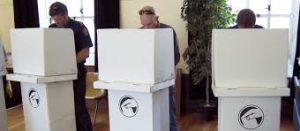
What sort of political party supporter actually turns out to vote? It’s not as straightforward and simple as just old, rich, male and white. However, turnout rate can serve as a useful indicator of general disenfranchisement.
Interestingly, the correlation matrix gives us a clue about a line of information that is completely closed off to anyone running a simpler analysis: we can know which party has the supporters that are most likely to vote by looking at the correlation between party vote in each electorate and the turnout rate in that electorate.
It seems fair to assume that, all other things being equal, the turnout rate of any party’s supporters is roughly equal to the degree that those supporters feel their needs and desires will be taken seriously by the eventual representatives. After all, if your vote will not count for anything because your MP will ignore you anyway, why bother to cast it?
Perhaps more than any other set of correlations, this one tells us who is running the country. If you have money and wealth, you can vote knowing that whoever wins the election will listen to you out of natural shared solidarity. If you are disadvantaged – poor, physically or mentally ill, female in some cases, the wrong religion or race in many others, you can’t.
Unsurprisingly, there is a strong correlation between turnout rate in 2014 and voting for National – this was 0.76. The Labour one, at -0.67, was almost as strong in the other direction. This difference represented by this correlation arguably reflects the most fundamental political division in society – between the haves and the have-nots.
This correlation is large enough that we can predict the vast majority of people who do not turn out to vote are Labour supporters.
Reflecting that the average Green voter is significantly wealthier than the average Kiwi, there is a significant correlation between turnout rate and voting Green – this is 0.26. Probably this would be higher if it reflected the level of class privilege of the average Green voter, but because the average Green supporter is also so young the turnout rate is somewhat suppressed.
The turnout rate was, as it was for Labour, significantly negatively correlated with New Zealand First support. The correlation here was a moderately strong -0.40, which is possibly even a little less negative than one might have expected based on the income of the average New Zealand First voter. Even though the bulk of New Zealand First supporters are working-class Maoris and thus have a low turnout rate, the party has a core of elderly white voters who can be counted on to vote.
The turnout rate was moderately correlated with voting for the Conservative Party in 2014 – this was 0.55, easily the second highest of all the correlations between turnout rate and voting for a party. This is even though voting Conservative in 2014 did not have a significant correlation with median personal income.
The main reason for this is the strong correlation between voting Conservative in 2014 and median age, which was 0.75. Because old people vote at significantly greater rates than the young, and because old people are religious fundamentalists at significantly greater rates than the young, old people will vote for a party (like the Conservatives) that appeals to religious fundamentalism.
All of the parties that had a high proportion of Maori voters had a significantly negative correlation with turnout rate. The correlation between turnout rate and voting Maori Party in 2014 was -0.74, with voting Internet MANA it was -0.69, with voting Aotearoa Legalise Cannabis Party it was -0.68 and with voting New Zealand First it was -0.40.
None of these are surprising considering the strong negative correlation between turnout rate and being Maori (-0.74). It may be that the natural support levels of both the Maori Party and Internet MANA are closer to what the Conservative Party is pulling in, but because of massive disenfranchisement among Maori are unable to translate that support into seats in Parliament.
*
This article is an excerpt from Understanding New Zealand, by Dan McGlashan, published by VJM Publishing in the winter of 2017.