

A Universal Basic Income Would Pay For Itself In The Bitching It Would Prevent

The Internet is full of bitching about who is entitled to what and who is ripping who off. Endless back-and-forths that have been running for decades already, and sometimes for centuries before the Internet was invented. This bickering does a tremendous amount of social damage, fostering distrust, suspicion and cynicism at all levels. As this essay will examine, a universal basic income would pay for itself by settling much of this bitching.

One of the eternal debates relates to the pension age.

Our society is currently structured so that 64-year olds are made to work under threat of starvation, but 65-year olds are gifted $370 a week from the state until they die, no questions asked. A person’s life is radically different from the week before they turn 65 compared to the week after. Turning 65 grants you access to so much free money that it’s like winning the lottery.

The problem, from the state’s point of view, is that the pension already costs New Zealand some $16 billion dollars per year – a figure that is rising by about a billion a year. This means that there is a great incentive to cut down on costs by raising the pension age. On top of that, many argue that the current pension arrangement in unsustainable, on account of that people are in good health for longer.

Naturally, proposals to raise the pension age are bitterly resented by those close to it. Howls of outrage are inevitable every time the media raises the subject. Also naturally, those younger still, who have no hope of the luxury pension lifestyle that today’s elderly enjoy, don’t give a shit, and are happy to just laugh. Therefore there is bitter resentment on all sides.

We already have a universal basic income for those over 65. If we would lower the size of the payment to something more reasonable, and then extend the age limit all the way down to 18, would could get rid of the need to argue over the pension age entirely.

Another eternal debate revolves around making a distinction between the mentally ill and the lazy. The logic is that it’s fair to pay mentally ill people welfare because they can’t be expected to hold down a job, but it’s not fair to pay lazy people on welfare because it will just encourage them to not work.

The difficulty is, of course, that it’s almost impossible to tell the difference between the two. It’s not at all routine to find agreement between two psychiatrists as to whether a given patient is mentally ill or a malingerer. It couldn’t possibly be, given how complicated the average mind is and how long it takes to get to understand it.

In practice, there’s essentially no way to tell whether a person’s unwillingness to work stems from mental illness (thereby demanding a feminine solution) or a failure of the will (thereby demanding a masculine solution). There is no scientific test, so the psychiatrist just asks a bunch of questions and then offers a degree of help commensurate with how much they like the patient.

This means that a large part of the welfare apparatus – that devoted to distinguishing the “deserving” from the “undeserving” – is superfluous and could be scrapped at no loss. A universal basic income would remove the need for absurdities such as the requirement to get a doctor’s certificate every year or so to “prove” that one was too mentally infirm to hold down a job.

A mentally healthy person will not choose to avoid work, for the simple reason that employment is the only realistic way to meet one’s social needs today. Some people might need to take a break away from intense social pressure on occasion, and a UBI would help them do this. Then they could return on their own terms when able. This would prevent people from being ground down into destruction through the stress of trying to maintain employment with a mental illness.

Seldom does a person stop and think about how much social damage is caused by arguments about who is worthy to receive a basic level of financial dignity and who isn’t.

A universal basic income would settle all of these disputes in one stroke. It would say: there is no such thing as public welfare anymore, only dividends. Every citizen gets a basic dividend of the nation’s wealth, enough to stave off abject misery, no questions asked. No more squabbling about who’s paid in enough and who has been promised what.

There is a lot of talk about a looming financial crisis, and how we can’t lower interest rates to fight it, and will therefore have to print money. The last time we printed money we gave to the banks, and that didn’t help alleviate the human suffering. This time we should print money and give it to everyone to meet their basic survival needs.

If 3,500,000 people received a dividend of $250 for 52 weeks, the total cost would be $45,500,000,000. According to the New Zealand Treasury, crown income was $81,800,000,000 for the 2016/2017 financial year. That same link also shows us that the current cost of social security and welfare is $30,600,000,000, currently paid for by taxation and not money printing.

This means that we could scrap the entire social security and welfare bureaucracy, shift all of the funding for it to a UBI, and we’d only be $15,000,000,000 short. This shortfall could be made up for by money printing, or from increased economic efficiencies brought about by the structural change of every person having government-backed poverty insurance.

One likely side-effect of a UBI is that is will make many things much cheaper.

For instance, without the life-or-death pressure of needing to get a job before one starves, Kiwis would be much more willing to live in places with fewer job opportunities. This would create a drift to rural areas and release some of the demand pressure on urban land. Introduction of a UBI would, of course, mean the termination of the Accomodation Supplement, as there is simply no justification to live somewhere you can’t afford if this isn’t necessary for work purposes.

The fact is that New Zealand needs entrepreneurial activity if it is to succeed this century, and much of this will necessarily be Internet-based owing to New Zealand’s extreme geographical isolation. A UBI would make it possible for small start-ups to get off the ground in the smaller centres, because these start-ups would have much lower initial costs.

The rest of the value might be made up from the social benefits of putting a definitive and official end to all questions about who was worthy of Government assistance and who was a bludger, malinger, thief etc. Everyone gets $250, and when the rate goes up it goes up for all. Because everyone gets it, and the same amount, there would be no question over who is entitled and who isn’t.

*

If you enjoyed reading this essay, you can get a compilation of the Best VJMP Essays and Articles of 2018 from Amazon for Kindle or Amazon for CreateSpace (for international readers), or TradeMe (for Kiwis). A compilation of the Best VJMP Essays and Articles of 2017 is also available.
Democracy Has Failed

It’s starting to appear that the democratic system now causes more misery and chaos than it solves. The ancient Greeks were well aware of its shortcomings, and now that our cultural decay is starting to become conspicuous, we’re learning about its shortcomings as well. This essay shows how democracy in the West has terminally failed, and what we can do about it.

In The Republic, Plato wrote about how the franchise begins with a small number of people and then gets expanded, in successive waves, to encompass everyone. When it does encompass everyone, it encompasses unwise people who don’t know how to keep their egos and desires in check, and these people cause the government to make bad decisions in trying to placate them.

Democracy leads to tyranny because people eventually get so fed up with the chaos, pandering and incompetence that they vote a strongman into power to sort it all out. This strongman usually rigs things so that it’s hard to get him out of power, and with that done, the system can become extremely brutal and autocratic. It’s a story so old that even by Plato’s time there were enough examples to describe a generalised form of it.

Democracy is to the people’s will to resist as a lightning rod is to the lightning bolt. The purpose of it is to dissipate energy so that it doesn’t do any property damage. Democracy takes the people’s anger about the way they have been abused and uses it to fuel this great ritual called an election. The point of the election is to dissipate the people’s anger by making them feel as if they are being listened to.

In order to keep people voting (and thereby not rioting), politicians have to keep up the facade that the people are in charge. If they can’t keep this facade up, then cynicism will become widespread, and people will start supporting other politicians or systems other than democracy. This cynicism, then, is the sign that a political system is failing.

Much like a fiat currency, a democracy needs to inspire confidence in order to keep existing. This can only happen if the people feel that they are in charge. Unfortunately for everyone, it’s now obvious that the people are not at all in charge.

The Brexit charade has now been going on for three years. It has been three years since the British electorate voted to leave the European Union, but not only is Britain still in, their rulers appear to have no clear plan for leaving. It’s obvious that the British Parliament has done everything they can to delay the process in the hope that it can somehow be abandoned outright.

There are many within that Parliament who appear to think it legitimate to work against the will of the people at the same time as drawing a paycheck for representing those people. They plan to force a second referendum and, if that should lose, a third. Some have responded to news of this plan with talk of civil war. Resisting Brexit has caused massive cynicism and resentment, dealing a crippling wound to British democracy.

The mainstream media, joined at the hip to the political class, pumps out propaganda as if there was a war on. The Economist magazine ran an editorial this week demanding yet another Brexit extension, at the same time as running a feature article about the danger of rising cynicism among the voters. All over the West, the mainstream media appears oblivious to how badly it has failed in its duty to inform.

In New Zealand, a similar situation is arising with refugees. It’s already more than apparent the vast majority of New Zealand do not want an increase to the refugee quota on account of that there are already 12,000 Kiwis on the public housing waitlist. Despite this, the Sixth Labour Government doubled that quota, knowing that most of the beneficiaries of doing so would be lifelong Labour voters.

Worst of all, the New Zealand First party that campaigned on a reduction to immigration is the same one that refused to table an objection to the doubling of the quota. This betrayal, among others, will further reduce faith in democracy among the very population groups whose confidence was wavering the most.

On top of all this, it has come to public awareness that pedophile rings operate at the top levels of government in every Western country. Jimmy Savile and Jeffrey Epstein were not outliers, but emblematic of a wider predilection among the ruling classes. Our ruling classes are literally raping our children en masse, and voting does nothing to stop the rot, as all of our elected representatives are on the same side as the child rapists.

It seems that the existing social contract is dead. There is no longer any pretence that the ruling class need take the opinions or even the wellbeing of the plebs into account. It’s now transparent that the ruling class make decisions based on what benefits them and their sponsors as a group, and the suffering caused to the lower classes is simply ignored as insignificant.

If it doesn’t matter when the demos gets overruled, left without shelter or raped by grooming gangs of predatory foreign men, then democracy is dead. What we have now is a tyrannical oligarchy held together by extremely sophisticated propaganda and a dogged refusal to allow any non-approved items onto the agenda.

The problem with declaring democracy dead is that there are a great many shitty alternatives to it. One of the foremost of these is the idea that the abolition of democracy constitutes a green light to getting rid of “them”. Authoritarianism is no alternative to democracy because it always leads to warfare, as authoritarianism naturally provokes all manner of people into becoming enemies.

However, that isn’t the fault of the observers, it’s the fault of those who killed democracy – the liars, the bullshitters, the opportunists, the narcissists and psychopaths whose conduct eroded faith in political co-operation. Let us not forget, the alternative to political co-operation is violence. For future co-operation to be possible, however, the three major failed ideologies must be rejected and a comprehensive understanding of inherent human rights embraced.

*

If you enjoyed reading this essay, you can get a compilation of the Best VJMP Essays and Articles of 2018 from Amazon for Kindle or Amazon for CreateSpace (for international readers), or TradeMe (for Kiwis). A compilation of the Best VJMP Essays and Articles of 2017 is also available.
Mummy Politics and Daddy Politics

If religion is for those who have outgrown their parents, as Freud had it, then politics could be said to be for those who haven’t outgrown their parents. The only reason why any person would want to vote for a ruler is because of an emotional juvenility that caused them to seek after a surrogate parent. As this essay will describe, there are essentially two reasons to vote for a politician: you either want a Mummy, or a Daddy.

When you’re a kid, it seems like adults have got a pretty good handle on what’s going on. In the majority of cases, your parents manage to keep you from starvation or death. Seldom does it occur to you that they’re doing this, at best, by their seat of their pants, and at worst, influenced by a pile of unresolved mental traumas that you’re about to inherit.

To the contrary: adults initially appear as gods, and then as either angels or demons depending on how fortunate you are. In any case, they know how things are. They understand the world, life and reality and can provide invaluable guidance. Their knowledge and wisdom seem limitless, as if they can genuinely see into the future.

The realisation that adults don’t know what the fuck they’re doing, no more than any monkey climbing a banana tree knows what it’s doing, comes as immense shock to many people in their teenage years. Most teenagers sublimate their dissipating adoration for their parents onto sports stars, movie stars, writers or musicians, and then use this to springboard themselves into an independent adult career.

A great number, however, don’t ever fully recover from it.

The shattering realisation that one’s parents don’t know what the fuck they’re doing leaves a gaping hole in the lives of many people. They need an authority in order to feel secure, otherwise they get panicky. This is probably an old instinct relating to herd behaviour. If this gaping hole is too deep, those people will try to fill it with a great power – either a religion or a government.

If a person decides that they need more government in their lives, it’s inevitably for one of two reasons. Either they need a Mummy, or they need a Daddy.

Mummy is kindness. Daddy is safety. These are the two fundamental motivations that lead a person to vote for a leader in a democratic system. These motivations have led to the formation of the left and the right wings, which closely correspond to Mummy and Daddy politics. After all, the right wing originally existed to keep the French king safe and the left wing originally existed to seek a kinder, more compromising position.

If a person is poor, they want Mummy. This is because poverty means hunger, which means one is slowly dying. Mummy’s breast brings absolution from hunger, therefore Mummy’s breast brings absolution from poverty. Mummy gets resources from elsewhere (we don’t care where) and gives them to us. Therefore, Mummy protects us from neglect.

Mummy rocks us to sleep with enchanting lullabies, and tells us bedtime stories about how the good guys win in the end. Mummy tells us how our side is morally superior to those filthy others, and how she knows that we’re going to get the bastards in the end. Mummy makes us feel warm inside.

If a person is wealthy, they want Daddy. Daddy keeps the thieves away by punishing them. If someone threatens me, then Daddy gets angry at that person to ward them off. If someone wants to take one of my ten houses away, Daddy smashes their skulls in.

Daddy keeps us safe from threats by laying down the law. He brooks no challenges the his authority. Daddy is Jupiter, laying down rule and order by application of might. Daddy causes our enemies to go weak at the knees. Daddy organises things, and gives orders that get followed.

Mummy politics secures resources for the needy, and it secures the home. This it achieves through soft words and smiles. Daddy politics keeps thieves away, whether those thieves come from inside or outside of society. This is achieved by hard words and threats.

Generally speaking, the older someone gets the more they prefer Daddy politics to Mummy politics. This is especially true once they secure their own income, because then they’re not dependent on Mummy anymore. Anyone who has not achieved independence will tend towards Mummy politics. Anyone who has accumulated enough resources to attract thieves will tend towards Daddy politics.

The Western democratic system has evolved, as per Duverger’s Law, into a plurality of different parties as it moves further towards proportional representation. This has meant that the duopoly that characterised the first-past-the-post system has developed into a multiplicity of parties representing different interests.

Nevertheless, the basic division between Mummy politics and Daddy politics still exists. The Greens might constitute an alternative to the old left, but it’s really just a better educated Mummy – a scientist instead of a kindergarten teacher. Likewise, the ACT Party is just a yuppier version of the old plutocrat Daddy who runs the National Party.

Those who don’t need a parent tend to not be interested in politics, unless they are trying to play the parent to someone else. If they are, they may be running a political party of their own.

*

If you enjoyed reading this essay, you can get a compilation of the Best VJMP Essays and Articles of 2018 from Amazon for Kindle or Amazon for CreateSpace (for international readers), or TradeMe (for Kiwis). A compilation of the Best VJMP Essays and Articles of 2017 is also available.

Lessons For New Zealand From the German Electoral System

When New Zealand adopted a MMP electoral system in 1996, we based that system on the German model. Germany had already had decades of experience with MMP, and it was thought that we could learn from their lessons. As demographer Dan McGlashan will show in this essay, there are further lessons to be learned from the German system – including lessons about what the future might bring for New Zealand.

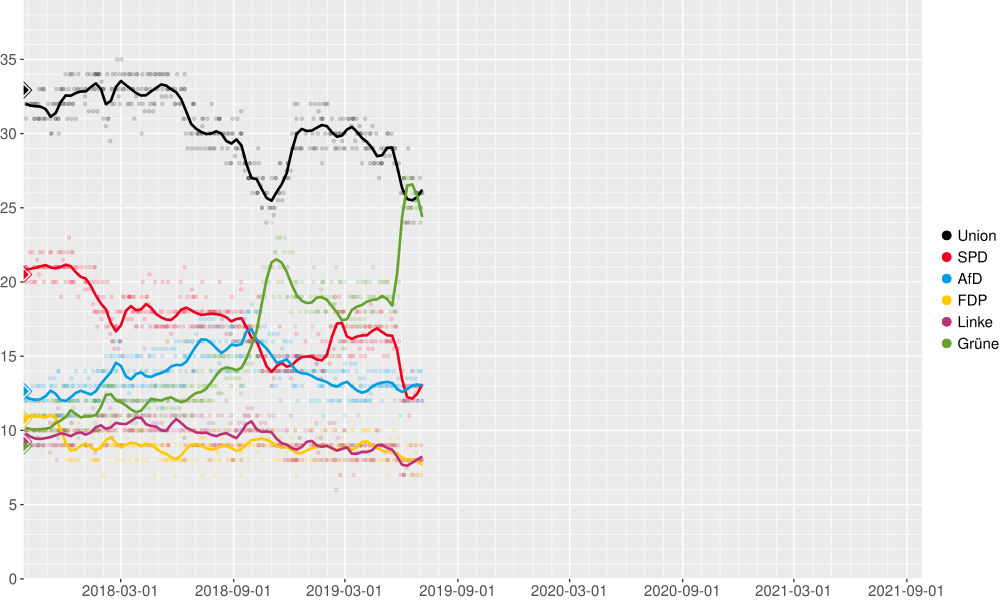
As can be seen from the image at the top of this page, recent opinion polling in Germany shows that the Establishment parties are bleeding support, while the alternative parties gain. Because the German system is more advanced and sophisticated than the New Zealand one, we can predict that phenomena that occur over there will soon be replicated over here. This is not so much true because of MMP as because of the fact that Germany and New Zealand are both part of a wider Western system.

Of concern to the Labour Party would be the fact that their German equivalent is currently polling at about 14%. The reason why the German SPD (Social Democratic Party) is doing so poorly is that they have abandoned the German working class in favour of identity politics – but the New Zealand Labour Party is in the process of making the same mistake.

Of hope to the Green Party would be the fact that their German equivalent is currently polling at about 23%. In fact, the German Green Party was the single highest-polling party in July, a fact that speaks of revolution. The main reason for their rise is the fact that the Greens never even pretended to represent the working class, which means that the large numbers of young people with university degrees have been able to find a home in them.

The major German conservative party, the CDU (Christian Democrat Union), has also seen a fall in fortune, although nowhere near as grievous as that of the social democrats. They are hovering around 27%, which probably reflects the relatively greater unwillingness of conservatives to abandon their party (Understanding New Zealand showed that the National Party had the strongest voting retention rate from one election to the next in New Zealand). It is still a marked decline from previous years.

The decline of the CDU is mirrored by the rise of the alt-right Alternative for Germany (AfD) Party, who are now polling at 13%. This party is frequently derided as being neo-Nazis on account of their strongly anti-Muslim sentiment. Some expect them to supplant the CDU on account of that the globalist parties are not conservative when it comes to cheap labour.

If we look at the German model and how it has turned out, we are able to make several predictions about how the New Zealand model will turn out. Two of these predictions stand out as particularly salient.

One is that the Establishment parties will do poorly – the New Zealand Labour Party will get sliced to pieces in coming years, and National will weaken heavily. The German SPD is already polling in the single figures in some states, and it’s clear that their message is resonating ever less with the electorate. The New Zealand Labour Party are steadfast globalists, despite that globalism destroys working-class wages, and rising nationalist sentiment among the working class will see Labour support decay.

If this happens, it will probably be put down to the incompetence of the Sixth Labour Government, but the truth will be that wider strategic and demographic changes make this all but inevitable. The Labour Party was founded by and for the white working class; having decided to no longer represent the white working class, they are in their death spiral.

This process is likely to heavily benefit the Greens, who will gladly take the now-middle-class young people who don’t identify with National, Labour or ACT. The Greens will also be the beneficiaries of that group of young people who, on account of class interests, would have voted National in previous generations, but who now are more concerned with virtue signalling over class.

In short, what’s happening is that the Establishment parties are losing support as those voters who have been propagandised to have faith in the Establishment die off, and who are then replaced by more cynical young voters who prefer the alternative parties. The Greens and the AfD already get 36% of the vote between them, which is almost as much as what the SPD and the CDU get between them.

The collapse of Labour will likely see its white voters turn to the Green Party on account of that they don’t identify with being working-class any more, its Pacific Islander voters turn to National as their religious sentiments clash with Labour’s globohomo agenda and its Maori voters turn to New Zealand First on account of that they feel abandoned by a Labour that panders ever more to refugees and urbanites.

A second prediction is that an alt-right movement will come to stake a meaningfully large presence.

In New Zealand, the lazy stereotype is that the strongest anti-immigrant sentiments are held by old white people who don’t have much experience in interacting with foreigners. This is mostly true when the anti-immigrant sentiments are held towards Asians and Islanders, which is to say that it was mostly true in the 1990s. By today, things are different.

In Europe, the new generation of anti-immigrant sentiments are held by young people who do have experience in interacting with foreigners. The fact is – although this will be strenuously denied by Marxists, slave moralists and equalitarians – interacting with another group will only improve sentiments towards them if those interactions are pleasant. If the interactions are unpleasant, sentiments towards that group will worsen.

The nature of the interactions between native Westerners and Muslim and African immigrants is radically different to the nature of interactions between native Westerners and immigrants from Asia and the Pacific Islands. Therefore, it can be predicted that, now that New Zealand is opening its borders to Muslim and African immigrants, sentiments towards immigrants in general will sour.

If this does happen, it will create an electoral opportunity for an anti-immigrant party along the lines of the German AfD. The AfD just took 27% of the vote in the regional elections in Brandenburg, and 23% in Saxony. These parts of Germany have fewer immigrants that other parts that have less AfD support, which suggests that at least some of the increasing support for the AfD comes from economic sentiments. But the economic outlook is grim.

Support for this idea comes from Sweden, which opened its borders to mass Muslim and African immigration 20 years ago. Today, the alt-right Sweden Democrats is the party with the best opinion polls. Should a decent alt-right party stand up in New Zealand, they could reasonably expect to get over 5% of the vote straight away.

In Understanding New Zealand, I showed that young conservative people are often more inclined to vote ACT than to vote National. The correlation between median age and voting ACT in 2017 was a mere 0.26, compared to 0.78 between median age and voting National in 2017. This suggests that the ACT Party could potentially surf the crest of this alt-right wave.

This newspaper has previously asked whether ACT would win from refocusing as the alt-right party, but the courage of the current ACT crew cannot be relied upon. One political trend that can be relied on absolutely for certain is that people will age, and for this reason we can predict that the right will eventually evolve into some form of the new right, despite their inherent disinclination to change.

There’s no guarantee that New Zealand will follow the German experience, but the same geopolitical and demographic factors that pushed them in that direction are also at play on us. That will probably mean that, over the coming decade, Labour weakens heavily, National weakens moderately, the Greens surge, and someone fills the demand for an alternative right-wing movement.

*

Understanding New Zealand, by Dan McGlashan and published by VJM Publishing, is the comprehensive guide to the demographics and voting patterns of the New Zealand people. It is available on TradeMe (for Kiwis) and on Amazon (for international readers).