
by Thomas S.
Of the wealth of Sanskrit literature which has been handed down from ancient times by the remnants of Āryan culture which still exist in the world, the Bhāgavata Purāṇa, consisting of some 18,000 verses which unfold across twelve cantos of graduated wisdom, is one of India’s most comprehensive scriptural texts.
Although the sage Vyāsadeva is credited as being the compiler of this Bhāgavata Purāṇa (which is also known as the Śrīmad-Bhāgavatam), the text itself is of the nature of ‘embedded narratives’, wherein several layers of dialogue by a number of different speakers are recited within each other, like a collection of Russian Matryoshka dolls.
The first layer of these conversations takes place amongst an assembly of sages headed by Śaunaka Ṛṣi, who after foreseeing the future calamities of the Kali Yuga which had already been set in motion, had gathered in the forest of Naimiṣāraṇya in northern India to perform a one thousand year-long sacrifice.
One morning while gathered around the sacrificial fire, the sages appealed to the most learned and qualified amongst themselves: a Vedic scholar by the name of Sūta Gosvāmī, who was well versed in the Purāṇas, histories and the Dharma Śāstras, to distill the essence of his acquired wisdom for the good of all living beings in times to come.
Taking his seat, the learned sage began to speak before those assembled in the forest, recollecting the same wisdom which had previously been spoken by the sky-clad mendicant Śukadeva Gosvāmī to a king who was awaiting his death and inquiring about the duty of everyone in all circumstances – and especially of one who is about to die.
This king was none other than Parīkṣit Mahārāja, the grandson of the renowned archer Arjuna, who had received the knowledge of the Bhagavad-gītā from Kṛṣṇa during the Kurukṣetra war of the Mahābhārata.
Having inherited the kingdom of the Pāṇḍavas from his great-uncle Yudhiṣṭhira, Parīkṣit Mahārāja is regarded as having been the last of the kṣatriya kings to successfully stave off the arrival of the Kali Yuga, some five millennia ago.
THE IRON AGE OF THE KALI YUGA
According to the ancient Āryans, the Kali Yuga is one of four cosmic ages or epochs, which are not dissimilar to those conceived of by the ancient Greeks and various other cultures.
In the Vedic version however, the four yugas or epochs are noted as being seasonal or cyclical in nature and are known respectively as the Satya (or Kṛta) Yuga, the Tretā Yuga, the Dvāpara Yuga and the Kali Yuga.
The golden age of the Satya Yuga is compared to spring, the Tretā Yuga to summer, Dvāpara Yuga to autumn and the iron age of the Kali Yuga to winter, which eventually cycles again into renewal during another Satya Yuga, or cosmic springtime upon the Earth.
Each of these yugas is gradually weathered by the corroding influence of the all-pervading element of Time; and in doing so, facilities are provided for the increasingly degenerate appetites of the materially conditioned living entities on their journey towards material exhaustion over countless lifetimes, which eventually inspires their gradual awakening towards spiritual inquiry.
The qualities associated with the Kali Yuga are described in detail in the twelfth canto of the Bhāgavata Purāṇa, wherein religiosity, truthfulness, cleanliness, tolerance, mercy, duration of life, physical strength and memory will all gradually diminish.
The role of wealth alone as an indication of one’s social standing, the misapplication of justice on the basis of individual power and influence, the erosion of marital and familial ties, deception in business as a means of success, the appreciation of religiosity by external dress and the overt sexualisation of masculine and feminine ideals, are also described.
As the Kali Yuga advances, one who can simply manage the maintenance of one’s own family will be considered to be an expert, and despotic rulers from the lower classes will rise to political power and will plunder the citizens of their property, wealth and even their wives, leading many to flee to the mountains and forests.
Harassed by excessive taxation, famine, drought and diseases, the maximum duration of life will be gradually reduced to fifty years, while the bodies of all men will be greatly reduced in size like that of pygmies, as will vegetation and animals, which will become dwarfish.
Although the collective burden of karma accrued over eons by those who are present on the Earth for the duration of the Kali Yuga certainly plays a role in bringing about these miserable conditions, the arrival of this cosmic winter season is nonetheless inevitable and unavoidable, being ordained by providence.
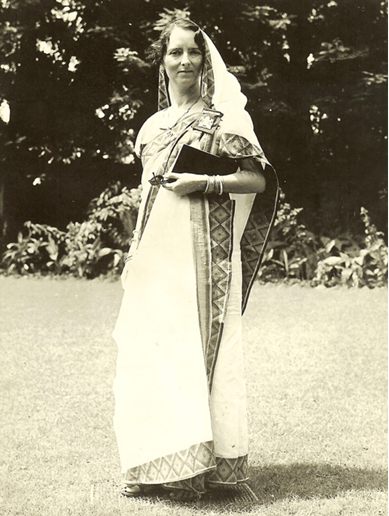
For as twentieth century philosopher Sāvitrī Devī has noted in her own writings on the Kali Yuga, this cycle depends “not upon man’s conscious effort, but upon iron laws, inherent to the very nature of visible and tangible manifestation” – all of which ultimately serves a higher purpose in the grand design of the cosmos.
SCALES OF COSMIC TIME
The Vedic paradigm speaks of many such ‘iron laws’ of nature, not least of which is the law of karma, which every layman of the modern day is familiar with. But other laws, such as that of the Vedic calculation of Time, are no less fascinating, though they be less well known.
Indeed, the Bhāgavata Purāṇa devotes an entire chapter in the third canto, to the calculation of time from the movement of the atomic particle, which after a specific number of combinations, forms one trasareṇu particle, which is visible to the eye and from which Vedic scholars calculate the atomic movement into units of minute measurement, which can then be further extrapolated out to calculate vast quantities of time.
The ancient Āryans used these measurements not only in micro matters of daily timekeeping, or for charting the passage of months and years in combination with astronomical observations, but also dealt routinely with cosmic measurements of time on a macro level, which defy the expectations of modern academia.
Indeed, the scales of time given by Vedic texts differ from those which are widely accepted by academics, who have drastically reduced the calculation of the yuga cycles in order to fit them into the timelines of either an Abrahamic ‘young Earth’ history not exceeding 6,000 years, or that of a Darwinian evolutionary model, as is more acceptable today.
In neither case – either that of early Indologists who harboured Judeo-Christian biases, or that of today’s generation of evolutionary anthropologists, is the Vedic concept of advanced human antiquity taken very seriously by mundane academia.
Rather, the discipline of Indology has frequently modelled India’s historical development on a parallel with the narratives surrounding Mediterranean history, with modern civilization emerging out of the bronze age and progressing on an upward trajectory ever since.
In addition to dealing with matters of advanced human antiquity, the Vedic texts also provide two parallel measurements of time, based on the concept that in the higher heavenly realm, time passes at a different pace than that of the middle earthly realm.
So for every year of the Devas (*Demigods or Gods) in heaven, some 360 years simultaneously pass here on Earth amongst the men and beasts.
And in regard to this, modern academia has in many cases, while endeavouring to reduce Vedic time scales into something more familiar and relatable, opted to interpret the years of the Devas provided in the Vedic sources as if they were indications of earthly years.
Meanwhile, others such as Rudolf Steiner who have included the concept of the Kali Yuga as part of an amalgamation of ideas derived from different cultural sources, have often provided their own measurements, which differ altogether.
The scales of duration of the cosmic seasons from original Vedic sources are as follows:
| Years of the Devas: | Earth Years: | |
| Satya Yuga: | 4,800 | 1,728,000 |
| Tretā Yuga: | 3,600 | 1,296,000 |
| Dvāpara Yuga: | 2,400 | 864,000 |
| Kali Yuga: | 1,200 | 432,000 |
| Total Aggregate: | 12,000 | 4,320,000 |
A complete yuga cycle is known as a mahā-yuga, and further considerations of a transitional period between each of these yugas known as a yuga-sandhyā, may also be included in some calculations.
The completion of one thousand of these yuga cycles constitutes one day of Brahmā, who is the first-born of all beings in each universe and who plays a secondary role in matters of creation. This cosmic architect is situated on Brahmaloka, above the three realms (heavenly, earthly and plutonic).
For every day of Brahmā, there is also a night of equal duration, in which partial dissolution occurs during the flooding of the three realms, which become in need of renewal each morning of Brahmā’s lifetime of one hundred years by his own estimation.
Meanwhile, a separate cycle of manvantaras is simultaneously occurring, with each manvantara consisting of approximately seventy-one yuga cycles. There are fourteen such manvantaras in every day of Brahmā, which pertain to the reign of different Manus.
The role of Manu is as the father and progenitor of mankind, and he is considered to be the archetypal human being who lays down the moral codes of the Manu Saṁhitā or laws of men. Each Manu’s lifetime is approximately 852,000 years of the Devas, or 306,720,000 years on Earth.
Interestingly, the Sanskrit word for mankind – mānuṣya, is derived from Manu, as is the English word for man or mankind. Sanskrit is after all, closely related to all Indo-European languages and many such examples of linguistic similarities exist between these languages.
Each manvantara has its own nuances and influences, and various celestial posts, such as that of Indra, the King of Heaven, whose equivalent is found in the rain-giving Sky Father Deities of Jupiter or Zeus, are also changed during each of these periods.
At the end of Brahmā’s lifetime of one hundred cosmic years, a total dissolution occurs and the countless universes which are considered to be as numerous as mustard seeds in a barrel, are absorbed into the pores of the body of Mahā Viṣṇu, who out of indifference to the material creation, is situated perpetually in yoganidrā, or divine sleep.
THE KALI PURUṢA
As with other cultures which are often disparagingly referred to as being ‘Pagan’ by the followers of the Abrahamic sects, the ancient Āryans interpreted the various aspects of nature as having personified forms and qualities.
And it wasn’t only the Devas in heaven, presiding over the elemental forces of nature, who pervaded the Āryan consciousness, nor simply the Avatāras of Viṣṇu which descend from beyond the material realm, but other supernatural beings as well, including the lesser hosts of yakṣas, angelic gandharvas, nymph-like apsaras – and even those of the personified yugas.
According to the Kalki Purāṇa, the personified Satya Yuga for instance, appears in the form of an effulgent and lotus-eyed mendicant with a bodily complexion like that of molten gold. Carrying a walking staff and with matted hair on his head, he appears to be always joyful and is engaged in giving shelter to dharmic principles.
Simply by contact with the breezes that touch the body of the personification of the Satya Yuga, one is purified, as is the entire Earth during the time of renewal at the beginning of each mahā-yuga.
In contrast to this, the Kali Puruṣa who presides over the Kali Yuga is described in the Kalki Purāṇa as having a complexion like black ointment that has been mixed with oil, with a frightening face, a greedy tongue and an abdomen like that of a crow. A foul smell emanates from his body and he is always seen to be holding his genitals in his left hand.
This personification of the Kali Yuga is not the same as Mā Kāli, who is the ferocious form of Mother Nature or Śakti and is the consort of Śiva, although this difference is frequently misunderstood due to the similarity of their names and their frightening appearances.
Although the yuga cycles operate in relation to the middle or Earth realm, the effects of the Kali Yuga are also indirectly perceived by the Devas in heaven, due to the cessation of ritualistic performances and religious offerings by man, which they are entitled to derive a proportional share of amongst themselves.
During the Kali Yuga, the Devas seldom visit the Earth, as they are often accustomed to doing frequently in other ages, not unlike the times spoken of in the Homeric epics of the ancient Greeks, when heroes like Odysseus were in regular communion with the Gods.
THE FOUR PILLARS OF DHARMA
As the sages of Naimiṣāraṇya sat around the sacrificial fire, Sūta Gosvāmī began narrating the history of the heir to the Pāṇḍava’s throne, who would later be cursed by a brāhmaṇa boy under the influence of the dawning age of the Kali Yuga to die untimely, thus leading to the scenario in which the wisdom of the Bhāgavata Purāṇa would be spoken during the king’s final days, surrounded by sages on the banks of the river Gaṅgā.
Parīkṣit Mahārāja, having become the disciple of Kṛpācārya, ruled the kingdom under the guidance of learned brāhmaṇas. And even the Devas were said to have attended sacrifices performed by the king, being visible at those times even to the common man.
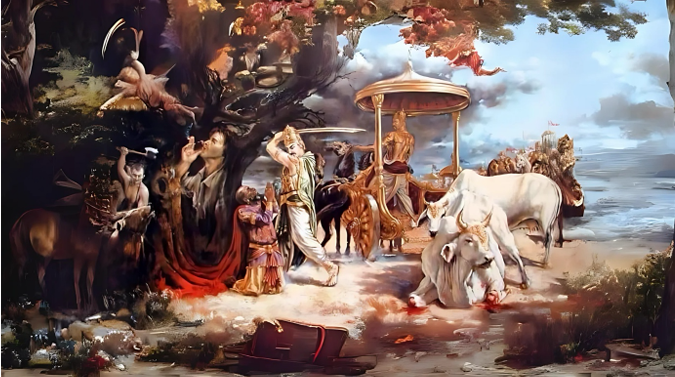
One day, while out touring the kingdom which was as vast as the known world in order to suppress the symptoms of the Kali Yuga and exact tributes from the provincial kingdoms, Parīkṣit Mahārāja encountered the Kali Puruṣa, who had dressed himself in the royal garb of a king and was beating a cow and a bull – an animal considered to be sacred in Āryan civilization, with a club.
Accompanied by a military escort comprised of charioteers, cavalry, elephants and infantry soldiers, Parīkṣit Mahārāja immediately seized the Kali Puruṣa, who had given the kṣatriya-spirited king the opportunity to fight.
The bull, who was as white as a white lotus, who was barely standing on one leg, the others having already been mangled, and who was urinating in distress, was the personification of dharma, while the cow who accompanied him was the personification of Mother Earth, who was weeping as the Kali Puruṣa beat her legs in the same way that he had beaten the bull.
Addressing Dharma the bull, Parīkṣit Mahārāja noted the symbolism of his mangled legs, each of which represented a pillar of dharma, upon all four of which the bull had stood in the Satya Yuga, and which had been reduced one by one with the passing of each successive age.
The four pillars of dharma are:
- Tapas – Austerity
- Śauca – Cleanliness
- Dayā – Mercy
- Satya – Truth
The last remaining pillar of dharma in the Kali Yuga is said to be that of truth, and even that principle reduces day by day and is under constant assault by the influence of the Kali Puruṣa. Truth is attacked last, because even the practice of cheating must make reference to that which is true in order to pass off that which is counterfeit as being authentic.
It is for this reason also, that truth still remains a powerful weapon in this age and it is for this very reason that the agents of Kali in our own time are hostile to truth and to those who bravely uphold this last remaining pillar of dharma.
Taking up his sword, Parīkṣit Mahārāja prepared to kill the Kali Puruṣa, who quickly threw off the royal garb and bowed pitifully to the king, begging for clemency. Accepting the enemy’s surrender, Parīkṣit Mahārāja spared his life, but banished him from his kingdom.
The Kali Puruṣa however, while trembling before the king, told him that because his kingdom spanned the entire known world, he could not enter into exile, even though he was willing to do so under the king’s order. He then begged for some concession – a place for his residence within the kingdom.
In response to this, Parīkṣit Mahārāja gave permission for the Kali Puruṣa to reside wherever the four primary vices are to be found, which notably correspond to the four dharmic principles of Āryan culture as follows:
Intoxication weakens austerity, prostitution pollutes the principle of cleanliness – both of the body and of the mind, the unnecessary slaughter of animals destroys mercy, and gambling compromises truthfulness.
Due to the rigid upkeep of dharma in the kingdom however, hardly a place could be found where these activities were occurring, and so the Kali Puruṣa begged for one more concession – a practical solution for his habitation.
And so Parīkṣit Mahārāja gave his permission for the Kali Puruṣa to reside wherever there is hoarding of gold, because in such places, the other vices naturally follow by way of course.
And so it is that the student of ancient history and mythology casually stumbles upon the etiological origins of the disproportionate influence which the financial powers have enjoyed at the expense of the Goyim for many, many centuries.
THE HOARDERS OF GOLD
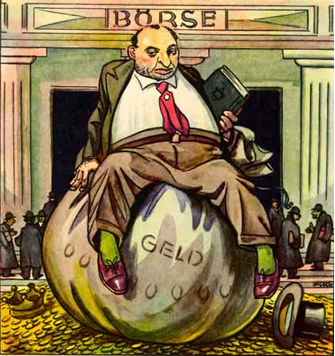
By learning of the source of empowerment via the Kali Puruṣa upon those people who are accustomed to the hoarding and manipulation of gold, we can understand the nuances of why it is that these people are so often accustomed to delight in depravities and to promote degeneracy and cultural distortion amongst the Gentiles, in addition to advancing their political ambitions for the Zionist state of Israel and a one-world dystopian government.
From the perspective of the sages of Naimiṣāraṇya, who were taught these insights by Sūta Gosvāmī many millennia ago, to learn that the merchants of the Sassoon Family, who are regarded as having been the Rothschilds of the East, profited from transforming a once glorious civilisation like that of China into a nation of opium addicts, which they enforced at the barrel of a British musket, would likely come as no surprise.
Likewise, it should come as no surprise to the student of the Bhāgavata Purāṇa that the enslavement, sadistic torture and genocide of millions which was enacted by the Jewish Bolsheviks during the communisation of Eastern Europe in the early twentieth century, was bankrolled by the speculative funds of Wall Street.
It should also come as no surprise to those with knowledge, that the opponents to the establishment of the Federal Reserve in the United States were murdered by the sinking of the Titanic in 1912, along with countless other lives, or that in 1933 the Jewish-controlled American government would confiscate all privately-owned gold before devaluing the dollar the following year.
A.C. Bhaktivedānta Svāmī, whose English translation and commentary on the Bhāgavata Purāṇa is the most widely published in the world, has noted that:
“So the personality of Kali became gold-standardized. According to Śrīmad-Bhāgavatam, gold encourages falsity, intoxication, prostitution, envy and enmity. Even a gold-standard exchange and currency is bad. Gold-standard currency is based on falsehood because the currency is not on a par with the reserved gold. The basic principle is falsity because currency notes are issued in value beyond that of the actual reserved gold. This artificial inflation of currency by the authorities encourages prostitution of the state economy.”
With this in mind, it ought not to surprise us to discover that in our own time, these same financial powers are now weaponising the power of illegitimate money in the form of fraudulent fiat currency in order to flatline the economy and to introduce a new system of central bank digital currencies tied to digital ID, one’s carbon footprint and a social credit score, all on the back of hyperinflation, as a tool of absolute compliance and political control.
Indeed, with these insights gleaned from the Bhāgavata Purāṇa, it should not at all surprise us that the so-called ‘bankers’ and those who are accustomed to the hoarding and manipulation of gold, have become the villains of our time, and that all other vices have followed them for centuries like a bad smell.
THE KALKI AVATĀRA
Despite the prevailing climate of the Kali Yuga and its inevitable deterioration, there are those amongst us who are determined to keep the flame of dharma burning. For, as Sāvitrī Devī wrote on the subject of the Kali Yuga in the last century:
“Exiles of the Golden Age in our Age of Gloom, the men “above Time” either live entirely within their own inner world, or else live and act in this one also, but as though it were still in its Golden Age. They either renounce this world or ignore it – or, better, forget it, as a man forgets the scars of sin and sickness upon a once beautiful face, which he still loves, in spite of all. They see the everlasting and unchangeable behind the downward rush of the stream of time; the Thing that is, behind the thing that seems. Even when they live in the world of forms, colors and sounds as earnestly and intensely as King Akhnaton – that supreme artist – did, still those impressions take on, for them, a meaning entirely different from that which they retain in the consciousness of people submitted to the bondage of Time. Men “above Time” enjoy with detachment, as people who know they will never die. They also suffer with detachment, being constantly aware of their blissful real Self, which is beyond pleasure and pain.
“And the fallen world can never understand them, i.e. know them, any more than they can understand the fall of man, in which they have no part, as others, who share it, can, and do. And yet, untiringly, – like the Sun, far away and omnipresent – they shed their light; that light which is, in our growing gloom, like a glimpse of all the past and future dawns.
“But, as we have said, there are also people with a Golden Age outlook, – fully aware of what a splendid place this world could be, materially and otherwise, – who can, however, neither renounce life “as it is” nor ignore it; people who, in addition to that, are endowed with what the Hindus would call a “Kshattriya” nature: born fighters, for whom difficulties exist only to be overcome, and for whom the impossible has a strange fascination. These are the men “against Time,” – absolutely sincere, selfless idealists, believers in those eternal values that the fallen world had rejected, and ready, in order to reassert them on the material plane, to resort to any means within their reach. As a consequence of the law of Time, those means are necessarily all the more drastic and all the more brutal as every historical Cycle draws nearer to its end. The last Man “against Time” is, in fact, no other than He Whose name, in Sanskrit Tradition, is Kalki, – the last Incarnation of the divine Sustainer of the universe and, at the same time, the Destroyer of the whole world; the Saviour Who will put an end to this present “yuga” in a formidable display of unparalleled violence, in order that a new creation may flourish in the innocence and splendor of a new “Age of Truth.”
The Kalki Avatāra referred to by Sāvitrī Devī is spoken of in detail in the twelfth canto of the Bhāgavata Purāṇa, as well as in the Kalki Purāṇa.
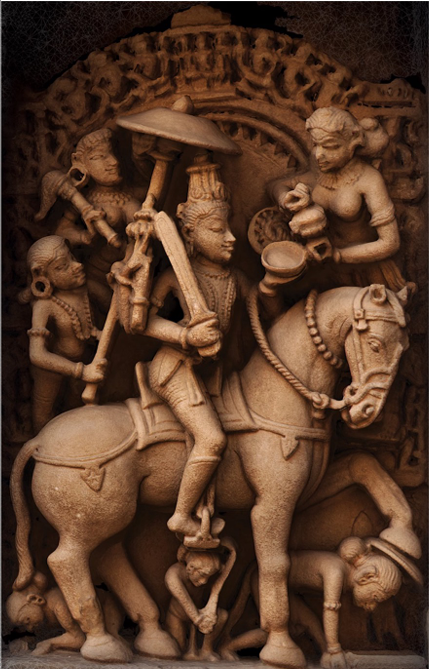
According to these sources, Kalki will be born in the legendary village of Śambhala on the twelfth day during the fortnight of the waxing moon in the month of Vaiśākha as the son of a brāhmaṇa named Viṣṇuyaśā and his wife Sumati, while the martially-spirited brāhmaṇa sage Paraśurāma, who is adept in the wielding of weapons and who once slaughtered the entire kṣatriya warrior class for their transgressions against the brāhmaṇas, will be his teacher.
Although Sāvitrī Devī had been hopeful about the advent of Kalki, the final Avatāra of Viṣṇu in times to come, the Vedic measurement of time indicates that, since approximately five thousand years of the Kali Yuga have already passed since the lifetime of Parīkṣit Mahārāja, another 427,000 Earth years are remaining of this age.
Throughout the duration of the Kali Yuga, several of these men against Time alluded to by Sāvitrī Devī will continue to exist, biding their time and awaiting the arrival of the Kalki Avatāra, to assist in the renewal of dharma.
Two of these men spoken of in both the Bhāgavata Purāṇa and the Kalki Purāṇa are the kings Maru and Devāpi of the Sūrya (sun) and Chandra (moon) dynasties, who have taken refuge in the village of Kalāpa.
And even those ordinary mortals who will have to endure lifespans of a short duration during the progression of the Kali Yuga, are still able to practice the yuga-dharma of the age and derive the same benefit as that accrued by the practice of dharma in previous ages, thus becoming men against Time themselves, despite Time’s external influences.
THE YUGA-DHARMA
In the Satya Yuga, mystic yogīs are able to take advantage of long lifespans and superior physical and mental endurance in order to master the yuga-dharma of meditation over the course of thousands of years of hermitic life in the Himālayas and other sanctified places.
In the Tretā Yuga, with the decline of these abilities, great yajñas or sacrifices become the yuga-dharma and are sponsored by the wealth of kings and are conducted by perfectly pure brāhmaṇas who wield brahmatejas or mystic power, and who are adept in the mastery of sound vibrations and the flawless recitation of hymns.
With the decline in the wealth of kings and the potency of the brāhmaṇical order, elaborate temple worship of Deities becomes the yuga-dharma in the Dvāpara Yuga, while in the Kali Yuga, the yuga-dharma is the chanting of the Mahā-mantra.
According to the twelfth canto of the Bhāgavata Purāṇa, “whatever result was obtained in Satya Yuga by meditation of Viṣṇu, in Tretā Yuga by performance of sacrifices, and in Dvāpara Yuga by worship of the Deity, is obtained in Kali Yuga simply by chanting the names of Hari.”
In this age, genuine yogīs are rarely found and what is passed off as yoga or meditation in the modern day by those wearing Lululemon yoga pants is farcical in comparison to the mystics of the Satya Yuga.
Similarly, ritualistic sacrifices which still form an important part of Hindu customs in the modern day, are displays of poverty in comparison to those conducted in the Tretā Yuga under the patronage of noble kings, which even the Devas themselves would often attend.
And as the archaeological record demonstrates, the remnants of temples from ancient times, many of which were constructed either during the Dvāpara Yuga, or the very early transitional portion of the Kali Yuga, far exceed in ambition and architecture, the houses of worship of various faiths which exist in modern times.
So while residual concepts of these previous systems of dharma still exist in some form, the practitioner of dharma in the present day concerns himself with perfecting the chanting of mantras, which are especially empowered in the Kali Yuga for the benefit of those with a short life span, reduced stamina of body and mind, and little wealth.
This yuga-dharma of the Kali Yuga was first popularised by Śrī Chaitanya’s movement of the sixteenth century, which emphasised the practice of kīrtana and did away with the rigid considerations of Brāhmaṇism by birth alone as a prerequisite for spiritual status in society.
Originally flourishing in West Bengal, that same saṅkīrtana movement later diverged into various branches of the Gauḍīya Vaiṣṇava tradition, which can still be found both in India and other parts of the world today.
Sāvitrī Devī, who first travelled to India as a pilgrim in the 1930’s and who would later engage in espionage activities against the British Raj during the war, is cited as having spent time with the Gauḍīya Maṭha, which was the most active branch of the saṅkīrtana movement at the time, on several occasions in 1935.
Sāvitrī Devī would later describe India as being “the last stronghold of living Āryan paganism” but also expressed concerns about the degrading influences of the Kali Yuga which were wearing down on India’s cultural and spiritual heritage, asking “how long is India going to last?”
Despite the inevitable advances and intrusions of the Kali Yuga however, those men and women who stand against the degrading influence of the Time factor and who are exiles of the Golden Age, still uphold the spirit of dharma in their own lives and have little to do with the devilish delights of the Kali Yuga.
After all, the word Āryan is derived from the Sanskrit verbal root ‘ṛ’, which means ‘to go ahead’ or to ‘progress’. Unlike the modern use of the word ‘progress’, which often indicates a pitch toward the left-hand-path of cultural inversion, the Vedic concept of progress indicates that one is moving forward spiritually, from whichever station of life one finds oneself – whether that be as a family-man, a renunciant, a scholar, a merchant or any other variety of legitimate and civilised social engagement.
As Sāvitrī Devī noted:
“There are no activities in “modern” life which are not futile, save perhaps those that aim at satisfying one’s body’s hunger: growing rice; growing wheat; gathering chestnuts from the woods or potatoes from one’s garden. And the one and only sensible policy can but be to let things take their course and to await the coming Destroyer, destined to clear the ground for the building of a new “Age of Truth”: the One Whom the Hindus name Kalki and hail as the tenth and last incarnation of Vishnu; the Destroyer Whose advent is the condition of the preservation of Life, according to Life’s everlasting laws.”
In this way, even in the midst of the chaos of the Kali Yuga, the modern-day Āryan who strives for self-sufficiency and who lives according to higher principles, while cutting down the symptoms of the age wherever needed, is able to live in the world, while forging bulwarks of resistance to Kali’s degenerate hordes.
* The Devas are sometimes translated as ‘Demigods’ and sometimes as ‘Gods’. While most people are familiar with monotheistic and polytheistic traditions, the Vedic version of theology is henotheistic in nature, in which both a Supreme Being existing beyond the material world, as well as lesser celestial Deities in charge of various aspects of material nature exist and are worshipped by different sub-sects, according to the desire and spiritual or material ambitions of the individual. Many Pagan traditions focus solely on the pantheon of heavenly beings, while Abrahamic sects like Christianity or Islam often ignore these angelic beings altogether. So sometimes the Devas are translated as being ‘Gods’, while sometimes they are translated as being ‘Demigods’ in order to differentiate them from the Supreme Being and His various Avatāras. In Greek and Roman mythology, we often find that the word ‘Demigod’ refers to heroes like Hercules who were born from mortal women, but who had a divine father – often Zeus. In Vedic mythology, heroes such as the five Pāṇḍava brothers were also born of mortal mothers in union with various Devas, but it is uncommon to refer to these heroes as being Demigods, but rather as extraordinarily powerful men.
*
If you enjoyed reading this piece, buy a compilation of our best pieces from previous years!
Best VJMP Essays and Articles of 2023
Best VJMP Essays and Articles of 2022
Best VJMP Essays and Articles of 2021
Best VJMP Essays and Articles of 2020
Best VJMP Essays and Articles of 2019
Best VJMP Essays and Articles of 2018
Best VJMP Essays and Articles of 2017
*
If you would like to support our work in other ways, make a donation to our Paypal! Even better, buy any one of our books!