
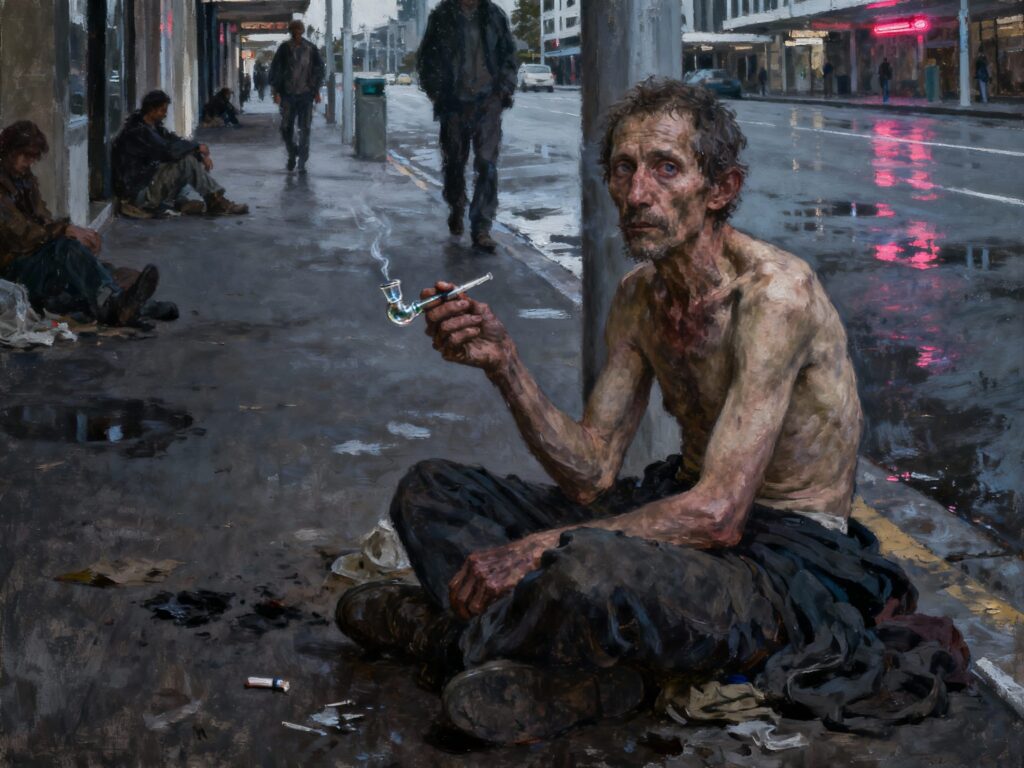
Everyone with any sense can feel that society is breaking down. The general atmosphere is much less pleasant than it was ten, even five years ago: more anger, depression, madness. Less laughter is heard. All the economic news is bad, and people no longer speak of the future as a friend, but as an enemy collecting a debt.
There is precedent for understanding what is happening: broken families.
There are many broken families in our society. These families are broken societies in microcosm. It’s common for parents in broken families to be negligent or abusive, even to have abandoned their own children. This is closely analogous to how governments work in broken societies. What the New Zealand Government did to its own people with Ruthanasia differs only in scale from what a parent does when it abandons its family, and Ruthanasia was only the worst of many examples of governmental neglect. More are to come.
Broken families produce low-trust people. Trust is essentially a person’s estimation of the probability of encountering honourable behaviour. Neglecting one’s children is a highly dishonourable act, a total failure to be an adult. A child so neglected will very likely grow up to be a low-trust adult. They will seldom punish dishonourable conduct, having normalised it, and they will seldom reward honourable conduct, believing it to be an aberration.
Broken societies are full of low-trust people. They expect the worst from others. As such, they’re not willing to give any “benefit of the doubt”. This makes them generally unpleasant to be around. But, like broken families, they aren’t natural. They only exist when an authority figure refuses to do their job properly. This is why low-trust societies are full of rebels and revolutionaries. As Western society becomes lower and lower trust, we can expect more dissidents of all kinds, especially violent ones. As low-trust neighbourhoods produce gang members, low-trust societies produce revolutionaries and tyrants.
A high-trust environment is honour based. Respect is apportioned on the basis of honourable conduct. People’s reputations for past honourable conduct determine the extent to which they are respected. Sophocles once said “Better to fail with honour than succeed by fraud”. In high-trust environments, a person can expect to lose but still be respected.
A low-trust environment is fear based. Respect is apportioned on the basis of malice. Only people malicious enough to do harm are respected; everyone else is exploited. In a low-trust environment, exploiting people is seen as intelligent. A caring person is just a target. Kind people are stupid, because if they were smart they would have perceived that they were operating in a low-trust environment. Low-trust people don’t view the kind as the freemasonry of society (which they are in high-trust environments). They view the kind as wolves would view a lamb.
For instance, people in Thailand have different attitudes to theft to people in Singapore. In Thailand, if you leave your property unguarded, the assumption is that you’re too stupid to deserve to own that property, and therefore stealing it is okay. The logic is similar in gang environments: if you’re too weak to defend your property through fighting for it, them you’re too weak to deserve to own that property, and therefore stealing it is okay. This kind of logic will become more common in the future.
In a low-trust environment, you exploit people up until the point where they push back. The low-trust presumption is that they would do they same to you if they could.
In a low-trust environment, you expect people to be lying. Speech is not assumed to be factual: people are assumed to be “talking shit” unless proven otherwise.
Low-trust thinking and short-term thinking overlap a great deal. As such, a high time preference is another psychological weakness we will have to contend with in the future. People in low-trust families don’t make rational long-term decisions. Neither do governments in low-trust societies. Probably Western governments will torch their economies in coming decades to keep Boomers in comfort. What comes after then will be a truly low-trust environment.
Coping with low-trust environments is primarily about lowering expectations. Lose the expectation of honourable conduct. Lose the expectation that your property rights will be respected. This means to become more cynical, paranoid and suspicious, which is a shame. But it’s a reasonable reaction to the way society is going. High-trust people are going to get destroyed.
Also important in the transition to a low-trust environment is learning to control oneself (to some extent this is downstream of lowering expectations). Living in a low-trust environment is stressful. One’s threat detection mechanisms are often running at full power. Adapting to a low-trust environment means suppressing emotion, both in range and intensity. Unfortunately this means that many people will become sadistic, even psychopathic. But many will have to choose between honour or survival in coming years.
Because low-trust environments are fear based, overcoming one’s fear of death will gain you respect. Thus, a genuinely spiritual attitude will gain you respect. People in low-trust environments have only contempt for the superficially spiritual. But if a person’s spirituality enables them to endure physical deprivations, stresses, threats and intimidation, they will do much better in low-trust environments than non-spiritual people.
*
For more of VJM’s ideas, see his work on other platforms!
For even more of VJM’s ideas, buy one of his books!
*
If you enjoyed reading this piece, buy a compilation of our best pieces from previous years!
Best VJMP Essays and Articles of 2023
Best VJMP Essays and Articles of 2022
Best VJMP Essays and Articles of 2021
Best VJMP Essays and Articles of 2020
Best VJMP Essays and Articles of 2019
Best VJMP Essays and Articles of 2018
Best VJMP Essays and Articles of 2017
*
If you would like to support our work in other ways, make a donation to our Paypal! Even better, buy any one of our books!