

If You Want the Young to Avoid Smoking, Properly Fund a Mental Health System

The way to lower rates of tobacco use is not by raising taxes on the substance but by curing the mental illnesses that lead to people finding solace in smoking

Decades of government propaganda has convinced most people that tobacco smoking is a harmful addiction with absolutely no benefits whatsoever. Unfortunately, this brutalist approach to what is really a complicated issue neglects the very real psychiatric benefits of smoking tobacco. This essay proposes that the only realistic way to get young people to avoid smoking is to properly fund a mental health system.

Because our culture is going backwards in many ways, we are losing a lot of wisdom that used to be common. A lot of old folk remedies have been forgotten because a large pharmaceutical company was able to make profits selling an alternative. Cannabis is the most obvious of these, but tobacco risks becoming another.

Tobacco has been used in the West for its anti-anxiolytic and antidepressant qualities for hundreds of years, beginning with its discovery by Europeans in South America. The substance has a long history of shamanic use in South America, where some traditions seemed to believe that the exhaled smoke carried one’s wishes up to God.

Unfortunately, knowledge about how to use this substance wisely has been lost, and most people have drifted to either the extreme of smoking a pack a day or the extreme of thinking that tobacco has no benefits at all. Subtlety has been forgotten.

The first public government campaign against tobacco smoking was carried out by Nazi Germany. The authoritarian nature of the National Socialists made them well suited for ignoring the mental health benefits of the substance. Despite that, the Nazis were unwilling to go quite as far as the New Zealand Government and try to have the substance banned.

The truth is that people smoke tobacco because it feels good, and that tobacco feels good not because it gives an instant rush of pleasure that makes you addicted but because it alleviates suffering that already existed in the smoker’s mind.

If it was true that it gave people a rush of instant pleasure then everyone should become addicted, but this is not at all the case. People who are suffering psychologically are far more likely to become addicted, for the simple reason that smoking tobacco temporarily takes the suffering away. This appears to be especially true of people suffering from schizophrenia, depression or anxiety.

Some will say that these people have “addictive personalities”, but that is rubbish. The simple fact is that people who are suffering are more likely to take a substance that alleviates that suffering than people who are not suffering – this is obvious if one considers the balance of incentives.

And so they smoke tobacco because it helps them deal with stress, anxiety, rage, depression, and a range of neurotic and psychotic disorders.

The correct approach here is not to brutally force the citizenry into abstinence by taxing the mentally ill into poverty like a 20th century authoritarian hellhole would, but to cure the mental illnesses that cause people to smoke tobacco before they start smoking it.

Fundamentally, this means two interrelated things have to change. The first is for the Government to acknowledge that mental illness are legitimate health problems in the same way that physical illnesses are, and to properly fund a mental health system. With a properly funded mental health system psychiatrists will be able to keep up to date in their field instead of parroting 30-year old drug war propaganda because they have no time to research.

For this to be possible depends on the second thing, which is that New Zealand makes a cultural change in which it acknowledges that mental illnesses are legitimate problems in the same way that physical illnesses are, and that “hardening up” when you are suffering from depression makes as much sense as hardening up when you have a broken leg, and is equally as likely to kill you if you try to go on with your life without getting help.
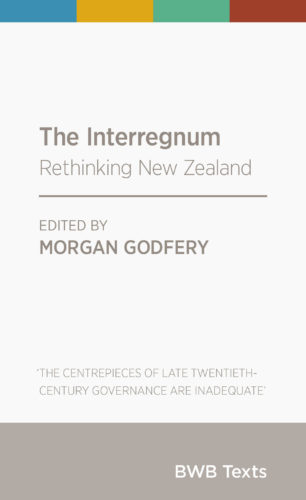

VJMP Reads: The Interregnum: Rethinking New Zealand IV

This reading carries on from here.

The fourth essay in The Interregnum is ‘Climate Change and Just Transition’ by Edward Miller. Keeping with the theme of the book so far, Miller describes himself as “a political activist with a keen interest in global justice,” and declares the enemy as “the deeply held commitment of large businesses and governments to maintaining economic growth at all costs.”

Miller laments that neoliberalism has made conditions worse for the “most vulnerable of society,” and it is for them who Miller claims to speak. There is already a problem with this, as anyone who has spent time around the most vulnerable of society would know, and it’s that people with pressing, immediate problems couldn’t care less about things like “global justice”.

Writing of the need to sacrifice economic growth for the sake of lowering our carbon emissions, Miller suggests that he is completely engrossed in the bubble of middle-class privilege, like many Green supporters. The practical reality is that sacrificed economic growth means workers getting fired, hours being cut, health care being postponed or cancelled, and children going hungry – considerations often lost on the young and carefree.

Action on climate change is described as something “we so desperately need” – further evidence that Miller lives in an echo chamber. What we need are better wages, better houses, and better attitudes to mental healthcare and to child abuse. Problems with proximate causes and clear solutions. Focusing on problems with clear solutions will all us to ensure that our energies are not wasted from virtue signalling about issues we cannot affect.

Much like other commentators in this book so far, Miller attacks neoliberalism as if it was an evil that sprang from nowhere upon an unsuspecting world in the mid 1980s. This is perhaps to be expected of young writers who are yet to comprehend that history and the world existed before they were born, and were not things discovered by them.

But it’s difficult to take seriously a work that does not place neoliberalism in its context of the complete collapse of the Soviet Union and the West’s increasing awareness that Communism had directly led to the starvation of tens of millions of people. In the 1980s and early 1990s, Communism appeared to the world as a monstrous evil that had, after almost half a century, finally been defeated. It was natural that things move in the direction away from it.

Almost certainly, this movement away from Communism went too far, as political movements tend to do, and so neoliberalism does need to be balanced. But we don’t need to balance it with economic and social policies that have established historical precedents of failure.

The idea of returning the means of production to the masses via an unelected ideological elite that purports to speak for those masses is known to be suicidal, but Miller avoids this easy fantasy, making a successful point when he promotes the idea of a universal basic income by means of the Government printing money.

Unfortunately, the fate of those other men who have proposed debt-free Government-backed money (McKinley, Lincoln, Hitler, Kennedy, Gadaffi) is ignored here. Perhaps this book is not thick enough for the kind of investigation necessary for such a thing.

VJMP Reads: The Interregnum: Rethinking New Zealand III

This reading carries on from here.

The third essay in The Interregnum is “Reimagining the Economy” by Wilbur Townsend. I must admit that reading a book that opens with several Marx and Gramsci quotes which then goes into radical economic intervention makes me think of the millions of people who starved to death in the 20th century. Despite that, I continue in the belief that the left must have learned to moderate its radicalism by now.

Promisingly, this essay opens by sticking to sober facts. Townsend points out that the economy has grown by 48% since 1990, but the average wage is only 22% higher, on account of that the dividends of this greater economic growth is not being distributed. Moreover, wages in finance and insurance have grown 62% while wages in hospitality have grown 3%.

“There is money being earned in this country but, increasingly, it isn’t being earned by us.” This is the central lament of this essay, and it’s a fair one. After all, neoliberalism and free trade are sold to the people as innovations that will increase the logistical efficiency of getting cheap goods and services to market. But it’s not worth saving $500 on a television if you also lose $15,000 in wages.

In an odd coincidence, the essay contains a reference to Luddites, in the context of people who opposed technological advancement on the basis that it destroyed labour opportunity, and who question the liberating potential of these advancements. Jonty Gillespie and the machine cultists in The Verity Key refer to people as Luddites if they’re not interested in going deep enough into a virtual environment to forget the outside world.

Despite representing working-class sentiments more faithfully than Morgan Godfery managed in his opening effort, the middle-class social justice warrior influence does shine through at some points in Townsend’s essay, such as when he laments that “Misogynistic workplaces” and “sexist bosses” are responsible for the dearth of female truckies and wharfies. One suspects that some of Townsend’s acquaintances would happily have a proportion of men castrated if such was considered necessary to “solve the gender gap”.

Like many in the left of today, biological explanations for gender differences are avoided with superstitious fervour.

The youthful idealism also shines through when he argues for a universal basic income.

No matter how good the arguments for a universal basic income are, we have never had one before and there are good reasons for this. Townsend possesses an eerie certitude about the idea that a universal basic income would lead to a sharp increase in the quality of life, and, although there’s good reason to agree with him, raising the spectre of people dropping out of society to move to Takaka and smoke bongs might not sell it to a Middle New Zealand that just put the National Party in power for nine years.

Townsend takes this idealism so far as to insist that the factories, machines and raw materials should be returned to the collective. He pre-empts the obvious criticism by acknowledging that historians don’t have much time for Communism, but he waves it away by saying “I suspect they just haven’t noticed it done well.”

Despite this, he makes a good point when he mentions that sovereign wealth funds could serve as the capital owners of a range of national assets or robot workfleets, and from there a universal basic income might become possible.

In summary, this essay mixes some good points with a terrifyingly nonchalant self-righteous belief in the primacy of Marxist ideas. It’s probably fair to consider this a piece inspired by youthful idealism, despite the intelligent points occasionally raised.