

Legalising Cannabis Would More Than Fix The Hole in New Zealand’s Education Budget

The Labour Party is crying loudly about the hole in the education budget, but is silent about the potential savings from repealing cannabis prohibition

Every week the Labour Party goes back on another one of its election promises, claiming that there’s much less money in the budget than anyone realised and so they won’t be able to fund anything: not education, not health, not welfare. What the criminal bullshitters in the Government don’t admit is that they could save 400 million dollars every year, starting tomorrow, simply by legalising cannabis.

The net benefits of repealing cannabis prohibition are no longer disputable. Eight US states now have fully legal cannabis, with further legalisation referendums to come, and no-one has any regrets. According to calculations by the New Zealand Treasury, this country is flushing $400,000,000 down the toilet every year in order to enforce a law that the New Zealand people do not want. That’s no small sum of money.

Education Minister Chris Hipkins has come out and said that there is a $1,100,000,000 shortfall in the education budget. The linked article cites Hipkins as claiming that “Over the next three budgets, $929m was needed to cover the cost of new schools and classrooms and to meet the cost of the Christchurch rebuild. The remaining $166m was needed for urgent remediation and demolition of classrooms and buildings that are unusable.”

In the linked article, Hipkins blames the former National-led Government for neglecting capital spending on educational buildings, claiming that Labour is not going to be able to meet its election promises as a consequence. But it’s absolutely absurd that the Labour Government is crying about funding shortfalls when it’s wasting such an incredible amount of money on conducting a War on Drugs against the New Zealand people.

According to the Treasury’s own calculations, if we legalised cannabis today, we would save $1,200,000,000 over the course of the next three Budgets, primarily through not having to fund the Police and “Justice” Systems to piss all that money up the wall on persecuting medicinal cannabis users. So it makes no sense at all for Labour to cry about a shortage of money when it’s wasting incredible sums on enforcing a law that the New Zealand people don’t want.

A study conducted in Colorado from last month has shown that even if one accounts for the increases in social costs that come in the wake of legalisation, there is still a large net gain to the economy. Moreover, “The researchers found no evidence that legal cannabis contributed to increased homelessness or increased youth use of marijuana.”

There are other costs to cannabis prohibition that don’t fall into the $400,000,000 of damages. By withholding a widely-recognised exit drug from people struggling with opiate addiction, we are literally killing the most vulnerable New Zealanders. Studies of American states that have liberalised their cannabis laws have shown that, given the choice between opiates or cannabis, many people with severe pain disorders prefer to use cannabis. This has led to thousands fewer deaths from opiate overdoses.

It’s absolutely insane that our school buildings are falling into disrepair, our hospitals have mold on the walls, and that our rape crisis centres are being closed down, all because of a lack of funding, when we’re wasting over a billion dollars every electoral cycle on cannabis prohibition. If the Labour Party were any less neoliberal than the National Party they replaced, they would open an honest discussion on the subject with the stated intention of legalising cannabis as Colorado did in 2012.

*

If you enjoyed reading this essay, you can get a compilation of the Best VJMP Essays and Articles of 2017 from Amazon for Kindle or Amazon for CreateSpace (for international readers), or TradeMe (for Kiwis).

Our Mental Health System Shouldn’t Run on WINZ Logic

A lot of people complain about the way WINZ treats its clients, but their logic makes a certain sense. By verbally and psychologically abusing many of the people who come to them for help, WINZ staff sharply reduce demand for WINZ services and thereby save taxpayer money. This is called WINZ logic, and our mental health system runs by the same principles.

WINZ logic seems to appeal to the vast majority of New Zealanders. We like to consider ourselves a people who have “hardened up”, and who don’t need faggy things like welfare. Moreover, the high levels of diversity in our society mean that those at the top are unwilling to pay taxes for the greater good, because those taxes won’t be helping people like them. So we make sure that WINZ runs an extremely tight ship, where there is absolutely no wastage.

Somewhere along the way, someone working at WINZ realised that many of their clients could easily be discouraged from seeking WINZ services. Many people who need WINZ services are socially outcast or psychologically damaged, and so they are easily disheartened by abuse. If these people were spoken to like thieving, bludging, malingering scum, instead of being treated like fellow humans who need help, they were less likely to come back and ask for more money.

Ultimately, the essence of WINZ logic is this: the more unpleasant the experience of being a WINZ client can be made, the fewer resources WINZ clients will collectively consume.

With ever-tightening social welfare budgets under nine years of a National-led Government, treating the clients badly became the default way to distinguish between the deserving and the undeserving poor. If someone really needed a benefit, WINZ logic claimed, they’d keep coming back despite the mistreatment. So treating the clients badly achieves the twin goals of saving money while still helping the needy.

Unfortunately, our mental health system works on the same logic. In order to save money, patients are systematically verbally and emotionally abused by support workers. They don’t admit to this, and nowhere is it written that this is official policy, but it’s apparent from collating the experiences of many users of the mental health services that this is the case.

The logic appears to be that it’s better for a hundred schizophrenics to starve in the street than it is for one person to perhaps get a benefit that they didn’t 100% need. After all, a severely mentally ill young person who is unlikely to work again is liable to cost the country up to half a million dollars in benefit payments alone over the course of their lives. If people like this could be convinced to commit suicide instead, the potential savings could run into the hundreds of millions.

This might sound implausible to some, but it’s a natural consequence of neoliberal reasoning. Human life has a dollar value. If mentally ill people can’t contribute to the tax farm, and if we can’t just kill them directly, we have to encourage them to kill themselves. This reasoning was introduced to New Zealand by Ruth Richardson in the 1991 Budget and it’s now an indelible part of our culture. After all, we already have “by far the highest youth suicide rates in the developed world”.

If this wasn’t true, then the experience of being a user of the mental health services would be entirely different. One would be treated much like a person ill with a physical illness – as a fellow human being who had had something unfortunate happen to them and required care in order to recover to normal function. Doctors would answer your questions honestly. Consultations would work towards improving your mental health rather than merely assessing your work readiness.

Further evidence for this comes from the refusal to acknowledge cannabis medicine. Despite the fact that there was enough evidence for the medicinal value of cannabis for California to make it legal already in 1996, New Zealand politicians and doctors still have their heads up their arses. Now even Zimbabwe has legal medicinal cannabis.

What this approach to cannabis tells the mentally ill in New Zealand is that the mental health system isn’t really interested in helping them. It’s just: “Take these sedatives and get back to picking cotton.” It wouldn’t matter if 100,000 people all lined up to tell doctors that cannabis had helped them sleep or had helped with anxiety, depression or suicidal ideation. No-one’s listening, no-one cares.

Our mental health system shouldn’t run on the WINZ logic of withholding aid to as many people as possible. It should be recognised that an investment in a person’s mental health now will have excellent returns in both their future productivity and future unwillingness to use mental health services. The emphasis should be on treating them well so that they can get better and we can save money over their lifetime, not treating them like shit to save money this month.

*

If you enjoyed reading this essay, you can get a compilation of the Best VJMP Essays and Articles of 2017 from Amazon for Kindle or Amazon for CreateSpace (for international readers), or TradeMe (for Kiwis).

Have You Realised Yet That We’re The Bad Guys Now?

In order for a person to be found guilty of a crime, the Police first have to be presented with enough evidence to justify an arrest, and then that person has to be tried in front of an impartial jury summoned to examine the evidence. In realpolitik however, as this essay will examine, such trivialities can be cast aside at the first sound of the war drums – provided you accept you’re the bad guys.

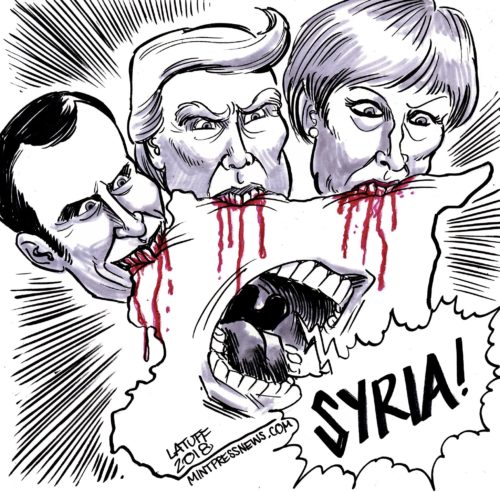
The leaders of the Anglo-French alliance just started a war without the approval of the representatives of their people. The US Congress, by law, has to give its approval before wars can be started. The precedent set by George W. Bush in Afghanistan and Iraq, however, is that the American armed forces will do whatever the fuck they’re told to do. Donald Trump, in ordering airstrikes in co-operation with British and French forces, is simply following this precedent.

Supposedly the reason for the missile strikes was to respond to a chemical strike allegedly ordered by the Government of Syrian President Bashar al-Assad on the civilian population of Douma. The difficulty comes from the fact that the leaders of the Anglo-French alliance did not wait for widely accepted proof of the chemical attack to be made public. The Organisation for the Prohibition of Chemical Weapons has yet to complete its fact-finding mission, meaning that there is no expert opinion yet on who was responsible.

Proof doesn’t matter for those leading the Anglo-French countries. Proof only matters to those who care about their reputation, and bad guys have no need to care about their reputation, long since lost. Worst of all, these countries have no credibility when it comes to claiming that the actions of a second party were heinous enough to justify military action – they’ve gone to war on utterly fictitious casus belli several times before.

New Zealand says it “accepts” what has happened, on the grounds that any attempt to go through the United Nations Security Council for approval would have been vetoed by Russia. This threat of veto is considered justification for ignoring the UN entirely. No questions are asked by the mainstream media. Neither do they mention where the New Zealand special forces are right now, or what they are doing there, or how long they have been there.

Nobody in any of the countries whose armed forces just committed an act of war without Congressional or Parliamentary approval (i.e. legal approval) will take any action to hold the politicians who gave the orders to account. We don’t care that our countries are run by war criminals. We didn’t lift a finger to make either Bush or Tony Blair pay for Iraq, and we won’t lift one here either.

It’s time to chew on a bitter realisation: we are now the bad guys. The Anglo-French alliance is not fighting for freedom or liberty or human rights or anything like it. We’re not fighting to reduce the amount of human suffering in the world. Such considerations are inconsequential. What matters is silver and iron – i.e. money and strategic positioning.

We’re fighting for power, or what of it we can hold onto as the West slides into irrelevance from our own greed, hubris and crapulence. We’re not fighting for any higher moral value. Proof for this contention comes from simply reviewing the evidence.

The American soldiers who just fired cruise missiles into Syria don’t get paid in one decade what one of those missiles costs. Some American cities – Detroit the most notable – already look worse than Damascus, without having to get bombed. This decay of physical infrastructure simply reflects the decay in psychological infrastructure that is the root cause of our civilisational failure.

We know this because we can observe how poorly we treat our psychologically vulnerable. We don’t invest anything into healing them, and the collective psychological damage incurred by this negligence has grown to monstrous proportions. America regularly denies housing or benefit coverage to the veterans of its military adventures, and the thought of them getting proper mental health care for their PTSD is a bitter joke. There’s only money for defence contractors.

New Zealand is no better, spending $400,000,000 of its own citizens’ money every year (over $100 per adult) to persecute them for using medicinal cannabis, while thousands of its children go to school too hungry to concentrate on studies. In a double cruelty, many of those children going to school hungry are the same children of the parents imprisoned for medicinal cannabis growing. How could we possibly be the good guys?

This pattern of gross indifference to the suffering within their own borders is characteristic of the fading powers of the West and the cowardice of its population. The political class uses our tax money to build missiles to fire into Syria, and they use our votes to give themselves permission, and we’re not going to do anything about it. We’re too scared, too lazy, too weak – we’re the bad guys now.

*

If you enjoyed reading this essay, you can get a compilation of the Best VJMP Essays and Articles of 2017 from Amazon for Kindle or Amazon for CreateSpace (for international readers), or TradeMe (for Kiwis).

Why Immigration Is a Weapon Of The Parasitic Rich

The parasitic class has many different strategies for destroying the mutual trust among the people – and opening the borders achieves several of them at once

Many were surprised, and many were not, by the news that the New Zealand Bus Drivers Union was opposing the request of Ritchies to import 110 indentured servants in the form of “migrant bus drivers”. Those who were surprised were those who thought that the union, being comprised ostensibly of leftists, ought to support bringing third-world people in to compete with the indigenous working class, because leftists are supposed to be all about solidarity for poor brown people.

Those who were not surprised were those who understand how reality works. The reality is that Ritchies put in such a low bid for the bus drivers’ contract that they couldn’t fill the positions with Kiwi staff, because the supply of people willing to work at wages that they can’t live off is almost nil. There is now an established precedent, however, for Kiwi employers who can’t find enough local suckers to subsidise their parasitic lifestyles: immigration.

Much like American employers with illegal Mexicans, Kiwi employers have cottoned on to the fact that maximising profitability is a function of minimising wages, and that minimising wages is a function of the leverage the employer has in the negotiation, and that this leverage is vastly increased if the worker is illegally in the country or wholly dependent on the whims of the employer for future work.

Not only does immigration give the local ruling class great power by populating the land with people dependent on them, but it also strengthens their economic position by destroying the leverage that local workers have in employment negotiations. This destruction of leverage is achieved by destroying the amount of trust that people have for each other, because solidarity is necessary to resist the depredations of the parasitic class and solidarity is primarily a matter of trust.

Game theory* tells us about the factors necessary for the evolution of trust.

The first is repeated interaction. People rarely trust others if they believe that they will never meet that other again, and for good reason: it makes sense from a game theory perspective to be more likely to exploit a person who you will never see again, for the reason that they will not be able to take revenge.

The greater the flow of people, the less repeated interaction there is. At one extreme end, there is very little solidarity in an airport terminal, for the reason that the vast majority of interactions here will not be repeated. At the other extreme, there is immense solidarity among members of a pioneer family deep in the Canadian wilderness, for the reason that virtually all interactions will be repeated.

The second important factor is the capacity for social interactions to be non-zero-sum games. In other words, trust only develops when social interactions result in clear mutual benefit. If either side feels like they lost out from the exchange, trust will dissipate.

Many people will make the claim here that immigration grows the overall size of the pie, for the reason that each new immigrant, even if they take up a job, creates at least one job’s worth of demand for other goods and services. This argument is often touted as a counter to the “Lump of Labour Fallacy” and, to that end, it has merit. But this argument ignores the impact of social status on a person’s well-being.

Social status is a zero-sum game in the sense that the higher one person is up the dominance hierarchy, the lower someone else must be. Low social status is extremely stressful – perhaps it wouldn’t have to be experienced as such in an ideal world, but we don’t live in one. In our world, a native person having to accept a lower social status than an immigrant is regularly experienced as a humiliation, for the reason that the native feels pushed out, as if by a cuckoo hatchling.

In a social environment where immigration means that the natives have to accept lower positions (such as an unemployment benefit in lieu of a living wage, as in the case of the indigenous bus drivers in the opening paragraph), there will naturally and understandably be resistance from those natives. This means that forcing it on those natives, against their will, will inevitably have the effect of causing those natives to hate the immigrants instead of trusting them.

The third important factor for the development of trust is to have low levels of miscommunication. As everyone who has spent any time on the Internet knows, clarity and precision are the cornerstones of communication, and when you have hordes of jabbering retards you end up having arguments and fights.

The greater the diversity, the greater the levels of miscommunication. This is because you have more languages and dialects to contend with, and any given person has an upper limit as to how many of these various forms of communication they can master. Exceeding this limit – which is guaranteed to happen if diversity keeps increasing – will cause miscommunication to happen.

Increasing the rates of immigration has the effect of bringing a diverse range of different forms of communication into everyday life, which increases the likelihood of someone misunderstanding someone else. So the greater the levels of immigration, the greater the levels of miscommunication and therefore the lower the levels of trust.

Who benefits from all this destruction of trust? The cheaters. The very same parasite class who entreats the Government to let them import indentured servants instead of paying a fair wage to local workers who are looking for employment. They benefit immensely from the destruction of trust, because an environment of distrust makes the people less able to organise to resist the hoarding of wealth, and this shifts the balance of power in favour of the wealthy.

The greatest trick the rich ever pulled on the poor was to convince them to open the net of solidarity so wide that no-one in it has anything in common with each other any more. The circle of trust has been cast so wide that it has fallen apart, and the traditional ways of re-forming bonds of trust have been destroyed or are severely discouraged.

This makes about as much sense as opening your pantry for the neighbourhood rats and mice to come and take their fill, on the grounds that rodents are disadvantaged compared to humans and therefore solidarity with other humans is a form of supremacism.

* For an outstandingly brilliant demonstration of the basic principles of game theory as it pertains to trust, see http://ncase.me/trust/

*

If you enjoyed reading this essay, you can get a compilation of the Best VJMP Essays and Articles of 2017 from Amazon for Kindle or Amazon for CreateSpace (for international readers), or TradeMe (for Kiwis).