Is The New Zealand Government About to See A Repeat of The 1990s?

The 1990s began with the chaos of a disintegrating Labour Government and ended with the chaos of a disintegrating National one

In the leadup to the 1990 General Election, the New Zealand Labour Party appeared to be falling to pieces. They had gone through three leaders in 15 months, with Mike Moore the most recent to wrest control of the jinxed idol, having convinced the hapless Labour Party caucus that he was a better bet for staving off what was looming as an electoral disaster.

The move turned a disaster into a catastrophe – the National Party won 67 seats in the election compared to Labour’s 29, as the Italy-style rapid changes in leadership gave the wider public the impression that Labour had lost the plot entirely.

This majority was enough for the National Party to force on the nation what the people called “Ruthanasia” – a Budget so callously tight-fisted that it appeared that National were trying to cull the poor through starvation.

The Budget was so unnecessarily cruel – in many cases leaving solo mothers unable to feed their own children at the end of the week – that even New Zealanders were appalled by it, and only by demoting the clearly psychopathic Ruth Richardson to the back benches did the National majority survive the 1993 General Election.

By the next election in 1996, the National Party had eroded most of the trust that Jim Bolger had earned in opposition, and they were only able to govern thanks to a rickety alliance with the New Zealand First Party.

When Jenny Shipley rolled Bolger in 1997, New Zealand had another psychopath in an influential position, and this made the alliance with Winston Peters untenable. Being neither a psychopath nor willing to submit to one, Peters was unable to work with Shipley and was duly sacked.

New Zealand First then disintegrated under the gravitational pull of the National Party as it tried to withdraw from its influence, and the New Zealand electorate responded to the wheels falling off the alliance by chucking the whole thing on the scrapyard.

The National Party was duly destroyed by Helen Clark’s Labour in 1999.

Since Helen Clark took the reins at the end of the 90s there has been nothing but orderly Government, but “History, with all her volumes vast, hath but one page…”

Our current situation in the winter of 2017 is fairly precarious, with Bill English having taken the leadership at the resignation of John Key last year. Any development that brought the stability of Bill English’s leadership into question could well lead to a comprehensive National Party loss this September.

The most likely way this would happen is by some scandal being followed by a poll that hinted suggestively at a National Party loss, at which point the National Caucus panics, then Paula Bennett does a Jenny Shipley and convinces the Caucus to support her leadership instead (ironically it was English himself who replaced Shipley as leader of the National Party in 2001).

In other words, Paula Bennett may seize upon any weakness shown by the blundering incumbent PM in order to achieve her own Prime Ministerial ambitions, despite being grossly unfit for the role.

Judith Collins might also play the role of Shipley, depending on who moves first and with what support.

Either would be suicide for the National Party, because there’s nothing less orderly than an involuntary change of leader.

What the public wants, more than anything, is that the Government maintains good order, and what the public needs, more than anything, is that the Government maintains good order.

We don’t actually need it to do much else. If it can simply keep the peace, the rest of us can get on with our lives of commerce and trade. We can make ourselves rich and happy without their help – all we need is for them to not interfere.

From 1840 to the early 1900s New Zealanders developed our country from the Stone Age to first place among all the living standards of the world, and this was achieved without any of the National, Labour, Green or New Zealand First parties existing.

All we need is for the megalomaniacs at the top of the national dominance hierarchy to maintain good order, and we can do the rest.

This is why many political commentators miss the mark when they decry Andrew Little for his lack of charisma.

It’s true that Little has the charisma of a brick, but so what? He’s not going to be personally leading a company of men into battle. He’s going to be inheriting the reins of a civil machine that has been fine-tuned for almost two decades.

His job, as mentioned above, is to maintain order. To that end, being boring is a qualification. He hasn’t said a word about either of the two hot issues stirring up the left at the moment (cannabis law reform and increasing the refugee quota), and this is no doubt a carefully calculated tactic to make him appear suitable as the man to steady the ship.

After all, it’s a heavy increase to the refugee quota that is more likely than anything else to bring a massive amount of chaos to these shores, as both the Green and Opportunity Parties are gagging for it.

Some say that the National Party are the natural ruling party of New Zealand. If there’s any truth to this it’s because the National Party are the best at maintaining good order.

If Little really wants to become Prime Minister this year, all he has to do is what Helen Clark did two decades before him – simply maintain good order in his own party, and wait for the ambition and greed of the National MPs to cause them to devour each other.
Can the Lions Cope With Blitzkrieg Rugby?

Rugby is a game that is based on the laws of battle. The forwards represent the infantry, the backs the cavalry, and the kicker the artillery. Much like warfare, team styles of rugby fall on a spectrum with attritional warfare on one end and manoeuvre warfare at the other.

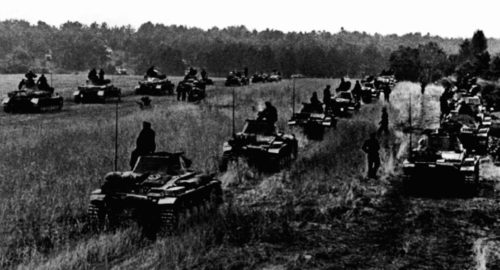
In the same way that the Wehrmacht shocked its opponents with revolutionary tactics in the opening stages of World War II, the reason why the All Blacks have dominated the world rugby stage for over a decade is that they’re conducting a blitzkrieg while everyone else is in World War I mode.

In other words, the All Blacks are fighting with manoeuvre warfare while everyone else is in the attritional mindset.

The concept of the blitzkrieg was based around two general principles: the schwerpunkt and the kesselschlacht.

A ‘schwerpunkt’ (“heavy point”) refers to a specific point in the enemy defensive line that was targeted for a sudden, intense rush of artillery, armour and infantry, with the specific intent of breaking the line and driving beyond.

Usually this took the form of an intense artillery barrage from multiple batteries concentrated on a single point in the line, followed immediately by a heavy tank charge with the intent of breaching the line, and then infantrymen into the breach with the intent of holding it and keeping it open.

Usually there was more than one schwerpunkt, the idea being that multiple columns of armour would break the enemy line at various points and then, as they penetrated deep into the enemy interior, link up in what was called a pincer movement, as it cleaved off a chunk of the map in a manner akin to the pincers of an insect.

When two or more columns of armour met in the interior of the enemy, that essentially meant that all of the enemy forces between the initial front lines and the two vast lines established by the armour were surrounded in the centre, making it possible to pin them with artillery fire.

Because this led to those enemy forces being rendered into chaos in much the same manner as water boiling in a kettle, this was known as a ‘kesselschlact’ (“kettle battle”).

The reason why this tactic – called blitzkrieg by the British – was so successful is that is allowed the attacker to break up tens of kilometres of enemy defensive line in one movement. This was a drastic change from the usual World War I tactic of winning a few hundred meters at a time in a slow, bloody grind that was vulnerable to counterattack.

Because so much of the enemy line was broken so quickly, it had a tendency to collapse before it could regroup, as was seen in France and the opening weeks of Barbarossa.

So much for the military lesson.

The two distinct styles of rugby union played in the world today could be roughly referred to as the Atlantic and the Pacific styles.

The Atlantic style is the traditional, attritional style of rugby favoured by the Northern Hemisphere sides and by South Africa and Argentina. It is otherwise known as “tight”, “10 man” or “up the jumper” rugby and refers to a love of mauls, scrums, pick and gos, high bombs, one-out crashballing, pinpoint kicking and generally just mudwrestling – essentially World War I-style tactics in miniature.

The Pacific style, championed by the All Blacks, is also played by Australia, Fiji, Samoa and Tonga. Japan used it when they shocked the Springboks at the 2015 Rugby World Cup, and Argentina flirt with using it. It is derided as “loose”, “festival” or “basketball” rugby by the Northerners.

Those who play this style love offloads, cut-out passes, goosesteps, wrap-around plays, fends that knock the fullbacks over, sudden and untelegraphed changes of attack direction, chipping and regathering, passing in front of the receiver, and perfectly-timed passes that allow the winger to skin the covering tackle on the outside.

Done poorly, the Pacific style can disintegrate into a shambles reminiscent of a scratch Barbarians game, in which the players are trying to force every pass and the opposition can win simply by waiting for opportunities to counterattack.

Done well, the Pacific style gives us blitzkrieg rugby.

Like the military blitzkrieg, successful use of this tactic is much more than just throwing the ball around and having big players who can run fast. It also requires a particularly high degree of co-ordination.

If there’s one way in which the All Blacks are always more effective than their opposition it is in their ability to support a line break. Almost every time an All Black breaks the line he has options for unloading.

This is a consequence of the fact that All Black players have usually played rugby since they were small children and have an intuitive ability to read the game that has been refined over more years than the other teams’ players.

In the same way that the Soviet Union stopped the Nazi blitzkrieg by successfully using multiple lines of defence, the Lions will have to accept and adapt to the fact that their first lines are going to get broken.

In other words, if the Lions are going to stop the blitzkrieg rugby of the All Blacks they are going to have to scramble like demons.

This will require a high degree of skill as the defenders will have to make correct decisions at extreme pace.

Usually these decisions involve which lines to run so as to shut down space in order to prevent the player making the line break from setting up an outside runner, as it is this aspect of the game where the All Blacks can devastate teams in very short order.

The blueprint for this ought to be the Irish win over the All Blacks in Chicago last year. The Irish defence retained its cohesion in that game despite the rapid manoeuvre attack of the All Blacks. If the Lions cannot at least equal the defensive cohesion of that Irish team, the All Blacks will cut them to shreds.

Furthermore, without a kicker near to the class of Dan Carter the Men in Black do not have a reliable Plan B. It’s blitzkrieg rugby or nothing – so the British and Irish can be expected to have an excellent game plan.

Rugby union is, and always has been, a game of skill.

The All Blacks will play to a gameplan which puts the skills of all 30 players under the highest possible stress at the highest possible tempo, because these circumstances give the decisive edge to the most skilled side, and they believe themselves to have the superior skills.

If the Lions are going to stop this blitzkrieg they are going to have to make intelligent decisions extremely quickly to an intelligent gameplan. The competitiveness of the series will hinge on their ability to do this.

Divide and Conquer in New Zealand

As the 2017 General Election draws nearer, the intensity of the propaganda is increasing from all sides. Even the Internet – once a technophile’s lodge of respite from politics – is now full of Gareth Morgan’s advertisements. In all the confusion, it’s easy to forget that the ruling class will win the election, as they have every other one.

The principles of iron are the same in all times and all places. Ultimately, if someone is capable of bringing more physical force to bear on your body than you can on theirs, they are your boss and you can only act freely at their pleasure.

It’s very easy to see how this operates in reality.

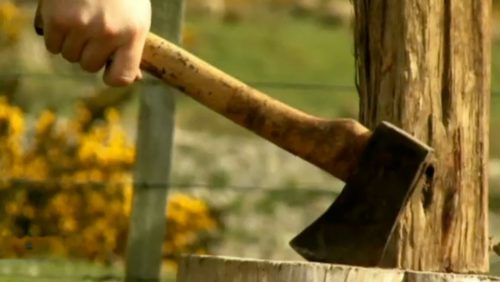
Iron can be used to make an axe, and the axe can divide the head of any person opposing the will of the wielder of that axe from that person’s body, rendering them incapable of resistance.

For the majority of the billion-year history of life on Earth, iron took the form of fangs and claws and teeth. Nowadays, that iron takes the form of handguns on the holsters of the loyal Police, but the principles are the same.

Everyone understands this – but few understand that the principles of silver operate in much the same fashion.

There is no need to divide someone’s body with iron if you can equally well render them incapable of resistance by dividing their mind – and this is done by silver.

More specifically, this is done by telling lies.

Take, for example, the lies that John Key told about GST to get elected – in particular, promising not to raise GST from its then 12.5%. This promise was made because it is known that consumption taxes disadvantage the poor relative to income taxes, and so the suckers in the middle were more likely to vote for Key.

When Key was duly elected and took power, one of the first moves was to raise GST to 15%. This had a particular effect on the electorate that was not noted at the time.

What this lie did was to cleave New Zealand, as if with a silver axe, into one group who profitted from the lie, and one group who suffered from it.

The group that profitted from it didn’t appear to really care much that the other half of the country had lost out from being lied to by their Prime Minister. After all, they ended up with the long-coveted income tax cuts.

The group that suffered from it found that, not only had they lost, but they had lost by being lied to, and they had lost from being lied to by their own Prime Minister. Worst of all, no conversation about the effects of these lies seemed possible.

The corporate media, beholden to Key and to the National Party for their news cycle, moved on to the next infotainment fad, and the subject was forgotten.

It can be predicted, without any great effort of foresight, that the corporate media will use this year’s General Election as an occasion to set the plebs against each other for profit.

It can also be predicted, with similar ease, that anyone who points out the grotesque nature of the charade that is the televised circus of psychopaths dumping their verbal excrement into your subconscious mind at 50Hz will not find appreciation among those same plebs.

So much so that knowing which of the possible options represent a “genuine change” and which are just the usual lineup of pocket-lining, trough-guzzling criminals will become impossible in the noise and chaos.

We could tell you that we were going to provide an alternative, but then why would anyone with sense trust us?