Not Kiwi Enough? If You Don’t Have Roots Here You’re Not a Kiwi At All

Very few New Zealanders would have the arrogance to move to another country and then lecture those people about who they are, and we shouldn’t accept it when it’s done to us

Three years as an immigrant in Europe taught me a lot about the concept of roots. This is a familiar concept to Maori people, who for a couple of centuries have had to tell the difference between Pakeha who were loyal to New Zealand and Pakeha who weren’t. The short of it is that one’s degree of belonging to a nation is a function of the roots that you have there.

In Sweden, like almost everywhere in the Old World, there is little question about who counts as a Swede. If you are Swedish then you have Swedish ancestors going back to the dawn of time, like all other Swedes. This is the common bond that gives rise to the Swedish nation.

If you do not have these roots you are not Swedish. This is a very simple and near-universally accepted belief. You can get a Swedish passport and become a ‘paper Swede’, and if you also speak Swedish this will entitle you to be treated with full dignity and as if your presence has as much value as anyone else – but you still won’t be Swedish.

Maoris in New Zealand have a similar concept. The depth of your roots tell you whether or not you can be trusted to stick around, or if you’re the sort of person who just wants to make a quick buck and then disappear (for obvious historical reasons, Maoris tend to be exceptionally wary of the latter sort of person).

The only real way to determine if a person is a Kiwi or not is whether or not they would stick by other Kiwis should a calamity befall the nation. This is a measure of the amount of solidarity that person has with other Kiwis. Would they stay to defend the country if it was attacked by foreign military forces? Or would they run away and leave Kiwis to their fate?

Fundamentally this is a question of solidarity. People with roots in New Zealand have cousins here, they have family friends in other cities, they have stories of how their great-great-grandparents or earlier descendants tamed the land, and this naturally leads to solidarity with other people who have similar roots and similar stories.

Golriz Ghahraman, who made the headlines today for lecturing Kiwis about our “internalised self-hate”, has no roots in New Zealand in any case, which is part of the explanation for the lack of solidarity she feels that she has received. Everything suggests that if the Kiwi people were ever truly in danger, she would rather move to another country than to stay and help out. If things got tough here, she would rather abandon us than face personal disadvantage by remaining here.

After all, she and her family have already done this once, so they have a track record of it.

She has no moral right to turn up in New Zealand as a migrant and then start lecturing us about what a Kiwi is or isn’t. The thought of a Kiwi moving to Iran and then presuming to tell the Iranians what’s what about who they are is ludicrous – so why do we accept the same in reverse? For someone with no roots in the country to act as if their verdict about our true nature has any weight represents an incredible arrogance and sense of entitlement.

Moreover, her implication that a refusal to allow New Zealand to become a dumping ground for the world’s human refuse is “race supremacy” is disgusting in light of the strong bonds of solidarity that exist between the descendants of British colonists and Maoris. These two groups get along as well as they do because they have shared roots in the country – it has nothing to do with race.

Obviously Ghahraman has spoken to very few Maoris in her lifetime, for if she had she would be aware that the strongest nationalist and anti-refugee sentiments in the country are harboured by them.

None of this is to argue that the National Front are correct or that they represent an appealing face of New Zealand. A New Zealand identity must not be based on a hatred of the other.

But for a Kiwi identity to exist, a certain degree of exclusivity is necessary. There is no other way of achieving this but to declare that people without roots in New Zealand are not Kiwis.

To make the argument that Kiwis with hundreds of years of roots in New Zealand are in the same category as people who just stepped off a plane and got a passport is preposterous. For one thing, it presumes to decide for those long-established New Zealanders who they are permitted to feel solidarity with. For another, it ignores the fact that almost every other culture in the world does the opposite.

Kiwis who are either Maoris or descended from colonists have a couple of centuries of family lore that relates to New Zealand that newcomers simply cannot have. They can tell you stories about how their great-grandmother cut her thumb off with an axe here, or how their grandmother broke her arm falling off a bicycle here, or how their grandfather used to go pig hunting here. Newcomers do not and cannot represent this culture.

At the end of the day, if people with deep roots in New Zealand want to exclude those who don’t, that’s their prerogative, and Iranian social justice warriors admonishing us to hate ourselves for it won’t make a mouseshit of difference.
Te Reo With Mnemonics: Kitchen Words

Spoon – koko

An old woman spoons cocoa out of a tin and into a cup.

Cup – ipu

A creature shaped like the letter E takes a cup, puts it on the floor and does a poo in it. In the cup is an E poo.

Door – tatau

A man shows off a tattoo on his arm. It is of a door that looks as though it leads to extradimensional places.

Oven – umu

A man tries to wrestle an emu into an oven.

Fork – paoka

A man is eating a casserole with a fork. Another man asks him what he’s eating, and he answers “Pork.”

Knife – naihi

A woman takes a knife and cuts her own knee.

The Maori word for ‘Door’ – tatau – sounds like the English word ‘tattoo’

Kettle – tīkera

(loan) A woman boils a kettle to make a cup of tea that has a carrot in it. The kettle boils the water in which floats the tea carrot.

Frypan – parai

A frypan is stuck to stovetop, so a woman tries to pry it off with a crowbar.

Towel – tāora

A princess is wearing a tiara on her head and nothing but a beach towel around her body.

Plate – pereti

A plate says to a woman “You are very pretty.”

Saucepan – hōpane

Someone knocks the bottom out of a saucepan and affixes it to a basketball backboard, where it serves as the hooping.

Broom – puruma

A puma is cleaning its house with a broom.

*

The above is an excerpt from the upcoming Learn Maori Vocabulary With Mnemonics, by Jeff Ngatai, due to be published by VJM Publishing in the summer of 2017/18.

New Zealand in India 2017 ODI Series, Second ODI Preview

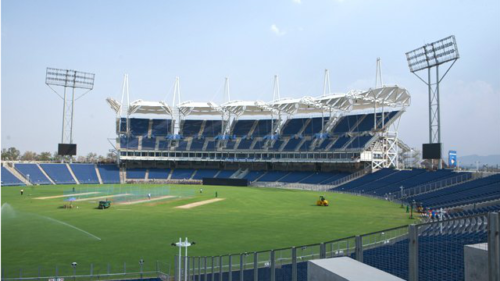
The previous ODI at this venue saw England post 350 batting first – and then lose

The Black Caps landed the first blow on their 2017 tour to India with a thumping six-wicket win in the first ODI in Mumbai, and a win in Pune tonight will see them inflict on India their first home series loss in two years. If the Black Caps can win both of the remaining matches (as unlikely as it might sound), they will go up to 3rd place in the official ODI team rankings – higher than Australia.

There is certainly a solid case that the Black Caps’ batting line-up is stronger than Australia’s, in Indian conditions at least. Martin Guptill does not have a high average in ODIs in Asia, and Colin Munro is so far unproven at the top in any conditions, but Kane Williamson, Ross Taylor and Tom Latham are all superb players of spin. Good enough so that India can’t simply rely on bamboozling them with drift and turn as for past Kiwi batting lineups.

In the previous ODI at this ground, earlier this year, England batted first and scored 350/7, and then India chased it down thanks to a Virat Kohli century and 120 off 76 balls from Kedar Yadhav. It’s not believed that the wickets in India will be as run-heavy this season, but in any case the Black Caps might be happier batting second.

Batting second confers a distinct advantage if the wicket turns out to be much more productive than initially believed. This is because of psychology. Generally speaking, a batsman will be reasonably satisfied with a big score batting first and might be more reluctant to accelerate if they feel they are already above par and don’t want to risk their lead by losing wickets.

This often leads to the team batting first not pushing hard enough for runs, and is why some massive totals have been chased down since the 2015 Cricket World Cup.

Apart from what to do in Pune if he wins the toss, Kane Williamson also has to think about which bowlers to take into the match. The batting lineup is settled and, apart from possibly Colin Munro as opener, the current top 5 will go all the way through to the 2019 Cricket World Cup, but there are two major questions about the bowlers.

The first is whether it might be a good idea to bring the legspin of Ish Sodhi into the equation to compliment the left arm orthodox of Mitchell Santner. India and Bangladesh have recently had plenty of success playing two spinners in subcontinent conditions, and Sodhi has improved majorly over the past 12 months, finally discovering the consistency he needed to be a genuine threat.

The second is whether or not they can keep leaving Matt Henry out of the starting lineup. Although Trent Boult’s place is assured it’s not at all clear that either Tim Southee or Adam Milne offer more threat than Henry with the ball. In fact, Henry averages 14 runs per wicket less than Milne in this stage of their careers, and Southee’s returns in recent years are not much better.

If Colin de Grandhomme cannot acclimatise to Indian conditions in time to reliably bowl 10 overs, the Black Caps might decide that the top six is strong enough that either Henry or Milne – who both average in the 20s in first class cricket – could be promoted to 7.

The Black Caps bowled well in the first ODI but the risk for the lineup they picked is that only Trent Boult and Mitchell Santner offer any realistic threat with the ball, considering the quality of the Indian batting. None of Southee, Milne or de Grandhomme were able to pose a consistent danger so perhaps the inclusion of Henry and Sodhi could make the bowling attack more dangerous at little extra risk of being bowled out.

We Don’t Need a Cannabis Referendum – Just Legalise It

Conducting a referendum about a liberty that should already be guaranteed by human rights legislation has proven to be highly divisive in Australia

Kiwi cannabis users have been buoyed by the demise of the Fifth National Government. It is already clear from the change in rhetoric that the incoming Sixth Labour Government will approach the issue with honesty, in contrast to the John Key/Bill English/Peter Dunne approach. However, honesty doesn’t prevent one from making errors – and the decision to hold a referendum about legalising the personal use of cannabis is one such error.

It’s widely accepted that the actions of the New Zealand Parliament in passing gay marriage legislation was a wiser, less divisive move than the actions of the Australian Parliament in holding a referendum on the subject. The Australian experience of having a referendum on such an emotive subject was that the country tore itself in two, with many people eventually choosing to vote against gay marriage out of sheer bitterness and resentment.

The New Zealand experience of making it legal by Parliamentary decree gave the country an opportunity to come together in mutual desire to right the wrongs of the past. Even conservatives like Maurice Williamson saw the need to give a passionate speech in favour of a law change, and the Parliament itself went as far as singing a song out of a will to demonstrate that the old days of hate were over.

It’s also widely acknowledged – by the New Zealand people, if not by the New Zealand ruling classes – that withholding cannabis medicine from sick people who need it is an extremely cruel thing to do, and something only done because of hate. Certainly it’s much crueler than withholding marriage rights from people, which, while inconvenient, are hardly a matter of life and death or daily suffering and misery.

Moreover, it’s obvious from the experience of the half a dozen American states that have already legalised the recreational use of cannabis that the downsides of doing so have been massively overstated for decades. The predicted crime explosion and spates of suicides never eventuated – indeed, some research suggests that suicide rates can drop by almost 5% in the wake of legalising medicinal cannabis, and this rises to almost 10% in the cases of young males.

So why not just do the obvious thing, acknowledge the evident truth, stop lying and just make the personal use of cannabis legal by Parliamentary decree, as the Labour Government intends to do with medicinal cannabis?

This way we can avoid giving a platform to moronic bigots like Bob McCroskie to further divide our society with fearmongering and lies. The Australian equivalents to McCroskie have polluted media space with hysterical predictions of doom, further alienating gay people from the mainstream, and the same will happen in New Zealand if we also put a question of basic human rights to referendum.

Ultimately, no-one has the right to prevent anyone else from using cannabis. No-one has the right to take this freedom away from other people, any more than they have the right to prevent them from watching cricket or eating parmesan. Therefore, there is no good reason to have a referendum about whether it should be legal or not, because there’s ultimately no good reason to obey any law prohibiting the use of cannabis.

Our law should simply reflect this reality and make it legal.

*

Vince McLeod is a former Membership Secretary of the Aotearoa Legalise Cannabis Party and author of the Cannabis Activist’s Handbook.