Some Problems With Defining Psychosis or Mental Illness

The medical establishment likes to give the impression that they are the authority on mental illness and that they know what they’re talking about. What we used to call “being mad” is now known as psychosis, which even has a nice, neat clinical definition: it requires a “loss of contact with reality”.

The difficulty with this definition – which no clinician will admit – is that no-one knows what reality even is. Simple logic will tell you that there are as many potential interpretations of what reality is as there are perspectives upon it to take.

And these are infinite.

So the definition of psychosis has become “loss of contact with what is commonly agreed upon to be reality”.

At this point one can continue to ask if it is legitimate, but it is worth noting that this no longer matters. Once the balance of political power supports the enforcement of a medical paradigm in which a loss of contact with what is commonly agreed upon to be reality is considered psychosis, that is what psychosis will be.

Even so, one must ask the question: how does the psychiatrist know what is commonly agreed upon to be reality?

The doctor can only know about reality in so far as they have experienced it, and chances are that they have experienced it from a biased perspective for reasons that are not admitted to because of politics.

For instance, the average doctor is a decidedly middle-class person. It takes a highly unusual academic aptitude to qualify. It’s unlikely that any given doctor has seen reality from the perspective of a very poor person, or of a mentally ill one.

So it’s apparent that whatever is commonly agreed to be reality is whatever the lowest common denominator considers it to be. And mostly all we can agree on is that the physical world is real – because, after all, it looks like it – so anyone who disagrees with this is psychotic.

Mostly we can agree on the realities of the social world – don’t hit people, kick them, spit or swear at them etc. Other social realities are not so clear.

For example, is homosexuality a mental illness or not? There was a time, only a few decades ago, when psychiatrists who considered themselves “experts” in psychosis and mental illness were comfortable in diagnosing their homosexual patients as mentally ill.

If one answers that the criminalisation of homosexuality was obviously a mistake and now we know better, what about the use of medicinal cannabis? Because a majority of psychiatrists still consider medicinal cannabis use for the alleviation of mental illness to be an “abuse” that leads to psychosis, and this opinion is no less ignorant, arrogant and boneheaded than the old ones about homosexuality.

Cannabis use can lead to psychosis, but not for the reasons they think it does. Cannabis wakes you up. Psychosis is little more than being prematurely woke, and panicking thereby. Cannabis makes you aware of things that you had previously been too stupid to be aware of. And this can cause psychosis in the young and in the dull.

In so far as people are dumb, anyone becoming suddenly woke is going to have what the still-dumb would call a “loss of contact with reality”. In fact, it’s hard to see how this is avoidable, given that the opinions people hold before they become woke are inevitably those of the herd that they have absorbed out of pliability.

Anyone who, for the first time, learns a truth that the majority do not already know risks being seen as a psychotic, because the majority have be conditioned to treat anyone waking up from mass delusions as if they are sick in the head.

In cases of purely technical knowledge, this is no big deal. In cases of politics or religion, or, even more crucially, of reality itself, it is a big deal.

Anyone who has read Plato’s Republic will not only understand the analogy, but they will also realise that woke people realised all this over 2,000 years ago, and warned anyone capable of listening in texts like Republic.

The famous analogy of the cave warned those already on the path to waking up that their superior insight will not and can not be accepted as such by the plebs.

So anyone who has been awoken to a higher order of reality by the original perspectives of thought offered by certain psychoactive drug experiences ought to know, right from the beginning, that these perspectives will never be accorded credibility by a medical establishment that is absolutely stuffed full of paid-up worshippers of the cult of materialism.

Any belief in a reality beyond the material is a mental illness in the current paradigm of the Western medical establishment.

Whereas the ancient Hindus, the ancient Egyptians and the ancient Greeks all came to a similar insight over 2,500 years ago – that the primary basis of reality is consciousness and that the material world, or Maya, is an illusion – one cannot simply expect this insight to be acknowledged by our cultural guardians of how reality ought to be interpreted.

They are materialists, and therefore anyone disagreeing with materialist dogma will be considered mentally ill. Psychosis is therefore not really a “loss of contact with reality” but “disagreeing with the materialist clinician about what reality is”.

So for the rest of us it may be a matter of bunkering down until this materialist craze blows over and those who have seen beyond can speak freely again.

Understanding New Zealand: Voting Patterns of Pacific Islanders

Many people, especially foreigners, tend to blithely assume that Maoris are more or less the same as Pacific Islanders, and could perhaps be placed in the same demographic category. Leaving aside the fact that both Maoris and Pacific Islanders would mostly object to this, there are statistical differences between the two groups that make them distinct.

The most notable thing about the Pacific Islander population is their love of the Labour Party. The correlation between being a Pacific Islander and voting Labour in 2014 was a very strong 0.78. For the most part, this simply reflects the degree to which Pacific Islanders in New Zealand tend to be working class.

The correlation between being a Pacific Islander and median personal income was -0.29, which is enough to suggest that the majority of them have an interest in voting for a left of centre party. There is also the correlation of 0.50 between being a Pacific Islander and working in the transport, postal and warehousing industries.

Predictably, then, there is a negative correlation between being a Pacific Islander and voting National, and this was -0.46. It’s worth noting that the Maori antipathy towards National was as strong as the Pacific Islander love of Labour, whereas the Maori love of Labour and Pacific Islander antipathy towards National were not as strong.

Perhaps reflecting the significant correlation between being a Pacific Islander and being born overseas (0.38), there is no significant correlation between being a Pacific Islander and voting New Zealand First in 2014 – this was -0.08.

Some believe that the Greens, in so far as they are a leftist party, get votes from socially disadvantaged people, but Pacific Islanders don’t see much in Green Party rhetoric to attract them. The correlation between being a Pacific Islander and voting Greens in 2014 was -0.27. Given that Pacific Islanders are not as socially disadvantaged as Maori, they might be the obvious next propaganda target for the Greens.

The votes for other parties reflected the dominance of Labour in the political minds of Pacific Islanders. They did not at all follow Maoris into voting for Internet MANA or the Maori Party – the correlation between being a Pacific Islander and voting Internet MANA in 2014 was 0.07, and for voting Maori Party in 2014 it was 0.01.

Neither were Pacific Islanders particularly interested in the far right of the spectrum. The correlation between being a Pacific Islander and voting ACT in 2014 was 0.06, which was not significant, and even this probably reflects the fact that ACT voters and Pacific Islanders both mostly live in Auckland more than it reflects any genuine ACT support among them.

Given the preponderance of religion and religious fundamentalism among Pacific Islanders in New Zealand, some might be surprised that the correlation between being a Pacific Islander and voting Conservative in 2014 was a significantly negative -0.29. However, the bulk of the Conservative Party vote was from the Anglican-Presbytarian-Baptist-Brethren axis and Pacific Islanders seldom belong to these movements.

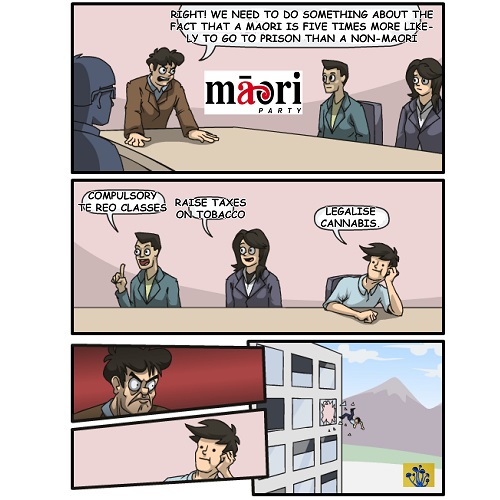
Probably the largest difference in terms of magnitude for any one political party was with the Aotearoa Legalise Cannabis Party, voting for which in 2014 had a correlation of -0.10 with being a Pacific Islander, in contrast with 0.89 with being Maori. Possibly reflecting the Christian fundamentalist influence still, Pacific Islanders are vastly different to Maori when it comes to attitudes towards cannabis.

*

This article is an excerpt from Understanding New Zealand, by Dan McGlashan, published by VJM Publishing in the winter of 2017.

Understanding New Zealand: Demographics of Christians

The Abrahamist tradition of Christianity has come to New Zealand in several waves, each one contributing to the replacement of traditional Maori spiritual practice, most of which has now been forgotten. But just who are the numerous followers of this Middle Eastern cult in New Zealand?

The statistic that will surprise many people is that there is no significant correlation between being of European descent and being Christian in New Zealand – this was -0.07. There are several reasons for this.

The most obvious is that, when people in New Zealand think ‘Christian’, they usually, without realising it, think ‘Anglican’ or, especially on the South Island, ‘Presbytarian’. The correlation between being Anglican and being of European descent is a strong 0.60, and that between being Presbytarian and being of European descent is 0.40.

Christians are much more likely to be Pacific Islanders than they are either Maoris or Asians. The correlation between being a Christian and being a Pacific Islander is 0.46, compared to -0.37 for being Maori and 0.03 for being Asian. Predictably, given all of these statistics, there is a significant negative correlation between being born in New Zealand and being Christian (-0.24).

Old New Zealand and New New Zealand divide sharply in attitudes towards Catholicism. There is a correlation of -0.27 between being of European descent and being a Catholic, and a correlation of -0.28 with being Maori and being Catholic. This contrasts with the correlation of 0.40 between being a Pacific Islander and being Catholic and the correlation of 0.42 with being Asian and being Catholic.

The obvious explanation for this is the strong negative correlation between being Catholic and having been born in New Zealand, which was -0.41.

Attitudes towards Mormonism, on the other hand, divide European New Zealanders from the others. Kiwis of European descent are highly unlikely to be Mormons: the correlation between the two is -0.71. Asians are mostly indifferent, with a correlation of 0.07, but Mormons are very likely to be Maori (the correlation between the two is 0.54) and even more likely to be Pacific Islanders (the correlation there is 0.68).

The reason for this is Mormons are generally quite hard done by. The correlation between being Mormon and median personal income is -0.46. Likewise, being a Mormon is negatively correlated with having any of the four university degrees. This reflects a deliberate strategy on the part of the Mormon church to target vulnerable people with their propaganda, knowing that the more desperate someone is the more likely they are to fall prey to a religion.

It could be predicted from the above that Anglicans and Presbytarians are signficantly more likely to be old. And they are – the correlation between median age and being Anglican is 0.56, and between median age and being Presbytarian it is 0.43.

Being Christian had a significant negative correlation with having a university degree, and looking closer at this shows a few distinctions. Being Catholic was positively correlated with having a Bachelor’s degree (0.37), with having an Honours degree (0.31) and with having a Master’s degree (0.37), which went against the general trend.

It was the mystery category of ‘Christian not further defined’ that caused the overall correlations between being Christian and having a university degree to be negative. Being ‘Christian not further defined’ had a correlation of -0.24 with having a Bachelor’s degree, -0.37 with having an Honours degree, -0.26 with having a Master’s degree and -0.39 with having a doctorate.

For both Maoris and Pacific Islanders, the correlation between being in this category was greater than it was for people of European descent or Asians. So this category may contain the various Christians that have not been raised in a particular subreligion (such as Anglicanism), i.e. adult converts, who as a rule have it worse than adults who follow the religion they were raised into.

Working in no industry had a positive correlation with being Christian, but many had negative correlations. The strongest was between being Christian and working in the arts and recreation services. This was a very strong -0.63. Perhaps the reason for this is that people who work in arts are iconoclastic by their very nature, as most creative people are, and therefore reject religious tradition.

There was also a strong negative correlation between being Christian and working in administrative and support services (-0.52), accommodation (-0.49), education and training (-0.48) and information media and telecommunications (-0.40). The most likely explanation for at least some of these is that Christians tend to be much older than the average worker in these industries.

There is also a significant negative correlation between being a Christian and being a professional (-0.42), reflecting the generally poor academic achievements of Christians.

Perhaps reflecting a general middle-of-the-road conservatism, being Christian had a negative correlation with being in all of the income bands below $15K and all of the bands above $50K. This was not the case for Catholics, who had a correlation of 0.30 with being in the $100-150K income band and a correlation of 0.24 with being in the $150K+ band.

Reflecting a combination of age, seniority and political dominance, there was a significant correlation between being Anglican and being a manager – this was 0.44.

The point about political dominance and disenfranchisement is underlined by the significant positive correlations between turnout rate in 2014 and being Anglican (0.41) and between turnout rate in 2014 and being Presbytarian (0.32). Contrast this with the very strong -0.68 between turnout rate in 2014 and being Mormon.

Presbytarians are very strong on the South Island, refecting the strong Scottish influence there. The correlation between being a Presbytarian and being a South Islander is 0.56.

*

This article is an excerpt from Understanding New Zealand, by Dan McGlashan, published by VJM Publishing in the winter of 2017.

Is this the Age of the Pleb?

There are many systems of thought that describe various times, epochs or ages that humanity appears to pass through on its collective historical journey through the Great Fractal. Plato’s Republic described it alchemically, the Hindu cosmology describes it in a similar fashion and many other traditions have a time of increasing disorder leading to a climactic revolution.

In Republic, Plato laid out how culture disintegrates over time. Society begins in a Golden Age, according to Socrates in Book VIII, and gradually deteriorates.

It begins with rulers who put virtue above all, and who accordingly cannot own property. Because of the errors that these good people inevitably make as a consequence of being fallible, they are replaced by an inferior and greedier set of rulers.

Eventually the greed of the society leads to money being lent out at high rates of interest, which inevitably concentrates wealth in the hands of a very few. Society degenerates further into the rule of the mob, when doing whatever one wishes to do is the only value.

Here there is little of the higher order that an alchemist would associate with gold, silver or iron. Indeed, the men of gold have vanished by the time it comes to democracy. The man of clay takes charge by convincing the man of iron that the man of silver wishes to enslave him, and by convincing the man of silver that the man of iron wishes to kill him, and so ensures that those two mutually destroy each other.

The Hindu timeline tells a fantastic – and weirdly similar – story. Each Great Year, or Age of Man, or Maha Yuga, itself consists of four smaller Yugas.

The first of these, the Satya Yuga, is also known as the Age of Truth, and it corresponds very closely to what an alchemist would call a Golden Age and what Plato would have called rule by aristocracy. Here it is the gods that are, rightly, in charge of their creation, and everyone knows their correct place.

In the next age, the Treta Yuga, righteousness gradually diminishes. An alchemist would call this an Age of Silver – spirituality begins to give way to materialism, and kings and rulers must use cunning to get their will through, no longer able to rely on the confidence that the ruled have in them.

The final stage is the Kali Yuga, which is known in Hinduism as a Dark Age.

Both of these systems of thought, like the Norse Ragnarok and the Abrahamist Armageddon, suggest that the human experience starts good and gradually gets worse until it has to be restarted in violent revolution. Before we get to this point, however, things have to become genuinely terrible.

An alchemist might point to the immense population surge of the last 150 years and declare that this must be the time of the man of clay, because it appears that no longer does anything other than sex matter. People breed mindlessly, with no thought to the long-term benefit of their actions or whether more offspring are desirable, and so the human population has exploded.

A consequence of this is a resurgence of lowest common denominator culture. American popular culture seems to have sunk to an almost childish level, with the people happy to accept any display of gross incompetence or unfitness for leadership from their ruling class.

In New Zealand it can be seen with the increasing media attention given to soccer, which is the McDonalds of world sports, at the expense of excellent sports such as rugby and cricket, and with the degeneration of the nation’s most popular media portals into click-baiting drivel.

Perhaps all of these systems of thought are all correct and we are currently living in the Age of the Pleb, ruled by the worst among us, and by the worst instincts within ourselves.

The good news is that, in all systems of thought that warn us of such a thing, the Age of the Pleb is always replaced by a new Golden Age.

To some extent, how this develops is inevitable. The man of gold, born into the age of the man of clay, finds himself impelled to take action. The degree of degeneration strikes him as obscene, and out of righteous anger he takes action.

This action usually has the effect of bringing fire into the world to burn away the rot and filth of the Age of the Pleb. Sometimes this means war – and with a massive and still-growing human population creating ever more pressure on ever depleting natural resources, this seems very possible.

The other way we might exit the Age of the Pleb is by a fiery revolution of thought, in which the mental cobwebs of long-decayed religions are burned away by righteous fire and the brutal monkey instincts at the bottom of our brains are tamed and sublimated into something valuable.