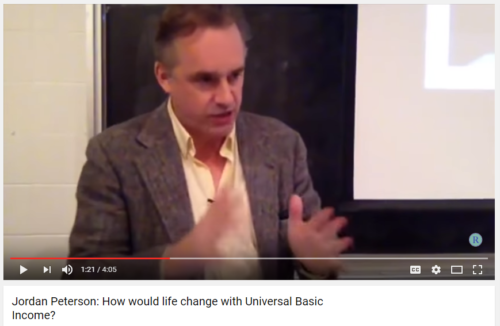
Jordan B Peterson understands the many benefits of a universal basic income
Many people have come to believe that the advent of a universal basic income is necessary to solve the social problems of the medium-term future. The received wisdom has it that increasing automation will soon make the majority of working-class professions obsolete, as they will be replaced with robots. This article looks at the social consequences of instituting a universal basic income.
Conservative interests are dead against the idea of UBI. The reason for this is the entirely reasonable belief that it will be expensive.
If one calculates the cost of a UBI in a country as small as New Zealand, with an adult population of just over 3 million, the cost becomes clear. Assuming that the current unemployment benefit is an amount of money that corresponds to the absolute minimum that a person could live on, 3 million multiplied by $250 per week equals three-quarters of a billion dollars every week.
3 million x $250 x 52 weeks = $39 billion dollars per year. This sounds like a tremendous amount of money – and it is – but according to the NZ Treasury, the cost of social welfare in New Zealand is already $29.8 billion every year. So our current welfare expenditure is already 75% of what it would be with a UBI.
What has to be borne in mind is that this money will not be wasted; indeed, virtually all of it will be funnelled straight back into the economy as it is spent on essential goods and services. Poor people don’t save money, as a general rule, because in order to save one needs a surplus and there is not likely to be a surplus on $250 per week. So the $250 they are given will be immediately put to use in lubricating the economy.
This is in stark contrast to the current system, in which almost the entirely of the operating budget of WINZ is completely wasted. The entire point of WINZ officers is essentially to decide which of their clients to deny an income to, and this role will be completely obsolete with a universal basic income – all of the money currently wasted on employing these gatekeepers will be saved.
The real effect of a UBI will come in the transformations it will make to the work force. Currently, a lot of jobs that are morally questionable or undesirable are done because the person needs to earn money. The threat of homelessness or starvation forces people to take jobs that might be soulless or immoral – and the people who control the money supply know this (and have always known it).
Journalists, for example, mostly produce absolute shit because of the desperate desire to sell advertising. A UBI would mean that instead of writing about sensationalised rubbish (or simply just making things up), journalists could go back to being the Fourth Estate.
Police officers find themselves tasked with enforcing laws that they know are immoral. A large proportion of the Police understand that it’s completely immoral for them to wage a War on Drugs against their own people, but there’s nothing they can do about it if they want to keep food on the table. A UBI would mean that prospective Police officers would be able to say no to enforcing immoral laws.
There are also a lot of people who work in advertising and finance who derive no satisfaction from their work because they know that it’s either completely meaningless or that it actually makes the world a worse place to live in for everyone, but these jobs pay. A UBI would provide an alternative for these soulless jobs.
There is also a belief that a UBI would make people ‘lazy’ and unwilling to work. This is a long way from the truth. In practice, a UBI would make it possible for people to refuse to work jobs with shit pay, shit conditions and shit bosses, which would force the labour market to improve working conditions. Improving these conditions would incentivise people to engage with the workforce.
One effect of this would be to make it much harder for abusive bosses to keep staff. In the New Zealand workplace of today, many employees find themselves having to put up with psychological abuse from their superiors because those superiors control the purse strings, and thereby control whether the employee gets to eat or not.
In summary, bringing in a UBI would sharply reduce the degree of coercive power that moneyed interests would have over people who were dependent on an income for food and shelter.
In this section (c. pages 426-573), Breivik discusses “Modern Jihad”, or how adherents of the Islamic religion fight for supremacy in the modern world. Opening with a quote of Surah 9 verse 5, in which Muslims are admonished to “kill the unbelievers wherever you find them”, this section details the existing Jihads carried out by Muslims against non-Muslims.
In his characteristic way, Breivik exhaustively catalogues the crimes committed by Muslims against non-Muslims. No offence, not even ones as prosaic as common assault, is too minor to be listed here. This is enough to give the impression that Islam is at war with every other culture that it shares a border with.
To some extent, Breivik has a point here. There are very few peaceful borders between Muslim-controlled areas and non-Muslim controlled ones, and prospects for there being more are very slim.
However, one glaring point is missed: if Islam is so ruthlessly aggressive when it comes to purging non-Muslims from Muslim lands, why are there still non-Muslims there? Nazi Germany managed to exterminate the vast bulk of European Jewry in fewer than six years of trying – how can it be that non-Muslim communities still exist in Muslim lands after what we are told has been 1,300 years of relentless extirpation?
Breivik mentions that one-sixth of the population of Egypt are Christians still. This seems like an extraordinarily high proportion for a group that has suffered 1,300 years of ethnic cleansing. The Native American population of the USA, the Aboriginal population of Australia and the Maori population of New Zealand are all much lower than this – and they were displaced over 400 years or less, meaning that the Christian exterminations of unwanted populations has been an order of magnitude more efficient and aggressive than those carried out by Muslims.
Moreover, the exhaustive list of Muslim crimes against non-Muslims is not compared to the list of non-Muslim crimes against non-Muslims, so there is no reference point against which to decide whether this list has any import. 800 Americans are shot dead by other Americans every single month – a monthly list of crimes much longer than the Muslim crimes detailed by Breivik in this document. And this is with a population one-fifth of the size of the Muslim world.
To some extent, Breivik is playing on the infamous persecution mania of Christians who see enemies everywhere and a never-ending infernal plot to drive them from the world in order to conquer it in the name of Satan. Ironically, although Breivik correctly points out that Muslims always try to cast themselves as the victims in order to gain sympathy, he does the exact same thing in this document.
There are many ways in which Breivik’s discontent with the current European situation is a consequence of the failure of European leaders. He correctly points out that part of the reason why Europeans are losing rights to increased security measures is because of the Islamic presence in Europe – had Europe never let the Muslims in, they never would have lost the freedoms that have been taken from them in the fight against extremism.
What needs to be done in response is clear. According to Breivik the terms of victory are “the total banishment of traditional Islam from a specific country. Widespread emigration/deportation and large scale conversion of Muslims in the country.”
This is necessary because “An objective analysis can never reach the conclusion that Islam is peaceful, tolerant and consistent with human rights.” Here, Breivik re-emphasises the point that Islam has never undergone a reformation of any kind. What Westerners foolishly call “moderate Muslims” are simply Muslims who are not particularly religious.
This section ends with a frightening question: “How was it possible that Immanuel Kant, who lived in a German state without liberal democracy, could criticise basic aspects of religion in the 18th century, while in the West of the 21st century there are social and legal consequences for criticising other religions and cultures?”
Have we really gone backwards since the Enlightenment?
In order for New Zealanders to be free and happy, Puritan culture has to be eradicated from the shores of Aotearoa
The basic principle of the New Zealand Anti-Puritan Party is that religious superstition in the form of Puritanism is, and always has been, the single biggest threat to the happiness and well-being of individual Kiwis. Puritanism is a hangover from centuries past that New Zealand, on account of our geographical isolation and cultural anemia, has been unable to overcome. The New Zealand Anti-Puritan Party intends to reverse ALL religious and superstition-based restrictions on free conduct.
This sixteen-point plan establishes how, if elected to Parliament, the New Zealand Anti-Puritan Party would act to restore freedom and dignity to Kiwis who face the humiliation of having 17th-century religious dogma forced upon them.
1. The Parliamentary Prayer to be abolished.
There is no reason why the representatives of a supposedly free people at the bottom of the South Pacific should have to pray to a Middle-Eastern God before they go to work. Worship of the God of Abraham belongs in the Middle East, not Polynesia. It has nothing to do with us here and we should not be supporting a foreign religious tradition. The New Zealand Anti-Puritan Party would abolish the Parliamentary Prayer and replace it with a karakia based on the spiritual traditions that developed here in Aotearoa.
2. Male infant genital mutilation to be made illegal.
There is absolutely no justification for innocent children to be mutilated shortly after birth because of some barbaric superstition. Male infant genital mutilation is a practice that has no place in New Zealand, and New Zealand children should be protected and kept safe from it. The New Zealand Anti-Puritan Party would make the act of male infant genital mutilation punishable by up to 14 years imprisonment, both for the “doctor” who carried out the mutilation and for the parents who procured it.
3. Forcing fundamentalist religion on children to be considered child abuse.
There is clear evidence that threatening small children with the threat of eternal punishment in hell for disobedience has a massively deleterious effect on their mental health as adults. New Zealand has recently made the physical abuse of children illegal over the objections of Puritans – the New Zealand Anti-Puritan Party would also make the psychological abuse of children illegal when this occurs in a religious context. It will become illegal to bring children to certain churches if the rhetoric of those churches is deemed to be abusive in nature.
4. The price of cigarettes to drop to less than $10/pack, legal age to buy tobacco dropped back to 16.
Tobacco has for centuries been one of the best psychiatric medicines for the alleviation of stress, anxiety and depression. The idea of a “Smokefree New Zealand” is more Puritanical bullshit that takes the freedom to self-medicate away from ordinary Kiwis. The New Zealand Anti-Puritan Party would slash tobacco taxes so that it was once again easy for ordinary New Zealanders to use tobacco to alleviate psychological discomfort, and would drop the legal age to buy tobacco back down to 16.
5. Legal age to buy alcohol dropped to 16 for beer and wine in pubs, kept at 18 for hard liquor.
In several countries in Europe it is possible to buy beer and wine in a pub at the age of 16. The New Zealand Anti-Puritan Party believes that all the strictures and laws surrounding alcohol in New Zealand is responsible for making the substance appear to be a forbidden fruit, and that this perception is chiefly responsible for the binge drinking culture we have here. The New Zealand Anti-Puritan Party would make it legal for 16-year olds to buy beer and wine if it was to be consumed in a supervised setting such as a licensed establishment.
6. Alcohol taxes to be slashed.
The Puritanical belief that making alcohol hard to afford leads to more responsible use has completely backfired. Even the most superficial analysis of the European experience demonstrates that making alcohol expensive leads to binge drinking because people are unable to attenuate themselves to regular responsible use of the drug. The New Zealand Anti-Puritan Party would slash excise duty on alcohol so that it became cheap enough for ordinary Kiwis to have a few drinks with their weekday dinners, instead of saving up to get wasted on the weekends.
7. Cannabis to be made legal and sold like tobacco, but with a legal age of 18.
There is absolutely no justification for putting good Kiwi people in prison because they sell or grow a substance widely recognised in non-Puritanical jurisdictions to have great medicinal value. The New Zealand Anti-Puritan Party would immediately legalise cannabis along the lines of the immensely successful Colorado model, but would allow for it to be sold alongside tobacco at dairies and petrol stations. A legal age of 18 would be established for purchasing the substance for the reason that cannabis, like alcohol, is a harder drug than tobacco.
8. Immigration from fundamentalist religious countries to be slashed.
If New Zealand is to keep itself free from the strictures of Puritanical religion, it is essential that the population of New Zealand be kept safe from Puritans moving here and forcing their demented morals on us. When immigrants come to New Zealand they bring with them cultural values that have the potential to lower the standard of living for the locals. The New Zealand Anti-Puritan Party would slash immigration from all countries that are deeply religious, in particular all Middle-Eastern countries.
9. Churches to no longer be considered charities.
The promulgation of Abrahamic religion is not charitable. Brainwashing people into hating gays, hating women, hating drug users and hating atheists is not a charitable enterprise and sharply lowers the standard of living of New Zealanders, as well as creating mistrust and disunity among the people. The New Zealand Anti-Puritan Party would strip tax-free status from all religious enterprises, thereby forcing them to compete on equal terms with secular ones.
10. Abortion to be made fully legal.
The Puritanical belief that women must be forced to carry to term a child that is not wanted and will have a terrible start to its life has caused immense suffering everywhere abortion is illegal. The New Zealand Anti-Puritan Party would remove the barriers to abortion that currently keep women under the Puritan thumb.
11. Euthanasia to be made fully legal.
The Puritanical belief that terminally ill people must be kept alive and suffering as long as possible is simply obscene. The New Zealand Anti-Puritan Party would take steps to ensure that people who have undeniably come to the end of their natural lives are able to die with dignity and without unnecessary misery and suffering.
12. Blasphemy laws to be abolished.
There is no place in a secular democracy for freedom of speech to be restricted just because it hurts the feelings of superstitious control freaks. The concept of blasphemy is a medieval idea that has no place in New Zealand. The New Zealand Anti-Puritan Party would enshrine in law the right of every Kiwi to make any religious or spiritual statement they like, no matter how offensive this may be considered by Puritan fundamentalists.
13. Access to fireworks to be reliberalised.
The great joy that kids and adults of all ages once got from home fireworks displays on Guy Fawkes Night should never have been taken away from the New Zealand people. Fireworks were only banned because of Puritanical moral panic; the New Zealand Anti-Puritan Party would bring back the same rights that free Kiwis used to have to buy and use fireworks leading up to Guy Fawkes Night.
14. Pornography to be liberalised.
The Puritanical obsession with sex has led to a number of anti-pornography laws that not only have no place in New Zealand but which are impossible to enforce in the Internet age. The New Zealand Anti-Puritan Party would make it legal to depict in film or images any sexual act that takes place between consenting adults.
15. All other drugs to be made legal with attention given to real-life consequences.
Puritanism hasn’t merely taken away our rights to enjoy cannabis, alcohol and tobacco as we see fit, but also every other drug is now illegal as well. As for cannabis, there is simply no justification for putting good Kiwi people in prison because of their use of a drug. The New Zealand Anti-Puritan Party would make every drug legal, with the exception of cases when the sale of a particular drug had a direct and clear negative effect on the health of individuals. This effect must be demonstrated through evidence – moral panic would not by itself be sufficient.
16. Eleusinian Mysteries to be reinstated and to occur at the start of every winter.
The Eleusinian Mysteries, in which participants would partake in a yearly ceremony that liberated them from the illusions of the material world and the brainwashing of culture, must be reinstated. The New Zealand Anti-Puritan Party would make institute a ceremony akin to the Eleusinian Mysteries in every city and town in the nation. It was such a ceremony that led to the Golden Age of Ancient Greece and there is no reason why the reinstatement of such a ceremony would not have similar benefits for New Zealand.
The Aotearoan Mysteries would take place about six weeks after the first winter frosts, which would give the priests enough time to collect the psilocybin mushrooms that are necessary to produce the kykeon. This would be drunk by the participants before they sit and watch a theatrical play that initiated them into the mysteries of life and death. Any adult who speaks English would be allowed to participate.
Full implementation of this 16-point plan would liberate New Zealand and the Kiwi people from the chains of silver and gold that Puritanical culture has enslaved us with. The New Zealand Anti-Puritan Party will thereby sharply increase the standard of living of everyday Kiwis and return to them their birthright of freedom and liberty.
Withholding medicine from a sick person who needs it, leading to that person’s death, is manslaughter – should Peter Dunne face charges for withholding medicinal cannabis from sick Kiwis who needed it?
Peter Dunne announced today that he will be stepping down at next month’s election and will not contest his current Parliamentary seat of Ohariu. It’s apparent that the National ship is sinking and, like a rat, he’s getting off while the getting’s good. However, that doesn’t mean he should get away with the suffering he caused to innocent Kiwis while in office.
The New Zealand Crimes Act sets out the definition for culpable homicide, one form of which is the crime of manslaughter. One example of culpable homicide is “causing that person by threats or fear of violence, or by deception, to do an act which causes his or her death”.
The threat of using the criminal justice system to put a person in a cage for using medicinal cannabis definitely qualifies here. Peter Dunne has acted to uphold cannabis prohibition ever since his agreement to support the Fifth Labour Government in exchange for no progress on cannabis law reform.
This has had the effect of causing people to avoid using cannabis medicine for fear of arrest and imprisonment.
Lying about the medicinal qualities of cannabis also qualifies here. Telling the people of New Zealand that cannabis is not a medicine, when its medicinal use is saving lives in dozens of overseas jurisdictions, is a form of deception that has caused a number of deaths.
If New Zealand was a fair society, if justice existed here for every person and not just for the wealthy, Dunne would be charged with causing those deaths.
Studies have shown that in American states with legal medicinal cannabis, deaths from opioid overdoses have decreased by 25%. This is because many suffering people would rather use cannabis than the highly addictive opioid-based painkillers that frequently lead to death by overdose.
Because Dunne blocked medicinal cannabis law reform for so many years, the use of prescription opioids in New Zealand has soared. A mainstream media article from a couple of months ago, titled Serious pain coming as NZ’s prescription opioid use soars, details some statistics that point towards the looming health disaster that Peter Dunne has dumped in our laps.
There’s no doubt that if a New Zealander went into someone else’s house and took away their insulin, and then that person died, then the person who took that medicine away could be charged with manslaughter. So why can’t Peter Dunne be tried for the people who died because he kept medicinal cannabis out of their hands?
If the case of sick Kiwis dying from having an effective medicine withheld from them is not enough to press charges, the ongoing spate of deaths from people using recreational alternatives to natural cannabis might be. Peter Dunne’s action in delaying the legalisation of recreational cannabis, at the same time as opening the floodgates for a variety of mystery drugs cooked up in Chinese labs and labelled “legal highs”, has been linked with nine deaths last month alone.
The fact is that these people are only dying because their first choice of recreational drug – natural cannabis – has been denied to them, incentivising them to use alternatives. Therefore, it can be argued that Peter Dunne, insofar as he blocked cannabis law reform for so long, is responsible for these deaths.
His disastrous Psychoactive Substances Act, one of the most overreaching and totalitarian laws ever passed in New Zealand, has had the effect of making a huge range of safe cannabis alternatives illegal, delivering this massive industry directly into the hands of the black market and the criminal gangs that exploit it. Because of the total absence of quality controls in the black market, recreational drug consumers have absolutely no idea what they’re getting when they buy a cannabis alternative.
As the Minister chiefly responsible for this shambles, Peter Dunne ought to face manslaughter charges for the innocent Kiwis who have died through having cannabis denied to them.