

Category: politics
What Does it Mean For The Left That Muslims Hate Homosexuals?

A horrific realisation is slowly dawning on Western leftists; something that, after the results of the Australian same-sex marriage referendum, can no longer be denied. The anti-conservative alliance that the Left has become claims to represent both homosexuals and Third World immigrants – but the problem is that most of those Third World immigrants despise homosexuals.
This column has previously raised the question of whether homosexuals can still be considered part of the victim class owing to the vast increase in their fortunes over the last four decades. Homosexuals are now over-represented in the New Zealand Parliament by a factor of 250%, and their average income is considerably higher than that of the average citizen in most Western countries.
Before the referendum, the Australian Left made a lot of noise about stopping white Christian bigots from spreading their homophobia and hate. So they got a lot of egg on their faces when it turned out that their beloved Muslims and Third World immigrants turned out to be the most strongly opposed to same-sex marriage.
This could eventually mean that homosexuals start to move their allegiances to the right.
Already it’s known that white people support conservative parties in much greater numbers than they do leftist/liberal parties, and since it’s really only white culture that accepts homosexuals, and considering that the average Western homosexual is wealthier than the average Western non-homosexual, the next logical step for the homosexual bloc is to shift allegiances to the right wing.
After all, it doesn’t really make sense for homosexuals in the West to facilitate the mass importation of people who consider them animals and who will vote to take homosexual rights away. Gay white men are already finding themselves increasingly more welcome in right-wing circles of employed middle-class people and increasingly less welcome in left-wing circles of brown-skinned religious fundamentalists.
No-one should be surprised to see a wholesale shift in gay loyalties in the West over the next few decades, from liberal to conservative. One could argue that it already has started to happen.
What this will mean for the Left is increased tension between factions, up until a point where that tension becomes insurmountable. You simply cannot have an alliance where one party wants to throw the other party off a rooftop by command of God, and so leftists will have to choose between homosexuals on the one hand and Muslims and Africans on the other.
What this will mean for the Right is also increased tension, but also an opportunity. The tension will arise from the fact that religious conservatives do not like homosexuals, but at the same time can see an opportunity to gain their support on account of having so much in common, and therefore will get a sniff of power.
What this should mean for the Left is a coming together under the banner of a shared value, such as universal compassion. Some would argue that this has been done already or at least has been intended to happen but it’s simply impossible when one faction wants to eradicate another one. Muslims and homosexuals cannot co-exist in one political movement, that is now clear.
If the Left is to survive the 21st century and provide a realistic alternative to globalist hypercapitalism, which is currently rampant, it has to stop being so soft and recognise that some boundaries are necessary to prevent total chaos. One of those boundaries might well be the blanket exclusion of people from cultures that do not place a high moral value on tolerance and compassion.
Are You Trapped At Stage 4 of Kohlberg’s Scale of Moral Reasoning?

American psychologist Lawrence Kohlberg had a lifelong obsession with morality and moral reasoning, and the best-known result of his research was his six-point scale of moral reasoning. A continuation of the child development studies of Jean Piaget, the theory suggests that people develop through discrete stages of moral reasoning, with each stage more sophisticated, effective and enlightened than the previous ones. This article discusses the tremendous number of people trapped at stage 4 of the scale.
Kohlberg’s scale suggests that moral sophistication develops over the course of a person’s life, with entry into each new stage marked by a brand new perspective which is different to the old one but still a derivative of it, in the sense that the individual holding it has “grown up” and become more of a functioning adult.
Essentially, most people start out with a similar level of moral reasoning to that of a wild animal. Kohlberg euphemistically referred to this stage as “Pre-conventional” and it consists of the wretches who do nothing but try to avoid punishment in stage 1, and the narcissists and psychopaths who are only interested in personal advantage in stage 2.
Conventional reasoning is where most people are. In this stage, moral decisions are justified with reference to what other people in society do or believe. Stage 3 of this involves an effort to display good intentions as defined by social approval, and a person here tries to be good and be thought of as good, wanting to earn a pat on the head.
In stage 4, a person comes to appreciate the value of the law. In this stage it becomes possible for a person to reason to themselves the need to follow a law or social convention despite that the people around them are not doing so. Someone here is capable of overcoming being induced by peer pressure into doing something immoral or criminal.
This is not the most sophisticated stage of moral reasoning, but in the same way that most people are intellectually unremarkable they are also morally unremarkable. In other words, most people just follow the herd and are neither vicious nor Buddha-like, and so they develop to here and no further.
It is speculated that most people never reach stages 5 and 6 of moral reasoning – collectively known as “Post-conventional” reasoning – on account of that they have neither the courage to stand out from the herd nor the intelligence to determine when it might be correct to do so. At these stages a person is willing to break the law if doing so would uphold a higher moral principle.
Kohlberg used to test the participants in his studies with something called the Heinz dilemma. This is a thought experiment in which the participants are invited to ask themselves if they might consider it morally permissible to steal a medicine if this was necessary to afford the medical treatment of a loved one.
New Zealanders often find themselves faced with something that we might call the Renton dilemma, after Rose and Alex Renton, who faced it. The Renton dilemma could be described as whether or not to act in order to help a sick person get hold of medicinal cannabis despite that the medicine has been prohibited by whatever local ruling power has claimed the authority to do so.
If a person was stuck at stage 4 of Kohlberg’s scale of moral reasoning, at which point they put the importance of the law above everything else, they would argue that Rose Renton should not have tried to get hold of medicinal cannabis without the relevant government approval, because laws like this must be obeyed for the sake of social cohesion.
The reason why this is dilemma is because a person who follows the law would not help a sick person get hold of medicinal cannabis, ergo they would let a sick person suffer needlessly for the sake of upholding the law.
A person at stage 5 of Kohlberg’s scale might not reason in such a manner, perhaps deciding instead that acting to reduce the sum total of human suffering in the world was more important than mindless obedience to a law that the people never consented to, and which was forced upon them on false pretenses and supported by lies.
Anyone who can’t get their head around the idea that the law can be wrong is likely stuck at stage 4 of Kohlberg’s moral reasoning scale, and it’s on issues at the forefront of cultural change, like cannabis law reform, where they get the most confused. Unfortunately, these people are by far the majority and the herd rules under the laws of democracy.
*
Vince McLeod is the author of the Cannabis Activist’s Handbook.
What’s Defective in the Brain of Gareth Morgan?
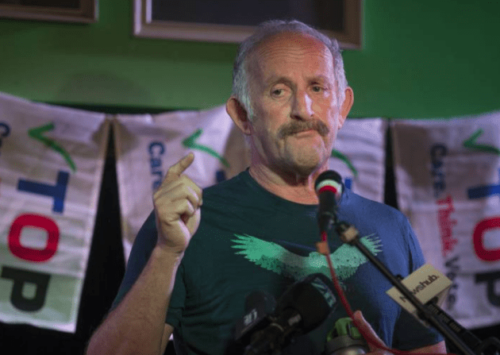
New Zealanders have had a collective experience this year – 97.6% of us have seen Gareth Morgan on television or social media and thought to themselves “There’s something fucking wrong with that guy.” Even by the mediocre, ignorant, bombastic standards of the puffed-up pissants who comprise New Zealand’s political class, Morgan stands out as a particularly vile specimen. This article takes a psychological perspective to examine what might be wrong with the man.
Having a go at someone on the occasion of the sudden death of a beloved pet, as Morgan did upon the death of Jacinda Ardern’s cat this week, is about as worthy of admiration as having a go at someone on the occasion of the death of a grandparent. It’s a really low thing to do, and a person wouldn’t normally think to do it unless something was missing from their brain. After all, many pet owners consider their animal friends a legitimate part of the family.
Imagine if Sam Morgan suddenly died and Jacinda Ardern had a go at Gareth on social media, taunting him on account of the damage Sam did to the environment with frequent international air travel. It would be the most appallingly unprimeministerial conduct ever witnessed in the history of the country. The whole nation would be united in agreement that someone who behaved like that was not fit to run a pub, let alone lead a country, on account of lacking basic compassion.
That this sort of conduct is not beneath Morgan won’t surprise the large numbers of people who have observed him speak and got a creepy vibe from the man, as if he was someone who you wouldn’t leave alone in a room with a pet or a small child.
Probably the reason for this is that Morgan, like most individuals who give other people the creeps, has a very low opinion of the importance of other people. As evidenced by his proposal to buy a section of Awaroa Beach, Morgan considers other people lesser beings, their opinions less worthy, their feelings less valuable.
This is not news to anyone who criticised Morgan’s refugee policy on one of his billions of sponsored FaceBook threads, and was verbally abused as a consequence.
It is cause to believe that Morgan has utterly failed at what a psychologist would call the development of a Theory of Mind – in other words, Morgan has absolutely no idea what’s going on in other people’s heads.
This hypothesis is supported by Morgan’s rude, crude, almost autistic dismissals of other people’s viewpoints. Like most narcissists, Morgan responds firstly with disbelief and rage when people disagree with him, and then when this cools becomes snarky and contemptuous. No effort at creating a common understanding with another person is made – you agree with the truth as divined by Saint Gareth or you are simply subhuman.
No amount of explaining could get it into Morgan’s head that most people are appalled by a tax plan that calls for taxing the family home. For the vast majority of people, their tenure of dwelling is their basic security in life: their castle and their home base. Of course, someone with hundreds of millions who can buy a house with pocket change cannot understand these sentiments, but the telling thing is that Morgan made no effort to – anyone who disagreed was simply a misinformed idiot.
Neither does he seem to have the faintest idea how much joy people get out of cats, and therefore the great anti-depressant effect that cats have on the people that spend time around them. He seems to have completely failed to understand that most cat owners see their cats as fellow beings of a similar order of importance to other people. This is pretty weird, all things considered, because there are very few people who are mentally defective on such issues of empathy.
Probably the main reason for this failure is that Morgan just doesn’t care. Judging by his behaviour on the campaign circuit, other people are, for him, just tools to be used in the achievement of a greater objective.
In other words, Morgan shares a failure to develop a theory of mind with all manner of criminals, psychopaths and dictators, who, like him, are missing the basic empathy that makes people truly human.