

The Real White Privilege Is Not Being White – It’s Being Around White People

If you live around white people, you’re generally in good hands

Some say that it’s a privilege to be intelligent, but genetic studies have shown that it’s actually of more benefit to be around intelligent people than to be intelligent oneself. In a social species such as homo sapiens, the real privilege is to reside in an environment that has intelligent people in it, thereby reaping most of the benefits of intelligence for none of the costs. This essay will argue that a similar scenario exists in the case of being white.

Being intelligent has clear benefits. It’s easier to see patterns that lead to dangers, it’s easier to remember dangerous things that happened in the past, it’s easier to come up with new and creative ideas. These abilities have a massive benefit to the survival prospects of those few who possessed them, creating immense selective pressure in favour of more intelligence.

However, being intelligent also has less obvious drawbacks. It’s much easier to get depression or anxiety if you’re hyperaware of all the dangers out there. It’s also much harder to get over trauma if you have a good memory, which the vast majority of intelligent people have. Many intelligent people are also more sensitive, which makes them more prone to psychological trauma.

So the real benefit to individual intelligence is gleaned by the friends and family of that individual more than by that individual themselves. This is the real privilege of intelligence, and it’s the same with being white. White privilege doesn’t come from being white. It comes from being around white people.

The wealthiest countries are wealthy not because they have high IQs or the right skin colour, but because they are not corrupt. Corruption – not intelligence or skin colour – correlates the most highly with national wealth because in a corrupt environment, intelligence and hard work are not rewarded.

The correlation between wealth and white people can be explained by that white people are less likely to be corrupt. This can be proven by noting that where white people are corrupt (i.e. Russia) they tend to be poor, and where non-white people are not corrupt (i.e. Japan and South Korea) they tend to be wealthy.

An understanding of reciprocal altruism reveals the brutal truth behind all these figures. The reason why white people have it good is because people trust them to reciprocate mutually beneficial acts of social benefit, and one of the results of a high level of mutual trust is wealth. The easiest way to understand all this is to think in terms of investments.

When a person has to decide quickly whether or not to trust a person they don’t know, they will make their judgment based on any recognisable cue. Skin colour (alongside skin health, clothing quality, posture, general grooming, tone of voice, display of status symbols) is one of those cues that tells you what’s likely to happen to your investment.

The point of weighing up these cues is to answer these questions: If you treat a person kindly, will they treat you kindly in exchange? Or will they use your kindness as an excuse to get into a position to exploit you? Because if having white skin correlates with a propensity towards reciprocal altruism, then living around white people is likely to make a person both wealthier and more trusting regardless of their own skin colour.

We could talk about Asian privilege in the same way – after all, it’s fundamentally a matter of investment. Some would argue that investing social capital in an Asian is unwise because it’s less likely to be reciprocated, but most would disagree. The fact is, history shows that when a large number of Asians move into an area the local standard of living either increases or stays the same.

Indeed, we can see that wealthy Asian countries such as Singapore, Hong Kong, Japan and Taiwan also rank among the least corrupt, while corrupt Asian countries like China are poor despite their high IQs. All of this is because acts of reciprocated kindness increase trust, which increases wealth. It’s a privilege to be trusted, true, but it’s also a privilege to live around trustworthy people – and it’s the trustworthiness that leads to being trusted, which leads to wealth, not the other way around.

Ultimately, the reason why white people are frequently favoured for certain roles and positions is because the people putting them there have good reason to expect that their largesse will be reciprocated. White privilege, then, can be boiled down to the fact that people have learned to trust individual white people more than individuals of other races on account of historically getting rewarded more for doing so.

This is certainly unfair to two groups of people: low-value whites who get a free ride on the erroneous assumption that they are high-value, and high-value non-whites who get offered worse deals on the erroneous assumption that they are low-value. The best way to combat this unfairness is not by shrieking about how racist and evil white people are, but firstly by rewarding other people’s trust and secondly by learning to make more sophisticated and accurate appraisals of other people’s trustworthiness.

*

If you enjoyed reading this essay, you can get a compilation of the Best VJMP Essays and Articles of 2017 from Amazon for Kindle or Amazon for CreateSpace (for international readers), or TradeMe (for Kiwis).

Why is it So Fashionable to Defend Islam?

It’s extremely fashionable right now, in some circles, to make a show of defending the virtues of Islam and of Muslims. Strangely, in those very same circles, it’s extremely unfashionable to defend the very same moral values supported and asserted by Islam and Muslims. This essay attempts to make sense of this curious contradiction.

Let’s be clear: Islam is an ideology of hate. Its holy scripture makes it very clear that Allah commands the subjugation of non-Muslims, women and homosexuals. There are numerous admonitions to violence in the Koran, and it is widely accepted – even by Muslims – that Mohammed, the Perfect Man, chopped the heads off 600 Jews on one particular day.

An extremely odd, but common, phenomenon nowadays is of people claiming to be enlightened humanists while defending Islamic ideology. In truth, defending Islam in the name of Enlightenment values is insanity. It doesn’t make any more sense than defending the same fundamentalist Abrahamism that the great thinkers of the Enlightenment valiantly struggled against for 300 years in its guise of Christianity.

This point can’t be overemphasised: the people defending Islam right now are attacking the same people who criticised fundamentalist Christianity for being supremacist, xenophobic, misogynistic and homophobic! In other words, the defenders of Islam are attacking the same people who won us our freedoms from fundamentalist Abrahamism. Freedoms that took hundreds – in some cases, thousands – of years to establish.

So what if the Muslims take over and install a new patriarchy ten times worse than the old one, the gutmenschen cry, like they did in Lebanon and a hundred other places? At least no-one called us racists!

The question has to be asked: why is it suddenly so fashionable to make a big show out of defending such a disgusting ideology, one which would see women stripped of the right to vote and homosexuals thrown from rooftops? This phenomenon can be explained in four major ways: some sensible, some not.

Much of the sentiment behind shrieking “Nazi!” at people who criticise Islam appears to come from a desire to avoid another genocide. The logic appears to be that the white working classes, twisted with the malice and hate natural to people of that station, are only one excuse away from stuffing millions of Muslims into gas chambers. All that’s needed to light a spark to this powderkeg is hate speech from some Islamophobic demogogue.

If anyone is allowed to criticise Islam openly, the reasoning goes, the working class will inevitably chimp out and everyone will get carried away until we’re beating out the brains of Muslim children in the street Lord of the Flies-style. Obviously it’s mostly just middle-class wankers who think like this, but there are a fair number who defend Islam on this reasoning.

Part of it is also pure submission. As this column has pointed out previously, terrorism works, and many cowards have calculated that it’s better not to criticise Islam in case doing so paints a target on the back. The hope of many Westerners is, as the old phrase has it, that “the crocodile will eat them last”. No need to go out like Theo van Gogh, after all.

A third reason is more narcissistic. Some people believe that by accusing someone else of unvirtuous conduct they draw positive attention to themselves, as if by making the accusation they must automatically be innocent of the same. It’s a narcissistic sentiment because it holds that by casting other people down into shame, the accuser brings glory upon themselves.

Leaving aside the obvious application of Haggard’s Law, this virtue signalling is the sign of a true dickhead. It can be observed every time that someone defends Islam by accusing its critic of making their criticism from a place of dumb hate or prejudice, as if Islam could not possibly be criticised on any other basis. It’s no less petty than ripping another person down for not being au fait with any other meaningless fashion.

The major explanation as for why people defend Islam, however, is simply our old favourite, human retardation. Many of these defenders have neither read the Koran nor studied Islamic history in any detail, and they simply aren’t aware of the amount of blood shed by people encouraged by these supposedly holy words. If they are aware, they blithely write it off as “no worse than Christianity”.

Some other retards have observed that most people who hate all other races also hate Muslims, and so, in the manner of retards, have reasoned themselves to the conclusion that anyone who dislikes Muslims must be a racist. Failing to realise that one can distinguish a racist from someone who doesn’t like Islam simply by asking a person their opinion of brown-skinned apostates, these retards tend to reflexively bleat about racism every time they hear a person express any misgiving whatsoever about the religion.

Unfortunately for lovers of peace and reason, it appears that defending Islam is currently fashionable for many reasons, which means it will continue to be defended for a long time yet, which means there will be many more terror attacks on Western soil before we wake up. Sit tight.

*

If you enjoyed reading this essay, you can get a compilation of the Best VJMP Essays and Articles of 2017 from Amazon for Kindle or Amazon for CreateSpace (for international readers), or TradeMe (for Kiwis).
Why Right-Libertarianism Is Full Of Autists

Many have had the experience of being surrounded by right-libertarians and realising that they have absolutely no clue about how other people think, and that this lack of insight inevitably dooms their political philosophy. It’s now apparent to many that the right-libertarian movement is chock full of autists. This essay will argue that right-libertarianism and autism overlap so heavily because they are both highly masculine mindstates with a shared evolutionary genesis.

Right-libertarians often like to paint a picture of how excellently everything would work if there was no welfare. In their minds, the welfare system only incentivises failure. If it was removed, they claim, people would work harder and pull themselves out of poverty rather than “relying on the Government”. Human suffering would decrease as a consequence.

What’s perfectly clear, to the 99% of the population who aren’t right-libertarians, is that this approach completely fails to account for the reality of human behaviour. Pulling the rug out from under tens of millions of struggling people at once would lead to chaos and violence in short order, and the thought that private security could manage enemy odds of hundreds to one is laughable.

Human suffering would increase sharply – and quickly – if we got rid of the welfare system, and a person doesn’t have to be a Dickens scholar to know this. We can simply observe the widespread misery in all times and places that don’t have one. Therefore, no-one will ever get rid of the welfare system, any more than they’ll ever get rid of the law against theft, and for similar reasons. Why don’t right-libertarians understand this?

One approach has it that the major difference between male and female psychology is that the masculine mind is systemising, while the feminine mind is empathising. The logic here is that men and women evolved to fit different niches in the biological environment: the male to the hunting niche, and the female to the gathering and nurturing niche.

Another theory has it that the major difference is that the male brain is autistic while the female brain is psychotic. This is apparent in several ways – chiefly the fact that boys are diagnosed with autism at many times the rate of girls, but also by genetic studies that show that autists tend to inherit from their fathers a disproportionately high number of genetic markers relating to brain development.

Yet another theory points out that men tend to vote for right-wing parties more than women do (a theory supported by the research of our very own Dan McGlashan), and from this draws the conclusion that men are naturally more conservative or orderly than women are.

What all these theories have in common is a realisation that men are not particularly empathetic. After all, the male brain has not evolved to be empathetic. For a hunter, empathy is not useful – in fact, it could even be detrimental if it caused the hunter to hesitate before landing a killing blow. All that really matters is the systemising ability to figure out how to get into position to land the killing blow. That is what is rewarded.

The male adaptation to a hunter’s niche is probably the underlying cause behind both high male rates of autism and of supporting right-libertarian parties. Essentially it’s a matter of a large swathe of people, predominantly men, lacking the brain capacity to imagine what it’s like to be another creature, and thereby coming to support a political movement that simply discounts such experience as a non-factor.

Females, for their part, tend to be neither hunters, autists nor right-libertarians. Their niche required more empathy, because it fell to them to do the bulk of the child-rearing and attending to the sick or old. It’s therefore not easy for women to ignore the suffering endured by other conscious beings. Women (like psychotics) tend to find it stressful when another conscious being is suffering; men (like autists) do not.

In order for a person to become a right-libertarian, they have to be usually masculine, in the sense that they have to have an unusually low amount of empathy for the countless millions who would suffer under their political system. Moreover, they have to keep supporting this system despite the overwhelming opposition from sensible people. These qualities are very similar to the tenacity and stubbornness that autists are infamous for, and probably because of a shared origin in masculine brain structures.

*

If you enjoyed reading this essay, you can get a compilation of the Best VJMP Essays and Articles of 2017 from Amazon for Kindle or Amazon for CreateSpace (for international readers), or TradeMe (for Kiwis).

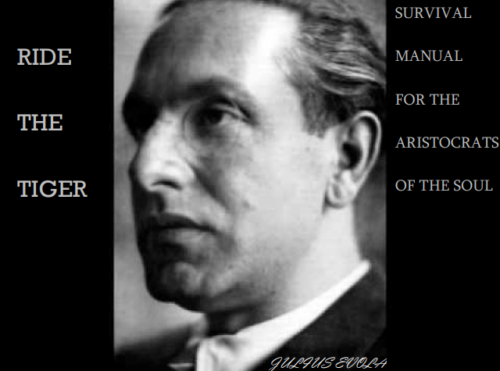
VJMP Reads: Julius Evola’s Ride the Tiger V

This reading continues on from here.

The 13th essay in Ride The Tiger is called ‘Sartre: Prisoner Without Walls’. This essay is very short – only three pages – and concerns itself with the attitude that one ought to take towards inherent freedom. Criticising Sartre’s conception of man as “condemned to be free”, Evola decries the idea that ultimate freedom is any kind of curse, describing this attitude as characteristic of the deep nihilism of the 20th century.

Sartre’s conception of life is, in Evola’s estimation, a fundamentally negative one in that one considers the human experience akin to being a prisoner without walls. For Evola, this maudlin attitude is not appropriate, for it brings with it suffering. Something more is needed.

The 14th essay is called ‘Existence, “Α Project Flung into the World”‘. Here Evola continues to outline his misgivings with existentialism, despite giving it credit for accurately describing the dilemma of the human condition. Existentialism also gets credit for moving beyond primitive solutions like religion and scientific materialism.

As mentioned previously, Evola’s main problem with existentialism is metaphysical. The varieties of existentialism that do not give a satisfactory answer to metaphysical questions are no better than nihilisms. For this reason, the maxim “existence precedes essence” must be rejected. A person is that which transcends the mere physical form; if not, existence is nothing more than morphing randomly into various shapes. Transcendence cannot and will not be found outside the self.

The idea of anxiety over lost choices, opportunities and paths is, for Evola, ridiculous – and materialistic. The transcendent principle ought to exclude such thoughts. The nature of things cannot usefully be said to be sinful in and of itself. Much better to adopt the ancient Greek view of cultivating appreciation of the beauty of limits and form.

The 15th essay is called ‘Heidegger: “Retreating Forwards” and “Being-for-Death” – Collapse οf Existentialism’. The problem with Heidegger, Evola contends, is that his philosophy is motivated principally by a fear of death, in particular the death of the false self, or I. It’s better to disavow identification with the I, and to choose instead to identify with the transcendent, than to march to the drumbeat of death.

Here Evola continues with his criticisms of existentialist philosophy, accusing it of promoting a bleak, sombre and submissive attitude towards the world, one of resignation. Jaspers offers no other solution but faith. In fact, none of the existentialists have offered a satisfactory solution to the problems of nihilism as outlined by Nietzsche. “Existentialism is a projection of modern man in crisis”.

Neither is faith satisfactory, for that is essentially no different from the “Catholic existentialism” that has already been rejected on account of positing the transcendent outside oneself. It must be accepted that God is dead. Transcendence ought not be conceived of as the ‘other’; rather one should begin from the point of transcendence and consider the world from that perspective.

In any case, all of these men, religious and existentialist alike, are written off as petit bourgeoisie, writing about petit bourgeoisie concerns. The real philosophy comes from the men who have survived the “storms of steel and fire” of the early 20th century: those who have been tested. These are the men who understand the true nature of things; they understand “being able to be destroyed, even, without thereby being wounded”.

*

If you enjoyed reading this essay, you can get a compilation of the Best VJMP Essays and Articles of 2017 from Amazon for Kindle or Amazon for CreateSpace (for international readers), or TradeMe (for Kiwis).