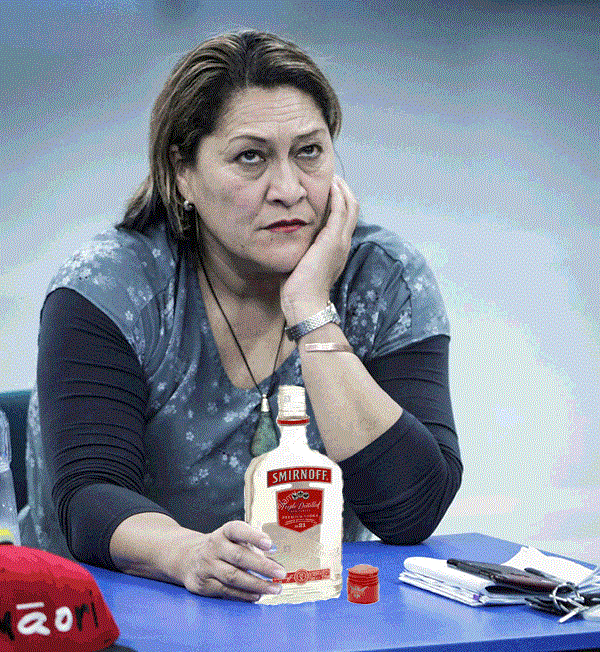
Government Action on Housing Crisis Missing-In-Action

by MARTIN GRONBACH

I stare wide eyed at my phone and let loose a snort of equal parts disgust and derision.

The listing on TradeMe for my neighbour’s house has revealed their asking price.

$540,000.

This probably won’t be terribly offensive to those of you battling to buy your own home considering the average house price in New Zealand reached an eye watering $645,250 as of last year, but let me put my outrage in context.

This is the asking price for a reasonable 3-bedroom house in Carterton, Wairarapa.

Over half a million for a house in Cartervegas, with me as a neighbour? Get the fuck outta here.

If this what politicians put forward as the “affordable provinces” then any young person aspiring to one day own their own home is pretty damn screwed. Trust fund babies need not consider themselves applicable.

Last year I decided to ask the three local councils as to what actions they were taking to address the housing crisis and housing affordability.

The responses ranged from “We can’t do anything”, “It’s not our problem to solve”, “Define affordable” to “We are waiting on direction and leadership on the issue from central government”.

Local governments are not interested in taking a leading role in solving the housing crisis. Maybe this is due to the nearly non-existent representation of young people in local body politics, but that’s a topic for another time.

If not local government, surely our transformative coalition government could surely be trusted to be kicking arse for the long-suffering Kiwi first home buyer?

Brace yourself for crushing disappointment as the salvation of Generation Rent won’t be found with this current government – at least not this term.

Kiwibuild has been flogged by Labour as the band-aid to fix the housing crisis booboo as far back as 2012. However once in a position to actually implement the policy in 2017, it was quickly revealed just how little thought had gone into it.

The reality was that Labour’s fix for the housing crisis was over-hyped and under-cooked, inaccessible for anyone earning the average wage, that had school age children, or any number of the realities New Zealanders face. With the additional restrictions on selling the property within three years, designed to stop property speculation, people considering Kiwibuild are better off not using the scheme if possible, as buying on the open market doesn’t have any such restrictions and, in the end, any difference in the final price paid was negligible.

It’s a sad state of affairs that even with the supposed singleness of purpose and financial backing of the tax payer, Kiwibuild has completely failed to deliver for the majority of people that voted for it.

With numerous New Zealand based kit-set home manufacturers, even houses built by robots in Wellington, building houses isn’t the bottleneck. Land supply, and the price of ticking the boxes before building, however, is.

Reforming the Resource Management Act to allow for faster development of land should be one of the more obvious issues to deal with if the Government was actually serious about tackling the housing crisis. Likewise, opening up the building materials market to some international competition by way of reforming the New Zealand Building Code could potentially topple the monopoly enjoyed by a select few manufacturers price gouging the currently captive New Zealand market and further decrease building costs.

Another touted solution in the build up to the election was the so-called foreign ownership ban. Put forward by both Labour and New Zealand First, this would stop overseas investment in our domestic housing market. However, this did not mean ALL foreign ownership as Australians, who make up a third of all foreign owners of New Zealand property alone, as well as Singaporean nationals in the pursuit of a YET ANOTHER free-trade agreement, are still able to buy New Zealand property.

Again, this was found to be a relative non-issue as measly three percent of all property sold was to foreign buyers and that three percent was mostly made up of large-scale farms and stations, life-style blocks and shares in new-build apartment blocks. While I don’t agree with any foreign ownership of New Zealand land, in the context of the housing crisis, this is, and continues to be, an outlying issue, if not entirely separate from the housing crisis.

Generation Rent isn’t, and never was, in the market for a thousand acres of pristine South Island sheep country, so the foreign ownership ban had little real impact in this regard.

The main influencers of the housing crisis are two issues. The first was, and continues to be, New Zealand’s high levels of immigration. That contentious issue both Labour AND New Zealand First made a huge deal about during the opposition years and during the 2017 election, which our coalition government now seems reluctant to firmly act on, apart from putting the boot into low hanging fruit like the dodgy export education industry.

Ironically the fallout following the banning of Huawei from supplying equipment for the upcoming 5G rollout, the responsive drop in tourists and wealthy international students from China may end up having more of a tangible impact on addressing housing affordability that anything the Government has intentionally done to date.

The second genuine influencer is the rife accumulation, hoarding and speculation of housing by fellow, and now extremely wealthy, New Zealanders. The final word on cause of the housing crisis is that it is a mess of our own making. Kiwis ripping off Kiwis. Ever heard of a cap or outright ban on the number of investment properties? Me neither, and so long as we keep voting for the same four political parties, you never will.

With Generation Rent’s patience starting to wear thin and half their term over already, the coalition government can’t afford to continue to wear the kiddie gloves for fear of threatening the entitlement culture of wealthy New Zealand nor the construction sector lobbyists whilst avoiding the real causes of our housing crisis. 2019 will either make or break this government and younger people’s trust in it.

At the end of the day I don’t want or need 20 rental properties. No reasonable New Zealander does.

I just want the safety and security of providing a home for my wife and children that won’t be put up for sale as soon as the market conditions are favourable.

But not for over half a million in bloody Carterton, thanks.

*

Martin Gronbach is an unashamed nationalist, self-aware 30-year-old boomer, active political shitposter, father, husband, engineering student and full member of Generation Rent who lives in the Wairarapa.

Electoral Consequences of the Rise of a New Blue-Green Party in New Zealand

Much recent attention has been given to the possibility that a new blue-green party might arise to contest the 2020 General Election. A man named Vernon Tava has been interviewed outlining his vision for the putative movement, which is said to have some support. In this article, demographer Dan McGlashan, author of Understanding New Zealand, explains the electoral ramifications.

First, we need to determine who might vote for such a blue-green party. Secondly, we will speculate on what might happen if a large number of people do.

Crudely speaking, and this is very crude, we can say that New Zealand divides into four groups: the urban poor, who vote Labour, the urban rich, who vote Green, the rural poor, who vote New Zealand First, and the rural rich, who vote National.

The borderline between the Green and the National parties, therefore, is between the city and the country, and the unifying feature of these two parties is that their constituents are wealthy. So any new blue-green party would primarily target people who were doing better than average, regardless of whether they lived in the city or the country. But to distinguish them from the conservatives, they would need either an environmental or a social justice aspect from the green side.

Green and National voters are also characterised by being better educated than average (indeed, this is the basis of their greater wealth). So a green-blue party might target students, especially those who study at suburban universities. What unifies them, in particular, is that they tend to have globalist sympathies, and they tend to oppose the nationalist sentiments that they observe in Labour and New Zealand First.

This column has previously discussed the fact that the National and Green parties could ally on the basis of both being strong supporters of globalism. A new blue-green party might combine the green commitment to environmental causes with the desire to liberalise free trade and the movement of cheap labour (ignore the contradictions in that for a moment). They would then effectively be a neoliberal party.

The most obvious point is that such a party would compete directly with The Opportunities Party. As I showed shortly after the previous election in 2017, the bulk of TOP voters were disaffected Green voters. They were mostly young and well-educated, of either gender and any ethnicity, and were the ones most easily reached by the heavy investment made by TOP in FaceBook advertising. They have also had the most anti-nationalist conditioning.

Green Party voters would also be tempted towards a new party. The reason for this is many Green voters are well-educated, and so they often find themselves becoming wealthy by the end of their 30s, which means that they start to have an interest in protecting that wealth, and thereby paying less taxes. This pulls them towards the National Party, but they tend to be repelled by National’s indifferent attitude to human suffering.

National voters, for their part, will be hard to tempt to any blue-green party. For one thing, National voters are particularly loyal: the correlation between voting National in 2014 and voting National in 2017 was 0.99, an exceptionally strong correlation and higher than the equivalent figure for any other party. The other reason will be the electoral ramifications, as discussed below.

Second, the other major area of interest is the electoral ramifications of such a party if it would form and seriously contest the 2020 General Election.

One obvious point here is that the rise of a blue-green party would make things exceptionally difficult for The Opportunities Party. Although TOP does not describe itself as a blue-green party, they are competing for almost exactly the same demographic as any such new endeavour would also be competing for. Getting 5% of the electorate vote is hard enough as it is, and having two fledgling parties contesting that vote will make things extremely hard for both.

The obvious major point here relates to the overlap with Green Party voters. The Green Party only just made it over the threshold at the 2017 General Election, winning a mere 6.27% of the total votes. This means that they would only have to lose 30,000 or so votes in 2020 to a new blue-green party to run the risk of falling under the 5% threshold and so dropping out of Parliament entirely.

Ironically, game theory suggests that this is one of the most plausible ways for National to win the election. If a blue-green party did win enough of the Green Party vote that both parties failed to make the 5% threshold, the left bloc would lose all those Green party votes as well as some of the blue-green party ones, whereas the right bloc would only lose some of the blue-green party ones. This would leave National and ACT against Labour, competing for New Zealand First support.

Of course, these options are moot if the proposed party does win 5% of the electorate vote. As explained above, this would almost certainly lead to the obliteration of both the Greens and TOP, who are chasing similar voters. Assuming New Zealand First also won 5%, then there could be another head-to-head fight between Labour and National for the loyalty of the centrist parties, who would then in all probability hold the balance of power.

Because getting 5% of the vote is so difficult, and because the competition for the blue-green niche already so fierce, the future chances of Vernon Tava’s movement look extremely slim. They might have a greater impact as a spoiler that helps to wipe out the Green and Opportunities Parties, for the sake of ensuring that National holds the balance of power after 2020.

*

Understanding New Zealand, by Dan McGlashan and published by VJM Publishing, is the comprehensive guide to the demographics and voting patterns of the New Zealand people. It is available on TradeMe (for Kiwis) and on Amazon (for international readers).

The Case For Cannabis: The Market Needs to Be Regulated

One of the strongest arguments for cannabis law reform is the appeal to regulate the market. The idea that a government can make cannabis illegal and then it just “goes away” is childish, and the historical example has borne this out. As this article will examine, legal cannabis is the only realistic way to regulate the market.

Many people envision that the world before cannabis prohibition was one of chaos. Shady dealers set up outside high schools to sell to pupils, pharmacists pushed untested and unresearched cannabis products on a naive public and criminal enterprises got fat with the income from cannabis bootlegging. The reality is closer to the reverse of this.

When a substance such as cannabis becomes illegal by act of law, what that means in practice is that the manufacture and supply of that good becomes completely unregulated. Making something illegal is not a way of regulating it – it’s a way of putting it into the “too hard” basket. It shifts control from the regulators to the black market.

The black market doesn’t attract nice people. It generally attracts people with no better options – desperados. Because there is currently no opportunity to legally profit from cannabis in New Zealand, the only people who deal with the subject matter are black marketeers. There is no guarantee that such individuals will adhere to what has been established overseas as professional industry standards for manufacture and supply of cannabis products.

Regarding the manufacture of goods on the black market, it’s apparent that there are little in the way of health and safety considerations. This is a relatively minor concern in the case of cannabis, but it’s still possible that any bud manufactured by a criminal enterprise has used unwanted chemicals in the growing process. They might have used chemical fertilisers that leave side-products that people don’t want in their bodies, or treated the bud with something to make it appear danker.

When it comes to supply, the situation is even worse. A normal business primarily competes with others through advertising, whether word-of-mouth or commercial. They don’t compete through intimidation. The manager of the local Countdown would never send an underling to take out Fresh Choice workers for selling on the wrong turf. Black marketeers selling illicit drugs happily take their competitors out such ways though.

The vast majority of the criminal activity associated with cannabis comes about because of prohibition. It’s isn’t natural to cannabis. With no regulatory oversight, there’s nothing stopping the black market selling to 13-year olds or wiping their competitors out in turf wars. Cannabis is already illegal, so it’s not like the victims could go to the Police. Black market actors have free rein until they are arrested.

Practically speaking, there is going to be a cannabis market whether we like it or not, so we might as well make sure that it’s on the level.

Regulation would solve the problem of tainted product, because growers will need to be able to account for their grow methodology and process. End consumers will be prevented from becoming ill because the possibility of dangerous chemicals being used at some point in the process will be minimised. If anyone does become sick, responsibility can be placed on the correct party and appropriate measures taken.

Moreover, a regulated cannabis supplier or dealer is much more likely to comply with public requests for decency than the black market is. Regulation will inevitably mean that cannabis dealers will need to become licensed, which means that they are strongly incentivised to adhere to laws regarding not supplying to minors, not supplying to intoxicated people etc. They also can’t shoot their competitors and expect that this will lead to a greater market share.

A final benefit is that regulation will mean that cannabis suppliers cannot deal with other products as well. As mentioned elsewhere, the gateway drug effect can only occur when people seeking cannabis are exposed to hard drugs. A professional cannabis retailer will not have an incentive to offer their customers methamphetamine, unlike a gang member. In practice, they are unlikely to even be allowed to sell alcohol or tobacco.

All this means that regulation will have the effect of almost taking cannabis away from the black market entirely. Those who are allowed to compete on the legal market for cannabis will have to meet quality standards that ensure that safety of the users (to such a degree that this is possible when people take psychoactive drugs). This will have the overall effect of reducing harm.

Cannabis should be legal because regulation of cannabis causes less suffering than criminalising it. We need to abandon the childish idea that making something illegal makes it go away, and employ a sophisticated and intelligent approach to dealing with the issues caused by cannabis. The only realistic way to do this is through regulation.

*

This article is an excerpt from The Case For Cannabis Law Reform, compiled by Vince McLeod and due for release by VJM Publishing in the summer of 2018/19.