

Writing Bulimia Nervosa

Bulimia nervosa (usually known as bulimia) is a psychiatric condition characterised by intense bouts of over-eating, followed by a “purge” of some kind. The condition is about nine times more common in women than in men, and is believed to affect 1% of young women at any given time. This article looks at how to write engaging and believable characters with bulimia.

The classic example of bulimic behaviour is to consume an abnormally large amount of food, and then go to the toilet to vomit it all up. It’s worth noting that simply throwing up a lot, even after eating, is not sufficient for a bulimia diagnosis. The throwing up is not the main factor, as the condition is psychological and not physical.

It’s also worth noting that bulimia is very different to anorexia, despite that both conditions are eating disorders caused by a nervous complaint. Bulimics and anorexics share many symptoms, in particular the obsession with food and body image, but there are major differences. Bulimics are often at or near a healthy weight (despite the unhealthiness of much of their activity), and anorexics do not binge eat as a general rule.

If the protagonist of your story encounters another character with bulimia, it might be a matter of slowly coming to the realisation. The character with bulimia might show signs of having thrown up a lot or recently, such as bloodshot, puffy eyes or burst blood vessels in the face. Other physical tell-tale signs are low energy and evidence of self-harm.

Another character might give away signs that they are falling into a pattern of bulimia. An obsession with dietary rules is a common early sign. A character developing bulimia might also develop a set of strict dietary rules that they expect themselves to abide by. These rules might seem obsessional to a second character, but the bulimic character is unlikely to appreciate this sentiment.

These rules are key to understanding the condition. Because consuming fewer calories than one needs to survive is not sustainable in the long-term, the strict dietary rules will inevitably be broken. This doesn’t come with a sense of relief but a sense of horror and shame – feelings so intense that they have to be purged. In this state, vomiting often brings the desired relief.

If the protagonist of your story has bulimia, they are likely to live a very difficult life with a considerable amount of confusion. Thoughts of suicide are common, a symptom of both the condition itself and the difficult life circumstances caused by the condition. Also common are depressive and obsessive-compulsive thoughts, especially self-recrimination and rituals relating to food.

A protagonist with bulimia will probably experience a great deal of anxiety in their everyday life. This is not just because of the condition itself, with the neverending worry and guilt relating to food and body shape. It is also because of the social anxiety that comes with trying to keep their condition a secret. Your protagonist might find themselves telling lies to keep other characters from realising they are bulimic.

A character who develops bulimia may do so on account of exposure to media images that create an idea about what a human body ought to look like. It’s common for teenage girls – especially those who have never previously thought about their bodies as things that sexually attract men – to develop an obsession with what their bodies ought to look like. Bodily self-hate is an inevitable consequence of this for some people.

Some societies that have not yet been exposed to sophisticated and manipulative Western advertising culture find it a shock when they finally are. Many people have been unaware of the possibility of hating their own body on account of it being the “wrong shape”. Some cultures are naive when it comes to lies and lying, and are more easily affected by them. These cultures can see sudden spikes of bulimia rates when this advertising does come.

Like many other psychiatric conditions, bulimia carries an increased risk of depression, anxiety and self-harm. Thoughts like this form an unpleasant positive feedback loop, where the low self-regard puts a person at risk for bulimia and the bulimia causes low self-regard. A character with the condition may not realise that their thoughts are circular. On the other hand, they might be all too aware, and start losing sanity.

Also like other psychiatric conditions, there is a body of literature that suggests a strong correlation between having bulimia and early childhood abuse, in this case sexual. It’s possible that the trauma of sexual abuse leads to some difficulty in handling thoughts and feelings related to one’s own sexual attractiveness.

Bulimia is, along with anorexia and schizophrenia, one of the psychiatric conditions most likely to end in suicide. It is easily possible that such a fate will await a bulimic character in your story – after all, the average woman can no easier look like a photomodel than the average man can look like Schwarzenegger. However, like most mental illnesses, the majority of people with bulimia find some way to accommodate it in their lives.

*

This article is an excerpt from Writing With The DSM-V (Writing With Psychology Book 5), edited by Vince McLeod and due for release by VJM Publishing in the summer of 2018/19.

Writing Bipolar Disorder

Bipolar Disorder is an extremely taxing mental disorder that is believed to affect about 1% of the population at any given time. Most commonly affecting people in their mid to late 20s, the condition affects men and women in roughly equal numbers. This article looks at how to write believable and realistic characters with Bipolar Disorder.

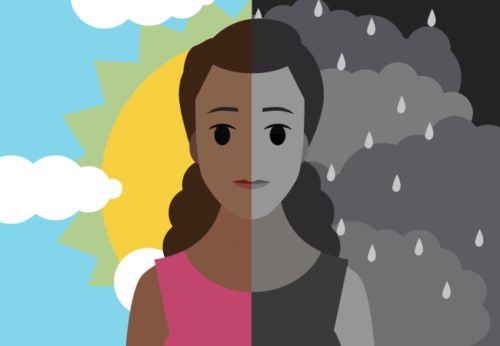
As the name suggests, bipolar disorder refers to two distinct poles, one corresponding to ‘up’, the other ‘down’. These relate to mood and behaviour; Bipolar Disorder was once known as “manic depression”. The stereotypical course of Bipolar Disorder is for someone to feel extremely low and depressed, and then suddenly feel high-energy and manic, only to fall back into depression, in a cycle that never ends (important to note here that the cycle is not predictable, like a pendulum, but chaotic).

Although the idea of mania can sound appealing to those with no experience of the condition, and although it is generally much less unpleasant than depression, Bipolar Disorder causes problems at either pole. It contrasts with healthy, natural changes in mood in the sense that people with the condition are seldom in an average, moderate state inbetween the two poles, as mentally healthy people are.

When a person in this condition is in a depressed phase, they are at risk for all of the suicidal behaviours that accompany Major Depressive Disorder. Self-harm is common among people with Bipolar Disorder, a function of the deep self-hatred that occurs in depressive phases. However, when a person is in a manic phase, they are also at risk of harming themselves.

Manic periods have to last for at least a week to really count, as an elevated mood could occur for any number of reasons. The manic phase of Bipolar Disorder can, at its most extreme, present much like a methamphetamine bender. A character undergoing one will tend to talk fast, sometimes stammering, and will have difficulty following a conversation, being easily distracted. Also like a methamphetamine bender, manic episodes tend to result in very little sleep. At worst, they can cause a person to become psychotic.

The combination of these factors can result in some extremely risky behaviour, which could be dynamite for your creative fiction. Hypersexuality, gambling, drug-taking and speeding in motor vehicles are all common behaviours for a person with Bipolar Disorder while they are in their manic phase. Someone behaving like this might seem like they’ve been given a week to live and want to make the most of it.

A character with Bipolar Disorder might not be easy for other characters to deal with. The erratic moods of bipolar sufferers means that other characters seldom feel comfortable around them. People with bipolar can be unpredictable. They are also very high suicide risks, because of the combination of impulsiveness arising from the mania and the self-hatred arising from the depression.

Sometimes a character with Bipolar Disorder will come across as full of energy and life and enthusiasm, making them seem very charismatic to another character. Other times they were be low in energy and miserable, which makes them seem very different. Someone who meets a Bipolar character while they are at one pole, and then meets them again while they are at the other, might have difficulty believing they’re the same person.

If the protagonist of your story has Bipolar Disorder, they might find themselves facing a considerable degree of social stigma. As mentioned above, their condition might make other characters feel uncomfortable. The protagonist might find themselves getting overlooked for parties and for social occasions on account of that other characters are afraid they will be in too crazy of a mood.

If the protagonist encounters another character with Bipolar Disorder, things might not be much easier. It’s common to meet a person with Bipolar Disorder during one of their manic phases, because this tends to cause them to become more extraverted. During this time, they might strike others as dynamic, engaging and enthusiastic. However, if a friendship is formed, it may not survive the depressive phase.

There are two kinds of Bipolar Disorder, known as Bipolar I and Bipolar II. The essential difference lies in the severity of the manic symptoms. The more powerful the manic symptoms, the more likely the sufferer will get a diagnosis of Bipolar I. This is not to downplay the difficulty of living with Bipolar II, but some of the hypomanic episodes in the latter case can actually be useful for getting things done.

Bipolar Disorder is distinct from Borderline Personality Disorder, although the behaviour of people with the condition can appear similar. For instance, people with either condition are capable of changing their attitude towards another person very quickly, but the Bipolar sufferer tends to have more self-awareness than the Borderline and maybe aware that their change in perception is not fully rational.

*

This article is an excerpt from Writing With The DSM-V (Writing With Psychology Book 5), edited by Vince McLeod and due for release by VJM Publishing in the summer of 2018/19.

Writing Panic Disorder

Panic Disorder (PD) is a kind of anxiety disorder that is characterised by reoccurring, sudden attacks of intense fear without any obvious cause. These attacks, called panic attacks, involve a number of unpleasant psychological and physical sensations, including shortness of breath, dizziness, heart palpitations and sweaty hands. This article looks at how to believably portray Panic Disorder in your creative fiction.

A panic attack usually lasts for about ten minutes. The first sign is usually a wave of adrenaline and noradrenaline that surges through the bloodstream in preparation for the fight or flight response. It’s common for sufferers to feel a panic attack even in their bowels. Despite the absence of an obvious threat, the panic can be equally as intense as if one was confronted with a terrorist mass shooter.

One unpleasant feature of these attacks is that they can stir many different kinds of fears. Some panic attacks make the victim afraid of dying, whereas others make them afraid that they will lose control and become a screaming mess (even though this is extremely rare). In some ways the experience is like a tour de force of terror.

Perhaps the most difficult thing about this condition is that panic attacks are so unpleasant that they can be traumatising, and this creates fear of future panic attacks, which is often enough to itself cause a panic attack. So a person with the condition can end up learning to fear situations which may cause panic, and this can lead to social isolation in a similar fashion to agoraphobia.

If the protagonist of your story has panic disorder, it is likely that they have to live a life somewhat on the outside. Panic Disorder makes it difficult to socialise, especially when a person starts to become afraid of future panic attacks. This can lead to an everyday experience of constant misery, as the protagonist starts to twist themselves up in knots of over-thinking and anxiety.

An interesting story can be told about a normal life that starts to break down because of Panic Disorder. It’s common for a sufferer of the condition, at least in the initial stages, to be unaware that they are suffering from a recognised psychiatric condition. The panic attacks can be embarrassing, on account of that they have no obvious cause, and it’s easy for a person who suffers them to consider themselves mentally weak rather than sick. They can seem to come out of the blue.

People with Panic Disorder tend to develop a fear of the places in which they have had panic attacks, by way of association. This is one of things that makes the condition so disruptive. Even something as simple as going shopping can become an ordeal if a person is afraid that the experience will trigger a panic attack. Because much of the suffering of the condition is caused by fear of the next attack, certain places can themselves become intimidating.

If a character in your story encounters another character with Panic Disorder, how the first character reacts will tell the reader a great deal about their level of compassion. Because panic attacks can be set off without any obvious cause, the suffering is in the mind. This means that people who need help and reassurance from others can usually only get it from especially empathetic people. A character who helps out another one suffering a panic attack might demonstrate their nature to the reader.

A character with Panic Disorder might have a very complicated relationship with drugs. Many people with the condition have found that alcohol, cannabis, tobacco etc. has a short-term, immediate effect of quelling the panic, but have also found that using these substances makes a panic attack more likely once they have worn off. A character taking drugs to treat their anxiety might not have figured the second point out yet.

In contrast with Generalised Anxiety Disorder (GAD), Panic Disorder tends to come in sharp spikes or groups of attacks. GAD is an ever-present background hum of anxiety, whereas people with Panic Disorder can often live entirely normal lives until the panic kicks in. When people with Panic Disorder are anxious, it is usually because of a particular fear of another panic attack rather than anything general.

Mass Panic Disorder is not a condition in the DSM, but the author might still like to use the phenomenon in their creative fiction. A contagious panic attack might be the event that leads to mass destruction of part of your story world, leading to the disruption of the life of one of your characters. An explosion might cause a mob reaction that a character gets caught up in.

Writing Borderline Personality Disorder

Borderline Personality Disorder (BPD) is a condition characterised by extreme emotional instability and sensitivity to criticism. This means that characters with the condition are naturally well suited to dramatic fiction. This article looks at how to write interesting and believable characters with Borderline Personality Disorder.

Originally named because it was the label given to those on the border between diagnoses (in particular psychosis and neurosis), BPD has taken on a somewhat different meaning in recent editions of the DSM. Indeed, some believe the name is no longer accurate, and the condition ought to be renamed as something like “Emotional Disregulation Disorder”.

People with BPD tend to have extremely strong reactions to criticism. This is believed to stem ultimately from a weak sense of self, which makes them prone to being heavily impacted by what other people say about them. It’s as if they don’t have the same defences that most people have when it comes to accepting criticism and resisting bullying.

They also tend to have problems when it comes to interpersonal empathy. A character with BPD might seem a bit narcissistic or psychopathic to other characters because of their apparent refusal to take other people’s feelings into account when making decisions. Alternatively, they might perceive someone to be angry at them when they really are not.

If the protagonist of your story has BPD, it might be that they experience even mild criticism as brutal, sharp and denigrating. This could make them seem extremely sensitive, or even narcissistic, to other characters. The difference between BPD and narcissism in this sense is that a person with BPD can be reassured that the criticism was not intended to be wounding, whereas a narcissist would likely bear a grudge.

People with BPD also tend to have a very strong fear of abandonment. It is uncommon for them to feel secure in romantic relationships. A protagonist with this condition will probably experience a lot of thoughts of jealousy and suspicion going through their minds. They will frequently perceive their partner as flirting with others when they really aren’t.

A protagonist that gets involved in a romantic relationship with another character who has BPD is probably in for a rocky time. People with BPD tend to treat their lovers like a demigod one minute and dogshit the next. This is often very difficult for those lovers, who then don’t really know where they stand. The line between this kind of behaviour and narcissistic abuse is not obvious.

On the other hand, a character with BPD might be more than memorable in bed. The combination of emotional intensity, need for reassurance, and lack of inhibition can make for an incredible sexual experience – perhaps even enough to make up for all the insanity otherwise endured. A psychologist can tell you that this kind of treatment is liable to become addictive, which makes for a tumultuous time.

Realistically, an experience with BPD is more likely to be deeply unpleasant than it is to result in legendary erotic achievements. Self harm is common among people with the condition, and could be considered characteristic of it. If the protagonist of your story encounters someone with scars on their forearms, this could foreshadow some intensely emotional scenes.

If your protagonist encounters a character with BPD, they might realise something is amiss on account of that that character has dysfunctional life goals. The borderline character might seem to drift from one meaningless activity to another, with little awareness paid to the fact that they’re getting older and that time is passing them by. This might manifest as a nihilistic streak.

A character with BPD might be disliked by other characters, sometimes intensely, if they don’t have sympathy for the condition. Because people with it tend to be deeply wounded by criticism, they can develop a tendency to lash out hard at minor insults. This can make them antagonistic and grudge-keeping. Other characters might get the perception that they have to walk on eggshells around the borderline or else run the risk of being attacked.

BPD is around three times more common in women than it is in men (this is likely one of the main reasons why women are often seen as less emotionally stable than men). This can add to the difficulty of having the condition. If you’re writing a female character with BPD, that character might discover that other people don’t take their condition seriously, because their prejudice leads them to put it down to being a woman etc.

In the eyes of a protagonist who is encountering a character with BPD, the borderline character might just seem like a loose cannon, akin to certain other conditions like Schizophrenia and Histrionic Personality Disorder. Much as with those conditions, the risk of self-harm and suicide is often present with BPD. This is partially a result of the disinhibition that comes with the disorder but it is also the result of the fact that people with BPD tend to have difficult lives.

All in all, a character with Borderline Personality Disorder is a good choice if your dramatic fiction needs some more drama. Things are unlikely to remain stable for long with such a character around. However, care will have to be taken to portray such a character with compassion, and not make them seem like an arsehole.

*

This article is an excerpt from Writing With The DSM-V (Writing With Psychology Book 5), edited by Vince McLeod and due for release by VJM Publishing in the summer of 2018/19.