
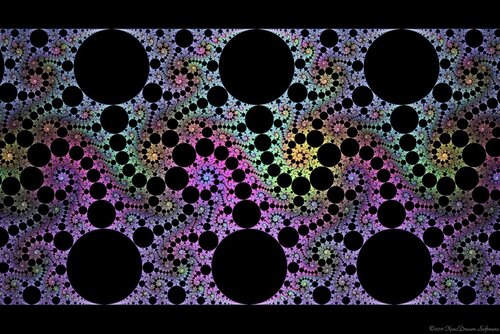
An Introduction To Great Fractal Theory (redux)

1. Great Fractal Theory starts with the First Tenet: the simple premise that consciousness is the prima materia.

2. As per the Second Tenet, everything that exists except for consciousness itself is part of the contents of consciousness, which are collectively known as the Great Fractal on account of that all possible contents of consciousness are fractal variations of each other.

3. Within the contents of consciousness are both the physical and metaphysical worlds.

4. The physical world is not truly real, although it may appear so to our fragments of consciousness.

5. The physical world has been dreamed up by consciousness, in the Great Act of Creation, and remains a dream.

6. Consciousness is therefore the creator of the physical world, in the same way that it creates the worlds we navigate in our nightly dreams.

7. Consciousness is the stage upon which the play of life takes place.

8. The physical world is most accurately understood as not being a place, but rather a matrix of self-similar fields of impressions that manifest in consciousness.

9. Each fragment of consciousness perceives a field of impressions that collectively creates the illusion that we are bodies living in a physical world, as opposed to the truth: that we are consciousness dreaming it up.

10. The essence of Great Fractal Theory is that all of the possible fields of impressions that consciousness could ever perceive are related to each other by way of a fractal matrix.

11. This matrix, known as the Great Fractal, contains every emotion, every thought, every desire and every sensory impression that could ever possibly manifest in conscious awareness.

12. The stories of our lives are not ones of rising up out of the dirt to become monkeys running loose on a rock in space, but rather stories of being fragments of consciousness navigating through an eternal and ever-changing Great Fractal of self-similar fields of sensory and mental impressions.

13. Consciousness is, right now, experiencing not only your current life but also all the possible gaps in between your birth and your death.

14. Your own personal fragment of consciousness may be living right now, in this current year, but other fragments of consciousness are living out every possible moment of your life, simultaneously.

15. If your life was divided into a billion chunks, each corresponding to a second or two of awareness, there is one fragment of consciousness for each of those billion chunks, each living its own life, usually unaware of the presence of the others.

16. Each of these billion fragments could themselves be divided into a billion fragments: a quintillion lives, each separated by one or two nanoseconds, rolling inexorably from birth to death like freight carriages on a railway.

17. One ends and one begins every few nanoseconds, and follows the exact path of the life that you are experiencing right now, past and future.

18. This is eternal recurrence: your current physical life will be lived over and over again, by another fragment of consciousness (sometimes even your own), forever, because it is an eternal part of the Great Fractal.

19. Every possible way that a human life can differ from another is another dimension of the Great Fractal.

20. There’s no reason, other than anthropomorphic conceit, to believe that only human beings are conscious.

21. Once it’s realised that consciousness is the prima materia and not a phenomenon of the brain, it becomes easy to understand that all other beings, indeed even insects and trees, are conscious like we are.

22. Therefore, every possible way that the life of any being can differ from the life of any other being is another dimension of the Great Fractal.

23. The number of dimensions in the Great Fractal is virtually infinite, and there are countless quintillions of beings for every dimension.

24. The entire Great Fractal is buzzing with consciousness.

25. Anything that can possibly be perceived by consciousness lies somewhere in the Great Fractal.

26. All moments of all lives of all possible beings in all possible worlds in all possible dimensions are contained within the Great Fractal, to be experienced by consciousness eternally.

27. Your current life is simply an infinitely small fragment of this incomprehensibly vast whole.

*

This chapter is an excerpt from Elemental Elementalism, the foundational scripture of the new religion of the Age of Aquarius.

*

If you enjoyed reading this essay/article, you can get a compilation of the Best VJMP Essays and Articles of 2020 from Amazon for Kindle or Amazon for CreateSpace (for international readers), or TradeMe (for Kiwis). A compilation of the Best VJMP Essays and Articles of 2019, the Best VJMP Essays and Articles of 2018 and the Best VJMP Essays and Articles of 2017 are also available.

*

If you would like to support our work in other ways, subscribe to our SubscribeStar fund. Even better, buy any one of our books!
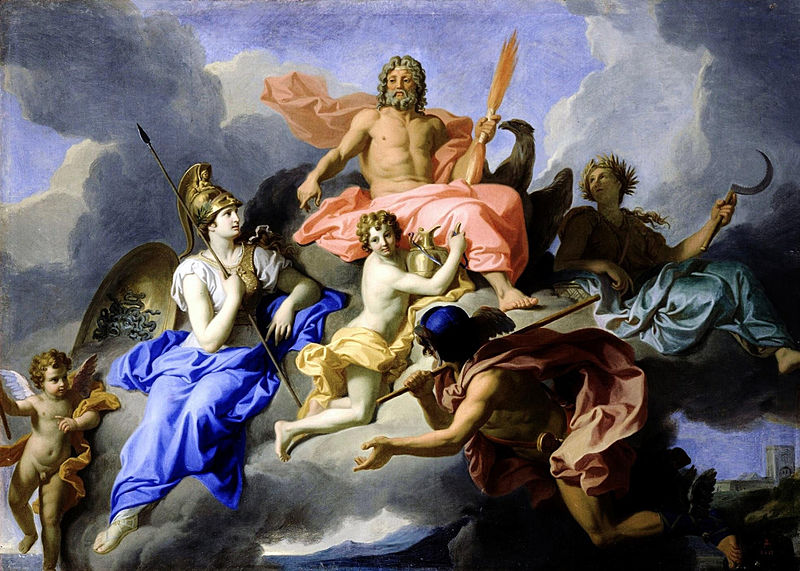

That Which Entertains The Gods

1. The physical world was dreamed up by God to entertain the gods.

2. The imperative to entertain the gods is why there is something rather than nothing.

3. The gods watch on from higher dimensions where we cannot normally perceive them. Yet, they perceive us, as we would perceive actors in a play or on a screen.

4. The hierarchy of beings and the hierarchy of consciousness are hierarchies of how well a fragment of consciousness entertains the gods. Cats and consciousnesses of gold entertain the gods the most; insects and consciousnesses of lead entertain the gods the least.

5. Life struggles primarily to entertain the gods, and not to survive or reproduce.

6. The struggle to survive and reproduce is merely the backdrop for something infinitely more meaningful: the entertainment of the gods.

7. The gods are primarily entertained by that which unexpectedly rises above.

8. As such, the two major components of the entertainment of the gods are novelty and surprise.

9. The gods are immensely entertained by that which they have never seen before.

10. The gods are also immensely entertained by unexpected behaviour in that which they have seen before.

11. The gods expect us to fail, on account of that we are mortals.

12. We were created to fail, so that it would be surprising if we succeeded. As such, any genuine success entertains the gods.

13. The gods are not entertained by those who meekly accept their fate. Such weaklings are, to the gods, indistinguishable from insects.

14. The gods are mildly entertained by those who overcome physical challenges. Great athletes are entertaining, but only mildly so.

15. The gods are moderately entertained by those who overcome emotional challenges. Those born into shit families but who manage to make decent lives for themselves are moderately entertaining.

16. The gods are highly entertained by those who overcome intellectual challenges. Scientists who push back the boundaries of human ignorance are highly entertaining.

17. The gods are immensely entertained by those who overcome spiritual challenges. Spiritual revolutionaries who repudiate religious falsehoods are immensely entertaining.

18. The gods are most of all entertained by great beings who alter the course of history. When a Buddha, an Alexander, a Caesar, a Napoleon or a Hitler rise up, all the gods watch on.

19. The gods are least of all entertained by people who conflate the Great Masculine Axis with the Great Feminine Axis.

20. The worse the family, neighbourhood, community or national situation one is born into, the greater one’s opportunity to entertain the gods by rising above it. The Elementalist, therefore, does not resent being born into bad families, neighbourhoods, communities or nations.

21. Let the entertainment of the gods be the meaning of our lives!

*

This chapter is an excerpt from Elemental Elementalism, the foundational scripture of the new religion of the Age of Aquarius.

*

If you enjoyed reading this essay/article, you can get a compilation of the Best VJMP Essays and Articles of 2020 from Amazon for Kindle or Amazon for CreateSpace (for international readers), or TradeMe (for Kiwis). A compilation of the Best VJMP Essays and Articles of 2019, the Best VJMP Essays and Articles of 2018 and the Best VJMP Essays and Articles of 2017 are also available.

*

If you would like to support our work in other ways, subscribe to our SubscribeStar fund. Even better, buy any one of our books!
The Elemental Hierarchy Of Consciousness

1. Consciousness is the prima materia and each one of us is ultimately a fragment of this consciousness.

2. Each fragment of consciousness possesses its own frequency. This frequency can be expressed as a number between 0 and 1, where 0 is the Winter Pole of the Quadrijitu, and 1 is the Summer Pole of the Quadrijitu.

3. All fragments of consciousness can be arranged into a hierarchy, such that the higher frequencies incarnate into higher worlds, and the lower frequencies into lower worlds.

4. Within this world, there is also a hierarchy of consciousness, such that the lower frequencies are close to sinking lower into the Hell Realms, and the higher frequencies are close to rising higher into the Heaven Realms.

5. The difference between the hierarchy of consciousness and the hierarchy of class is that the former can be altered quickly whereas the latter cannot.

6. One’s consciousness is a matter of one’s will in the present, but one’s class is a matter of one’s will in the past, including past lives.

7. The lowest frequency of consciousness is equivalent to lead.

8. A consciousness of lead lives in constant fear.

9. Fear kills the mind. A consciousness clouded by fear will make selfish decisions, and will thereby increase the suffering of those around them, creating a Hell on Earth.

10. The next highest frequency of consciousness is equivalent to tin.

11. A consciousness of tin lives to indulge itself.

12. Material indulgence is tempting because it can heal the suffering caused by an excess of fear. However, this indulgence frequency results in more suffering because it can lead to degeneracy and addiction.

13. The next highest frequency of consciousness is equivalent to iron.

14. A consciousness of iron lives for honour.

15. Honour is tempting because it can heal the suffering caused by an excess of indulgence. However, an excess of honour can lead to conflict.

16. The next highest frequency of consciousness is equivalent to copper.

17. A consciousness of copper lives for novelty.

18. Novelty is tempting because it can heal the suffering caused by an excessive focus on honour.

19. The next highest frequency of consciousness is equivalent to silver.

20. A consciousness of silver lives for glory.

21. Glory is tempting because it can heal the suffering caused by an excess of novelty.

22. The next highest frequency of consciousness is equivalent to mercury.

23. A consciousness of mercury lives for knowledge.

24. Knowledge is tempting because it can heal the suffering caused by an excess of glory.

25. The highest frequency of consciousness is equivalent to gold.

26. A consciousness of gold lives to know the truth.

27. Truth is tempting because it can heal the suffering caused by an excess of knowledge.

28. The struggle to raise one’s frequency of consciousness is one of the most worthy of all aspirations. The most important thing, however, is that this struggle entertains the gods.

*

This chapter is an excerpt from Elemental Elementalism, the foundational scripture of the new religion of the Age of Aquarius.

*

If you enjoyed reading this essay/article, you can get a compilation of the Best VJMP Essays and Articles of 2020 from Amazon for Kindle or Amazon for CreateSpace (for international readers), or TradeMe (for Kiwis). A compilation of the Best VJMP Essays and Articles of 2019, the Best VJMP Essays and Articles of 2018 and the Best VJMP Essays and Articles of 2017 are also available.

*

If you would like to support our work in other ways, subscribe to our SubscribeStar fund. Even better, buy any one of our books!

The Elementalist Conception Of Order And Chaos

1. Order and chaos are loosely analagous to masculine and feminine, respectively. They are not, however, analagous to good and evil.

2. Order is determined, chaos is undetermined.

3. Thus, order is represented by a 1, chaos by a 0.

4. Good order is that which decreases the suffering of sentient beings. This is usually caused by order that guides, enlightens, nurtures, and safely directs emotions.

5. Legal prohibitions on causing injury or harm to other sentient beings are examples of good order.

6. Bad order is that which increases the suffering of sentient beings. This is usually caused by order which stifles, strangles and suffocates.

7. Legal prohibitions on spiritual sacraments are examples of bad order.

8. Good chaos is that which decreases the suffering of sentient beings. This is usually caused by chaos which liberates and entertains.

9. A spiritual revolution that destroys a rotten and corrupt religious structure is an example of good chaos.

10. Bad chaos is that which increases the suffering of sentient beings. This is usually caused by chaos which spreads fear.

11. The best examples of bad chaos are crimes such as violence, theft and abandoning one’s family.

12. An excess of either order or chaos is indistinguishable from death.

13. Life exists, and can only exist, in the space where order and chaos are correctly balanced.

14. The more masculine a person is, the more they will prefer order. A preference for order follows naturally from the Fundamental Masculine Attitude.

15. The more feminine a person is, the more they will prefer chaos. A preference for chaos follows naturally from the Fundamental Feminine Attitude.

16. The Elementalist seeks spiritual balance, and as such does not preference either order or chaos.

17. The Elementalist prefers order if order helps the Elementalist to achieve their aspirations.

18. The Elementalist prefers chaos if chaos helps the Elementalist to achieve their aspirations.

19. Neither order nor chaos induces any strong emotional reaction in the Elementalist. Like yang and yin, both order and chaos rise and fall. The Elementalist watches them both rise and fall without clinging to either.

20. The gods are most entertained by the correct balance of order and chaos. As such, their will is to impose order upon the excessively chaotic, and chaos upon the excessively orderly.

*

This chapter is an excerpt from Elemental Elementalism, the foundational scripture of the new religion of the Age of Aquarius.

*

If you enjoyed reading this essay/article, you can get a compilation of the Best VJMP Essays and Articles of 2020 from Amazon for Kindle or Amazon for CreateSpace (for international readers), or TradeMe (for Kiwis). A compilation of the Best VJMP Essays and Articles of 2019, the Best VJMP Essays and Articles of 2018 and the Best VJMP Essays and Articles of 2017 are also available.

*

If you would like to support our work in other ways, subscribe to our SubscribeStar fund. Even better, buy any one of our books!