
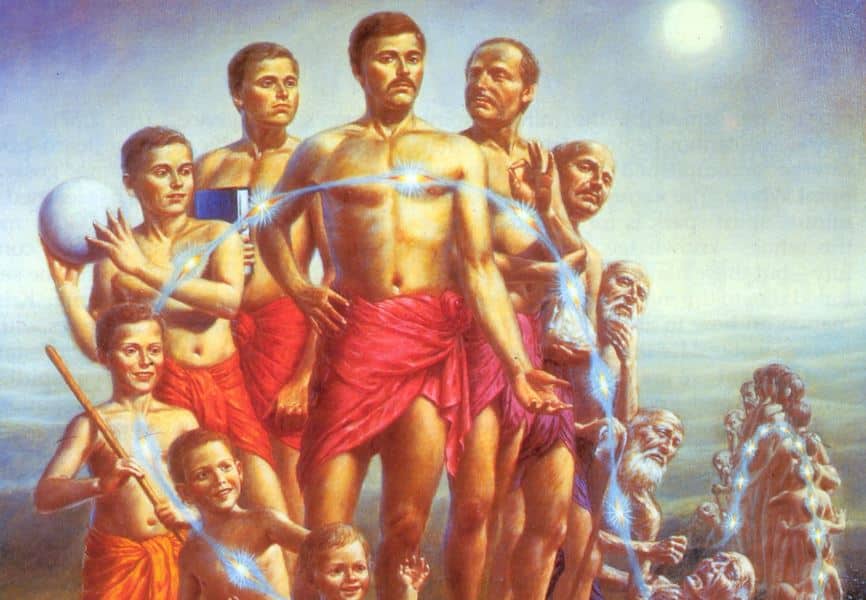
Why You Incarnated Here

Many an Earthling has looked around themselves and asked: “What the fuck am I doing here?” This planet is so horrific that it can seem as if it must be a place of punishment. Planet Earth is, indeed, one of the Hell Realms. The explanation for why we incarnated here, and not somewhere better, is a fundamental part of Elementalist philosophy.

The Law of Assortative Reincarnation teaches us that the frequency of the consciousness of each of us is matched after death with the frequency of the part of the Great Fractal that we reincarnate into in the next life. High-frequency souls that tend to produce bliss in their near environment incarnate into blissful parts of the Great Fractal, while low-frequency souls incarnate into awesome parts of the Great Fractal.

Spiritual adepts can sense that, because everything incarnating into this realm must die, and because most deaths are extremely painful, this is not one of the higher realms. This world is, in fact, one of the Hell Realms, in which consciousnesses come to suffer for the sake of purifying themselves.

In order to incarnate into one of the higher realms, such as the Heavenly Realms, a consciousness has to be high-frequency enough to match the beings in that Heavenly Realm. Those beings don’t want – and don’t deserve – to spend time around a selfish, abusive, retarded low-frequency consciousness. Low-frequency consciousnesses ought to quarantined along with the rest of their kind.

A high-frequency consciousness can be trusted to behave in a way that does not unjustly cause suffering to other consciousnesses. It will not act sadistically, only causing harm to prevent greater harm. That high frequency, then, is like an entry ticket to otherwise exclusive places: the higher realms.

A low-frequency consciousness, by contrast, cannot be trusted to behave correctly in one of the higher realms. As such, they incarnate into a lower one, so that the suffering inherent to that realm is sufficient to motivate them to raise their frequency. The lower the frequency of the consciousness, the less subtle the lessons have to be.

In much the same way that the body raises its temperature to fight off a fever, a soul can purify itself by entering into a high-intensity environment. The further away from God’s natural state of bliss one incarnates, the more awesome the experience, and therefore the greater the impression one’s lessons make upon one’s consciousness.

All of us incarnated into this realm because, in our previous lives, we allowed our consciousness to fall to a particularly low frequency. Because this world is a slaughterhouse in which animals kill each other all the time, we know that, in our previous lives, we must have acted with murderous intent (or perhaps suicidal intent).

The 24/7/365 abbatoir that is Planet Earth exists because we killed other beings in our previous lives.

Your author can remember one such deed. I was a duke, in some kingdom across the Great Fractal from here, and had a great many loyal underlings. One of them I sliced up with a sword, suspecting him of plotting against me. In reality, he was entirely innocent. Because of the severity and the unjustness of this slaying, I incurred an enormous karmic debt.

For this grotesque act of evil I was cast down into this lowly realm, to incarnate into a deeply traumatised family for which violence was seen as normal.

Deeds like these – of homicidal selfishness – consign souls to Hell Realms in which killing and death is a part of everyday reality. Hence, we incarnate on Earth, doomed to die, doomed to watch that which we love die, doomed to constantly feel the shadow of death across our hearts. We suffer here until our consciousnesses are purified enough to allow us entry into a higher realm.

The vibrations of the beings in the higher realms are much the same as the vibrations of the beings in this realm. But their frequencies are all higher than the frequencies of the beings in this realm. As such, in the higher realms, it is much less common to see hatred, fear and violence.

Ultimately, all of us incarnated here because this is where we deserve to be. We don’t deserve to be in the company of either higher or lower consciousnesses than our own. As such, we ended up here, in a world full of violence and death, but a world that could be much worse. May all of us summon the will to overcome, and to purify our consciousnesses so that we may rise above the Hell Realms.

*

This chapter refers to the text of Elemental Elementalism, the foundational scripture of the new religion of the Age of Aquarius.

*

If you enjoyed reading this essay/article, you can get a compilation of the Best VJMP Essays and Articles from 2021 from Amazon for Kindle or Amazon for CreateSpace (for international readers), or TradeMe (for Kiwis). A compilation of the Best VJMP Essays and Articles of 2020, the Best VJMP Essays and Articles of 2019, the Best VJMP Essays and Articles of 2018 and the Best VJMP Essays and Articles of 2017 are also available.

*

If you would like to support our work in other ways, subscribe to our SubscribeStar fund, or make a donation to our Paypal! Even better, buy any one of our books!


The Major Aspiration (redux)

1. In Elementalist philosophy, there are two meanings to life.

2. The lesser of the two, the Minor Aspiration, is personal.

3. The greater of the two, the Major Aspiration, is superpersonal.

4. This Major Aspiration applies to every person, no matter whether or not they accept it.

5. The Major Aspiration of every living being is to entertain the gods.

6. The Major Aspiration reflects the ultimate Will of God: to be entertained.

7. Not knowing suffering or ignorance, God experienced boredom in God’s natural state, and it was to alleviate this boredom that God dreamed up the Great Fractal.

8. God dreamed up the Great Fractal and, so as to best explore it, split Godself up into an infinite number of fragments. Each of these fragments is an individual consciousness.

9. You, the reader, are one of these infinite fragments of consciousness.

10. The contents of your consciousness are the path taken on your journey through the Great Fractal.

11. In accordance with the Third Tenet, the Great Fractal is understood to be the eternal and infinite interplay of the dance between masculine and feminine and the battle between good and evil. This is, in the simplest possible terms, the formula for the entertainment of the gods.

12. In much the same way that we humans are fascinated and entertained by the dramas of others, so too are the gods entertained by our struggles and travails.

13. There’s little difference between a human being reading a book such as Anna Karenina and a higher-dimensional being observing the family dramas of a group of humans on Earth.

14. The best reason for anyone to do anything is to entertain the gods.

15. Therefore, any person who has lived in such a manner as to have caused the gods to gaze upon them is esteemed.

16. It cannot ever be clear precisely how the gods are best entertained, but it’s not supposed to be clear, because that would be boring.

17. If the Major Aspiration is to entertain the gods, and if the gods are like us but greater, it follows that the gods are best entertained by godlike heroism.

18. The heroism that entertains the gods is best expressed in the overcoming of challenges and obstacles.

19. Some of the most heroic actions one can undertake are those in service of one’s Minor Aspiration. A wholehearted attempt to achieve one’s Minor Aspiration has a good chance of also achieving one’s Major Aspiration.

20. A child born crippled is not born into any shame in the eyes of the gods, as long as it overcomes. The gods are more entertained by a cripple who overcomes than by a prince who wastes his advantages.

21. The gods are more entertained by those who unexpectedly overcome than by any amount of stagnant grandeur or wealth.

22. Ultimately, the gods are most entertained by will, which is why will is represented by mercury as the element immediately below the divine gold.

23. A sufficient concentration of will sends a signal that passes through space and time, and which the gods perceive like a sound wave in dimensions above, calling them to pay attention.

24. This is why it is said that “Fortune favours the brave”: because the gods favour the willing.

25. A person can reject the Major Aspiration if they like – they have the freedom to do so.

26. They can elevate their Minor Aspiration to a position higher than their Major Aspiration any time they wish to.

27. But the beauty of the Major Aspiration is that it applies even to people who explicitly reject it.

28. A person can explicitly declare that the favour of the gods is meaningless to them – and the gods will be just as well entertained by that person’s life. Perhaps even more so.

29. Insofar as it’s meaningful to judge other people for behaving correctly or otherwise, it’s best to judge whether their behaviour serves their Major Aspiration.

30. It’s usually pointless to ask if a person is behaving morally, because morality depends on the fashions of the time and place, and is more a function of who seized power last than of any objective truth.

31. The imperative to entertain the gods, however, is eternal.

32. The Major Aspiration is an imperative that transcends not only times and places but also dimensions.

33. All Elementalists aspire to entertain the gods, and to that end aspire to overcome any and all challenges, no matter how difficult.

*

This chapter is an excerpt from Elemental Elementalism, the foundational scripture of the new religion of the Age of Aquarius.

*

If you enjoyed reading this essay/article, you can get a compilation of the Best VJMP Essays and Articles of 2020 from Amazon for Kindle or Amazon for CreateSpace (for international readers), or TradeMe (for Kiwis). A compilation of the Best VJMP Essays and Articles of 2019, the Best VJMP Essays and Articles of 2018 and the Best VJMP Essays and Articles of 2017 are also available.

*

If you would like to support our work in other ways, subscribe to our SubscribeStar fund. Even better, buy any one of our books!

The Elementalist Exhortation Against Suicide (redux)

1. Albert Camus wrote that humanity is constantly challenged by the ever-present prospect of suicide.

2. To many people, it isn’t obvious why one should keep living in a world with as much suffering in it as this one.

3. The approach of most other religions is to say that committing suicide will cause you to reincarnate in the Hell Realms.

4. This is a crude and superstitious explanation, and as such is not convincing to most adults.

5. Elementalism offers a much more coherent and persuasive admonition: to commit suicide is to cause oneself to be reincarnated in a world where people commit suicide.

6. A distinction needs to be drawn between tragic suicides and understandable suicides.

7. A tragic suicide is one that increases the net amount of suffering in the world.

8. The vast majority of suicides of young people are tragic ones, on account of that young people usually have a number of family and friends who care for them and who would be upset by their death.

9. An understandable suicide is one that does not increase the net amount of suffering in the world.

10. An example is when a person is so old that their life is no longer worth living on account of the pain and humiliation of physical and mental decrepitude.

11. If a person has outlived all their friends, their brothers and sisters, and their wife or husband, they might not be causing more suffering by ending their life.

12. Elementalists believe in the Law of Assortative Reincarnation. This is the belief that the consciousness of individuals and the consciousness of worlds are matched by a process of metaphysical assortment that occurs after the death of each individual’s physical body.

13. It doesn’t ultimately matter if a suicide is tragic or understandable, because determining which realm one reincarnates in is not based on categorical variables such as suicide or natural death, believer or non-believer, but on a continuous variable, namely one’s frequency of consciousness.

14. A person reincarnates into a particular world because the frequency of that person’s consciousness matches the frequency of that world.

15. Thus, the frequencies of the beings in the next world one reincarnates into will be reflective of one’s actions here in this world.

16. If one’s actions here are violent, reckless and indifferent to human suffering, then the actions of the beings in the next world will be similar.

17. A suicide might reincarnate into the next world, and start to live in the hope and expectation that they can wring some joy out of their life, only to have a loved one of theirs kill themselves at a vulnerable moment.

18. Or they might reincarnate into the next world and be left orphaned by a parent’s suicide.

19. The extremely callous and violent nature of a tragic suicide means that their being confronted with callous violence in the next life is extremely likely.

20. It is not possible to say that simply because one performs a particular behaviour in this world that one will encounter that precise behaviour in the next world, therefore it’s not as simple as saying that suicide leads to suicide.

21. But if one lives a life on a frequency of murderous self-hatred that leads to suicide, one will manifest in the company of beings on a similar frequency, and suffering will almost inevitably follow.

22. Someone who struggles with depression or despair and overcomes it will find that their frequency of consciousness changes to reflect that.

23. Therefore, the sort of people they will attract, both in this life and the next, will be the sort of person who suffers and then overcomes it: men and women of gold.

24. If a person can suffer and yet transmute that energy into something positive, so that the initial suffering eventually leads to a net reduction of suffering, then they have successfully practised gold magic.

25. The ability to transmute suffering into its opposite is the highest of all arts, and, commensurately, the transmutation of suicidal ideation into the will to live is among the greatest of all achievements.

26. An Elementalist who properly understands Elementalist doctrine will be extremely disinclined to kill themselves.

27. The true path of liberation is to not kill oneself, and to instead take the opportunity presented by the difficulties of life in this realm to raise one’s frequency of consciousness through transmuting suffering into joy.

*

This chapter is an excerpt from Elemental Elementalism, the foundational scripture of the new religion of the Age of Aquarius.

*

If you enjoyed reading this essay/article, you can get a compilation of the Best VJMP Essays and Articles of 2020 from Amazon for Kindle or Amazon for CreateSpace (for international readers), or TradeMe (for Kiwis). A compilation of the Best VJMP Essays and Articles of 2019, the Best VJMP Essays and Articles of 2018 and the Best VJMP Essays and Articles of 2017 are also available.

*

If you would like to support our work in other ways, subscribe to our SubscribeStar fund. Even better, buy any one of our books!

The Elementalist Conception Of Death (redux)

1. Foreknowledge of one’s inevitable demise can seem to make all of our actions in this world meaningless.

2. The greatest test of merit of any spiritual tradition is that it assuages a person’s fear of death.

3. Death is naturally both terrifying and inevitable, and all the more terrifying because it is inevitable. The fact that we cannot escape it casts a shadow over every single action – and inaction – we take in this realm.

4. The inevitability of death means that nothing we achieve or acquire here can ever be permanent.

5. It means that no matter how many billions we collect, or how many children we produce, or how many awards and honours we attain, all is rendered null upon the expiration of our physical bodies. Death will separate us from all.

6. The Elementalist doesn’t take this fact as cause for despair, but rather as cause for quiet rejoicing.

7. Socrates said that the purpose of philosophy was to prepare oneself for death, and, to this end, Elementalism has specific, defined teachings about death and the nature of death.

8. Central to Elementalism is the knowledge that consciousness is the prima materia, and the physical world merely a set of sensory impressions within that consciousness, in the same way that dream worlds are.

9. The physical bodies of each of us are also merely sets of impressions within consciousness, and these perceptions will come and go like any other.

10. Consciousness is more fundamental than space and time, and therefore is not affected by whatever part of the Great Fractal it happens to be perceiving.

11. To the contrary – the Great Fractal comes alive when it is perceived by consciousness.

12. This means that our physical bodies can never really die, because consciousness will always dream them up again.

13. The Elementalist conception of death accords with the line in the Bhagavad Gita which states: “Never have you existed not.”

14. The true self is the consciousness that endures through all the changing perceptions; the false self is the physical body currently ensouled by that consciousness and the identity that goes with that body.

15. Understanding that consciousness is the prima materia, the Elementalist’s faith in reincarnation is absolute.

16. As such, the death of one’s current physical form is not to be feared.

17. It may even be something to look forward to – the death of one’s physical body in this realm might allow one to attain a higher form in another realm.

18. In any case, the Elementalist knows that they will get what they deserve, in accordance with the Law of Associative Reincarnation.

19. Elementalists know that all things existing in this realm are just shadows of eternal forms that exist elsewhere in the Great Fractal.

20. There are countless dimensions of existence both above and below the one in which we find ourselves now.

21. One’s physical death in this realm might cause one’s consciousness to ascend to a higher realm, in which case it will incarnate into a less flawed form of the same body.

22. Elementalists, therefore, have a different conception of grief.

23. Our friends and family members, when they die, are only gone from us in the most immediate and most physical sense. Their consciousness, their vibration and their frequency still exist in the Great Fractal – and always will.

24. All possible aspects of every possible life are being experienced in every moment by God. As such, all of the consciousnesses, vibrations and frequencies that we engaged with in this life will reunite with us after death, as we reunite with God.

25. In the same way that white light contains all other frequencies of light, God contains all frequencies of consciousness.

26. Even if a friend or family member should die young, their consciousness, their vibration and their frequency still exists within God – and even in forms which did not die young.

27. A person might lose their attachment to a particular physical form when that form dies, but then, being freed from that form and reunited with God, that person will also become reunited with all the other consciousnesses, vibrations and frequencies that were encountered during that person’s previous life – or lives.

28. The easiest way to conceptualise the Elementalist understanding of death is to imagine climbing an arduous mountain trail and, after several decades, coming to the top, whereupon one reunites with all the friends and family that one ever had, in every previous life.

29. Death is much like arriving at this rest space on top of this mountain. From this vantage point, it’s possible to see, stretching off into the distance, all of your previous lives, represented as other mountains and valleys.

30. Every time the trail descends and then rises again represents another life. With the right vision, it’s possible to see previous lives stretching off into infinity.

31. After an unknown length of time on this mountaintop (in reality a higher dimension serving as a rest space) another descent into a valley is made, and that will be experienced as another life, wherein the true nature of reality will again be forgotten – and then again be remembered.

32. The cycle of existence is to be one with God, and one with all the frequencies that resonate in harmony with your own, and then to separate from this state of congregated bliss and to enter into an illusionary world of suffering, only to awaken and return to God again.

33. Elementalists call this pattern the Cosmic Dance, and we all dance it, even if we’re not very good at it, and even if we’re unwilling.

34. The purpose of the Cosmic Dance is to entertain the gods.

35. The correct approach to death is to live with the highest possible frequency of consciousness: one that values life, but at the same time does not forego rectitude on account of the inevitability of physical death.

36. Such an approach will lead to reincarnation among the highest possible frequency of beings.

*

This chapter is an excerpt from Elemental Elementalism, the foundational scripture of the new religion of the Age of Aquarius.

*

If you enjoyed reading this essay/article, you can get a compilation of the Best VJMP Essays and Articles of 2020 from Amazon for Kindle or Amazon for CreateSpace (for international readers), or TradeMe (for Kiwis). A compilation of the Best VJMP Essays and Articles of 2019, the Best VJMP Essays and Articles of 2018 and the Best VJMP Essays and Articles of 2017 are also available.

*

If you would like to support our work in other ways, subscribe to our SubscribeStar fund. Even better, buy any one of our books!