The Mithraic Ladder Of Drugs

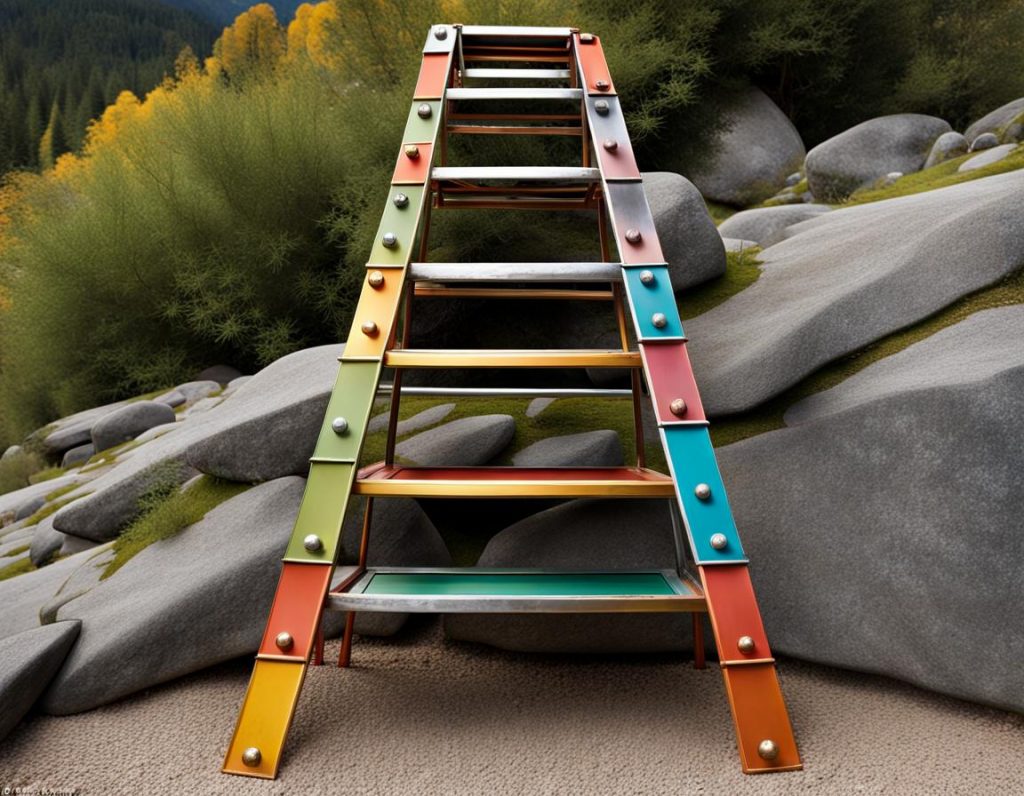
Mithraic Ladders can be found everywhere in both natural and artificial worlds, because they are forms of the Great Masculine Axis. The drug world is no exception. This is to say that the various drugs in common use correspond to various levels of the Mithraic Ladder. This essay explains.

At the bottom of the Mithraic Ladder is lead. Lead is the dark element representing our basic fears for survival. It also represents Saturn, otherwise known as The Grim Reaper. Decay, deterioration, destruction and decrepitude are all energies of the level of lead. A person at this level will be merely surviving and nothing else.

The drug of lead is heroin. This is the drug often used by the survivors of the worst abuses and crimes. If a person has given up on life, heroin is often what they turn to. Appropriate to the level of Saturn, heroin (and the drugs like it) kills people the most easily. Heroin users are of the lowest frequency of any drug users.

The next step up the Mithraic Ladder is tin. Tin represents Jupiter, the jovial god of greatness and irresponsible good times. The characteristic emotion is joy – joy being what arises when the fear of the lead stage dissipates. People at the level of tin are looking to have a good time ahead of any other consideration. There is a high time preference.

Alcohol is the drug equivalent of the level of tin. On alcohol it’s possible to have a fantastic time in a very irresponsible manner. Much like Zeus, there are millions of drunkards out there who have children they conceived in a drunken frenzy, and then didn’t look after. If a story was written about Zeus today, he’d kill someone drunk driving.

The third step of the Mithraic Ladder is iron. This is analogous to Mars, the god of war. The emotion emblematic of this step is rage. Once you start having a good time, you quickly learn that there are people who want you to suffer and be enslaved instead. Thus, a person has to learn rage in order to live free.

The characteristic drug of this third stage is methamphetamine. Not only does meth use make people prone to violently attack others (even more so than alcohol), it’s also beloved of actual warfighters, most famously the German Army in France in 1940. Meth is an outstanding war drug because if your enemy needs to sleep and you don’t, then you win.

The fourth step of the Ladder is copper, analogous to Aphrodite, Venus and Freya, the goddesses of love. Copper is the stage one reaches after all the fighting. After all, men mostly fight to win women. So once a man has a woman his attention naturally shifts, from fighting to lovemaking.

The fourth level is represented in the drug world by MDMA, the love drug. MDMA is famous for increasing the release of oxytocin, the neurotransmitter that makes people bond with each other. If Aphrodite would cast a spell to infatuate someone today, she’d probably involve MDMA.

The fifth step of the Mithraic Ladder is silver. The brilliance of silver is analogous to the knowledge that is beloved of people at this level. Silver is more precious than copper, because this is the stage at which someone moves away from simple pleasures, and starts to become attracted to the truth. At this level a person starts to think of suprapersonal concerns.

Silver is analogous to tobacco, the drug of industry. This is not to say that tobacco is a particularly great drug – it’s not more fun than taking MDMA. But it’s possible to achieve awesome things with the diligence associated with tobacco use. Many of the engineers behind the great engineering projects of the 19th and 20th Centuries would have been habitual tobacco smokers.

The sixth step of the Mithraic Ladder is mercury. If silver is brilliance, mercury is genius. The quicksilver nature of mercury reminds of the quicksilver nature of the extremely intellectually gifted. A person at this level cannot easily be judged by the masses, who, being unable to distinguish genius from madness, cannot make sense of this level.

The characteristic drug of this sixth stage is cannabis. This is the drug used by most of the creative people today; the writers and musicians, artists and filmakers. People use cannabis for a variety of reasons, not all associated with the relatively high frequency of mercury. But those who do use it for creativity readily find a bottomless well of inspiration in the herb.

The top level of the Mithraic Ladder is gold. This represents a person who has transcended mere egoic concerns, and who has fully integrated their will with the Will of God. A person at the top of the Mithraic Ladder is beyond genius: they are a divine spark. They want for nothing, having returned to the natural state of bliss that is the province of pure consciousness.

The drugs representing the top stage of the Mithraic Ladder are psychedelics. These are the substances that can induce a person to see beyond the material illusions and to rediscover their own soul. Psychedelics also have the quality of being all but impossible to become addicted to. It’s common for people who take a strong dose of a psychedelic to not want to use them again for a while, in stark contrast to heroin and tobacco.

The Mithraic Ladder can be found everywhere in reality. In the world of drugs, it manifests as a spectrum with opiates and depressants at the bottom, and spiritual sacraments at the top.

*

For more of VJM’s ideas, see his work on other platforms!
For even more of VJM’s ideas, buy one of his books!

*

If you enjoyed reading this essay/article, you can get a compilation of the Best VJMP Essays and Articles from 2021 from Amazon as a Kindle ebook or paperback. Compilations of the Best VJMP Essays and Articles of 2020, the Best VJMP Essays and Articles of 2019, the Best VJMP Essays and Articles of 2018 and the Best VJMP Essays and Articles of 2017 are also available.

*

If you would like to support our work in other ways, subscribe to our SubscribeStar fund, or make a donation to our Paypal! Even better, buy any one of our books!

Five Aspects Of Masculinity

People are deeply confused today about what masculinity is. There are many differing thoughts, depending on the emotional maturity of the person thinking. Looking at masculinity from an alchemical point of view, there are five different aspects to be considered, corresponding to the top five steps of the Mithraic Ladder.

For young boys and emotionally retarded men, masculinity is about physical force, especially violence. The spiritually stunted tend to think of everything in terms of who could beat up who. These men represent the element of iron, at the third step of the Mithraic Ladder.

In pre-civilisational societies, or in societies of feral humans (such as criminal gangs), the dominance hierarchy is all about ferocity and physical strength. This sort of behaviour is masculine in a sense, but that’s only one very limited aspect of masculinity.

A higher kind of man grows out of the violence and learns how to make love. He represents the element of copper, which is the first of the precious metals on the Mithraic Ladder. Having realised, consciously or otherwise, that the point of fighting is to win women, the man of copper simplifies the procedure and simply works on making himself attractive to women.

Men who can readily attract women look down on brawlers as meatheads. If the meatheads take each other out, then the more women for the rest of us. In at least one major sense, men like this are far more masculine than the men of iron: they can attract women with less opposition.

A still higher kind of man grows out of cooming and learns social influence. The fifth step of the Mithraic Ladder is represented by silver, which is brilliant in comparison to the lowest four steps. This brilliance leads the man of silver to see a bigger picture, one that goes beyond mere dominance and pleasure to the creation of political structures.

Men at this level also look down on the brawler as a meathead, but on top of that they see the manwhore as a pointless coomer. The reasoning is that a man only needs one woman to have a family and children, so interacting with women beyond that is pointless unless one is seeking social influence.

A yet still higher kind of man judges his fellows on intelligence. Fighting, lovemaking and politics might entertain the gods to some extent, but they’re ultimately all mundane pleasures. Some rarer pleasures are only open to a few, no matter how hard they work. One of those pleasures is achieving a deep and accurate insight into the workings of Nature.

For men at this level, the level of mercury, mainstream interests no longer suffice. The aspect of mercury judges men on how far they have seen into the nature of reality. Fighting and lovemaking might be fun but they’re really for lower animals. Even gaining political power is barely respectworthy. The creative man, the one who can summon divine inspiration and transmute it into worldly forms, is higher than all of those.

The highest kind of man is spiritual. Men at this level are all but invisible to those who have not seen beyond. Despite this, their influence is the most powerful. These men of gold complete the divine calling begun by the men of mercury. The spiritual man has transcended the need to control the material world. Only the higher pleasures are still desired.

At the top level of the Mithraic Ladder, not even seeing beyond is enough. One must have fully integrated those visions, such that one’s own being radiates the divine. This is a conception of masculinity enormously far removed from the warrior at the level of iron. If the warrior imposes order upon the physical, the philosopher imposes order upon the metaphysical.

Complicating this admittedly one-dimensional view of masculinity are the great many bullshitters and bluffers. Because spiritual achievement is not something that can readily be measured, false gurus abound. The sour grapes of failing to assert oneself physically or sexually drives many a man to claim a spiritual acumen he doesn’t truly possess.

It must be emphasised that a man of true power is capable of representing all five of these aspects simultaneously, as per the needs of the situation. Plato may have been a superb philosopher, but he was also a superb wrestler. The completely masculine man is not limited to the level of gold, much less any other one of these five aspects.

These five conceptions of masculinity encompass the spectrum from most material to most spiritual. When times are tough, the men of iron will come to the fore. But when peace reigns, the men of gold start to shine through. The higher the proportion of men of gold in a society, the closer it is to divinity.

These five aspects of masculinity also correspond closely to Plato’s five stages of political decline, as described in Republic. Men of gold correspond to aristocracy, men of mercury to timocracy, men of silver to oligarchy, men of copper to democracy and men of iron to tyranny. Thus, the quality of any political system is primarily a reflection of the quality of the men who comprise it.

*

For more of VJM’s ideas, see his work on other platforms!
For even more of VJM’s ideas, buy one of his books!

*

If you enjoyed reading this essay/article, you can get a compilation of the Best VJMP Essays and Articles from 2021 from Amazon as a Kindle ebook or paperback. Compilations of the Best VJMP Essays and Articles of 2020, the Best VJMP Essays and Articles of 2019, the Best VJMP Essays and Articles of 2018 and the Best VJMP Essays and Articles of 2017 are also available.

*

If you would like to support our work in other ways, subscribe to our SubscribeStar fund, or make a donation to our Paypal! Even better, buy any one of our books!
Narratives Of Life Vs. Narratives Of Death

There are two types of narrative that an individual or culture can tell themselves about the meaning of life. Although there might be an infinitude of specific narratives, they all share enough features in common to divide them into two groups. The first are life narratives and the second are death narratives.

Life narratives are the original human spirituality. All natural spiritual traditions emphasise the passage of life through the four corners of the dharma wheel: through Spring, Summer, Autumn and Winter. They also emphasise that these four seasons apply to the life of humans as well. In fact, this quadrichotomy describes the natural life path of everything that exists.

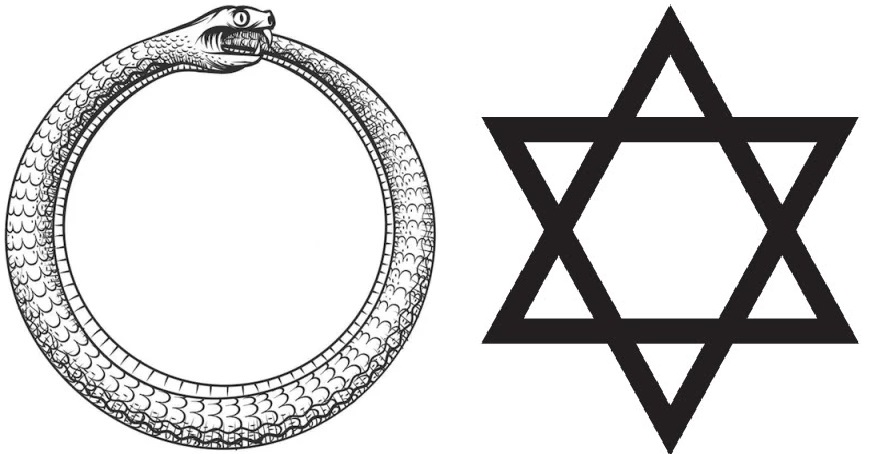
Narratives of life are all circular. This is why the holy symbols of all life religions are circular. The ouroboros, the Taijitu, the Quadrijitu and the dharma wheel are all circular. From this circularity the core spiritual truths of reincarnation and karma can be derived. After the Winter always comes another Spring.

Or, as the Bhagavad Gita puts it, “death is fixed for those who are born, and birth is fixed for those who die.”

Life narratives also emphasise gratitude. Being natural, being vital, one is grateful for life. As such, there is no desire to escape life, or to escape reality. There is no resentment, no slave morality. So life narratives celebrate the return of the Sun after the Winter Solstice, and they celebrate the peak of the Sun at the Summer Solstice, and in either case they are grateful.

Death narratives were invented later, for the sake of political control. Death narratives all promise the same thing: that you can escape the misery of life through obeying those pushing the narrative (usually a priest). So in order for a death narrative to catch on, there has to be widespread suffering.

Death narratives mostly arose after the advent of civilisation. Civilisation leads to the survival of individuals who would not have survived in a state of Nature. Most of these individuals can intuit that they are defective, and as a result they desire oblivion. This is especially true if, as is often the case, they were born into slavery.

When you have an overpopulation of useless eaters, promoting life narratives is dangerous. It can lead towards a total collapse of the ecosystem. Much better to promote death narratives, so that the population can return to a balance with Nature.

Narratives of death are linear. This is why the holy symbols of all death religions are made of straight lines (such as the Star of David and the Christian cross), or circles reduced to a minimum (such as the Islamic crescent) or both (such as the hammer and sickle).

All religious narratives that have an end times belief are narratives of death. A will to escape the world is a longing for death and thereby rejection of the world. Therefore it is a naysaying, a mental illness. Believing in an Armageddon or hoping to escape Samsara are both a rejection of the reality that the gods dreamed up for entertainment.

Materialism, with its Big Bang and Heat Death of the Universe concepts, is another linear narrative, and therefore another death narrative. Because it’s a death narrative, it belongs in the same category as the Abrahamic religions. Indeed, it was a Catholic priest who came up with the idea of the Big Bang in the first place, possibly to delegitimise the esoteric belief that all conscious beings are co-creators of the Universe.

Ultimately, materialism offers the same solace to those who hate life as the Abrahamic cults. The only difference is that there’s no priest to obey (perhaps scientists are the priesthood of materialism). All one has to do is wait until the physical body expires, whereupon the warm embrace of oblivion will envelop one for eternity.

Marxism, as Sri Dharma Pravartaka Archaya realised, is another form of Abrahamism. The narrative that the bourgeosie have to be destroyed before a Golden Age can begin is a relative to the narrative that Amalek/the heathens/the infidels have to be destroyed before Yahweh will return to Earth.

Marxists also share a personality type in common with Abrahamists. The vicious, petty, dishonourable conduct of both types is infamous. The predilection towards becoming a two-faced backstabber is shared by all who resent the world.

Gnosticism is yet another death narrative. The idea that the material world is inherently evil is borne of the same kind of resentment that motivates the other Abrahamisms. Gnosticism might be a step closer to the truth in that it recognises Yahweh as the Principle of Evil (a belief shared by Elementalism). But it is still a narrative that repudiates life in the physical world.

Believers in life narratives and believers in death narratives could not behave more differently. Believers in life narratives feel kindness for all other life and for the life process. Believers in death narratives invent practices like kosher and halal slaughter, and infant genital mutilation. That life narratives promote compassion and death narratives promote sadism is perhaps their most salient difference.

*

For more of VJM’s ideas, see his work on other platforms!
For even more of VJM’s ideas, buy one of his books!

*

If you enjoyed reading this essay/article, you can get a compilation of the Best VJMP Essays and Articles from 2021 from Amazon as a Kindle ebook or paperback. Compilations of the Best VJMP Essays and Articles of 2020, the Best VJMP Essays and Articles of 2019, the Best VJMP Essays and Articles of 2018 and the Best VJMP Essays and Articles of 2017 are also available.

*

If you would like to support our work in other ways, subscribe to our SubscribeStar fund, or make a donation to our Paypal! Even better, buy any one of our books!
The Four Elemental Spiritual Forces

Various physical theories exist to explain the phenomena of the natural world. Far fewer theories exist to explain the phenomena of the spiritual world. This very basic essay seeks to explain the four elemental spiritual forces that operate on people’s lives.

This essay contends that there are two factors of utmost importance when it comes to determining the true nature of any spiritual force.

The first is whether the force causes a person to raise the frequency of their consciousness or to lower the frequency of their consciousness. Forces that raise the frequency of consciousness cause a person to act more like Socrates. Forces that lower the frequency of consciousness cause a person to act more like a wild beast.

The second is whether the force comes from an internal or an external energy. It’s not quite as simple as saying that internal forces come from the soul and external forces are material. This is because there are spiritual forces outside of oneself, on account that all of us are a fragment of consciousness that God cast into the Great Fractal for the sake of entertainment.

The best kind of spiritual force is that which rises up from within. This is also the hardest to harness. In principle, there are two major ways that a person can generate a spiritual force within themselves that takes them to a higher place. The first is meditation and the second is spiritual sacrament use.

Meditation works as a kind of alchemy, through which a dumb animal that identifies with its body transmutes itself into a fragment of consciousness that sees the body as something subordinate to its true essence. As the Bhagavad Gita states: “the self is not killed when the body is killed.” Through meditation one can distinguish the true self from the false self.

Spiritual sacrament use is also a kind of alchemy, only it’s more like being struck by lightning. With judicious psychedelic use it’s possible to transmute one’s soul from that of a beaten-down wretch to that of an angel of the Sun. ‘Psychedelic’ means ‘soul-revealing’, and many atheists have been transformed into spiritual people through a dose of psilocybin, mescaline or LSD.

Another positive spiritual force is that which pulls up from above. This is when a person is able to draw inspiration to raise their frequency from their environment. Sometimes climbing a mountain can lead to the sense of awe that leads people to believe in divinity. Others have drawn such inspiration from great works of art or architecture.

Being pulled up from above does not necessarily mean that God pulls people back to Godself. As mentioned elsewhere, the Will of God is to entertain the gods. Life is not a matter of learning or overcoming anything (if it was, God would have created us already learned). But the gods can be entertained by watching humans otherwise lost in the darkness becoming able to “see the light” and become spiritual.

The most dangerous force is that which sinks down from within. This happens when a person gives in to their bestial impulses. The soul takes on a lower frequency when a person chooses to act like a lower animal. It becomes darker and heavier. The face of the person often transfigures to reflect the inner nastiness.

Contrary to the usual Abrahamic moralising, sinking down because of inner factors is not necessarily a bad thing. The most important thing is to entertain the gods. Therefore, it might be correct on some occasions to indulge in the sloth, gluttony or lust of the lower frequencies. However, people should always be aware that, in so indulging, they are playing with danger.

The fourth force is that which pulls down from below. This is described in various ways. Some call it the Matrix, some the Control System, others Angra Mainyu. It consists primarily of threats and terrors. In principle, anything that depresses, demoralises, horrifies or humilates will pull a person’s frequency of consciousness down towards the bestial level.

In our unfortunate modern lives, where we are materially blessed and spiritually impoverished, almost the entire political establishment can be described as a spiritual force that rips people down. As readers of 1984 will know, the control system is incentivised to make the population suffer because suffering makes them easier to control.

Mastery of these forces means that one can rise up the Great Masculine Axis at will.

Failure to master these forces will mean that one gets dragged back and forth through the Great Fractal by powers beyond one’s comprehension.

*

For more of VJM’s ideas, see his work on other platforms!
For even more of VJM’s ideas, buy one of his books!

*

If you enjoyed reading this essay/article, you can get a compilation of the Best VJMP Essays and Articles from 2021 from Amazon as a Kindle ebook or paperback. Compilations of the Best VJMP Essays and Articles of 2020, the Best VJMP Essays and Articles of 2019, the Best VJMP Essays and Articles of 2018 and the Best VJMP Essays and Articles of 2017 are also available.

*

If you would like to support our work in other ways, subscribe to our SubscribeStar fund, or make a donation to our Paypal! Even better, buy any one of our books!