
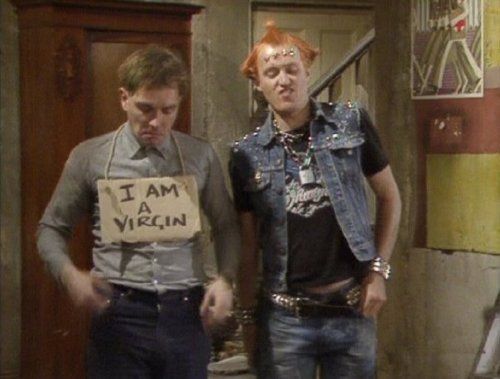
Clown World Chronicles: Who Is Virgin?

Most of the luminaries in the Clown World pantheon are admired and imitated, but others serve as warnings. Human nature contains a great variety of instinctual desires and impulses, and many of those are nasty. Every spiritual tradition carries warnings about indulging those desires and impulses to excess. In Clown World, one such warning is the example of Virgin.

Virgin is not conspicuously shorter or uglier than average. If he was, he wouldn’t be the Virgin – he’d just be some short or ugly man. To have achieved a place in the Clown World pantheon, Virgin has had to embody a particular spiritual essence. His is the essence of narcissistic masculine self-absorption.

Virgin shuffles along in drab clothing and cheap sneakers, his gaze downcast, his shoulders hunched. Never does he think about the effect that his sullenness has on the other people around him. Nor does he think about how his passive and weak body language repels women. His virginity is, in his mind, 100% the fault of other people.

The idea that virginity is shameful is an old one. It follows from the idea that women are the gatekeepers of sex, and so only men who have been declared worthy may enter. It’s related to the idea that losing one’s virginity makes one a man. Most people understand that sexual reproduction is, to a major extent, a contest, and to get laid is therefore to win.

‘Virgin’ has been used as an insult ever since. It refers to an unworthy man who does not appeal to women. Since the roasties of Clown World will fuck almost anything, a man usually has to have something wrong with him to still be a virgin. But there’s more to Virgin than being simply physically unattractive. He is very different to El Goblino.

The major difference between Virgin and Chad is that Virgin is massively egotistical.

Legends tell of women that were into Virgin but got rejected because they were less than perfect. Virgin is so conceited that anything less than perfection is not up to his standards. He genuinely believes that he is the greatest of all men, and therefore that he deserves the best looking of all women.

Virgin is also heavily neurotic, again for egotistical reasons. He doesn’t know if he prefers Stacy for a summer romance or Waifu for a permanent relationship. He is the archetypal example of chasing two rabbits and losing them both. Fundamentally, his neurotic insecurity follows from being unable to let go of the delusion that he is the centre of the Universe.

Chad causes Virgin to seethe in many ways. It isn’t just that Chad gets laid all the time when Virgin does not. It’s also that Virgin attributes all kinds of false motives to Chad’s masculine rectitude. Where Chad is friendly, Virgin sees him as shallow. Where Chad is brave, Virgin sees him as stupid. Where Chad is honest, Virgin sees him as immoral.

This uncharitable cynicism is the main reason why Virgin is a god of the negative axis. He is an unpleasant character, always complaining, always trying to pull others down to make himself appear better by comparison.

Although a pitiable figure, Virgin’s suffering is all self-inflicted. As such, he serves as a dark figure of warning. In the Clown World pantheon, Virgin represents the dangers of letting one’s ego get out of control. He is entirely capable of achieving great things and becoming a Chad himself, but he is prevented by the fact that he won’t let go of his ego.

Virgin is the Younger God of the Negative Masculine Axis. He is what Wojak can transmute into if he falls off the spiritual path. The everyday Clown World citizen can start losing the spiritual battle if they, like Virgin, fail to keep their egos in check. Virgin serves as a warning of what happens if one doesn’t do enough meditation or smoke enough weed.

If Virgin doesn’t change the path he’s on, he’ll end up like Doomer. Doomer is someone who never figured it out, and who can only see the evil in the world. The main difference between the two is that Virgin, being the Younger God, still has hope that things will change for the better.

The best option for Virgin is to unfuck himself, start getting laid and transmute into Chad. There are two ways to do this, as mentioned above.

The first way is to meditate. Virgin won’t do this because he lacks a spiritual sense, on account of that he thinks of himself as the highest god. As such, he is utterly incapable of understanding his own shortcomings. Lacking self-insight, he behaves in ways that appall others. Meditating would allow him to learn the humility he needs to become like Chad.

The second way is to take spiritual sacraments. As Alan Watts said, “People suffer only because they take seriously what the gods made for fun.” The insight brought about by the use of sacraments such as cannabis, psilocybin, LSD and dimethyltryptamine has the potential to radically alter a person’s spiritual path. Virgin isn’t interested in spiritual sacraments, on account of that he already considers himself perfect.

Any denizen of Clown World who wishes to alleviate their spiritual suffering might win from meditating upon the travails of Virgin. It is often worth reflecting upon the fact that excessive self-regard can repel both women and other people in general. Clown World could be conceptualised as a time when ego runs rampant, and Virgin as an example of the type of man it produces.

*

This article is an excerpt from Clown World Chronicles, a book about the insanity of life in the post-Industrial West. This is being compiled by Vince McLeod for an expected release in the middle of 2020.

*

If you enjoyed reading this essay, you can get a compilation of the Best VJMP Essays and Articles of 2019 from Amazon for Kindle or Amazon for CreateSpace (for international readers), or TradeMe (for Kiwis). A compilation of the Best VJMP Essays and Articles of 2018 and the Best VJMP Essays and Articles of 2017 are also available.

*

If you would like to support our work in other ways, please consider subscribing to our SubscribeStar fund. Even better, buy any one of our books!

The Elementalist Conception Of Time

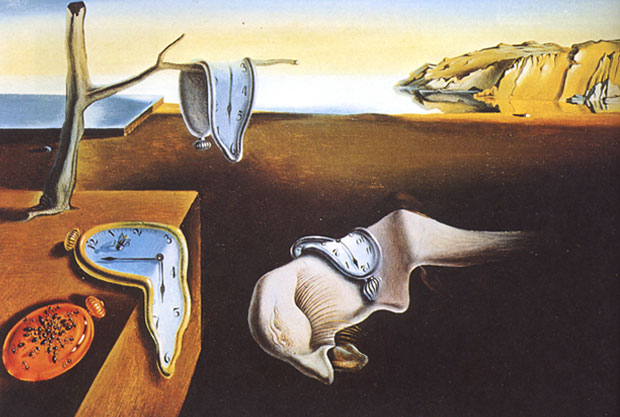
As with many other philosophical questions, Elementalism has its own ideas about the question of time. Most people take it for granted that there is such a thing as time and that it just kind of ticks along. Upon thinking about it, though, things are no longer as straightforward. This essay explains the Elementalist conception of time.

Most people assume, as if naturally, that space and time exist and that we move around in them. Space is three dimensional (the x, y and z axes), and time adds another dimension of movement, so spacetime can be said to be the four-dimensional space in which we all live. We are born at one point in spacetime and, over the course of our lives, move through it.

This materialist conception of time brings with it a number of logical quandaries.

Quandaries such as: when did time begin? Time seems to run as an arrow flies, unstoppably from one point to the next, but when and how did it start? If time started some fourteen billion years ago, with the Big Bang, what happened before then? Did time exist? If not, how could the material universe possibly have started?

Is time an inherent property of the Universe or does it exist as the result of the will of some divine creator? If an inherent property of the Universe, what makes it progress at the speed it does, and not a greater or a lesser speed? Why progress at all? And – most frightening of all – if it begins and progresses then will it end?

All of these questions create a great number of logical dilemmas in the minds of materialists and non-Elementalists. But an Elementalist, who believes that consciousness is the prima materia and that it explores the Great Fractal to entertain the gods, has no such dilemmas.

To the Elementalist, time is an illusion. Simply put, it doesn’t exist. It’s an illusion brought about by the movement of consciousness through the Great Fractal at a certain rate. Because the perceptions that occur to consciousness appear to change in a rule-based manner, the impression is created that time exists and flows at a uniform rate. The reality is somewhat different.

The illusion of a moving picture, on film or on television, is made by displaying a number of frames every second (usually 25), in quick succession. If these frames are displayed rapidly enough, the image on the screen will appear like it is moving, an illusion known as beta movement. The images aren’t really moving – they just appear to, as if in a flipbook.

Our consciousnesses navigate the Great Fractal in a similar manner.

It sounds incredible, but the reality is that our perceptions cycle through a cosmically large number of static universes in extremely short order. Entire universes blink in and out of perception a such a speed that it feels like we’re moving through them fluidly. But in fact, this movement is no more fluid than that of a horse running in a motion video. It’s also an illusion.

The Great Fractal, in its unspeakably majestic, all-encompassing nature, is static. Because the fragment of consciousness that each of us possesses can only be aware of a tiny section of it, and because the tiny section that we are aware of keeps changing, it seems like time exists. And it does, in a sense. But not in the sense that most people are used to thinking of it.

In reality, there is only one ever-present and unchanging now, and consciousness exists there. In this eternal now, perceptions change, and that’s all that time is. The contents of consciousness are ever-changing, but consciousness itself is not, serving as an unwobbling pivot around which the entire drama of material existence unfolds.

This perception of time sounds entirely radical to the materialist mind, but for a Buddhist, a Taoist or a Hindu, everything written here so far is familiar. It has to be understood that the common Western perception of time follows naturally from the common Western assumption of materialism – and this assumption is neither accurate nor rational.

Dilemmas like the Grandfather Paradox are easily solved by the Elementalist. Not believing that time is one-dimensional, there is no “go back in time”. A world in which your grandfather lives and gives rise to one of your parents exists in the Great Fractal, and will always exist. Therefore, a life in which your grandfather gave rise to you is, and will forever be, lived by a fragment of consciousness somewhere in the Great Fractal.

Somewhere in the Great Fractal are worlds in which your grandfather is killed, but this doesn’t negate the fact that there are still an infinitude of worlds in which he was not killed. Therefore, you could kill your grandfather a million times and it wouldn’t change a thing. He would still exist in the Great Fractal, so consciousness would still be aware of him, and would still perceive lives in which he existed and gave rise to progeny.

Likewise, dilemmas about how time started and where it will end are easily resolved. To the Elementalist, there is only one eternal now, and in that now we navigate the Great Fractal. Knowing that time is an illusion, questions about how it started or where it will end are meaningless. Consciousness exists outside of time and is more fundamental than it. Therefore, time is a function of the contents of consciousness only.

In summary, Elementalists have an entirely different conception of time to that of the ordinary materialist. Not only do they not believe in time in the sense it is usually understood, but neither do they believe in any of the conclusions drawn by materialist philosophers of time. For the Elementalist, all these dilemmas really do have elemental solutions.

*

If you enjoyed reading this essay, you can get a compilation of the Best VJMP Essays and Articles of 2019 from Amazon for Kindle or Amazon for CreateSpace (for international readers), or TradeMe (for Kiwis). A compilation of the Best VJMP Essays and Articles of 2018 and the Best VJMP Essays and Articles of 2017 are also available.

*

If you would like to support our work in other ways, please consider subscribing to our SubscribeStar fund. Even better, buy any one of our books!

Clown World Chronicles: Who Is Doomer?

The horrifying and seemingly hopeless nature of Clown World can easily lead to despair. As suicide rates climb all around the world, one member of the Clown World pantheon grows ever stronger. He is the Doomer, and his presence can be felt everywhere.

The Doomer cuts a depressing figure. His very appearance is doom. Sunken eyes peer out from a pallid, unshaven face, the expression on which is one of dread. A smouldering cigarette juts from his mouth – it should have been ashed five minutes ago but he isn’t paying attention. He looks extremely tired, the sort of tired where one needs to sleep but can’t.

His clothing, like his beanie, is black and grey, the colours of depression. The Doomer fears and is anxious for the future, but at the same time he is tormented by the fact that he doesn’t know why. He understands that he lives in a time of great material wealth, and feels guilt that it doesn’t bring him happiness. But deep in his heart, he knows that Clown World isn’t normal.

Clown World is the Doomer, and the Doomer is Clown World. He feels the pain and fear of the world acutely. The Doomer manifests in the expectation that everything in the world is about to get worse. His time comes in the great autumns of the world cycle. When the nights are warm and dark, the Doomer stalks the streets.

The Doomer is one of the Elder Gods, occupying the position beyond the Virgin on the Negative Masculine Axis. The essential nature of this axis is passivity – but where the Virgin is physically and socially passive, the Doomer is spiritually passive.

This spiritual passivity is not only the key to understanding the Doomer, but understanding Clown World itself. The Doomer is very much Clown World in microcosm. His suffering might seem overwhelming, but the grim truth – which he is unwilling to accept – is that most of it is self-inflicted. His own habits and his own moral failures have led him here.

The spiritual passivity of the Doomer has made him indifferent to his spiritual needs. The Doomer doesn’t meditate, because he can’t stand the noise in his head. Either he doesn’t use spiritual sacraments or he uses them irresponsibly. Most of the time he’s under the influence of pharmaceuticals or alcohol, or smoking something. Anything to numb the longing for a better world.

Nightwalking is the closest that the Doomer gets to a spiritual practice. This he does compulsively, as if an automaton, driven by a desperate need to escape his suffering. But in nightwalking he finds peace. Perhaps it is from intuiting the lesson of the streetlight: it’s forever meaningful to shine in the darkness, because a new dawn always comes.

This is one important facet of the Doomer: he contains within himself the seed to grow into a Bloomer, his exact opposite. The Doomer might be in pain, but that’s only because he cares enough to keep going. In that sense, the Doomer represents a flicker of light in every spiritual darkness. His spirit is more than just suffering – it’s also that which endures it.

As mentioned above, the Doomer is what a Virgin becomes if they continue along the Negative Masculine Axis, of which the Virgin is the Younger God. The most common path to doomerhood isn’t an extended spell of involuntary celibacy (i.e. it’s not merely extended virginity). When men become Doomers, it’s usually because they succeed in attracting a woman and establishing a romantic relationship – and then it collapses.

The Doomer is not created from a man who can’t get what he wants, but the reverse. Once a man gets what he wants, and finds that it isn’t sufficient to make him happy, he can become a Doomer. If a Virgin makes love to a beautiful woman and then the next morning realises that it didn’t solve any of his existential problems, he’s taken the first step to transitioning into a Doomer.

Doomers became numerous after the Great Financial Crisis, which could be argued to herald the descent into Clown World. It was in 2008 that an entire generation of men became faced with the reality that they would not enjoy the same easy lives that their fathers did. A few years after that, the doom had become widespread and permanent.

The solution for the Doomer is to develop spiritual strength, which will enable his will to correctly guide his mind and body to make the right moves. In doing so, he transitions onto the Positive Masculine Axis and becomes a Chad.

*

This article is an excerpt from Clown World Chronicles, a book about the insanity of life in the post-Industrial West. This is being compiled by Vince McLeod for an expected release in the middle of 2020.

*

If you enjoyed reading this essay, you can get a compilation of the Best VJMP Essays and Articles of 2019 from Amazon for Kindle or Amazon for CreateSpace (for international readers), or TradeMe (for Kiwis). A compilation of the Best VJMP Essays and Articles of 2018 and the Best VJMP Essays and Articles of 2017 are also available.

*

If you would like to support our work in other ways, please consider subscribing to our SubscribeStar fund. Even better, buy any one of our books!

Clown World Chronicles: Who Is ‘Karen’?

Clown World, it is oft lamented, is beset by Karens. Middle-aged women with deep feelings of entitlement are making everyone’s lives harder, but there seem to be more and more of them as society decays further. These Karens are avatars of Karen herself, the Elder God of the Negative Feminine.

A Karen is typically a middle-aged woman with a fashionable haircut and aggressive clothing. She is demanding, aggressive, bossy and rude. She is seldom violent, but that’s precisely why she’s so terrifying – the damage she wreaks is in the invisible, metaphysical realm, and so is harder to defend against.

Retail workers, more than any other, fear the Karen. She will complain that her coffee wasn’t made right, and if you’re not apologetic enough she will ask to speak to the manager. Like a spoiled princess, the Karen thinks the world revolves around her, and she expects others to behave accordingly. A failure to do so is met with rage.

The nightmare scenario is to have a Karen as a boss or a wife. Her vanity is such that one cannot engage with her without becoming drained.

Karen is one of the Elder Gods. Her realm is the space beyond the Roastie on the negative feminine axis. The fundamental energy of the negative feminine is narcissism, and Karen shares with the Roastie a deep self-absorption. If a Roastie continues on her path of manipulating and self-obsessed attention whoring, she is liable to grow into becoming a Karen.

In Clown World terms, the Roastie transforms into a Karen once Chad is no longer interested in fucking her. Normally, by this stage, a healthy woman will have developed enough devotion to transition into a Waifu. The Karen has failed to do so. She is not devoted to a family – it’s still all about her.

The root cause of Karen’s shitty behaviour lies in her dismay that she doesn’t attract male attention like she used to. Instead of moving on gracefully, she exerts herself to remain the centre of attention. She hasn’t figured out that the attention she once received was a consequence of physical characteristics that are now irrecoverably lost. As such, she cuts a tragic and terrible figure.

None of this is to imply that Karen is despised. To the contrary, Karen is both feared and revered, much like the goddess Kali in the Hindu pantheon, and much like the Roastie who is her younger manifestation. Her good will is strenuously courted by the citizens of Clown World, who know that she is the favoured daughter of the Merchant.

A widespread belief holds that good fortune can be had by appeasing the Karen. After all, the majority of followers of the Clown World pantheon are young, and so they are likely to have Karens as managers. Karens are often promoted into managerial roles on account of that the company is often owned by the Merchant. This relationship is one of the Five Alliances of Pain.

The difference between the Karen and the Waifu is stark.

The Karen is fundamentally opposed to the Waifu, who is the Elder God of the Positive Feminine. The Waifu is the metaphysical representation of devotion, and as such is selfless. The Karen is the exact opposite. The Karen cannot find, or is unwilling to recognise, true rectitude. Absent rectitude, she has nothing to be devoted to. Absent devotion, she becomes something bestial.

The Karen is also fundamentally opposed to the easy-going Boomer, who is the Elder God of the Positive Masculine. The Boomer has demonstrated physical rectitude in his chadly youth, and now he demonstrates spiritual rectitude by going with the flow and not clinging to his desires. The Karen is the exact opposite here, too.

In summary, the Karen is a spirit that represents the energy of the divine feminine if it becomes twisted towards egotism as it ages. She is an almost demonic figure to anyone who becomes stuck with her, but can deliver great blessings of fortune to anyone manly enough to win her good favour.

*

This article is an excerpt from Clown World Chronicles, a book about the insanity of life in the post-Industrial West. This is being compiled by Vince McLeod for an expected release in the middle of 2020.

*

If you enjoyed reading this essay, you can get a compilation of the Best VJMP Essays and Articles of 2019 from Amazon for Kindle or Amazon for CreateSpace (for international readers), or TradeMe (for Kiwis). A compilation of the Best VJMP Essays and Articles of 2018 and the Best VJMP Essays and Articles of 2017 are also available.

*

If you would like to support our work in other ways, please consider subscribing to our SubscribeStar fund. Even better, buy any one of our books!