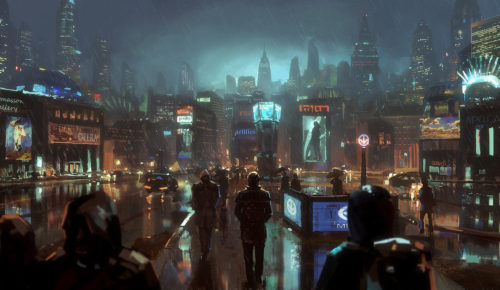
How Cyberpunk Did The World Become?

It’s now 33 years since Neuromancer was published – establishing the cyberpunk timeframe as near-future – and that’s as long as either Alexander the Great or Jesus had in this world. It’s long enough for this essay to look back from the vantage point of 2017 and see how cyberpunk Planet Earth ended up becoming in this timeline.

Where Neuromancer and Snow Crash were half right was in their prediction of a matrix within cyberspace that filled the human need for societal interaction. FaceBook and the other giants of social media certainly led the ordinary citizens of meatspace to spend a lot more time in cyberspace, but we are still limited to the bulletin board model.

Advancements in virtual reality technology have been limited, to a large part, by the need for extreme amounts of processing power. A VR setup must be capable of generating a sufficient rate of frames per second to avoid latency from the perspective of the user, because this leads to simulator sickness, which decreases the level of telepresence.

So nothing really like the eponymous all-encompassing virtual environment in The Matrix, or the metaverse, has yet arisen.

Where all of the cyberpunk classics got it right was in the widespread adoption of novel classes of synthetic drugs.

Humans have always loved to experiment with consciousness – use of magic mushrooms, cannabis and alcohol all predate the use of writing. So it was fairly predictable that new advances in chemistry would lead to new frontiers in the exploration of mental space.

Although most of the chemical enhancement in cyberpunk literature has been for the purposes of increasing martial aptitude, as in Lucifer’s Dragon, most of its use in consensual reality has been psychonautic. In other words, here on Earth people mostly use the new waves of drugs to get high – but that doesn’t make for very good fiction.

Blade Runner didn’t foresee much different in the way of human drug consumption, but it did anticipate how close artificial intelligence came to passing the Turing Test. Many people chat with bots on social media without even knowing it – especially in online poker rooms and on large politics pages.

Certainly this film, based on Philip K Dick’s Do Androids Dream Of Electric Sheep?, accurately captured the uneasiness of being a human and dealing with something that appears entirely human but for subtle differences.

Where the classics tended to get it wrong was politically, especially the diminished role of territorial governments. There seemed to be a glib assumption, perhaps expressed in extremis in Snow Crash, that corporations and the influence of corporations would expand to the point where 20th century-style governments no longer held any power.

In reality, hard iron laws like “political power grows out of the barrel of a gun” continue to hold true, and any government capable of raising sufficient taxation to raise an army or secret police will still be a force on the world stage.

In the world of soft power, Transmetropolitan correctly predicted that the political landscape would be as shallow and insane as ever. The absurdity of the various political candidates in Spider Jerusalem’s life are an eerily accurate foretelling of the rise of the Donald Trump/Hillary Clinton circus.

Corporations have started implanting microchips in their employees, which has been a staple of cyberpunk horror for a long time. My own The Verity Key, however, predicted a different path of adoption for microchips under the skin: I figured that people, especially the technophilic, would adopt it themselves for increased access to private space.

It remains to be seen if this will happen – the expense involved in reaching a sustainable critical mass might make private adoption of RFID networks unworkable.

Things didn’t really get as dark and dystopic as cyberpunk predicted. This was always the probable outcome for a literary genre that consciously adopted elements of horror from other genres and from film noir. Things really just became weird. Perhaps the most accurate of all – predicting the current obsession with transgenderism – was Joe Haldeman’s The Forever War.

If there are new avenues of cyberpunk still to be explored, it’s possible that they will feature characters who are unrepentant rebels with regard to questions of cognitive freedom, in particular characters pushed underground by new technologies that make intrusion into the mind possible.

That’s one way in which the brilliant anime series Psycho-Pass blazes a new path: from the harder, engineering and physics based sciences towards the biological ones. Much like The Verity Key, the Psycho-Pass series raises the question of what life will look like when neuropsychological technology advances to the point where the private thoughts of every individual have become a public matter.

The controllers of the mindreading technology in Psycho-Pass are public entities (or at least government ones), which makes for an oppressive totalitarian atmosphere, as opposed to the nihilistic anarchy of The Verity Key. Probably this timeline became more nihilistic than totalitarian, but who knows what might still happen?

With news that remote-controlled drones and tank-like war machines running off AI might soon become cheap enough for terrorists or rogue states to use every day against enemy targets, the most cyberpunk elements of human history, fictional or otherwise, may be still to come.

*

Vince McLeod is the author of cyberpunk novel The Verity Key and of the upcoming cyberpunk novel The Man With A Thousand Fathers, to be serialised here starting from the summer of 2018.
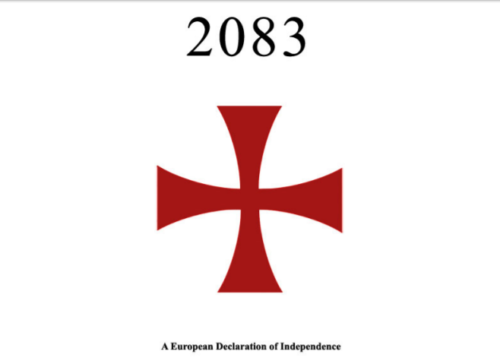
VJMP Reads: Anders Breivik’s Manifesto III

This reading carries on from here.

In this section (pages c. 90-200), Breivik details the history of relations between the West and Islam. In his analysis here, there is nothing peaceful – Islam has been attempting to conquer the West since its inception, and would have succeeded already if not repelled at either Tours or Vienna, or other places.

The destruction of the Ottoman Empire at the end of World War One, Breivik claims, is how the West has earned some breathing space against this relentless assault. The Caliphate was shattered after the Battle of Megido in 1917, and only because of this has Islam been unable to attack Europe in recent decades.

With sentences such as “the Islamic sources make clear that engaging in violence against non-Muslims is a central and indispensable principle to Islam,” and “Those cultures and individuals who do not submit to Islamic governance exist in an ipso facto state of rebellion with Allah and must be forcibly brought into submission,” a particular kind of Nordic bleakness shines through in this document.

It’s a kind of bleakness that has resigned itself to violence as a grim but inevitable outcome of the play of natural forces. They are attacking us is Breivik’s message. They always have been attacking us and they always will be.

Perhaps the following paragraph summarises this section of the document best:

The spectacular acts of Islamic terrorism in the late 20th and early 21st centuries are but the most recent manifestation of a global war of conquest that Islam has been waging since the days of the Prophet Muhammad in the 7th Century AD and that continues apace today. This is the simple, glaring truth that is staring the world today in the face — and which has stared it in the face numerous times in the past — but which it seems few today are willing to contemplate.

In this section Breivik continues to emphasise the point that no reformation of Islam is possible, for the reason that would-be reformers are unable to refer to any scriptural injunctions towards peace with non-believers. The example set by Muhammad himself was an example of war and of violence, so anyone with a will to reform is snookered from the beginning.

Essentially, anyone trying to move Islam away from violence has to work against the scriptures. Therefore, Islam cannot be used as a civilising force in the same way that Christianity could; no-one could discover through serendipity a message of peace and tolerance in their study of the Koran.

From reading this section there are two elements of Breivik’s reasoning that seem objectionable.

The first is that, although the list of historical atrocities by Muslims and modern apologies for these atrocities by Muslims is long, there are over a billion Muslims and Islam stretches back to the seventh century. As an inevitable consequence of existing for that long on a planet as violent as Earth, a cherry-picked list of bad things committed by or in the name of a group that large and old is going to be lengthy.

There’s no doubt, for example, that one could compile a hundred pages of grossly supremacist and chauvinistic admonitions to violence from a number of nationalities, including the Spanish, the French, the Germans, the British, the Russians, the Chinese, the Japanese, the Mongols, Huns, Persians and others, not to mention every other major Abrahamic sect.

Breivik may well have a point that most Westerners are not taught a deep general historical knowledge of Islam, but this only reveals a kind of autism on his part – after all, most people couldn’t care less about history full stop, let alone someone else’s.

The second obvious point of objection is that, although Breivik is correct in many ways when he criticises the unwillingness of Western historians, historical educators, or politicians to write or speak honestly about Islam, he doesn’t say much about an alternative.

If his contentions about the warlike nature of Muhammad and of Islam are accurate, and that they intend to subjugate the entire rest of the world, then there is a very good reason to not acknowledge this: doing so would be tantamount to an immediate declaration of war.

If Western leaders chose to go on television and say that the Prophet Muhammad was a pedophile and that the history of Islam was one of bloodshed, it would become a self-fulfilling prophecy in short order.

They appear to be gambling on the idea that, if left for long enough without provocation, Islam could reform itself. In this they stand in complete opposition to Breivik.

However, a wiser head might make the claim that if faced with an apocalyptic war today, just about any alternative is preferable, and therefore if there’s any doubt about the willingness of Islam to subjugate the world we should accommodate that doubt in our conversations with them.

New Zealand Should Only Let Female Refugees In

The hordes of refugees that Europe has let in have mostly been male, and the results have been catastrophic – let’s do the exact opposite

New Zealand, like much of the rest of the Western world, is stuck between a rock and a hard place on the refugee issue. On the one hand there are humanitarian concerns, on the other there is evidence that letting people from certain cultures into your own country drastically lowers your own quality of life. This essay explores a middle ground: only let female refugees in.

With regards to the humanitarian concerns, it can fairly be stated that one refugee life saved is equal to any other refugee life saved. Therefore, if New Zealand could take an extra 1,000 female refugees at the cost of taking 1,000 male refugees, it would not be a net loss on utilitarian grounds.

So this policy is neutral in terms of humanitarian impact. But with regards to lowering one’s own quality of life, it’s obvious that the refugees who do lower the life quality of their host societies are almost always men.

The European experience has demonstrated that to open the door to males from the sort of cultures that are currently producing the majority of refugees is to betray your own womenfolk.

It’s now common for European women to report feeling too afraid to go outside at night – an absolute disaster from the perspective of law and order, let alone the perspective of needing to protect your society’s most vulnerable.

Given that letting male refugees into your country has had the proven effect of inviting the sexual harassment and rape of your own women, why not simply refuse to let in male refugees full stop?

Female refugees don’t commit crimes at anywhere near the rate of males, and they almost never commit the violent sex crimes that often create life-long psychological trauma. So why not cut the supply of these criminals off at the source?

Doing so would also have the effect of greatly allaying the entirely reasonable fears that members of the host society have about mass resettlement of refugees in their neighbourhoods. Banning men would have the effect of banning virtually all crimes of sexual or physical violence, which ought to make the host population much more receptive to the humanitarian needs of the women who would be let in.

So if there are genuine humanitarian reasons that obligate the West opening its borders to the world’s rejects, it’s best to do so in a way that minimises the potential blowback from the host society. This means filtering out those among the refugees who cause most of the blowback.

After all, not much makes a person want to burn down a refugee shelter more than hearing news about another young girl molested by an adult male refugee.

From the perspective of the other side, nothing would incentivise the remaining men in fucked-up countries to unfuck themselves more powerfully than raising the spectre of a future without women.

They would be forced to choose between settling their petty squabbles and religious shitheadedness and finding a way for everyone to live in peace, or living in a world where sexual opportunities were limited to goats and camels.

Some critics might contend that such a policy will just make those places crack down on women’s rights harder and restrict their freedom of travel even more.

If that was the result, that would simply prove that the culture of these places was fundamentally opposed to women’s rights and to freedom in general, and thereby demonstrate the moral obligation that we have in the West to give women shelter from the men enforcing the values of that culture.

Perhaps the best aspect of this policy is that it appeals to the innate sense of justice that most people have. After all, it is the men of these places that are creating all the conflicts that are causing each other to flee, so why should women be punished for any of it?

Let the men sort it out in the absence of women, as they were forced to do in Lysistrata.