If Speculative Fiction Genres Were Psychoactive Drugs

Every genre of speculative fiction has its own signature atmosphere: often a combination of fantastic, awesome, terrifying and bizarre. So do psychoactive drugs – and the two match up. This article looks at which drugs give a vibe that best matches the vibe from a genre of speculative fiction.

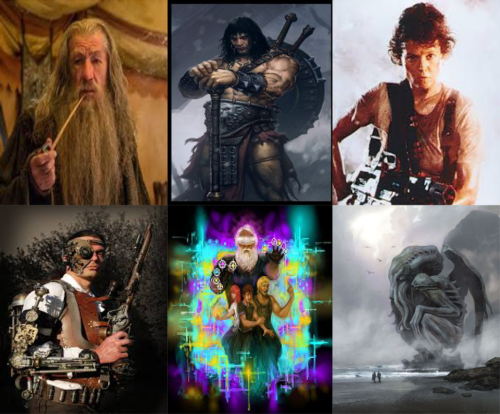
High fantasy fiction matches up to cannabis. Lord of the Rings contains a couple of sly allusions to cannabis use, most notably when Saruman admonishes Gandalf for his “love of the halfling’s weed” while explaining how Gandalf missed a clue that he should have noticed. The scene in the film Fellowship of the Ring where Gandalf and Frodo sit above the drunken revellers and smoke some magical substance from a pipe is one familiar to most stoners.

Some of the experiences that Elric has in the Stormbringer series of novels by Michael Moorcock were also very likely to have been cannabis-inspired. There’s something about Elric’s experience of having an extremely powerful ally that couldn’t really be trusted that speaks to the paranoia that sometimes comes with the cannabis experience.

The sword and sorcery style of low fantasy matches up with psilocybin mushrooms. It’s unlikely that Robert E Howard took any magic mushrooms before writing any of the Conan the Cimmerian stories, but the protagonist’s many adventures in dark, subterranean caves and inside fantastic towers and castles are reminiscent of the depth and range of sometimes terrifying personal insight that often comes with mushrooms.

The Forgotten Realms universe of Dungeons and Dragons adventures, with their massive, dark forests full of elves and goblins also relates closely to the vibe of the psilocybin mushrooms experience. The reason why magic mushrooms enthusiasts are encouraged to try taking five grams in silent darkness is because it leads to exploration of a fantastical inner world, and going down into the subterranean to arise wealthier at some later point is a regular theme.

Most of what sells as science fiction could have been inspired by LSD. Stories like The Demolished Man, with a very strong psychological content, harken to the disintegrative effect that psychedelics can have on the personality. The main character of The Demolished Man, somehow between protagonist and antagonist, ends up having his personality completely demolished (and then rebuilt) as punishment for his crimes, reminiscent of how the psychedelic experience can destroy a person and then build them back as something stronger than before.

This sense of twisted psychology comes through also in the writings of Philip K Dick, who had himself tried LSD. Psychedelics might have inspired the plot of Ubik, in which the character Glen Runciter experiences a believable but bizarre reality while his physical body is “on ice” in a cryogenic chamber. Wondering if you’re really dead or alive is the kind of thing that LSD can make happen to you.

The almost schizophrenic belief in a hidden real world outside of this merely simulated one is a mainstay of cyberpunk literature, and is similar to the impressions one gets on DMT or salvia divinorum. For thousands of years, human shamans have been having experiences of dying to the physical world and being reborn to the real one, like Neo did in The Matrix. In that regard, The Matrix is really a retelling of the ancient mystery school teaching of death and resurrection, reclothed in 21st-century technology.

A description of what might be the spirit of the DMT experience is given in the ANZAC cyberpunk novel The Verity Key. In the chapter Mindknife, the protagonist Jonty Gillespie has his perception altered by ingestion of a drug called Cinque Nuevo, which briefly blasts his consciousness out of his physical body and into an entirely external dimension that is occupied by beings that take the form of balls of light, while mechanical constructs that might be metaphors churn around him.

The datura experience is pretty similar to what befell many of the unfortunate researchers in the Cthulhu mythos of H. P. Lovecraft. A disquieting sense of things not being quite as they should be grows into an intense paranoia that leaps at every shadow and from there to total psychological collapse at the raw horror of reality itself. Alien beings that seem to have come to Earth just to torment you is the kind of thing you’re dealing with in either case.

Datura is also the kind of drug that fits the background of weird horror stories such as those in His Master’s Wretched Organ. Talking to grotesquely deformed entities like Mr. Creamfeather and eating tobacco cakes are the sort of horror that, once experienced, leaves a person never quite the same again. The concept of ordeal rituals that leave you wiser for having suffered come to mind here.

Others are arguable. The steampunk of The Rocketeer might suit opium, the boo-yah aggression of Starship Troopers might suit mescaline, and the gritty military noir of the Altered Carbon series might be the old classics of caffeine, nicotine and alcohol.

It might be hard to read any speculative fiction on most of these drugs, because a person on them is more likely to be occupied with the inner theatre of the thoughts in their head than a book in the external world. However, it might be possible to have a richer experience of reading speculative fiction after having tried some of them, because they could open your awareness to realms of thought previously unimagined.

Writing the Schizophrenic

The literary medium offers vast scope for portraying the perceptual and cognitive oddities characteristic of schizophrenia

There are a tremendous number of misconceptions about schizophrenia – a combination of a cultural reluctance to confront the reality of mental illness and prior inaccurate portrayals in popular media. Avoiding these misconceptions and cliches is crucial to creating a believable and engaging schizophrenic character.

Perhaps the most glaring misconception is the belief that having schizophrenia means having multiple personality disorder. Many people still seem to believe that having schizophrenia is like Strange Case of Dr. Jekyll and Mr. Hyde, in which a powerfully suppressed evil nature sometimes breaks through to the surface and takes over the mind of the patient.

It’s certainly possible that a schizophrenic might have powerful struggles with inner demons, but they are not werewolves. A psychopathic alter ego is more characteristic of the psychopath. Powerful mood swings might make the schizophrenic seem like different people, and might make them difficult to deal with, but the characteristic of multiple personality disorder is that the personalities are not aware of each other, and schizophrenics are not afflicted by this.

It’s also not true that a schizophrenic will just babble nonsense all the time. Although psychological disorganisation is characteristic of schizophrenia, and although this disorganisation makes it more difficult to speak and converse coherently, speaking in word salad is more characteristic of an acute state of psychosis. This is a common state for a schizophrenic to fall into, but is different to schizophrenia itself.

Schizophrenics usually spend much more time in non-psychotic states than psychotic ones because it’s extremely difficult to maintain the state of acute agitation necessary to become psychotic. This state requires so much emotion and energy that in practical cases the sufferer either wears themselves out or ends up becoming convinced (or forced) to take medication.

So it’s relatively rare for a schizophrenic to act truly crazy all of the time.

What is characteristic of schizophrenia are what is called positive and negative symptoms. These don’t mean ‘good’ and ‘bad’ symptoms but whether the loss of touch with reality is the result of something being added to the “normal” experience of reality or something being taken away from it.

Dramatic visions, delusions and hallucinations, such as those portrayed in the film A Beautiful Mind, fall under the rubric of positive symptoms. The most common form of positive symptom is that of hearing voices. This is very difficult to imagine for anyone who has not experienced it, but a character who suffers this symptom might think that someone is talking to them when no-one is really there.

Sometimes when a schizophrenic appears to be rambling, they are having a coherent conversation with someone who doesn’t appear to be there. This naturally sounds like rambling to an outside observer although the schizophrenic themselves might believe that they are having a perfectly reasonable conversation with someone right next to them.

Likewise, when a schizophrenic appears to be staring into space, it may be because they believe themselves to be in a part of the Great Fractal that is different to where the outside observer is. Much like in a dream, the material world might not be making much of an impact on the consciousness of the schizophrenic.

This means that writing a story from the perspective of the schizophrenic is likely to be a cross between surreal and terrifying. Because what other people take for granted as firm laws of reality do not seem to apply to the conscious experience of the schizophrenic, it’s very difficult for any other character to understand what the experience of a schizophrenic is like.

It’s also terrifying because having original ideas about the nature of reality brings out some powerful emotional responses in other people. It isn’t easy to have other people profoundly disagree with you about things that you take for granted. Experiences like this might go some way to explaining why a schizophrenic character would also suffer from negative symptoms.

Disengagement with society, flattened emotions and an inability to maintain routines are the characteristic negative symptoms of schizophrenia, and if you can present realistic positive symptoms to your reader then some of these negative symptoms should be easy to believe.

For example, the reader might understand why a schizophrenic character feels the need to disengage with society if they read about how frustrating and frightening is to constantly be told, by everyone that character meets, that reality is actually very different to how that character perceives it.

Likewise, they might understand why schizophrenics have flattened emotions when they read about how a schizophrenic character has to compensate for the apparent fact that many of the things they perceive to exist aren’t really there. There are good reasons to not react strongly to things, even when those things are extremely bizarre or unusual, if one ordinarily sees a series of bizarre things that aren’t really happening.

The experience of being unable to maintain routines is a natural consequence of having an unusual amount of chaos in the mind, and it could be the routines in a character’s life falling to pieces that gives the first sign to those around them that a mental illness is developing.

Generally speaking, schizophrenia is an extremely difficult condition to portray accurately because of its complexity and because the experience of a schizophrenic is often fundamentally different to the experience of other people. Often the schizophrenic character will react reasonably and logically to the impressions that come into their mind and it is how those impressions get there which is the truly strange thing.

*

This article is an excerpt from Writing With The DSM (Writing With Psychology Book 5), edited by Vince McLeod and due for release by VJM Publishing in the summer of 2017/18.

The Limits of Inclusiveness

Gay people are categorically unwelcome here

With news that Queensland Islamic authorities are urging their followers to vote “No” to same sex marriage, the levels of cognitive dissonance among many on the left are starting to become painful. It’s now undeniable that a grand coalition of everyone who isn’t a rich, straight white male is an untenable concept. This essay examines why.

For the past couple of decades, leftist groups across the world have looked for solidarity on the basis of “the enemy of my enemy is my friend.” This logic has inspired the “tolerant left” to make a show of solidarity towards any and all groups that had a grudge against the people running the world – commonly agreed to be rich, straight, white men.

This has led to the left adopting the idea of inclusiveness as a moral virtue. Any and all alliances with people who hated the Establishment had to be entertained. It didn’t matter if they were women, gay, black, Muslim or anything else, just as long as they wanted to overturn the status quo.

However, this grand political dream to remake the world in one’s image fell apart, as such schemes inevitably do, because it ran into inexorable silver laws of psychology.

It can be stated as a psychological rule that, the larger and more diverse any given group, the weaker the bonds of solidarity that hold it together will be, and the smaller and more pure any given group, the stronger those bonds of solidarity will be.

This is obviously true if we look at the extremes. At one far extreme we could consider the nuclear family to be the smallest group with the strongest solidarity. Parents are often ready to kill if that is necessary to protect their offspring, and “brother” is used as a gesture of common bonds in all kinds of ideological movements, so it’s easy to see how this small, extremely exclusive group has the highest solidarity.

The reason why you can’t just let a random person into your family and have them considered one of you is because this would increase the degree of diversity of the group to the point where such extremely strong bonds of solidarity are no longer tenable because the necessary level of trust isn’t there.

The obvious reason for this is because the already existing members of the family have next to nothing in common with a random person, so there’s no special reason to trust them.

At the the other far extreme we could consider the human species to be the largest group with the weakest solidarity. Indeed, we can see here that people generally don’t care at all if they hear that someone on the other side of the world died, unless that person had something in common with them, such as a native language or racial origin.

Further evidence for this can be observed if we place the nation states along a line with a familial level of solidarity (highly discriminating and strong) at one end and a universal level of solidarity (undiscriminating and weak) at the other.

Here it can be seen that the nations that cast the net of citizenship over an extremely broad set of different people (USA, Brazil, South Africa, Russia) have the lowest levels of solidarity, measured by the unwillingness of the wealthy to contribute to the communal welfare in the form of taxes, and by the willingness with which the poor use lethal violence on other citizens.

It can also be seen that the nations that cast this net more exclusively, such as only over a small, homogenous ethnic group (Scandinavia, Japan, Germany, South Korea, Canada), have the highest levels of solidarity, measured by an egalitarian culture and low levels of interpersonal violence.

Fitting this trend, countries with moderate levels of diversity (Argentina, Britain, Australia, New Zealand, Chile) are in the middle.

There’s no escaping this silver law: the more inclusive the group, the weaker the bonds of solidarity, and the less inclusive the group, the stronger the bonds of solidarity.

The idea of trying to include as many people in the wider group as possible is essentially a feminine idea, and this is why it is generally associated with the left. It’s a form of horizontalisation that seeks to remove all distinctions from people in order to homogenise us into an easily malleable ball of putty.

However, we can now see the limitations of it. The motivation behind this idea is ostensibly to avoid making people feel bad on account of being excluded, but the flipside of it is that no-one ever feels good on account of being included.

This has led to a situation where Muslim immigrants, considered by the trend-setters among the left to be allies on account of a mutual Christian enemy, will vote against the rights of other leftist allies if those allies are homosexuals. It is a tremendous irony that these religious fundamentalists, allowed into the country because of a desire to display the virtue of tolerance, do not share the belief in the value of that tolerance, and so are now acting to maintain intolerance towards groups they consider outsiders.

With the recent wave of immigration having made our societies much more diverse, we have correspondingly lost much of the solidarity that used to provide us with a sense of society and community. The net has been cast so wide, thanks to a fanatical ideology that believes it can erase all human uniqueness, that it cannot keep hold of what it covers.

In other words, the inevitable consequence of trying to treat everyone like your brother is that your brother can no longer count on a brotherly level of exclusive solidarity from you, and will have to settle for much less. People who believe that inclusiveness is necessarily a virtue might therefore want to be careful what they wish for.

Stockholm Syndrome and Modern Society

Victims of Stockholm Syndrome might be a lot more common than is usually appreciated

44 years ago, two Swedish bank robbers took four hostages during a failed robbery attempt at the Kreditbanken in Norrmalmstorg, Stockholm. Although the robbers kept the hostages for six days and forced them to endure psychological torture, the hostages declined to testify against the robbers when freed and even went as far as raising money for their defence. This phenomenon gave rise to the term “Stockholm Syndrome“.

The psychological literature defines Stockholm Syndrome as “strong emotional ties that develop between two persons where one person intermittently harasses, beats, threatens, abuses, or intimidates the other.” It appears to have similarities to battered wife syndrome and to learned helplessness, and is otherwise known as “capture bonding”.

This phenomenon appears strange to neutral onlookers because the expected emotional consequence of subjecting someone to the trauma of being taken hostage is hatred. Because one loses one’s ability to move and talk freely on pain of being shot dead, it could reasonably be expected that a hostage would feel, at first, fear and anger, and then hatred.

Stockholm Syndrome doesn’t only occur in cases of botched robberies. The specific phenomenon is probably related to behaviour that naturally occurs in dominance hierarchies – in other words, Stockholm Syndrome is a manifestation of a specific submissive strategy that probably had frequent application in the brutal biological past of the human species.

For the vast majority of the history of the human species there have been no laws, and nothing even approaching a justice system. The first ever code of laws is thought to have been introduced by the Babylonian King Hammurabi almost 4,000 years ago, which means that for 96%+ of our existence the only thing that passed for justice was what you were physically capable of beating out of other people with your fists.

Because humans are a social species, this environment of easy violence meant that a large range of behaviours relating to how to show aggression and how to show submission evolved over time. Of course, many of these behaviours would have evolved long before humans ever became a separate species, and many of them are so old that their expression is more subconscious and instinctual than a deliberate attempt to manipulate.

Stockholm Syndrome is similar to the phenomenon of learned helplessness, in which a creature that has been brutalised without hope of escape for long enough comes to “learn” that no escape is possible, and can consequently fail to take an opportunity to escape when one does arise. In this sense it could also be considered similar to clinical depression.

What most people don’t realise is that we, the people of modern Western societies, have also been brutalised into submission by our own ruling classes, and so badly that our relations to them are akin to a hostage with Stockholm Syndrome towards their captor. In the middle of an election campaign – as we can see all around us – it’s possible to observe the abject state of emotional submission to which the populace has been reduced.

This is partially achieved by the kind of sadism that is common in primary school students. Like Winston Smith in 1984, who had a form of Stockholm Syndrome deliberately inculcated in him by the sadistic O’Brien, we have been meticulously brutalised by a control system that has had 5,000 years to perfect its tactics for manipulating the peasantry.

From childhood we are forced to get up early in the morning so that we can be most efficiently conditioned into a life of factory work. Anyone who has not received enough sleep by this time, for whatever reason, is severely punished. Absolute submission to authority is rewarded, on a daily basis, for over a decade, and all instances of failure to submit are punished mercilessly.

After a decade, it’s generally assumed that the brains of the victims have been tenderised enough for the teachers to hand us over to the employers, with whom we remain until it’s time to throw us on the scrapheap.

If at any time during this period of servitude we get the idea that we would like to smoke a medicinal flower to take some pain away, or to take some magic mushrooms in order to bring us closer to God, then members of a group of enforcers specially chosen for their willingness to follow orders will come and put us in a cage with rapists and murderers.

It will not be possible to reason with this enforcer class. One cannot argue, for example, that this enforcer class has no right to put you in a cage for simply trying to heal yourself physically, emotionally or spiritually. If you resist you will be attacked, and if you continue to resist you will be killed.

Neither can one count on the support of your fellows to resist such laws. The vast majority of the people has been conditioned to bow their heads and shrug their shoulders when they hear stories about the crimes that the enforcer class have committed against them. Ideologies of freedom, like anarcho-homicidalism, are mocked and rejected.

Such arbitrary laws, against medicines and sacraments that have been used by humans since before the Code of Hammurabi, can only have the effect of demoralising the people who fall under their whip.

Most of the people who don’t find the current state of affairs appalling are suffering from Stockholm Syndrome, where they are the hostages and the ruling class are the captors. Essentially they are those who have been brutalised so hard that they have lost all will to resist and can be directed by the ruling class as easily as sheep can be led to slaughter.

We can see them being led to the voting booths right now in order to show their consent to the whole ghastly procedure. Here we can see that the emotionally mutilated citizenry will not only cast a vote in favour of the Establishment that mutilated them, they will also cast a vote to give that Establishment permission to emotionally mutilate their children too.

That a random person suffers from Stockholm Syndrome is not the exception but the iron-fast rule in our modern societies.