The Game Theory Of Immigration

Imagine a situation – let’s call it 1970s Sweden – where 99% of the population are Swedish. In such a homogenous society, there is a high level of genetic relatedness. Even people who are not direct family will have a common ancestor a few dozen generations back. Any two Swedes from the same city have an excellent chance of having common family, even if through marriage.

In such an environment, the nation is like an extended family. Any two randomly-chosen Swedes will be some kind of cousin, even if distant. Going back 25 generations – some 500-600 years – means a person will have tens of millions of ancestors. In a country of ten million such as Sweden, that means multiple common ancestors.

Imagine an altruistic action that cost a Swedish person, but which benefitted their society. Putting a shopping trolley away, picking up rubbish, volunteering for community work, donating to charity, choking down rage when someone offends them.

Lets say this person’s pro-social action cost them 100 units of misery, but provided two units of joy to 100 people in their community. If 99 out of 100 members of their community are related to them in some way, that means that 198 units of joy were created for that person’s kin. If everyone in the community contributed in such a manner, then even with a few freeriders it would be possible to have a very high standard of living.

Now imagine a situation – let’s call it 2020s America – where some 50% of the population are of one nation, related by flesh and blood, and where some 50% of the population are from other nations. In such a heterogenous society, flesh and blood relations are not the norm. It’s more common for people to live in neighbourhoods with others who don’t share recent common ancestors.

In an environment like this, society is not like an extended family. Half of the people one meets will be complete strangers – friendly? hostile? no-one has any idea. Any two randomly-chosen Americans have a 50% chance of being part of the same nation, and a 50% chance of being as distant as any two randomly-chosen Earthlings.

Lets say, as in Sweden, that a person’s pro-social action cost them 100 units of misery, but provided two units of joy to 100 people in their community. Because only 50% of the community are kin, that means 100 units of joy were created for the American’s kin from that action. It’s an even equation, and we would expect, therefore, the average American to be somewhat indifferent about such pro-social actions. And they are. This is the main reason why American infrastructure is less well maintained than Swedish.

Now imagine an immigrant whose kin makes up 1% of the local population. It doesn’t matter which country they live in, just as long as their kin are only 1% of the population, and the other 99% are mere strangers.

This person’s pro-social action also costs them 100 units of misery and provides two units of joy to 100 people in the community, just like it does for everyone else. But there’s a difference for the immigrant. Only 1% of the community belong to the immigrant’s kin. So the pro-social action – which costs 100 units of misery just as for anyone else – only provides two units of joy to the immigrant’s kin.

Why not, then, restrict pro-social actions solely to one’s nearest kin?

This is the question that many immigrants end up asking themselves – and the more diverse a society becomes, the more others ask it as well. The inevitable end result is a low trust, dog-eat-dog society.

Imagine now, an action that cost only ten units of misery but produced two units of joy to 100 people in the community. This wouldn’t be a major volunteer effort: it would be more like putting one’s shopping trolley away or putting one’s litter in the bin. Those basic civil behaviours that many Westerners consider normal if they’ve never been to the Third World.

The Swede and the American would both do it without thinking. The payoff for both is obvious. But the logic for the immigrant is different. Ten units of misery might not be much, but 99% of the benefit from making the effort will go to strangers. Only two units of joy will be received by the immigrant’s kin. So it’s still not worth taking the action.

One can see, therefore, that even minor acts of civil respect are no longer performed once the surrounding population is sufficiently different.

These potential actions constitute a basic Prisoner’s Dilemma. Do I cooperate or defect? Co-operating here means to spend time or energy on upkeeping or improving society. Defecting is spending time and energy on one’s closest kin or oneself only.

We can see from basic evolutionary psychology and game theory that people are much more likely to cooperate if doing so would benefit their kin. They know that their kin are much more likely to cooperate in return. This is the basis of altruism. But there’s a flipside: if not enough of one’s kin would benefit from an action being taken, one doesn’t take it.

It’s not as simple as this, of course. People in reality don’t make such hard distinctions between kin and non-kin as in this thought experiment. But however you figure it, there are thresholds of diversity that, once passed, dissuade people from taking various pro-social actions. If the energy from a pro-social action does not help one’s kin but instead just dissipates into the wider world, then why bother? Many people reason this way, and it’s entirely natural.

It’s often asked by social commentators why people don’t contribute anymore. The answer is blackpilling: society has become so diverse that it no longer makes sense to. In diverse societies, people tend to “hunker down”, as described by Robert Putnam in his lecture E Pluribus Unum: Diversity and Community in the Twenty-first Century. Putnam summarises the findings of social psychology research into diversity with “The more ethnically diverse the people we live around, the less we trust them.”

In more specific terms, consider the above logic in terms of support for taxation.

A Swede in 1970 might pay 100,000 Swedish krona in taxes, and not complain, reasoning that his kin will get 99,000 krona in value from it. Even if he assumes that there are no economies of scale from government spending, and that taxation has a redistributionary purpose only, enough of his kin benefit from the redistribution that he can easily reason society is made better thereby.

An American in 2025, by contrast, might pay the equivalent of 100,000 Swedish krona in taxes, and complain heavily, reasoning that his kin will only get 50,000 krona in value. “I can spend my own money better than the Government can,” is a common refrain in America, for this reason. The tax money one pays mostly goes to someone else’s kin. Any economies of scale earned mostly go to someone else.

An immigrant to either society in 2025 might reason that his 100,000 krona only pays back 2,000 krona in value to his kin. Might as well not even bother working if this is the case. Especially if the tax money that pays your welfare is paid by non-kin. Why would anyone feel guilty about being on welfare, if it’s non-kin who have to pay for it?

All this explains why the more diverse a country is, the less taxes people pay. Countries like Sweden, where taxes mostly go to help the kin of the taxpayer, vote for higher taxes than countries like America. Immigrants, for their part, vote for low taxes if a net tax payer and for high taxes if a net tax receiver.

All this also explains the voting patterns of the various American demographics. Highly white, high-trust states like in New England vote for high taxes, just like highly white, high-trust Sweden. White people in multicultural areas like Los Angeles, Houston and Atlanta vote for right-wing parties and for low taxes. Blacks and Hispanics vote for high taxes and more welfare; Asians and Indians vote for low taxes and less welfare. These patterns are to be expected given the game theory of immigration.

As a final thought experiment, flip misery and joy around and think about crimes.

A Swede will be highly disinclined to commit a crime against a random member of his community, because they are probably related. Although many crimes, in practice, are committed against kin, this is almost entirely a function of the proximity effect. In terms of inclination to commit a crime, the vast majority of people are more inclined to attack non-kin, which is the main reason Swedes commit so few crimes.

An American who lives in a community that is 50% kin can be predicted to be only moderately disinclined to crime. Indeed, crime rates are much higher in America than in Sweden. Revealingly, white Americans in 95% white American communities commit crime at a similar rate to white Europeans in 95% white European communities. It’s a different story in the urban jungles of the big cities. There it’s possible to find whites much more violence-prone than the average Swede.

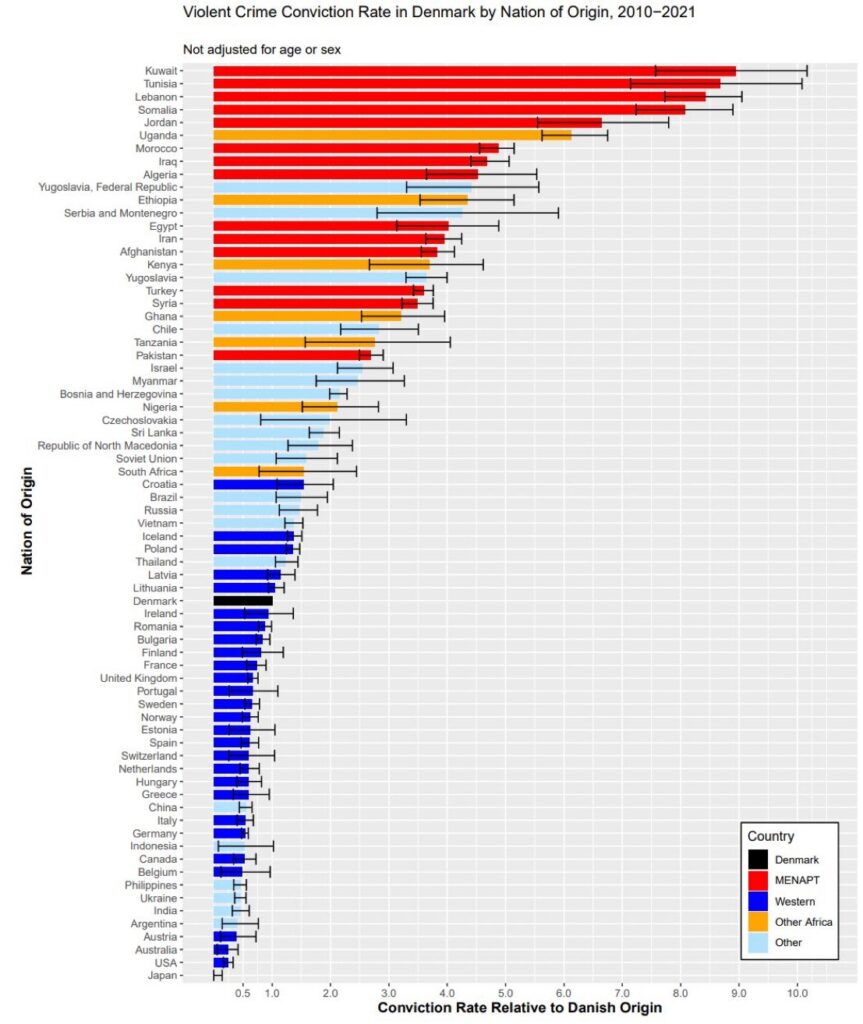
An immigrant who lives in a community that is only 1% kin has very little reason to care about crime. If 99% of people are non-kin, then crime and its consequences are someone else’s problem. Thus you might as well do crime if you feel like it. This is principally the main reason why certain immigrant groups commit such tremendous rates of violent and sexual crimes against the locals. As can be seen in the table above, Kuwaitis commit an incredible amount of violent crimes in Denmark, yet Kuwait itself is not particularly dangerous.

In summary, investigating the game theory of immigration makes it clear that as a society becomes more diverse, ever-more marginal pro-social actions get taken less often, and that society deteriorates. A study in The Quarterly Journal of Economics found that “Trustworthiness declines when partners are of different races or nationalities”. In other words, diversity destroys trust. Because the solidarity inspired by trust is the bedrock of society, it’s no exaggeration to say that diversity destroys society itself.

*

For more of VJM’s ideas, see his work on other platforms!
For even more of VJM’s ideas, buy one of his books!

*

If you enjoyed reading this piece, buy a compilation of our best pieces from previous years!

Best VJMP Essays and Articles of 2023
Best VJMP Essays and Articles of 2022
Best VJMP Essays and Articles of 2021
Best VJMP Essays and Articles of 2020
Best VJMP Essays and Articles of 2019
Best VJMP Essays and Articles of 2018
Best VJMP Essays and Articles of 2017

*

If you would like to support our work in other ways, make a donation to our Paypal! Even better, buy any one of our books!

Clinical Narcissism: Think Lightly Of Yourself And Deeply Of The World

Guest Post by Thomas S.

According to ancient Greek mythology, Narcissus was a youth of incomparable beauty, born from the coupling of the river deity Cephissus and a nymph named Liriope. Such was his beauty that bewildered and broke the hearts of all those who chanced to see him, that the blind prophet Tiresias cautioned Liriope that her son would live a long life, so long as he never came to know himself.

Followed by wanton eyes and beseeched by the lusts and longings of hopeful lovers, Narcissus would reject all advances made upon him. This eventually led to a curse by Ameinias, who upon rejection was handed a sword with which to commit suicide, but not before appealing to Nemesis, the goddess of revenge, that Narcissus would never be able to obtain the one he would one day fall in love with.

It was after losing his way while out hunting in the forest one day, that this curse of Ameinias, as well as the prophecy of Tiresias, would eventually bear fruit. Tired and thirsty, Narcissus happened upon a pool of water, which he stooped over to drink from.

Meanwhile, a mountain nymph named Echo was weeping nearby, having been the most recent suitress to have been rejected by Narcissus after having fallen in love with his beauty and made shy advances upon him.

Interestingly, the nymph, who had been cursed by Hera, the Queen of Heaven, for having deliberately distracted her with idle gossip in order to prevent her from discovering the affairs of her husband Zeus, was only able to utter the last few words of another, and was otherwise deprived of the ability of speech.

Unable to bear the torment of rejection by Narcissus, the mountain nymph was consumed by grief and her physical form melted away, leaving nothing more than a whisper, capable only of mimicking the words spoken by another, as is our experience of an echo still to this day.

While Echo’s voice trailed away, Narcissus scooped water from the pool in order to quench his thirst. As he did so however, a charming face below the shimmering waters caught his eye and soon became the object of his own heart’s desire – an object, which as per the curse of Ameinian, would remain unobtainable to him.

Forgetting his thirst, Narcissus reached toward his own reflection, while his reflection reached upward in return, only to be dispersed by the splashing until the stillness of the waters resumed between each failed attempt to clasp his beloved’s hand.

Eventually, Narcissus gave up his life due to the torment of being unable to attain himself, and was transformed into the daffodil flower.

Like many Greek myths which are etiological in nature, the story of Narcissus offers an explanation for why observable phenomena within our human experience, have come to be.

Clinical Narcissism

In the modern day, this same phenomenon of excessive self adoration, which was also evident in ancient times and thus deserving of an origin story, has come to be known as the narcissistic personality disorder, which can also sometimes be regarded as being pathological in nature.

While a high degree of variability of character is evident in those diagnosed with the condition, such as being either socially reclusive or highly extroverted, self-loathing or self aggrandising, having a history on the right or the wrong side of the law, and demonstrating all manner of success or failure in the professional field, narcissism can be problematic to diagnose clinically.

Additionally, there are specific clinical subtypes of this condition, and while narcissism is often associated with the grandiose and overtly arrogant and exploitative stereotype, there are also those who are fragile, shy and hypersensitive to the evaluations of others while harbouring deeply envious as well as grandiose delusions.

Both subtypes however, are excessively self-absorbed and it is possible for a narcissist to fluctuate between these states, depending on life’s circumstances.

It is also possible for a narcissist to exhibit a mix of these qualities, as well as for a narcissist to be ‘high functioning’ and able to employ their character traits in order to succeed, while their competitive, attention seeking and sexually provocative traits can often go unrecognised.

Former New Zealand Prime Minister Jacinda Ardern for instance, could be described in this way, for she employed various devices and rhetoric around themes of compassion and kindness, which all turned out to have been self-serving and politically expedient tools, rather than sincere sentiments. The effects soon wore off during the tyranny which ensued during her time in office.

Despite the diversity of narcissistic personalities, there are however, several indicators which have been published by the American Psychiatric Association, which may contribute to such a diagnosis when several exist concurrently in an individual.

These indicators are as follows:

1. Has a grandiose sense of self-importance (e.g., exaggerates achievements and talents, expects to be recognized as superior without conmmensurate achievements).
2. Is preoccupied with fantasies of unlimited success, power, brilliance, beauty, or ideal love.
3. Believes that he or she is “special” and unique and can only be understood by or should associate with, other special or high-status people (or institutions).
4. Requires excessive admiration.
5. Has a sense of entitlement (i.e., unreasonable expectation of especially favorable treatment or automatic compliance with his or her expectations).
6. Is interpersonally exploitative (i.e., takes advantage of others to achieve his or her own ends).
7. Lacks empathy: is unwilling to recognize or identify with the feelings and needs of others.
8. Is often envious of others or believes that others are envious of him or her.
9. Shows arrogant, haughty behaviors and attitudes.

Of course, it is reasonable to expect that most people experience some degree of arrogance, selfishness and other character flaws, although clinical narcissism is a condition deeply affecting an individual’s self-esteem, sense of identity and their relations to others.

While the causes of clinical narcissism are not definitively known, there are indications that several factors, including genetics, childhood trauma and parenting, as well as cultural factors, may all contribute to an individual displaying a narcissistic personality disorder.

In particular, abuse, neglect, or parental overindulgence may inhibit the development of a child’s expectations in regards to themselves and other people. Adoption, divorce and losing a parent prematurely through death are also factors which may put a child at risk of developing a narcissistic complex.

Unfortunately however, many cases of emerging clinical narcissism in childhood and adolescence are left to develop without intervention through counselling or behavioural therapy. And later in life, many narcissists remain wholly unaware of their own character flaws and unwilling to admit that they could do well to improve themselves.

And while many narcissists do eventually self destruct under the weight of their own absurdities, the tragedy is that few are willing to learn from these mistakes, instead placing blame on those around them whenever discrepancies are called to account.

True Wealth Of Character

Unlike the narcissist however, there are those in life who in addition to a high degree of personal achievement, also demonstrate those qualities which may be regarded as wealth of character, such as genuine humility, renunciation, compassion and so forth.

The Japanese swordsman Miyamoto Musashi, who lived in the sixteenth and seventeenth centuries for instance, was a revered martial artist who attained the status of a kensei and was regarded as the most accomplished swordsman of his time, capable even of fighting with a sword in each hand.

After a life of considerable achievement, he eventually took to Buddhism in his later years, retiring from martial arts and taking to deep contemplation and a solitary existence. Musashi produced two works during his retirement, Go Rin No Sho, or The Book of Five Rings, as well as Dokkodo, or The Path of Aloneness.

Both books were passed on to his students in the days prior to his death and have been widely studied in many languages in the centuries since. Most significantly, according to precept four of Dokkodo, Musashi advises one to “think lightly of yourself and deeply of the world”.

As this precept suggests, Musashi was grounded in a higher reality afforded by spiritual practice and practical renunciation, rather than base egoism. And interestingly, the seeds of this worldly detachment had also been tended to and nurtured prior to his retirement, throughout his career as a mendicant swordsman where he was confronted with the impermanent nature of life on a regular basis.

This deep sense of renunciation or detachment is one of six primary opulences in life, and is a precursor to the development of finer qualities of character, beyond the base animalistic ambitions. The opulence of wealth for instance, is rendered more desirable when complemented by detachment and a man who humbles himself despite his status, endears himself to others.

Those who are preoccupied by the low-hanging fruits and the bondage associated with self-absorption and egoism however, whether they be clinical narcissists, or simply those who indulge too frequently in their lower nature, are unable to obtain or sustain true wealth of character, despite their worldly achievements.

*

Thomas S. is a Kiwi writer with an obsessive interest in the truth, especially when it comes to spirituality and politics.

*

If you enjoyed reading this piece, buy a compilation of our best pieces from previous years!

Best VJMP Essays and Articles of 2023
Best VJMP Essays and Articles of 2022
Best VJMP Essays and Articles of 2021
Best VJMP Essays and Articles of 2020
Best VJMP Essays and Articles of 2019
Best VJMP Essays and Articles of 2018
Best VJMP Essays and Articles of 2017

*

If you would like to support our work in other ways, make a donation to our Paypal! Even better, buy any one of our books!

Some Very Basic Advice For The Mentally Ill, From A Veteran Of The Mental Health System!

This year marks the thirtieth anniversary of my entry into the New Zealand mental health system. It’s been a frustrating and horrifying journey, a blend of Brave New World and Dante’s Inferno. Because much of what mental health experts have told me in this time has turned out to be false, I have had to teach myself about psychiatry to a major extent. If I could summarise what I have learned about dealing with a psychiatric condition oneself, I would give two basic pieces of advice.

First, understand nervous system regulation.

Modern psychiatric theory has abandoned the chemical imbalance model for the traumagenic neurodevelopmental (TN) model. This means that no well-informed person still believes that mental illness is mostly caused by chemical imbalances that can only be corrected by expensive pharmaceuticals.

According to the TN model, early childhood trauma plays the major role in mental illness by causing the brain to develop in unnatural ways. The brains of highly traumatised people tend to respond much differently to stress: some anxious and neurotic types powerfully over-react, some bluntened and depressed types under-react. Such abnormal responses to stress can make it much harder to live a normal life.

This model has implications for those who have, until now, believed that their condition was the result of something intrinsically wrong with them mentally or spiritually. It turns out that most psychiatric conditions are actually physiological in nature.

Somatic symptoms such as headaches, insomnia, nausea and migranes are often stress responses, and signals that the nervous system is already hyperaroused. Anxiety and depression are common consequences of suffering this hyperarousal for an extended period of time. As such, keeping the nervous system well-regulated is crucial for lessening the impacts of most psychiatric conditions.

The best way to do this is to avoid stress, which is not always possible. The grim truth is that most stresses are forced on people by the needs to find food and shelter. Nonetheless, there’s a lot each individual can do to minimise the stress on their nervous system.

Learning to meditate is one of the best things that anyone with a psychiatric condition can do. Cultivating the ability to not physiologically react to distressing thoughts is as good as taking any pharmaceutical. Dedicated meditation practice can downregulate the nervous system more effectively and more permanently than anything else.

Another great move is learning to avoid toxic narcissists. This is also not always possible, because of family and work obligations. But it’s very useful to learn the typical early warning signs of toxic narcissism, so that those displaying it can be shunned as early as possible.

Second, understand the importance of connection. This means connection at every level: to family, to community and to the divine.

The simplest and easiest way to feel connection is through one’s family. But, if you have a psychiatric condition, chances are high that your family environment is psychotogenic. If so, then interacting with your family can add to the stress and nervous system dysregulation. This is where the community comes in.

Connection to the community is relatively easy, but here a person has to be realistic. A mental illness will mean that certain avenues into the community will be closed off. However, it will also mean that solidarity can be easier to find in some other ways. It’s very easy to feel solidarity with other people who have had to deal with the psychiatric system. Groups organised on this basis that meet physically can be challenging to find if one doesn’t live in a city, but there are numerous online groups devoted to every psychiatric condition.

Divine connection is harder to find. The main problem here is that Westerners have been lied to about spirituality for centuries. The native Western spiritual traditions were destroyed by the coming of Christianity, so that when Christianity died, we were left with only memories of the divine. When the European spiritual traditions, such as the Eleusinian Mysteries, were lost, the Western soul was lost to confusion.

The answer here is a combination of meditation and spiritual sacraments. Correct meditation will silence the mundane thoughts, and correct spiritual sacrament use will bring the glory of the divine back to consciousness. This combination of meditation and spiritual sacrament use is the basic formula espoused by some New Age religions such as Elementalism.

Cultivating a divine connection can help create a sense of belonging, which many people do not otherwise have. It’s common to feel like an alien on this planet and in this society. Meditating or taking spiritual sacraments with friends or family can create powerful feelings of connection with the rest of reality.

Society might never have been more mentally ill than today. However, it has (probably) never been easier for an individual with a mental illness to cope with it. Advanced knowledge of the causes and treatment of mental illness is now available through the traumagenic neurodevelopmental theory, and communities of meditators or spiritual sacrament users have never been easier to find.

*

For more of VJM’s ideas, see his work on other platforms!
For even more of VJM’s ideas, buy one of his books!

*

If you enjoyed reading this piece, buy a compilation of our best pieces from previous years!

Best VJMP Essays and Articles of 2023
Best VJMP Essays and Articles of 2022
Best VJMP Essays and Articles of 2021
Best VJMP Essays and Articles of 2020
Best VJMP Essays and Articles of 2019
Best VJMP Essays and Articles of 2018
Best VJMP Essays and Articles of 2017

*

If you would like to support our work in other ways, make a donation to our Paypal! Even better, buy any one of our books!
What El Salvador Could Teach New Zealand About Solving The Gang Problem

Nayib Bukele is the President of El Salvador, having won re-election earlier this year with almost 85% of the popular vote. Most of his popularity is a result of his security strategy, which has transformed El Salvador from an extremely dangerous country to a safe one. On X, Bukele describes himself as a “philosopher king”. His security philosophy might be applicable to other places plagued by gangs.

Bukele’s approval rating today is some 89%, making him arguably the most popular leader of any country. Understanding why he is so popular requires understanding the difference between the El Salvador before Bukele took power, and the El Salvador now.

El Salvador used to be the most violent country in the Western hemisphere. The MS-13 and Barrio 18 gangs had reduced the country to a battleground. With everyday life under gang control, El Salvador was in danger in collapsing into Haiti-style anarchy. The homicide rate in 2015 was over 100 per 100,000 people.

Bukele came to power in 2019. The homicide rate had fallen from its peak since then, but was still extremely high. In March 2022 there was a spike in homicides due to MS-13, wherein 87 people were randomly murdered by the gang over a three-day period. This was apparently an attempt by MS-13 to intimidate the people of El Salvador into submission.

The response was a ‘War Against the Gangs‘, launched by Bukele that same month. He had described gangs as the metastases of a cancer that is killing Salvadorean society.

The crackdown saw the arrest of around 2% of the Salvadoran population and the construction of a 40,000-person maximum security prison, known as the “Terrorism Confinement Centre”. Since these measures were taken, El Salvador’s homicide rate has plummeted. In 2023 it was a mere 2.4 per 100,000 (c.f. Canada at 2.3).

Could a similar strategy work here?

For one thing, New Zealand gangs don’t cause as much damage as the gangs in El Salvador. The homicide rate in New Zealand is lower than even the 2023 rate there. New Zealand gangs might be feral by New Zealand standards, but by Latin American standards they’re standard-bearers of civilisation.

However, the general cancer metaphor is apt. As family members of gang members can tell you, the damage caused by gang members is not limited to crime. Immeasurable quality of life damage is caused by the constant threats, intimidation and antisocial behaviour that comes with the presence of gang culture.

Moreover, existing gangs could cause extreme damage in the future. The example of El Salvador shows that the homicide rate can increase manyfold in a short period if the economic and social environment permits. Given the ongoing economic collapse of the Anglosphere, anyone could confidently predict a rise in both volume and intensity of gang activity in coming years.

Bukele’s Terrorism Confinement Centre has room for 40,000 people. New Zealand was known to have 8,300 gang members nationwide near the end of 2022. We could, therefore, build a much smaller prison – one that fit 10,000 people – and still have enough room to put every single gang member in it for life.

Other anti-gang measures could readily be adopted from El Salvador.

One of these is the reduction of the age of criminal responsibility, from 16 to 12. Having the age at 16 makes sense in a high-trust, high-social capital environment where most people want to do good. In a low-trust environment, however, tolerance and kindness just gets taken advantage of. Gangs exploit that tolerance and kindness by getting younger teenagers – too young to be charged – to commit crimes. This phenomenon also exists in the New Zealand gang scene, so we might benefit from a similar reduction in the age of criminal responsibility.

Of note is that one element of Bukele’s crackdown was banning media from expressing pro-gang sentiments. If implemented in New Zealand, this would prevent The New Zealand Herald offering a column to former Black Power pack rapist Denis O’Reilly. It would also prevent the numerous hagiographies about gang leaders doing community work.

Unfortunately, no measures will be taken to protect the New Zealand people from the gang menace as long as globalists are in power.

What New Zealand needs is a leader that cares about the New Zealand nation first and foremost.

Also of note is that the political philosophy of Bukele’s movement is explicitly anti-democratic. Bukele’s Vice-President, Felix Ulloa, has said “The democratic system that existed for years in El Salvador only benefited crooked politicians.” The system that exists in New Zealand also only benefits crooked politicians. That suggests that solving our leadership problems might require also solving the democracy problem.

All this might be too much for New Zealand for now – we are yet to see the Mongrel Mob, the Headhunters, Black Power or the Hell’s Angels murder random civilians in New Zealand to intimidate the Government. But the worse our gang problem becomes, the more we will need to consider the need for a Nayib Bukele-style crackdown.

*

For more of VJM’s ideas, see his work on other platforms!
For even more of VJM’s ideas, buy one of his books!

*

If you enjoyed reading this piece, buy a compilation of our best pieces from previous years!

Best VJMP Essays and Articles of 2023
Best VJMP Essays and Articles of 2022
Best VJMP Essays and Articles of 2021
Best VJMP Essays and Articles of 2020
Best VJMP Essays and Articles of 2019
Best VJMP Essays and Articles of 2018
Best VJMP Essays and Articles of 2017

*

If you would like to support our work in other ways, make a donation to our Paypal! Even better, buy any one of our books!