Lies Are Far More Toxic Than Drugs Ever Could Be

Illegal drugs are illegal, so we are told, because they harm the brain. Drugs such as cannabis are apparently toxic enough to cause brain damage in those who use them, rendering them mentally defective and often permanently so. One notable thing harms the brain more than cannabis though – lies.

The brain is an extremely plastic organ, and it has a number of defences against injury and poisoning, notably the blood-brain barrier which prevents poisons reaching the brain from the main blood supply (contrary to popular belief, smoking cannabis doesn’t cause psychoactive molecules to enter the brain directly through the lungs). It’s a terrible idea to mistreat your brain, but the fact is that the brain can deal with a lot.

The human mind is also extremely plastic, but, also like the brain, there are circumstances in which it is not. Under these circumstances, suffering can cause part of the mind to solidify so that it fixates on a certain belief or impression. This is very common in the case of trauma, because there is a clear biological imperative to learn quickly to avoid it.

A great example of this is how a religious upbringing often leads to people who hate religion with a passion. It is traumatic to be subjected to the heavily guilt and shame-based psychological manipulation that is a cornerstone of many religions (particularly the Abrahamic ones). Many women and homosexuals grow up hating themselves because of religious abuse, and if/when they realise as adults that this abuse was unnecessary, they come to hate the culture that abused them.

When people are told that, for example, male infant gential mutilation is a good thing, or that Johnny from down the street is going to hell forever because his family are the wrong denomination, they learn to hate and fear. When these people grow up and become adults, and realise that they now need Viagra because of lost penile sensitivity from the mutilation in infancy, the natural response is to hate the religious and anyone who claims to speak for the spiritual.

Perhaps the most disgusting, harmful and shameless set of lies are those stemming from the War on Drugs that the Government is conducting against us. These lies have been destructive in two major ways. Not only have they obscured the truth about the medicinal value of the cannabis plant, but they have also eroded public trust in institutions that society relies on to function.

For instance, many people who distrust and despise Police officers do so because they had a Police officer come to their school and lie to them about the alleged negative effects of cannabis use. It’s distressing to have an authority figure and representative of the state come and lie to you in order to justify their War on Drugs, and doubly so when you have family members who benefit from the medicinal use of cannabis, as many people do.

Many people have similar feelings towards, psychiatrists, who have also been willing tools in the Government’s war against drug-using members of its own population (i.e. us). It’s an awful feeling to be told, by a supposed mental health authority, that cannabis only causes psychosis and brain damage, while also being aware of the reality that medicinal cannabis is helpful for a range of psychiatric conditions – a reality that is becoming ever more apparent as research progresses.

It’s hard to overstate the amount of psychological damage that such actions cause. Many of the students who see a Police officer lying to them about cannabis – like the patients who hear a doctor lying about cannabis – come to lose trust in all authority figures. This makes it harder for the Police to find witnesses to crimes, because any witness who also happens to be a cannabis user will not want to volunteer their contact details, and it makes it harder for psychiatrists to convince patients to take medicines that do benefit them, because the patients suspect that the doctor is lying.

Much of the antagonism that Police officers face on a daily basis is a consequence of the lies that their authority upholds by virtue of upholding the drug laws. In the Netherlands, where these lies are not told (at least, not about cannabis), relations between the Police and their communities are much warmer. Dutch people don’t have to worry about the insult of getting arrested from using or cultivating a medicinal plant, and so they have little reason to see Police officers as enemies.

Another extremely damaging set of lies relates to the “Wir schaffen es!” mentality of Angela Merkel’s Christian Democrats with regard to the hundreds of thousands of allegedly Syrian refugees that have poured into Germany in recent years. We were told they would integrate, work, learn the language, pay taxes, abide local laws, but these promises turned out to be lies also.

They should have told us the truth about all of these things. Lies generalise, so that when a person suffers trauma from believing one they learn to distrust not only the person who told the lie, but also any other people who belong to groups that the liar also belonged to. And so, one doctor lying about cannabis one day leads to a parent refusing that doctor’s advice to vaccinate their children on another day.

The real danger for the West is that authority figures have told so many lies now, and for so long, that no Westerner has cause to trust any authority at all any more. If the masses decide that religious, political, academic, scientific and business authorities are all just liars, they will be primed for the coming of a demagogue and the catastrophes that demagogues bring with them.

*

If you enjoyed reading this essay, you can get a compilation of the Best VJMP Essays and Articles of 2017 from Amazon for Kindle or Amazon for CreateSpace (for international readers), or TradeMe (for Kiwis).

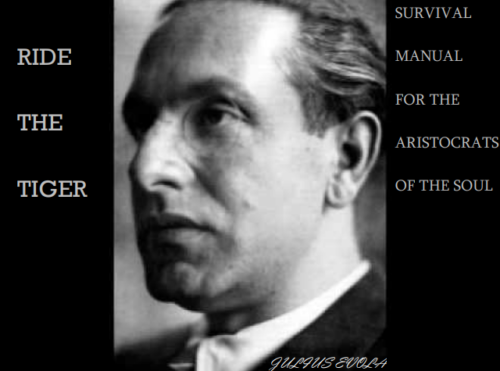
VJMP Reads: Julius Evola’s Ride the Tiger VI

This reading continues on from here.

Part Four of Ride The Tiger is called ‘Dissolution of the Individual’ and is comprised of three essays. The first of these, the sixteenth in the book, is called ‘The Dual Aspect of Anonymity’. Railing against the “collectivism, mechanization, standardization, and soullessness οf modern existence,” here Evola attempts to find an answer to the question of what is worth saving.

It’s at this point that Evola finally gets to the esotericism. Individualism is part of the problem facing us, he contends, because it has led to the atomisation of society. Worse, it has no spiritual basis. What is taken by Westerners to be the individual is not what a person really, fundamentally is.

In esoteric terms, Evola is here talking about the difference between silver and gold. Here the men of silver are decried for their pomposity and hypocrisy, for this has obscured the light of spiritual truth and made it more difficult for the men of gold to play their part. The false self must be transcended and the true self reconnected with, otherwise we will continue to flounder.

The seventeenth essay is called ‘Destructions and Liberations in the New Realism’. Here, Evola gives us for the first time a specific sense of what it might mean to “ride the tiger”. For him it is a life lived at the limit, in a way that actualises the “absolute person”. Most people who discover this do so through warfare, for it is here that an extreme lucidity stripping away all extraneous concerns can be achieved.

Evola makes vague hints at a gross feminising process that, he warns, will make any individualisation impossible. Crucially, however, this feminisation is necessary, to destroy the corruption of the old order. He continues to emphasise that any true revaluation of values must come from that “minority” who retain a sense of the transcendental. Anyone else will merely make the same mistakes that the other non-spiritual people have made.

What is necessary to move forwards from here is “a clear, detached, objective vision οf existence” and “a positive, existential incapacity to submit to ‘myths’ οf any kind whatsoever”. The new mythologies (such as Marxism) are not only doomed to fail, they are in fact signs of systemic failure.

The eighteenth essay is called ‘The “Animal Ideal” – the Sentiment of Nature’. Here Evola talks about the two fundamental spiritual orientations – the first being the hermit who lives without company and the second the wanderer who lives without fixed abode. Incredibly for an essay published in 1961, here Evola talks about the isolation and detachment that can be caused by modern communication technology and city life, foreshadowing contemporary sentiments about the Internet and smartphones.

Anticipating – and pre-emptively decrying – the hippie movement as a bourgeoisie failure, Evola rejects a return to primitivism as being merely a naked form of materialism. Conceding that athletics and sports may be useful (although he decries professional sport), Evola once again asserts that spiritual needs must come first. The true aristocrat of the soul must feel as comfortable among dams and skyscrapers as among trees and streams, for the former is an expression of human nature and thereby of Nature itself.

Fundamentally, a person needs to accept that “nothing extraordinary exists in the beyond”. Only the real exists and only the real can be said to exist. To this end, there is a lot of wisdom in ancient traditions, especially Zen. These allow us to cultivate an appreciation of how reality consists of both the immanent making itself transcendent and the transcendent making itself immanent.

*

If you enjoyed reading this essay, you can get a compilation of the Best VJMP Essays and Articles of 2017 from Amazon for Kindle or Amazon for CreateSpace (for international readers), or TradeMe (for Kiwis).

Truthophobia

A new mental illness has been observed in the modern world. It’s found among people who have irrational, fear-based responses to hearing true statements. Instead of responding to these statements like rational adults, and acknowledging their truth value, they tend to have abusive outbursts: they have truthophobia.

We can define truthophobia along the lines of other phobias, which are defined as: “exaggerated usually inexplicable and illogical fears of a particular object, class of objects, or situation”. In short, truthophobia is an exaggerated, inexplicable and illogical fear of statements of truth.

It may have a second meaning, along the lines of homophobia and Islamophobia, which is to say a political meaning alongside its linguistic meaning. In this sense, truthophobia refers to the act of denying the truth specifically because that truth is politically inconvenient.

Characteristic of a truthophobe are theatrical displays of moral outrage intended to distract from good points made by truth-tellers. For example, they like to scream “Racist!” when statistics about the sexual assault rates of Muslim and African immigrants to Europe are brought up. They also like to scream “Racist!” whenever criticisms of Islam are made, even when those criticisms have nothing to do with any racial distinctions.

What’s telling here is that truthophobes don’t ask questions about these true statements in an effort to understand them, like an honest person would do. The truthophobe simply reacts, on the basis that the truth might harm a belief that they hold, and that this belief needs to be defended by any means necessary. They are dishonest as well as cowardly.

Any learned Buddhist could quickly determine what was wrong with the average truthophobe. Clinging to material phenomena causes suffering, and clinging to a particular interpretation of reality so tightly that expressions of any alternative interpretation are taken as threats is a fitting example of such. The more truthophobic a person, the harder they dig in; the harder they dig in, the more suffering they cause themselves and others.

Why do people become truthophobics? We can group them into three major groups.

The first are the simply dumb. Being dumb is not enough by itself to be a truthophobe, but it can be a major contributing factor, especially if the dumb person has already been brainwashed into believing something untrue. Dumb people mostly are truthophobic because of the cognitive dissonance arising from really thinking about things properly. Consequently they prefer comfortable lies to truths.

This first group are arguably the least malicious of the three, because they are the most likely to admit the truth once it is evident. Being dumb doesn’t necessarily preclude one from being honest, and dumb people are often capable of seeing the truth if they are given the time and space in which to do so. The other two groups lack the shame to admit the truth no matter how evident it is, but this first group will often change their mind if the truth is presented to them correctly.

The second group of truthophobes are the fanatics. This group believes fervently in a particular doctrine, usually political, and so much so that any statement contradicting it is aggressively attacked regardless of any truth value that statement may possess. This group is worse than the first, because not only do they refuse to accept the truth when it’s presented to them, but they actively talk a lot of shit and thereby obscure the truth from those honestly seeking it.

Fanatics are also dumb, because their fanaticism invariably creates more suffering than their ideology would prevent, even under the best possible circumstances. Fanatics degrade the quality of public discourse by being unreasonable and dishonest, which makes the truth harder to see. In this group can be found a large number of Marxists as well as the religious fanatics that they resemble.

The third group are evil. The unfortunate truth is that a particularly malicious strain of truthophobes exist – one who tell lies and deny the truth specifically because to do so brings suffering into the world. Many in this category spread confusion and fear because they directly profit from it. Invariably they don’t simply reject the truth but actively seek to destroy the reputations of anyone speaking it, so as to discourage them from trying to speak the truth again.

People in this third group are mostly afraid of the truth about themselves, because it’s this fundamental fear that motivates their evil. Their ultimate fear is that they are truthfully not worth very much themselves, and the key to defeating these people is to never let them suspect otherwise.

Anyone trying to speak the truth in today’s environment will certainly encounter all three of these types in short order.

*

If you enjoyed reading this essay, you can get a compilation of the Best VJMP Essays and Articles of 2017 from Amazon for Kindle or Amazon for CreateSpace (for international readers), or TradeMe (for Kiwis).

Have You Realised Yet That We’re The Bad Guys Now?

In order for a person to be found guilty of a crime, the Police first have to be presented with enough evidence to justify an arrest, and then that person has to be tried in front of an impartial jury summoned to examine the evidence. In realpolitik however, as this essay will examine, such trivialities can be cast aside at the first sound of the war drums – provided you accept you’re the bad guys.

The leaders of the Anglo-French alliance just started a war without the approval of the representatives of their people. The US Congress, by law, has to give its approval before wars can be started. The precedent set by George W. Bush in Afghanistan and Iraq, however, is that the American armed forces will do whatever the fuck they’re told to do. Donald Trump, in ordering airstrikes in co-operation with British and French forces, is simply following this precedent.

Supposedly the reason for the missile strikes was to respond to a chemical strike allegedly ordered by the Government of Syrian President Bashar al-Assad on the civilian population of Douma. The difficulty comes from the fact that the leaders of the Anglo-French alliance did not wait for widely accepted proof of the chemical attack to be made public. The Organisation for the Prohibition of Chemical Weapons has yet to complete its fact-finding mission, meaning that there is no expert opinion yet on who was responsible.

Proof doesn’t matter for those leading the Anglo-French countries. Proof only matters to those who care about their reputation, and bad guys have no need to care about their reputation, long since lost. Worst of all, these countries have no credibility when it comes to claiming that the actions of a second party were heinous enough to justify military action – they’ve gone to war on utterly fictitious casus belli several times before.

New Zealand says it “accepts” what has happened, on the grounds that any attempt to go through the United Nations Security Council for approval would have been vetoed by Russia. This threat of veto is considered justification for ignoring the UN entirely. No questions are asked by the mainstream media. Neither do they mention where the New Zealand special forces are right now, or what they are doing there, or how long they have been there.

Nobody in any of the countries whose armed forces just committed an act of war without Congressional or Parliamentary approval (i.e. legal approval) will take any action to hold the politicians who gave the orders to account. We don’t care that our countries are run by war criminals. We didn’t lift a finger to make either Bush or Tony Blair pay for Iraq, and we won’t lift one here either.

It’s time to chew on a bitter realisation: we are now the bad guys. The Anglo-French alliance is not fighting for freedom or liberty or human rights or anything like it. We’re not fighting to reduce the amount of human suffering in the world. Such considerations are inconsequential. What matters is silver and iron – i.e. money and strategic positioning.

We’re fighting for power, or what of it we can hold onto as the West slides into irrelevance from our own greed, hubris and crapulence. We’re not fighting for any higher moral value. Proof for this contention comes from simply reviewing the evidence.

The American soldiers who just fired cruise missiles into Syria don’t get paid in one decade what one of those missiles costs. Some American cities – Detroit the most notable – already look worse than Damascus, without having to get bombed. This decay of physical infrastructure simply reflects the decay in psychological infrastructure that is the root cause of our civilisational failure.

We know this because we can observe how poorly we treat our psychologically vulnerable. We don’t invest anything into healing them, and the collective psychological damage incurred by this negligence has grown to monstrous proportions. America regularly denies housing or benefit coverage to the veterans of its military adventures, and the thought of them getting proper mental health care for their PTSD is a bitter joke. There’s only money for defence contractors.

New Zealand is no better, spending $400,000,000 of its own citizens’ money every year (over $100 per adult) to persecute them for using medicinal cannabis, while thousands of its children go to school too hungry to concentrate on studies. In a double cruelty, many of those children going to school hungry are the same children of the parents imprisoned for medicinal cannabis growing. How could we possibly be the good guys?

This pattern of gross indifference to the suffering within their own borders is characteristic of the fading powers of the West and the cowardice of its population. The political class uses our tax money to build missiles to fire into Syria, and they use our votes to give themselves permission, and we’re not going to do anything about it. We’re too scared, too lazy, too weak – we’re the bad guys now.

*

If you enjoyed reading this essay, you can get a compilation of the Best VJMP Essays and Articles of 2017 from Amazon for Kindle or Amazon for CreateSpace (for international readers), or TradeMe (for Kiwis).