
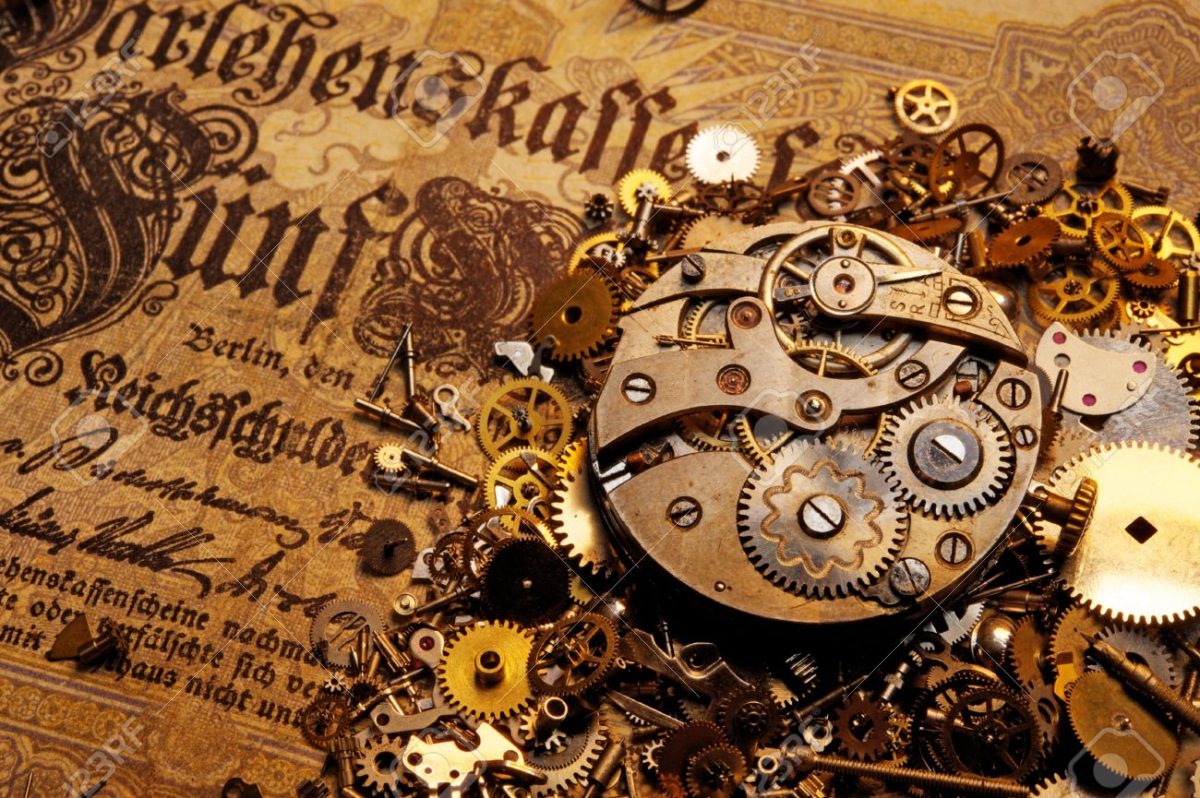
"The mind is like a cellar,” Zomblique's philosopher Mr. Boggs opined in a hollow voice which seemed to ring out from inside a tin can.

"The mind is like a cellar," he repeated with self-assured gusto after a long pause.

Zomblique's right hand shuddered as it hovered above the blank paper pad, the great plume of the quill wavering like a strutting peacock.

"The mind is like a cellar," Zomblique repeated deflatedly and set his pen back in the inkpot, drumming his fingers on the desk in frustration. "Boggs by name, Boggs by nature," he muttered through his teeth.

The mechanical philosopher was not working out. He could never afford another, for there would never be sufficient coin. Not so long as the only thing the wretched clockwork theorist was spouting was precisely such nonsense as this.

Truism after truism, empty beatitude after beatitude, triteness, passing conjecture, idle wonder.

Sellard's Philosopher, a dedicated aphorist belonging to his neighbour, had run like a top since it had first come into his possession. Dourf owned a verifiable man of letters, a clockwork vintage of one hundred and fifty years in age, still putting forward no less than three sweeping theories per week, publications in major journals at least once per month. His wife and children did not go hungry. Creech had a model that was a patent Fool, not even a Philosopher and it still managed to successfully produce biting satire of a somewhat dark although entertaining tone.

Zomblique bit into the lace sleeve that covered his hand and attempted to stifle the misery that clutched at his throat. A lone tear escaped. The swine rustled impatiently in the sty, the baby cried plaintively.

Fitting on his leather gloves to avoid the philosopher's sharp edges, Zomblique set his chest of pauper's tools next to the chair in which the automaton was seated.

Tuning the fickle machines was more art than science, or so he had been told, and each model was unique. No more than one was ever produced by any one craftsman. Which combination hadn't he tried? Dourf had suggested alternately tightening and loosening the brace that held the mandible in place, to no avail. His grandfather who had been the original owner of the philosopher suggested setting the misericord beneath its left shoulder deep enough so that it was pressing upon, but not puncturing, the diaphragm corresponding to the human heart.

It made no difference. He had measured the cranium and expanded and contracted the skull with drift punch and tongs – nothing. Although walking models were said to fare better, the sitting and reclining models also had their strong suits. Zomblique's philosopher had not responded favorably to any variation in positioning. He had tried setting him as if gazing aloofly out of a window, as though aspiring to grasp the heavens. He had tried posing the thumb and forefinger to thoughtfully cradle the chin.

"Hungry dogs will eat dirty pudding," Mr. Boggs mumbled.

Dourf climbed down the ladder, followed by his lanky companion, the artifice known as Vesselius. Brass bones encased in handsomely-grained walnut, studded with small levers and dials, emblazoned with esoteric glyphs and almost perfectly silent but for the quiet whirring of gears. A darkly shining monocle regarded the limp philosopher with what appeared to be sympathy.

"Vesselius, something inspiring please," Dourf requested in his unusually soft tone.

The mechanical thinker stood in silence for some moments before adopting a theatrical stance and looking to the skies as though there were no ceiling, he spoke:

"It is only the deepest motivation which inspires each and every human action, and it is the vain fear of vulgarity which lies the deepest and closest to man's heart."

Zomblique slapped his face with both palms and began to weep.

There was a long silence. The animatron maintained its pose as gears whirred, quietly contriving another profound aphorism.

"A little cynical," Dourf offered by way of consolation.

"I would cut off my thumbs for cynicism," moaned Zomblique. “Please leave us be."

Dourf and his machine crept back up the ladder to the sunlight above, a realm where Zomblique would perhaps occasionally visit, but never dwell.

To his surprise, Mr. Boggs suddenly stood up. Zomblique's jaw nearly dropped. With clacking wooden feet he made his way to the ladder and followed after Dourf and Vesselius.

"Yes, that's right you wretch. Go with them, you're of no use to me."

Mr. Boggs awkwardly clambered up the ladder. Before his head went through the trapdoor he turned to Zomblique with his typical empty expression and issued his parting words.

"The mind is like a cellar."

The mechanism left, never to return.

Through the swinging doors, the sullen Zomblique returned to the stink of the underground sty, and the croaking and barking of angry swine.

All that remained was the empty cellar, a fine chair and writing desk. Finally without either the consternations of Zomblique nor the dubious adages of Mr. Boggs there was a beautiful silence - a silence that belonged there.

*

Simon P Murphy is a Nelson occult philosopher and the author of His Master's Wretched Organ.
Category: the human condition
Slave Morality in 2019

Some people have made the assumption that, because Christian morals have faded from the zeitgeist in recent decades, Nietzschean concepts like slave/master morality are no longer relevant. As this essay will examine, this is not only wrong but the opposite of the truth. Slave morality, in 2019, is more influential than ever before.
The slave/master morality dichotomy comes from The Genealogy of Morals. In this book, Nietzsche outlined the distinction between the master morality that arises in a state of Nature, which divides the world into good and bad, and the slave morality that arises after civilisation and which divides the world into good and evil, with the evil being the same as the good of the master.
Understanding slave morality is to understand resentment: the man with slave mentality resents the man with master morality, and seeks to bring him down. This resentment is the emotion that arises when the ego cannot get consensual reality to conform to its will, as a slave cannot. Resentment is, therefore, the natural consequence of weakness, whether that weakness be physical, emotional, intellectual or spiritual.
One major problem with the modern world is that it is heavily overpopulated. We are coming up to 8,000,000,000 human inhabitants on this planet. This means that the vast bulk of us have effectively no influence over the course of the world, or even over our own lives. We can only move around in small boxes built by other people.
The result is that there are now previously unheard of levels of resentment in our society. This resentment has found a florid range of expression.
Social Justice Warrior culture is one of most apparent examples. The resentment of the weak can be clearly heard in the cries about privilege and oppression. The mantra of SJW culture is that whoever has power is automatically the bad guy in any conflict against someone with less power. The intention of SJWs is the same as that of the slave moralist: to rip down anyone strong and call them evil.
As Ted Kaczynski pointed out in Industrial Society and Its Future, these impulses on the part of the leftist can’t ever be satisfied. Their passion to change the world comes from the resentment of being stupid and ignorant, and this doesn’t go away no matter who they destroy. So every time they succeed in destroying someone, they simply move on to the next target.
Therefore, as long as resentment exists, there will be Social Justice Warrior culture. This culture will, like slave moralities everywhere, try and destroy anyone who is happy. SJW culture chooses to do this by calling them bigots, Nazis and racists, and declaring that all good in their lives is privilege that has been stolen from someone else.
Related to SJW culture is ethnomasochism. This is when a person derives a particular kind of thrill from running down their own people. In the same way that a regular masochist will tell his dominatrix that everything he does is wrong, so does the ethnomasochist declare that the history of his people is littered with acts of irredeemable evil.
This ethnomasochism is related to the Holocaust religion, in the sense that it posits a white boogeyman whose excessive in-group favouritism has brought terrible suffering and evil to the world. In the quasi-religious context of ethnomasochism, ‘sin’ is replaced with ‘racism’, which has to be beaten out of society by ripping down anyone who suggests it’s okay to be white.
The resentment of the ethnomasochist leads them to destroy their own nation through support for things like open borders and the mass immigration of Muslims and Africans. The paradoxical fact that they derive a sense of control from this can be explained by comparing the mentality to someone who cuts their own arms: if one must suffer, then at least one can learn to suffer on demand.
Trans culture is a third example. Many men who have found that they don’t come up to the mark as men, i.e. men who women are not naturally attracted to, also find that they can get more attention if they pretend to be women. This is particularly common among men who are physical weaklings. This behaviour mimics a mental illness known as gender dysphoria.
The fundamental motivation for many of these people is to destroy the legitimate enjoyment that normal people get out of natural interactions between masculine and feminine. They want to destroy the natural concept of both “man” and “woman” so that healthy people who fit into these roles cannot enjoy them. A generation ago, homosexuality filled this social niche, but today it’s no longer shocking enough to do so.
Already trans culture has had enough of an impact to make it difficult for quality women to find a man worth being devoted to. By continuing to delegitimise and denormalise healthy expressions of masculinity and femininity, those who promote trans culture find expression for their resentment by destroying the natural and the beautiful.
The inability to understand the importance of free speech or the right to self-defence is yet another example. When a person with slave mentality gets into power, as has happened in New Zealand with the ascension of Jacinda Ardern to the Prime Minister’s position, they are liable to strip these rights away from the populace.
This is made possible by the resentment of the dumb and boring conformists who have nothing interesting to say. Slaves don’t care about the erosion of free speech because they have nothing to say worth listening to, and therefore are not impacted by the loss of an ability to speak, any more than the average person would be impacted by a ban on professional boxing.
People with slave morality don’t understand the desire of master moralists to have the ability to defend themselves either. After all, the defining feature of a slave is that he will not defend himself if he is beaten. The resentment that comes from being this weak manifests as a desire to remove other people’s ability to defend themselves.
A fifth way is the bizarre alliance with Islam. As a psychologist writing in New English Review has explained, Islam is the perfect religion for the resentful who like to see themselves as victims. It takes the same persecution mania as the other Abrahamic cults and raises it to another degree. Muslims resent the current order of the world, and so they are natural allies to the slave moralists.
Many secular Westerners with slave mentality have powerful sympathies for Islam, and can relate to a person throwing their life away in a suicide bombing. After all, the more one resents life, the less value one puts on it. As Nietzsche wrote, the slave moralist is the one who has said ‘No!’ to life, and there is no more vivid expression of this rejection of life than a suicide bombing.
The depth of the resentment can be seen by the size of the cognitive dissonance that arises when the Islamophile is asked about Islam’s attitude to women and homosexuals. Despite the brutally cruel oppression of these groups by Muslim culture, the resentment of the Islamophile is so great that all of these crimes will be swept under the carpet. In this sense, the Islamic apologist is to this generation what the Communist apologist was to the previous one.
These are merely a sample of all the various ways that slave morality expresses itself in 2019. The frightening thing is that, as the world gets more impersonal and more overpopulated, slave morality looks set to become even more influential. The only solution appears to be a massive cull, and an emptying out of the cities where this cancerous mentality has its strongholds.
*
If you enjoyed reading this essay, you can get a compilation of the Best VJMP Essays and Articles of 2018 from Amazon for Kindle or Amazon for CreateSpace (for international readers), or TradeMe (for Kiwis). A compilation of the Best VJMP Essays and Articles of 2017 is also available.
The Empire vs. The Nations

All throughout history, there has been a neverending struggle between two implacably opposed forces. Much like good and evil themselves, human history has been characterised by an eternal struggle between an Empire that sought to conquer the world and the Nations that sought to resist. This essay elucidates.
Much as the Sun beats down from above, its rays bringing order to the Earth that receives them, so too does the Empire impose itself from above, onto the Nations that form from below.
On the world stage, the Empire is the force that seeks to subjugate all the nations. It is based around the idea of central rule, where a single leader imposes a code of laws on its subjects. The Nations are those who rise up from the soil and who self-organise based on natural similarities between members of a wider kin group.
On one level, the words democracy and republic means the same thing. But they reflect different perceptions. Democracy means rule of the masses, deriving from demos, which means people, and -cracy, which means form of rule. Republic also means rule of the masses. The difference is that democracy is a national concept, whereas republicanism is an imperial one.
The concept of democracy, in a Greek sense, is easy to understand if one if familiar with Aristotle’s Politics. In the same way that the head of a family makes decisions of behalf of their family, who gives them power, so does a chieftain make decisions on behalf of their village, a baron on behalf of his county, and a king on behalf of his nation. This is all good and well, but the bottom-up structure of every nation clashes with the top-down system imposed by the Empire.
This conflict between top-down and bottom-up systems can be seen all throughout history. In a sense, it doesn’t really matter what or where the Empire is, or whether it’s Roman, Mongol, British or American. At the centre of the Empire is the one who wields the Spear of Destiny, for they are the one who directs the course of this Empire, and the course of Empire reflects them and their will.
The two are fated to clash because the morals of the two systems are entirely different.
The moral virtues of the Empire are all about expedience. The Empire cares about control and profit. Its basic inclination is to expand. Enjoyment of life comes from glory and domination. The Empire believes that it has a moral blueprint that can serve for all human life, and therefore they’re doing the Nations (i.e. the barbarians) a favour by subjugating them. The Empire has no problem with the Big Lie.
By contrast, the moral virtues of the Nations are the same moral virtues that allow one to thrive in a state of Nature. The Nations care about the physical and mental health and strength of their peoples. Their basic inclination is to remain the same, and to enjoy life, which comes from interaction with people and places that they love, and from being at peace with God.
Alchemically speaking, it could be said that the Empire was of iron and silver while the Nations were of clay and gold. The Empire values cheap labour, willing mercenaries and the kind of science that builds artillery, battleships and railroads. The Nations value good sex, good food, being healthy and a direct spiritual connection to God and the Great Fractal.
In most cases, the desires of the Empire and the Nations are the same. Both want peace. Both want order. In most cases, they also agree on how to achieve this. Both the Empire and the Nations strive to keep their citizens fed and entertained. Their approach is, however, entirely different.
The Empire believes the state of Nature to be a state of war, and consequently declares it a good thing that the Empire imposes order. The greatest motivation of the Nations is to resist the impositions of Empire and to live a life in accordance with Nature, which they believe to be a state of peace until disturbed by Empire.
Because of this difference in approach, certain political issues cause great tensions.
Open borders seems like a great idea for the Empire, because it allows them to import cheap labour en masse to any territory they desire. If a Caribbean island starts a sugar plantation, the Empire can’t wait to import 10,000 Africans to work it. The Nations, however, hate open borders, because open borders means the destruction of all national, regional and local solidarity and culture.
The question of open borders has divided our societies into imperialists who want to import capital and workers as fast as possible, and who are pro-immigration, and nationalists who want to emphasise bonds of solidarity between kin and neighbours, and who are anti-immigration. Both sides declare the other evil, accusing one of being soulless money-worshippers and the other of being narrow-minded bigots.
The matter of religion and spirituality also causes great conflict. The desire of the Empire is to have a “Holy Land” that all of its children look to, and a single religious template into which all spiritual inquiry must be forced. The Nations, however, tend to resist this centralisation. The spirituality of the Nations tends to revolve around great local men who have achieved gnosis by discovering or developing a particular methodology.
The religion of the Empire is that which inspires them to conquer and to impose their order; the spirituality of the Nations is what which inspires them to resist and to tell the truth in the face of expedient lies. In our iteration of the world, societies are split between imperialists who usually support some form of Abrahamism, and nationalists who are more interested in direct gnosis and local traditions.
In many of the great issues of today, it’s possible to see that, fundamentally, these issues have arisen because of the conflict between the Empire and the Nations. Where it really gets tricky is that this conflict, much as the conflict between good and evil, runs through every human heart.
There are two types of people, therefore: children of the Empire, and children of the Nations. If you are a child of the Empire you probably speak English as a native language. You probably feel most at home in universities and airports. If you are a child of the Nations you might speak anything as a native language. You don’t feel home in places but in one particular place.
New Zealanders, like all children of the Empire, have a unique dilemma. The vast majority of us are raised speaking English, the Empire’s language. As such, we have a very weak national identity. Many New Zealanders are perfectly happy moving to Sydney or London and working there. There is almost no culture shock when one moves from one part of the Empire to another, but the economic opportunities may be many times greater, and so the pull is extremely strong.
Over the past century, however, a nationalist sentiment has slowly risen. This was first inspired as a reaction to the indifference with which Empire administrators treated the well-being of our soldiers in World War One. After Gallipoli and Passchendaele we came to understand that being children of the Empire was to be so much cannon fodder. Self-rule was the only way to have the requisite dignity.
Therefore, many of us suffer from divided loyalties. A line runs through the hearts of many New Zealanders: do they choose the Empire side, and emphasise the great wealth and economic opportunity that comes with being a native English speaker with an Anglosphere passport, or do they choose the Kiwi side, and emphasise loyalty with their neighbours and region?
*
If you enjoyed reading this essay, you can get a compilation of the Best VJMP Essays and Articles of 2018 from Amazon for Kindle or Amazon for CreateSpace (for international readers), or TradeMe (for Kiwis). A compilation of the Best VJMP Essays and Articles of 2017 is also available.
Clown World Chronicles: What is a ‘Baizuo’?

The English language has stolen another word, this time from the Chinese. ‘Baizuo’, pronounced ‘bye-tswaw’, translates directly as ‘white left’, and refers to a particular kind of ignorant and arrogant liberal leftist who seems too ridiculous to be possible, but who actually thrives in today’s world. This article explains.
Strong men create good times. Good times create weak men. Weak men create bad times, and bad times create strong men. This is the course of history.
We are currently at the end of the good times creating weak men phase of history. The West has been so prosperous for so long that most of us can no longer see reality accurately. This is because we are no longer punished for seeing reality inaccurately, because our wealth is such that we still have full bellies, shelter and entertainment – even if we make mistakes, and usually even if we make an endless string of mistakes.
This means that the natural corrective mechanisms that Nature uses to prevent people from becoming too dumb no longer function. Stupidity is allowed to flourish, because it no longer makes us suffer, go hungry or die. The stupid have therefore come to thrive under these new conditions – and stupidity has become the new normal.
Many Chinese Internet dwellers have noticed this in their online encounters with Westerners, and have become fascinated by the phenomenon, labelling those Westerners as ‘baizuo’. Baizuo mentality appears similar to the mindset of the Romans at the time of Nero. It’s a consequence of the decadence brought about by the presence of great wealth over several generations.
There are a large number of people in the West whose entire lives have been lived among plenty. They have no conception of how it is to grow up poor, and so they don’t understand the problems that come with being poor, which are little more than the problems caused by our metabolic needs in a state of Nature.
The major problem with growing up poor is that a poor life is unforgiving. If you damage or lose an item of clothing, getting a replacement is not a simple matter. Paying an unexpected bill doesn’t mean dipping into the savings fund, it means going without somewhere. And God help you if you damage anything valuable, for the punishment for that, usually from parents, can be swift and merciless.
But there is also a major benefit with growing up poor. This is, in the same way some amount of yang always exists even at peak yin, one is forced to see reality accurately. One can thereby develop a perceptual edge over one’s otherwise more privileged fellows.
The baizuos no longer see reality accurately, because they no longer understand Nature. As such, they no longer believe in Nature. They do not believe that men and women are different, and they don’t understand that the various groups of people around the world are different. The joke is that they think food comes from supermarkets.
The baizuo phenomenon is essentially the mass psychosis of a generation raised in such wealth that they could get away with losing touch with reality. Unlike generations raised in poverty – such as the Chinese – the vast majority of Westerners under the age of 40 have been raised in such a total absence of poverty that they have forgotten entirely that life on Earth is fundamentally an eternal struggle.
There are several facets of this phenomenon that the Chinese find especially fascinating, as does any rational Westerner trying to make sense of his fellows.
One is the obsession with political correctness, to the point of the baizuo’s own detriment. Whereas the Chinese loves to make jokes that defy the ruling authorities, and whereas most Chinese have a VPN to evade Government censorship, the humourless baizuo appears to desire more authoritarianism and more free speech restrictions and crack downs.
Another is the astonishing, almost child-like naivety when it comes to the dangers of the world. The majority of baizuos are asleep and dreaming when it comes to the issue of mass Muslim and African immigration. They absolutely refuse to listen to the experiences of people who have seen the deleterious effect of mass Muslim and African immigration on other nations, especially those in Europe.
Baizuos believe that all of the poor people of the world truly yearn for peace and tolerance and understanding for all, if only we would give them the opportunity to move to the West. That this has never been the rule in history doesn’t bother them, for they don’t believe in history any more than they believe in biology. They genuinely believe that all other groups of people are just like them, and think just like them.
A third is the arrogance with which the baizuo is stupid. In a state of Nature, stupidity is punished with pain, so that people who demonstrate stupidity soon become humble. The stupidity of the baizuo does not get punished, and, as a result, baizuos come to think they are right about everything all the time. Their arrogance is unchecked.
Whereas a well-travelled person could talk to a typical Chinese about the problems caused by Islam and be understood, the baizuo response would be to shout ‘racist’ and imply that the traveller must have been biased against Muslims all along, their observations merely confirmation bias. Most baizuos have never travelled outside of their own language zone, but are still conceited enough to think they know everything about the world.
The baizuo mentality, then, can be thought of as a form of slave morality. The baizuos are the weak men who lead to bad times, but their influence is already peaking. This means that the bad times are coming, and with their arrival the baizuos will disappear.
*
If you enjoyed reading this essay, you can get a compilation of the Best VJMP Essays and Articles of 2018 from Amazon for Kindle or Amazon for CreateSpace (for international readers), or TradeMe (for Kiwis). A compilation of the Best VJMP Essays and Articles of 2017 is also available.