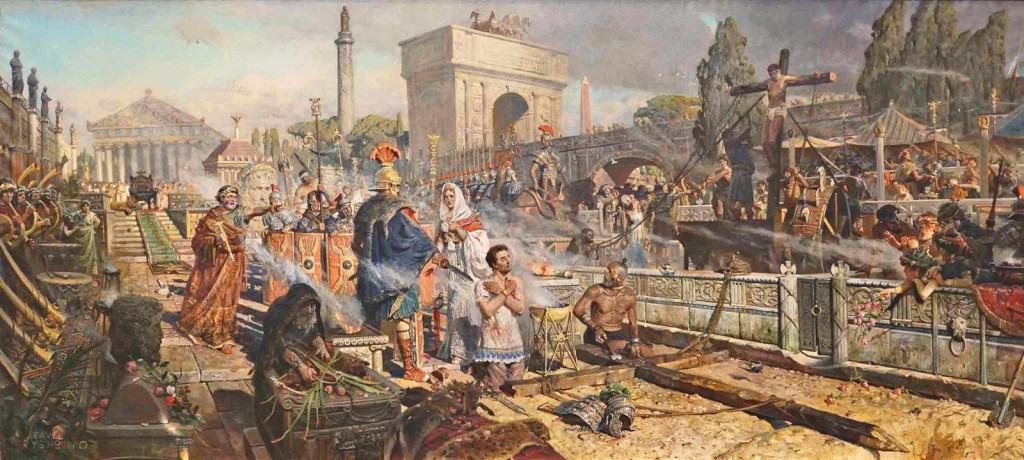
The First Shall Be Last And The Last Shall Be First

The phrase “The first shall be last and the last shall be first” is mentioned in many different spiritual or religious contexts, perhaps most famously in the Bible. It refers to a Nietzschean revaluation of all values, where the existing social order is completely inverted. This essay takes a detailed look at the various ways that such an inversion can happen.

There are four realms of elemental alchemical energy: the realm of clay, the realm of iron, the realm of silver and the realm of gold.

When one transitions from one realm to another, it inevitably means that the previous social order is upset, often to the point of being completely reversed. Sometimes it means that the very actions that led to success (or failure) in the one realm lead to the exact opposite result in the new realm.

For instance, large men with big muscles dominate in the realm of iron, because they are better at fighting. But if their group should transition into the realm of clay, the base survival level, being big is a disadvantage. In a state of resource scarcity, the largest individuals have the greatest stress trying to obtain enough resources to meet their metabolic needs. The best fighters tend to be the worst scavengers.

When Jesus used this phrase, he was referring to the transition from the realm of silver to the realm of gold. The time that Jesus lived in was one when the advances of civilisation had led to a grossly materialistic culture. He was warning those who benefitted from that materialism that their positions at the top of the hierarchy weren’t as secure as they wanted to think.

There are other transitions: from iron to silver reflects the imposition of an age of peace, from silver to iron represents the collapse of a peaceful age into a one of war etc.

In all of these transitions, there is an element of the first shall be last and the last shall be first. The man of silver, whose gregarious and social nature makes him the dominant party during peacetime, usually becomes a weakling when society transitions into the realm of iron. Likewise, the man of iron, whose physical courage and unyielding nature makes him a war hero, becomes a criminal delinquent when society transitions into the realm of silver.

On Earth, it’s possible to accumulate vast wealth and power. Doing so for the sake of rising in social status is something that is common to all social animals, and in the realm of silver it will increase your position on the hierarchy. Upon the death of the physical body, however, the connection to all of that wealth is lost, and one’s soul stands before God once again.

Should it be God’s judgment that your wealth was accumulated at the cost of other people’s suffering, then your likely fate is to be reincarnated into a world where people behave like you did. Your next life, then, will be fraught with the suffering caused by greed. You will, of course, not complain, because before God you will understand that it’s perfectly fair for you to reincarnate in a world full of beings on the same frequency as yourself.

By this means, a man who could have been the very highest of all in one material world might become the very lowest of all in the next one.

This is not at all to imply that it’s immoral to be wealthy. It’s entirely possible that a person’s great wealth is the result of being showered in gratitude by the multitudes who that person has helped. There’s no reason to automatically assume that any given fortune was acquired by crime. It’s simply a fact that advantage in one realm does not correlate with advantage in the next one.

On the other side of the divide, there are many people today who possess vast spiritual knowledge but who sit at the bottom of the social hierarchy on account of that such knowledge is not valued. We may live in a degenerate age, perhaps even a Kali Yuga. This means that the sort of person who once concerned themselves with spiritual knowledge is now inevitably an outcast.

The knowledge that is valued today is that which causes one to grow in material power or wealth. Spiritual knowledge, and the desire for spiritual knowledge, are more or less considered mental illness. Those who currently rule the West are so utterly Godless that they have pathologised the very belief in God. We have fallen very far from the realm of gold.

Once upon a time the spiritual man would have been a shaman or a sage, and warrior-kings would come to speak to them about things that no-one else understood, and their advice would thereby lighten the suffering of many myriads. Great witches, likewise, would have been consulted on decisions that set the course of kingdoms and empires.

Today we look at the shaman or witch and, instead of seeing a person whose mind is set on the spiritual at the expense of the material (and therefore holy), we see one whose mind is set on delusions at the expense of the real (and therefore diseased). We see a psychotic to be treated with disdain rather than a visionary to be treated with regard.

However, the time may come when a revolutionary spirit is stoked and when the shackles of materialism are thrown off. It’s already apparent to many that the obsessive focus on GDP growth at the expense of all else is causing more misery that it’s alleviating. A transition to another realm could involve the introduction of a new Golden Age onto the Earth.

The world is rapidly approaching a revolutionary transition between realms in any case. The elite governments of our world are hopelessly corrupt, and awareness of this is spreading faster than ever (a process that some are describing as The Great Awakening). The pre-existing fractures in our society will not be able to survive the stresses that are coming.

Perhaps the first shall become last in the sense that the elites of one corrupt system are cast down when it is overthrown, and the last shall become first in the sense that the good people who were kept down by corruption will rise to their natural place in the hierarchy. The best thing is to work on raising one’s own frequency so that one can take the right measures when the time comes.

*

If you enjoyed reading this essay, you can get a compilation of the Best VJMP Essays and Articles of 2018 from Amazon for Kindle or Amazon for CreateSpace (for international readers), or TradeMe (for Kiwis). A compilation of the Best VJMP Essays and Articles of 2017 is also available.

Slave Morality and Modern Conceptions of Human Nature

The main reason why there is so much political disagreement in the world is because there are many different conceptions of human nature. As this column has discussed previously, a person’s politics follow directly from their conception of human nature. This essay will look specifically at how slave morality conceives of human nature, and the effect this has on public discourse.

To understand how slave morality conceives of human nature, it’s first necessary to understand the difference between the Hobbesian and the Rousseauean conceptions of it.

Hobbes’s conception, as discussed in Leviathan, is that human life is “solitary, poor, nasty, brutish and short.” The state of nature, for humans, is the same as the state of nature for other animals – a zero-sum game characterised by violence and cruelty. Because life is naturally miserable, enlightened elites are justified in defying nature in various ways, such as building a giant state apparatus to watch over people.

Rousseau’s conception is best described as that of the “noble savage”. The essential idea here is that humanity was better before it was corrupted by civilisation. In a state of nature, Rousseau contends, humans are gregarious, wealthy, kind etc. – the opposite of Hobbes’s conception. Rousseau’s idea belongs to a school of thought broadly described as Romanticism.

The idea that humans are intrinsically good is far from a new one. Confucian philosopher Mencius made the argument, some 2,400 years ago, that humans were inherently good because all humans would instinctively act if they saw a baby crawling towards a well. Confucius himself, however, argued that men had to be bound by laws imposed upon them from above by their betters.

The reality is better understood today, thanks to advances in biological science and ethology. Observational fieldwork of other primate species has shown us that Hobbes and Rousseau were both right and wrong. Humans are more than capable of being either good or evil, both at an individual and at a collective level, and are really more opportunistic than they are moral.

Slave morality blends these two conceptions together and combines them in a single idea girded by unalloyed resentment. Slave morality expresses itself as a belief that the weaker party is automatically the morally superior party. Therefore, whenever there is a conflict, picking a side is as simple as determining who is the weaker party.

What this has led to is a conception of human nature that claims strong people are nasty and Hobbesian, and weak people kind and Rousseauean.

Anyone with high social status is assumed to have achieved it by viciousness, aggression, skulduggery and violence. Nastiness is, to the slave mindset, the only way that one can distinguish oneself from the masses – there is no such thing as excellence. Even the desire to distinguish oneself is evil.

Anyone with low social status, by contrast, is assumed to have received it because they were too kind and loving. Either they got exploited by a nasty Hobbesian, or they gave so much of their wealth away that they were left with nothing themselves. Kindness is, to the slave mindset, the highest moral value, because it avoids confrontation.

Another way that slave morality expresses itself is a refusal to concede that any one person or group of people are superior to any other, in any way. This mentality will deny that the great variety of different environments on this planet resulted in a commensurate variety of different adaptations. To admit this would be to concede that some were better adapted to others. Slave mentality is too resentful to admit this.

At its most dogmatic, slave morality denies any inherent difference between population groups full stop. All differences in outcome are therefore considered to be cultural in nature. This mentality was satirised by StoneToss when he pointed out the contrast between how willing people are to concede that genes explain physical differences on the one hand, with how willing people are to concede that genes explain mental or behavioural differences on the other.

This reaches its greatest absurdity when slave moralists insist that the difference in physical strength between men and women is due to environmental causes. This comically naive logic would be laughable if it was held by a child. When held by a fully serious adult it’s monstrous, and the shadows of the gulags become apparent.

Anyone who has travelled and observed the world (and many people who haven’t) will, of course, have noticed that there are many people who have laboured their entire lives without building up much strength (such as Indians), whereas others don’t need to exercise at all to become strong (such as Polynesians). The other population groups are all somewhere in between.

Moreover, anyone who has travelled will have observed that there are a vast range of different environments on Planet Earth, and therefore a vast range of different survival pressures. This range of survival pressures has necessarily led to a multiplicity of genetic variation.

The genetic basis for the differences in physical strength between populations is obvious. Therefore, it stands to reason that there will be a large variation in mental, intellectual and behavioural tendencies because of genetics.

To disagree is to deny reality, but this is the real horror of slave morality – it rejects life and even reality itself.

Unfortunately, slave morality has started to become normalised on account of the fact that populations are so large now that the vast majority of people have no chance of ever achieving a leadership position. This means that resentment-based narratives will become ever more popular, and accurate scientific information will become ever harder to find.

*

If you enjoyed reading this essay, you can get a compilation of the Best VJMP Essays and Articles of 2018 from Amazon for Kindle or Amazon for CreateSpace (for international readers), or TradeMe (for Kiwis). A compilation of the Best VJMP Essays and Articles of 2017 is also available.

Why Beneficiaries Are Morally Superior to Workers

It’s a nearly universal assumption nowadays that people who work are morally superior to people on welfare. People on welfare, we are told, are essentially parasites that do nothing but suck wealth out of the system, and we’d all be better off without them. As this essay will explain, this is almost the exact opposite of reality. People on welfare are, in fact, morally superior to those who work.

The vast majority of human history has been one of deprivation and toil. Having evolved from a common ancestor with chimpanzees and bonobos, the primary survival challenge facing our species for almost the entirety of its existence was finding enough food to meet the metabolic needs of our bodies. For the most part, this was a brutal and bloody struggle against the world – and each other.

This had a powerful effect on the evolution of human behaviour – and our morality.

Because resources are scarce, and the metabolic clock is ticking, humans have always needed to be active. We have always needed to work, whether that be hunting, gathering, fishing or working the land in the form of agriculture. This was how we gathered enough resources to survive. The alternative to activity was death.

Because working was necessary for survival, we have always praised those who did it, and always excoriated those who did not. It was probably necessary to do this, because, had we not done so, the lazy would have dragged all of society down with them. Our culture, especially Northern European culture, came to consider work something almost holy, as if the meaning of life.

Working more and harder is how wealth is built, but as can be seen in the graph at the top of this essay, the planet cannot support the level of consumption that humans are currently subjecting it to. There simply aren’t enough of the necessary resources. The resources that do exist are being depleted at such a pace that we can see hard physical limits approaching, and there’s no escaping it.

The fact is that a profound paradigm shift has taken place over the past few hundred years, and we’ve barely even noticed it, let alone adapted to it.

American agricultural productivity increased 1200% between 1950 and 2000. This was thanks to something called the Green Revolution, which increased agricultural productivity severalfold all across the world. What this means is that it requires far, far fewer people to feed society today than what it took in the past. Therefore, most people are now surplus labour.

We have adapted to this by setting the now-redundant agricultural workers to work in other industries. First was manufacturing, then service industries. This worked out great for a long time, because all of these non-essential workers were able to produce things that raised the human standard of living, even if those things weren’t necessary.

This was pretty awesome for a few decades, and arguably continues to be. However, we are now aware of some things that we once didn’t know. In particular, we are now aware of the pressure we’re putting on the natural environment through shifting those surplus workers into manufacturing all sorts of things. We now know that we can’t keep doing this.

The world doesn’t need hard work and production any more. Those days are over. What the world now needs are people who can restrict their consumption to a level that the world can sustain. As seen on the graph above, that level is about half that of the average Chinese level of consumption, some $15,000 of resources every year.

In other words, a First World standard of living will, necessarily, become a thing of the past sooner or later.

For the average Westerner, restricting one’s consumption to about $15,000 worth of goods and services a year will not be easy. This will demand an extremely sharp curtailment of material desire. It will mean that far fewer international trips can be taken, and far fewer new cars or big screen televisions can be bought. It may require vegetarianism or something like it. It will require great sacrifice.

Without such a great sacrifice, our planet cannot survive, or at least not in a form that can sustain human life. Therefore, doing so is a moral imperative.

The average Western beneficiary has already achieved this. Considering that the average Western beneficiary already survives without the excessive consumption displayed by almost everyone in a job, they are in fact showing the way forward for the rest of the Western World. They are the pioneers of the future, demonstrating the correct way for the rest of us to behave. They are the Men of Gold.

Like the holy ascetic men of the great Eastern religions, the Western beneficiary class has liberated themselves from materialism. They are therefore showing the way forward for the rest of humanity, and ought to be praised as spiritual masters. The rest of us need to follow the path of the beneficiary, and stop following the path of the worker/consumer. The first step is recognising the moral superiority of the welfare recipient.

*

If you enjoyed reading this essay, you can get a compilation of the Best VJMP Essays and Articles of 2018 from Amazon for Kindle or Amazon for CreateSpace (for international readers), or TradeMe (for Kiwis). A compilation of the Best VJMP Essays and Articles of 2017 is also available.

How to Deal With the Fact That We’re All Going to Die

Many psychologists and psychiatrists have noticed a sharp recent increase in the number of people who present to them with anxiety about ecological collapse. The proliferation of media relating to end-of-world environmental disaster scenarios has made many people fearful. This article will give some tips for dealing with the fact that we’re all going to die.

The phenomenon has been called climate despair. Fuelled by headlines about people dying in Japanese heatwaves, how last month was the hottest month in human history, or how humanity only has 18 months to act if catastrophe is to be averted, climate despair is when people give up on life on account of believing that humans have destroyed the climate of Earth, and thereby its capacity to support life.

It could be said to be a kind of existential horror, one that arises at the thought of a future Earth that is barren of life owing to Venus-like conditions. What is the point in doing anything, in struggling to achieve things, if we’ve just wrecked the planet and are all going to die?

Climate despair may not be irrational. Some climate models do indeed predict that we have cooked the planet beyond the point where human civilisation can continue to exist. Even though things are ticking along alright now, there may be several degrees of warming that are inescapable from this point owing to what has already been added to the atmosphere.

However, from an existential and spiritual point of view, climate despair is a needless suffering and therefore ought to be counteracted. The good news is that, in principle, climate despair is nothing more than bog-standard death anxiety wearing a new mask. Therefore, the old ways of dealing with death anxiety are applicable to dealing with climate despair.

The problem that we’re going to die is essentially two problems rolled into one.

The first is that it isn’t obvious, to many people, that consciousness survives the death of the physical body. In much the same way that the Earth intuitively feels flat, many people intuitively feel that the brain generates consciousness, and therefore the death of the brain with the death of the physical body means that consciousness ends.

The second is that it isn’t obvious, to many people, that anything we do here has any meaning. We’re all going to die, and even if consciousness survives this and goes through into the next world, we don’t appear to be able to take anything with us. We can’t take property with us, we can’t take family with us, we may not even be able to take memories with us. Therefore, no actions in this world have meaning, and despair must follow.

Solving the first problem isn’t too difficult. That’s a simple matter of refuting the common illusion that the brain generates consciousness.

If a person makes the argument that the life is meaningless because we all die, and with the death of the body goes our consciousness, therefore we are doomed to forget everything we have done and everything we are, they run into a problem. This problem is called the Argument from Biological Necessity.

Evolution is an extremely efficient process, and it only ever selects for traits that confer an immediate advantage in either survival or reproduction. But, as anyone who has read any Dostoevsky can tell you, being conscious confers no such advantage. The human animal could just as well fight and fuck without being aware of what it is doing.

If anything, consciousness is an impediment to survival, on account of that it leads to depression, anxiety and existential angst and horror. These emotions paralyse us and drive us to suicide. It would be much better to not be conscious – then one could simply do whatever was necessary to best further one’s genes.

If consciousness is not necessary, then it cannot have been selected for by natural or sexual selection, as all of the facets and qualities of the brain have been. Therefore, it cannot be generated by the brain, and therefore there’s no reason to assume that the death of the brain should affect the presence of it.

The second problem is much harder. Even if you can logically and convincingly argue that consciousness must survive the death of the physical body, is not clear that anything apart from consciousness survives with it. This raises the possibility that, after the death of the physical body, one has to start again, as if this life had never happened.

Broadly speaking, there are three ways to get life wrong as a result of all this, and one way to get it right.

One can become obsessed with breeding, and adopt the delusion that one has cheated death by producing offspring. People under this delusion know no greater pleasure than just to rut like animals, and seldom consider the stark fact that their offspring will also grow old and die, as will their offspring etc.

One can become obsessed with physical dominance, and adopt the delusion that just because one is hard to kill that one has cheated death. Even if a man is really big, strong, fit, trained in martial arts and carrying weapons, time will grind him down. Age will weaken his arms, and eventually a major organ will fail. This is no solution either.

One can become obsessed with intellectual dominance, or wealth and social status. Such a person adopts the delusion that one can live on in history if one achieves sufficiently great deeds. Of course, as the example of Ozymandias showed, even the greatest deeds are worn away by time. One can never be famous enough to overcome one’s own mortality because no-one can escape the fact that everyone dies alone.

The solution is to focus on refining one’s frequency of consciousness, because that is something that might well carry through into the next world. This means to use the power of will to work one’s consciousness into a state where it serves to bring peaceful and joyous order to the intellectual, emotional and physical environment.

The Law of Karma tells us that the energy we put out is the energy that we get back. Therefore, one ought to direct one’s will towards reducing the suffering of the conscious beings around you. If one does this correctly and of one’s true will, then chances are that one comes to be reincarnated in a place where beings with similar wills exist.

This act of changing the frequency of one’s consciousness is the only way that we can work to taking something with us into the next world. It’s therefore always possible to improve the quality of one’s spiritual position by working towards the cessation of the suffering of other sentient beings. This is true no matter what the current or future state of the world’s climate.

*

If you enjoyed reading this essay, you can get a compilation of the Best VJMP Essays and Articles of 2018 from Amazon for Kindle or Amazon for CreateSpace (for international readers), or TradeMe (for Kiwis). A compilation of the Best VJMP Essays and Articles of 2017 is also available.