
The Political Implications Of Kinship Intensity

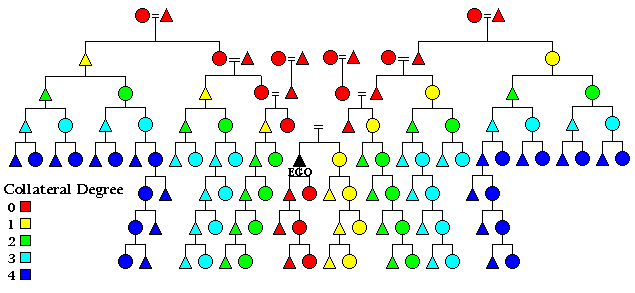
The phrase “kinship intensity” is rare in the behavioural science literature, but it’s making a resurgence thanks to new understandings of genetics. Although the concept of kinship intensity has been thoroughly elaborated upon with regards to mate selection, its inevitable profound impact on our political philosophy has yet to occur. This essay gives a foretaste.

Kinship is the primary organising principle of human societies. The reasons for this have been described at length by evolutionary psychologists and by biologists in works such as The Selfish Gene. In short, kinship organises societies because organisms that co-operate socially are more likely to survive and to reproduce than ones who don’t.

The great political philosophers like Plato, Aristotle, Confucius, Chanakya, Machiavelli and Hobbes didn’t know about genes, and so they had no concept of kinship intensity. Aristotle was aware that families organised into villages, and villages into provinces, and provinces into nations, but he didn’t know that it was kin selection on the basis of shared genes that drove all of that.

Back in the old days, before the Age of Exploration and mass transit, almost everyone lived in a state of high kinship intensity. Most people only knew a couple of hundred other people from their village and a few regional luminaries like the local sheriff or priest. Virtually everyone was related to each other in some way. They celebrated each others’ weddings and birthdays all the time.

In the modern world, most people live in a low state of kinship intensity. Living in big cities, many people encounter strangers all day – not only people from other tribes but from other countries and continents. In big cities, one comes into contact with people whose natural behaviour is so different to one’s own that it seems alien.

This change – from medieval to modern – has had profound effects on our political attitudes.

When a society has a high degree of kinship intensity, people are much more generous and co-operative. It’s logical to be, because any given act of kindness is more likely to benefit someone like you. If many of your kin live in the same society, it makes sense to work towards the betterment of that society, perhaps even making sacrifices for it. Your kin will benefit, and will reciprocate.

When a society has a low degree of kinship intensity, people are much less generous and co-operative. This is also logical, because acts of kindness cost the same amount to perform but will benefit someone unlike you, who is unlikely to reciprocate it. If you’re the only one of your kin in a society, there’s very little reason to work hard to better that society.

The West has always been split into a high kinship intensity Old World and a low kinship intensity New World. As mass immigration continues, the kinship intensity of all societies in the West will continue to fall: the Old World will become like the New and the New World will become like Brazil. This will have predictable consequences for human political behaviour.

As the degree of kinship intensity in Western countries continues to fall, people will care less and less about the people on the bottom of society. Once rich people no longer have much in common with poor people, those rich people will stop wanting to pay taxes or donate to charities that help. Decreasing kinship intensity will inevitably lead to both lower taxes and a corporate mentality where other people are viewed as tools to generate profit, and not as human beings.

If the people you’re exploiting aren’t related to you, then who cares?

The more diversity there is in a society, the more willing people in that society are to exploit others. People tend to enslave outsiders if they can, rather than their neighbours. The Barbary Coast slave traders raided Europe for slaves; the plantation owners of the American South bought theirs from Africa. African slaves constitute the largest proportion of slaves traded today, mostly by Arabs.

By contrast, the societies with the least amount of exploitation are the homogenous ones. Japan, South Korea and Scandinavia are characterised by being high-trust, low-crime societies where people habitually contribute to the common good. Societies like these, with high degrees of kinship intensity, are like large families.

We can see from this that kinship intensity predicts a number of outcomes. The higher it is, the less within-group exploitation there is. The lower it is, the greater within-group exploitation there is.

Kinship intensity predicts outcomes such as weight of taxation. In societies with high kinship intensity (like Scandinavia), people are generally happy to pay high taxes, knowing that the tax money will benefit their kin. In societies with low kinship intensity (like America), people don’t want to pay any taxes, because they feel that the tax money will benefit those who aren’t their kin.

It follows logically, therefore, that lowering the kinship intensity of a society through means such as mass immigration will make people less willing to contribute to the greater good. This apparent selfishness makes perfect sense from a kin selection perspective, and will obtain until intermarriage makes the newcomers the same kin as everyone else (or until there is civil war).

So anyone who wants to have a culture in which people contribute to the greater good, instead of exploiting it, better support policies that maintain a high level of kinship intensity. Crucial to this objective is limiting immigration to a level at which the newcomers can be absorbed into the kin networks of the existing population, rather than forming their own parallel networks.

*

If you enjoyed reading this essay, you can get a compilation of the Best VJMP Essays and Articles of 2019 from Amazon for Kindle or Amazon for CreateSpace (for international readers), or TradeMe (for Kiwis). A compilation of the Best VJMP Essays and Articles of 2018 and the Best VJMP Essays and Articles of 2017 are also available.

*

If you would like to support our work in other ways, please consider subscribing to our SubscribeStar fund. Even better, buy any one of our books!
Debunking The “Structural Racism” Conspiracy Theory

The most prevalent conspiracy theory of our time is so prevalent that it’s accepted as truth by most media entities. This theory has it that black and brown academic and economic underachievement can best be explained by structural racism and white supremacy. The truth is that, like most conspiracy theories, this theory goes directly against the relevant science, and can be disproven by it.

When 9/11 happened, a popular conspiracy theory said it was an inside job. One particular version claimed that, as the melting point of steel is higher than the burning point of jet fuel, the twin towers could not have collapsed on account of being struck by aeroplanes (the official explanation). They had to have been taken down by explosives placed within the structure of the buildings.

The way to refute this theory was to ask people qualified in the relevant science. You could say to a civil engineer or a physicist “Jet fuel can’t melt steel beams,” and they would tell you that it doesn’t have to melt the beams, it just has to heat them up enough so that they become too soft to support the weight of the building, at which point it will collapse. This is what happened in the case of the twin towers. Conspiracy theory debunked.

Anyone wanting to test other conspiracy theories can do likewise. If you want to know whether the Earth is flat you could ask an astronomer. If you wanted to know whether the Earth was 6,000 years old you could ask a geologist. If you wanted to know whether humans landed on the Moon you could ask an aeronautical engineer. And if you wanted to test whether the structural racism conspiracy theory was bullshit, you could ask a psychologist.

This is what a psychologist would tell you.

The science of IQ is the most robust and heavily supported of any social science. There is more evidence backing the validity of it than there is backing anything else. Most importantly, IQ also has more predictive power than any single other variable known to Psychology.

If you disagree about its predictive power, consider the following analogy.

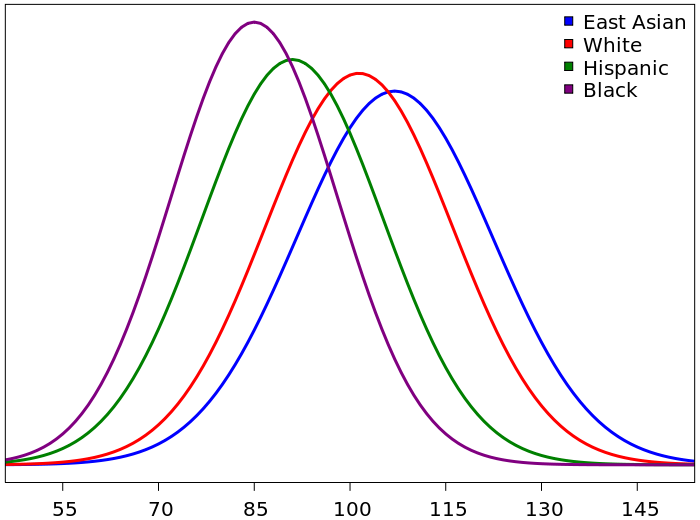
You have two 13-year old boys. One is tested to have an IQ of 115, i.e. one standard deviation above average. The other is tested to have an IQ of 85, one standard deviation below average. The two boys are followed up ten years after the test. Without knowing which boy is which, you’re told that one has recently completed an accounting degree, whereas the other dropped out of school and drifted into petty crime.

Can you guess which is which?

Almost everyone would guess that the boy with an IQ of 115 became the accountant. And, in the vast majority of such cases, they’d be right. Accountancy is intellectually challenging: far more accountants have IQs closer to 115 than to 85. Likewise, far more petty criminals have IQs closer to 85 than to 115. Almost everyone knows this, and almost no-one questions it.

The fact is that IQ is so powerfully predictive that we can already get a rough idea of how a person’s life will turn out just from accurately measuring their IQ. The average person with an IQ of 85 will have much greater trouble learning and recalling information than the average person with an IQ of 100. Their impulse control, measured by ability to delay gratification, will be significantly inferior.

Because their intellectual ability and their discipline are poorer than than of the average person, they will be less able to meet the demands of the modern workplace. As such, they will be marginalised into unemployment and underemployment more often. Any population of people with an average IQ of 85 will be much poorer and much more criminal than any population with an IQ of 100 or higher.

85 is also the average IQ of black Americans and Pacific Islanders, with Maoris being slightly higher (around 90). This we know from the research compiled by researchers like Richard Lynn in books like Race Differences in Intelligence.

Psychological science, therefore, can predict on the basis of IQ alone that black Americans and brown Kiwis will be poorer and will be more involved in the criminal justice system than white Americans and white Kiwis. This can be confidently predicted even in the total absence of structural racism or white supremacy.

At this point, a believer in the structural racism conspiracy theory will argue that structural racism not only makes blacks and browns poorer and more likely to be involved with the criminal justice system, but it also makes their IQs lower on account of things like teachers ignoring them more often during class or discouraging them from study. Therefore, even if they do have lower IQs, it’s still white people’s fault.

For one thing, we know that this contention can’t be true because intelligence is mostly genetic and not environmental. Although the environment can have a powerful effect on the intelligence of young people, the effect of environment on IQ is no more than 0.2 by adulthood – a phenomenon known as the Wilson Effect. Therefore, low adult IQ is primarily a genetic phenomenon.

For another thing, we can observe the experience and outcomes of other racial groups who have similar IQs to white people.

105 is the average IQ of Far East Asians. The structural racism conspiracy theory would predict that Far East Asians do worse than white people, on account of that white people deny them opportunities for advancement and discriminate against them in business and politics. After all, white supremacists don’t like Asians any more than they like blacks.

The psychological science theory would predict that Far East Asians do as well or better than white people, on account of that their high IQs lead to successful careers and less criminality. Being high IQ and having good impulse control, they should study hard and get decent jobs.

As it turns out, Asian Americans earn 7% more than whites at the median. They are also significantly less criminal, despite that more of them are from poor families and many are even refugees. This directly refutes the structural racism conspiracy theory and directly supports the psychological science theory.

Ultimately, the main reason why blacks do worse than whites in America, and the main reason why browns do worse than whites in New Zealand, is because of low IQ. This low IQ leads them to make more impulsive decisions, which leads to poverty. This isn’t at all controversial among those who have studied the relevant science.

The conspiracy theory that says blacks and browns do worse because of white racism is bullshit. This means that the poorer outcomes of blacks and browns cannot be explained by white racism, but by factors inherent to the blacks and browns themselves.

*

If you enjoyed reading this essay, you can get a compilation of the Best VJMP Essays and Articles of 2019 from Amazon for Kindle or Amazon for CreateSpace (for international readers), or TradeMe (for Kiwis). A compilation of the Best VJMP Essays and Articles of 2018 and the Best VJMP Essays and Articles of 2017 are also available.

*

If you would like to support our work in other ways, please consider subscribing to our SubscribeStar fund. Even better, buy any one of our books!
The Elementalist Conception Of Time

As with many other philosophical questions, Elementalism has its own ideas about the question of time. Most people take it for granted that there is such a thing as time and that it just kind of ticks along. Upon thinking about it, though, things are no longer as straightforward. This essay explains the Elementalist conception of time.

Most people assume, as if naturally, that space and time exist and that we move around in them. Space is three dimensional (the x, y and z axes), and time adds another dimension of movement, so spacetime can be said to be the four-dimensional space in which we all live. We are born at one point in spacetime and, over the course of our lives, move through it.

This materialist conception of time brings with it a number of logical quandaries.

Quandaries such as: when did time begin? Time seems to run as an arrow flies, unstoppably from one point to the next, but when and how did it start? If time started some fourteen billion years ago, with the Big Bang, what happened before then? Did time exist? If not, how could the material universe possibly have started?

Is time an inherent property of the Universe or does it exist as the result of the will of some divine creator? If an inherent property of the Universe, what makes it progress at the speed it does, and not a greater or a lesser speed? Why progress at all? And – most frightening of all – if it begins and progresses then will it end?

All of these questions create a great number of logical dilemmas in the minds of materialists and non-Elementalists. But an Elementalist, who believes that consciousness is the prima materia and that it explores the Great Fractal to entertain the gods, has no such dilemmas.

To the Elementalist, time is an illusion. Simply put, it doesn’t exist. It’s an illusion brought about by the movement of consciousness through the Great Fractal at a certain rate. Because the perceptions that occur to consciousness appear to change in a rule-based manner, the impression is created that time exists and flows at a uniform rate. The reality is somewhat different.

The illusion of a moving picture, on film or on television, is made by displaying a number of frames every second (usually 25), in quick succession. If these frames are displayed rapidly enough, the image on the screen will appear like it is moving, an illusion known as beta movement. The images aren’t really moving – they just appear to, as if in a flipbook.

Our consciousnesses navigate the Great Fractal in a similar manner.

It sounds incredible, but the reality is that our perceptions cycle through a cosmically large number of static universes in extremely short order. Entire universes blink in and out of perception a such a speed that it feels like we’re moving through them fluidly. But in fact, this movement is no more fluid than that of a horse running in a motion video. It’s also an illusion.

The Great Fractal, in its unspeakably majestic, all-encompassing nature, is static. Because the fragment of consciousness that each of us possesses can only be aware of a tiny section of it, and because the tiny section that we are aware of keeps changing, it seems like time exists. And it does, in a sense. But not in the sense that most people are used to thinking of it.

In reality, there is only one ever-present and unchanging now, and consciousness exists there. In this eternal now, perceptions change, and that’s all that time is. The contents of consciousness are ever-changing, but consciousness itself is not, serving as an unwobbling pivot around which the entire drama of material existence unfolds.

This perception of time sounds entirely radical to the materialist mind, but for a Buddhist, a Taoist or a Hindu, everything written here so far is familiar. It has to be understood that the common Western perception of time follows naturally from the common Western assumption of materialism – and this assumption is neither accurate nor rational.

Dilemmas like the Grandfather Paradox are easily solved by the Elementalist. Not believing that time is one-dimensional, there is no “go back in time”. A world in which your grandfather lives and gives rise to one of your parents exists in the Great Fractal, and will always exist. Therefore, a life in which your grandfather gave rise to you is, and will forever be, lived by a fragment of consciousness somewhere in the Great Fractal.

Somewhere in the Great Fractal are worlds in which your grandfather is killed, but this doesn’t negate the fact that there are still an infinitude of worlds in which he was not killed. Therefore, you could kill your grandfather a million times and it wouldn’t change a thing. He would still exist in the Great Fractal, so consciousness would still be aware of him, and would still perceive lives in which he existed and gave rise to progeny.

Likewise, dilemmas about how time started and where it will end are easily resolved. To the Elementalist, there is only one eternal now, and in that now we navigate the Great Fractal. Knowing that time is an illusion, questions about how it started or where it will end are meaningless. Consciousness exists outside of time and is more fundamental than it. Therefore, time is a function of the contents of consciousness only.

In summary, Elementalists have an entirely different conception of time to that of the ordinary materialist. Not only do they not believe in time in the sense it is usually understood, but neither do they believe in any of the conclusions drawn by materialist philosophers of time. For the Elementalist, all these dilemmas really do have elemental solutions.

*

If you enjoyed reading this essay, you can get a compilation of the Best VJMP Essays and Articles of 2019 from Amazon for Kindle or Amazon for CreateSpace (for international readers), or TradeMe (for Kiwis). A compilation of the Best VJMP Essays and Articles of 2018 and the Best VJMP Essays and Articles of 2017 are also available.

*

If you would like to support our work in other ways, please consider subscribing to our SubscribeStar fund. Even better, buy any one of our books!

Clown World Chronicles: Who Is Doomer?

The horrifying and seemingly hopeless nature of Clown World can easily lead to despair. As suicide rates climb all around the world, one member of the Clown World pantheon grows ever stronger. He is the Doomer, and his presence can be felt everywhere.

The Doomer cuts a depressing figure. His very appearance is doom. Sunken eyes peer out from a pallid, unshaven face, the expression on which is one of dread. A smouldering cigarette juts from his mouth – it should have been ashed five minutes ago but he isn’t paying attention. He looks extremely tired, the sort of tired where one needs to sleep but can’t.

His clothing, like his beanie, is black and grey, the colours of depression. The Doomer fears and is anxious for the future, but at the same time he is tormented by the fact that he doesn’t know why. He understands that he lives in a time of great material wealth, and feels guilt that it doesn’t bring him happiness. But deep in his heart, he knows that Clown World isn’t normal.

Clown World is the Doomer, and the Doomer is Clown World. He feels the pain and fear of the world acutely. The Doomer manifests in the expectation that everything in the world is about to get worse. His time comes in the great autumns of the world cycle. When the nights are warm and dark, the Doomer stalks the streets.

The Doomer is one of the Elder Gods, occupying the position beyond the Virgin on the Negative Masculine Axis. The essential nature of this axis is passivity – but where the Virgin is physically and socially passive, the Doomer is spiritually passive.

This spiritual passivity is not only the key to understanding the Doomer, but understanding Clown World itself. The Doomer is very much Clown World in microcosm. His suffering might seem overwhelming, but the grim truth – which he is unwilling to accept – is that most of it is self-inflicted. His own habits and his own moral failures have led him here.

The spiritual passivity of the Doomer has made him indifferent to his spiritual needs. The Doomer doesn’t meditate, because he can’t stand the noise in his head. Either he doesn’t use spiritual sacraments or he uses them irresponsibly. Most of the time he’s under the influence of pharmaceuticals or alcohol, or smoking something. Anything to numb the longing for a better world.

Nightwalking is the closest that the Doomer gets to a spiritual practice. This he does compulsively, as if an automaton, driven by a desperate need to escape his suffering. But in nightwalking he finds peace. Perhaps it is from intuiting the lesson of the streetlight: it’s forever meaningful to shine in the darkness, because a new dawn always comes.

This is one important facet of the Doomer: he contains within himself the seed to grow into a Bloomer, his exact opposite. The Doomer might be in pain, but that’s only because he cares enough to keep going. In that sense, the Doomer represents a flicker of light in every spiritual darkness. His spirit is more than just suffering – it’s also that which endures it.

As mentioned above, the Doomer is what a Virgin becomes if they continue along the Negative Masculine Axis, of which the Virgin is the Younger God. The most common path to doomerhood isn’t an extended spell of involuntary celibacy (i.e. it’s not merely extended virginity). When men become Doomers, it’s usually because they succeed in attracting a woman and establishing a romantic relationship – and then it collapses.

The Doomer is not created from a man who can’t get what he wants, but the reverse. Once a man gets what he wants, and finds that it isn’t sufficient to make him happy, he can become a Doomer. If a Virgin makes love to a beautiful woman and then the next morning realises that it didn’t solve any of his existential problems, he’s taken the first step to transitioning into a Doomer.

Doomers became numerous after the Great Financial Crisis, which could be argued to herald the descent into Clown World. It was in 2008 that an entire generation of men became faced with the reality that they would not enjoy the same easy lives that their fathers did. A few years after that, the doom had become widespread and permanent.

The solution for the Doomer is to develop spiritual strength, which will enable his will to correctly guide his mind and body to make the right moves. In doing so, he transitions onto the Positive Masculine Axis and becomes a Chad.

*

This article is an excerpt from Clown World Chronicles, a book about the insanity of life in the post-Industrial West. This is being compiled by Vince McLeod for an expected release in the middle of 2020.

*

If you enjoyed reading this essay, you can get a compilation of the Best VJMP Essays and Articles of 2019 from Amazon for Kindle or Amazon for CreateSpace (for international readers), or TradeMe (for Kiwis). A compilation of the Best VJMP Essays and Articles of 2018 and the Best VJMP Essays and Articles of 2017 are also available.

*

If you would like to support our work in other ways, please consider subscribing to our SubscribeStar fund. Even better, buy any one of our books!