
Metaphysical Phototropism

On Planet Earth, the light of the Sun imposes order upon the chaos of the dirt and water. The rays of the Sun are the metaphysical masculine that imbues the metaphysical feminine with life and energy. As the feminine is devoted to the masculine, so does life on Earth show its devotion to the Sun by growing towards it.

Plants that grow towards light sources are called phototropic. Phototropism is the quality that enables the shoots of seeds to grow upwards out of the soil. It is why trees grow to be tall and upright. Phototropism is so common that it can be stated, as a general rule, that plant life seeks the light (although vines tend to be an exception).

The light of the Sun is responsible for all life on Earth by way of providing the base of the food chain. Photosynthesis is the process by which plant life grows. Without it, there would be no animals, no humans, just bare rocks. In this sense, the Sun is very much something divine. This divinity inspired the Roman cult of Sol Invictus to celebrate the return of the Sun on December 25th, three days after the Winter Solstice.

The Second Hermetic Principle, the Principle of Correspondence, teaches us that as below, so above. The patterns we observe in the physical world are replicated in the metaphysical world. Applying this to the workings of plants gives us the concept of metaphysical phototropism. This is the phenomenon of growing towards metaphysical light.

Most human beings naturally grow towards the light, only here it is not meant the light of the Sun. Most humans, being spiritual creatures, grow towards metaphysical light. This means spiritual wisdom, that which is often referred to as “enlightenment”.

If one looks at the life story of a great number of people, a common theme of growing towards the light becomes evident. Most people were born into a state of fear and confusion, and suffered greatly as a consequence. Most of these people were able, at some point in their lives, to develop enough wisdom so that they could act to avoid the worst of the suffering.

It’s common for people drift through years of hatred, bitterness, trauma or pain before they experience enough divine light to see the metaphysical truth: that only actions towards the cessation of suffering have value. Because of this confusion, people often cause great harm to themselves or others. But an inbuilt tendency to grow spiritually towards the light seems to be part of the human condition, and so most people overcome.

Physical phototropism has two separate components: positive phototropism, in which plants grow towards the light, and negative phototropism, in which plants grow away from the light, and which is much less common. This division is also replicated in the metaphysical realm.

In metaphysical terms, positive phototropism describes the phenomenon of individuals whose consciousness grows towards the light. These are people who seek out enlightened others, make friends with them, and esteem them. These people are drawn to spiritual places and spiritual texts, and they intuitively understand that wisdom is as precious as gold.

Negative metaphysical phototropism describes the phenomenon of individuals whose consciousness grows away from the light. For whatever reason, these people elect to shy away from wisdom and reject it. Wisdom is for them as pearls to a swine. These people are rare, being more like demons than natural beings, but they exist in all times and places.

In the same way that some plants are more phototropic than others, so too are some people more phototropic than others.

Most people are mildly phototropic, in the sense that they understand and appreciate the value of wisdom. A smaller number are moderately phototropic, and study wisdom like they study other subjects. An even smaller number are majorly phototropic, and devote their lives to seeking wisdom like men dying of thirst devote themselves to seeking water.

Furthering the plant analogy, human society could be compared to an ecosystem. Most people are shrubs and bushes, some others are trees, and some others are like great oaks that stand so tall they give everything else in that ecosystem something to look up to.

In the same way that the physical health of a plant is a function of the force that compels it to grow towards the Sun, the spiritual health of a human is a function of the force that compels it to seek out wisdom. As below so above: in the same way that the life force of a plant will wither and die without sunlight, so too will the human life force wither and die without spiritual nourishment.

*

If you enjoyed reading this essay, you can get a compilation of the Best VJMP Essays and Articles of 2019 from Amazon for Kindle or Amazon for CreateSpace (for international readers), or TradeMe (for Kiwis). A compilation of the Best VJMP Essays and Articles of 2018 and the Best VJMP Essays and Articles of 2017 are also available.

*

If you would like to support our work in other ways, please consider subscribing to our SubscribeStar fund. Even better, buy any one of our books!

Clown World Chronicles: What Is A ‘Soyboy’?

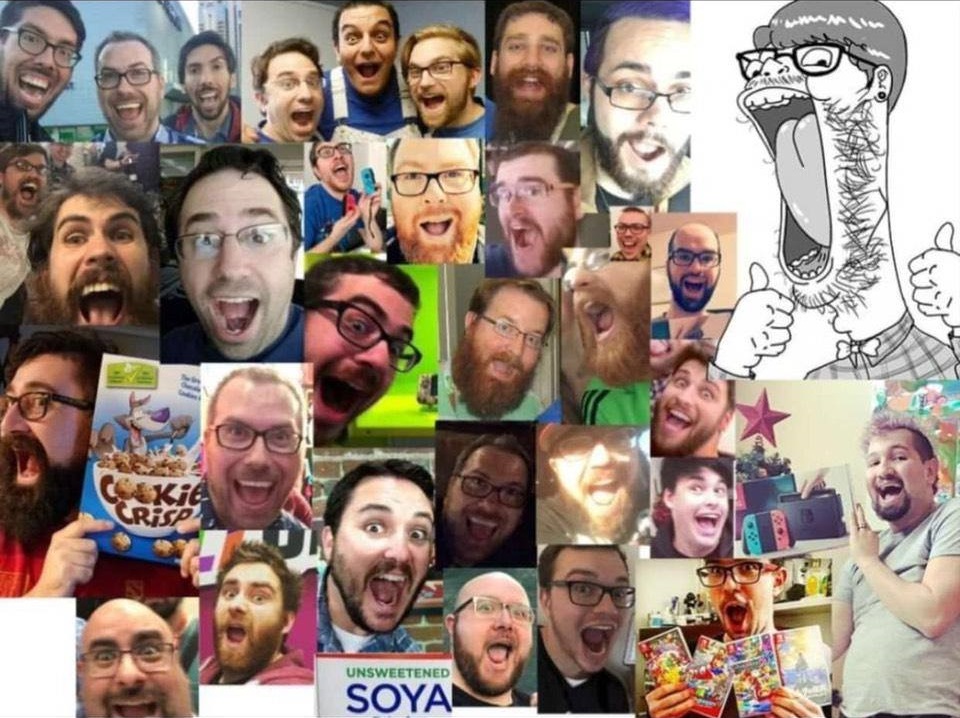
Of all the weaklings of Clown World, none are more widely despised than the soyboy. Their low-testosterone faces can be seen everywhere, their raised eyebrows and gaping mouths desperately signalling an absence of threat. Right now, a great many men are soyboys and their number seems to be increasing. This essay explains the phenomenon.

The name ‘soyboy’ is bipartite.

The ‘soy’ refers to the commonly-held belief that ingesting too much soy will feminise a man. Many believe that a high-soy diet increases one’s estrogen production to the point where it breaks down muscle and adds fat. Research has linked soy consumption to low sperm count, which some believe to be the result of this feminising effect.

The ‘boy’ comes from the fact that a soyboy is too feeble to be considered a man. They are incapable of asserting themselves as a man because they are far too afraid of their own physical safety. The soyboy would get his arse kicked in a fight against any real man and against half of all women. Not that they’d ever get into one, because their instincts are to cower away when threatened.

The definition of a soyboy, then, is a male who failed to progress past juvenility. Despite being old enough to be a man, the soyboy is still a child in every meaningful sense. They are an example of arrested development, not a proper adult. Not ever having developed the masculinity of a proper man, they are as precious and as feminine as most children.

This femininity is the reason for the characteristic soyboy gape. Posing for a photo with one’s mouth open in a smile is usually associated with female anime characters. The soyboy has adopted this facial expression in an effort to look unthreatening. He is terrified that if he appears threatening, someone will attack him. So he cowers.

This fear of confrontation is why the soyboy is the way he is.

To avoid confrontation, the soyboy makes himself look physically weak and unassuming. The body language of even the largest of them displays passivity. This extreme meekness distinguishes the soyboy from the regular adult male in Clown World. It isn’t a gentlemanly, civilised meekness but a craven, slave-minded one.

Another characteristic sign of a soyboy is a preoccupation with childrens’ toys and games. An adult male who collects Star Wars figurines is typical. The ultimate expression of the soyboy is a 35-year old staring sheep-eyed at a camera with an open-mouthed smile, proudly holding up the boxed Lego spaceship they got for a birthday present.

Soyboys arise when the strong men-good times-weak men-hard times cycle hits the “weak men” phase. The reason why they are so numerous now is because the industrialised world has been so wealthy for so long. When things are going well, everyone suffers less, and eventually become accustomed to not suffering. As such, they become soft.

Also when things are going well, the tendency is to let weakness slide rather then to crack down on it. In hard times, weakness is beaten out of everyone because it’s understood that it endangers everyone else. In good times, people tend to ignore it or even laugh about it. When Clown World nears its peak, then weakness is held up as a virtue. The soyboy exemplifies this phenomenon.

Ted Kaczynski argued that men like soyboys were examples of oversocialisation. The more mollycoddled a boy is, and the less time he spends exploring the world on his own initiative, the more likely he is to grow into a soyboy. In this sense, the soyboy is much like a pampered housecat.

Fundamentally, the soyboy is the way he is because he cannot control his own fear, and as such it controls him. His life is a series of actions taken to forestall anxiety and tension. He fears conflict of any kind, and makes himself as unassuming as possible in the hope that aggression will avoid him.

The difference between a soyboy and a simp is that the soyboy is weak in an allround sense, whereas the simp’s only major weakness is specifically that he is an appeaser of women. The soyboy appeases women, but he appeases everyone else as well. The simp, on the other hand, is fully capable of aggression, even unprovoked.

The difference between a soyboy and a baizuo is that the latter is specifically an activist on the political left. Soyboys tend to lack the aggression to assert themselves politically. They would rather be at home playing video games than protesting. Baizuos have the same slave mindset as soyboys, only the baizuo is capable of aggression against their perceived enemies. The soyboy has no enemies because he has never stood up for anything.

Many soyboys are incels, but the overlap is small. Most incels are that way because they are too masculine and aggressive – i.e. they are the kind of man who demands total submission from their marriage partners and (for obvious reasons) they can’t find someone to volunteer. Soyboys are extremely feminine, not masculine, and are not necessarily incels (in fact, they are often the “kept man” of a gainfully employed woman).

Eventually, soyboys will become so numerous that opportunistic criminals will appear to take advantage of the collective weakness. The soyboys won’t resist. This is when we enter the “hard times” part of Clown World. The tyrants stand up and everyone is too submissive to oppose them. Then the real suffering begins.

The cure to the soyboy phenomenon, as the popular meme might suggest, is beatings.

*

This article is an excerpt from Clown World Chronicles, a book about the insanity of life in the post-Industrial West. This is being compiled by Vince McLeod for an expected release in the middle of 2020.

*

If you enjoyed reading this essay, you can get a compilation of the Best VJMP Essays and Articles of 2019 from Amazon for Kindle or Amazon for CreateSpace (for international readers), or TradeMe (for Kiwis). A compilation of the Best VJMP Essays and Articles of 2018 and the Best VJMP Essays and Articles of 2017 are also available.

*

If you would like to support our work in other ways, please consider subscribing to our SubscribeStar fund. Even better, buy any one of our books!
Hate Is Good When It Keeps You Safe

An enormous amount of effort is being made right now to “fight hate”. The logic is that a great deal of suffering in the world is caused by hate, and so there is no place for it. Although this might be a lovely sentiment, it’s a futile one, because hate is a natural and inescapable part of life. This essay explains.

All human emotions, without exception, evolved for a particular reason.

Love evolved to create pair bonds. If a man and a woman genuinely love each other, their mutual care will create a much better family environment than if they did not. A better family environment means that the offspring are much more likely to survive to adulthood in a state where they’re fit to reproduce. So over time, the offspring of those who were capable of love outcompeted the offspring of those who were not.

Fear evolved to keep us safe from danger. A person who feels an instinct to retreat at the sight of a dangerous animal will have a much better chance of surviving than one who does not. As such, the offspring of those who felt fear at the sight of danger outcompeted the offspring of those who did not.

Hate evolved for the same reasons as love and fear. Although the reasons for hate are not as obvious, the same general rule applies. Like all other emotions, hate evolved because it either helped people reproduce or it helped them survive. The role of hate in helping people reproduce is minimal, but its role in helping people survive is great.

Simply put, if someone wants to kill you or enslave you, then hating them will greatly increase your chances of survival. People who were able to hate those who wished them harm were more often able to destroy those enemies, instead of being destroyed by them. As such, they survived to reproductive age more often, and their offspring outcompeted those who were incapable of hate.

More specifically, hate motivates people to protect that which is valuable to them. If an intruder breaks into your house to rape your family and steal your possessions, it is hate that keeps you safe by providing the motivation to destroy that intruder. So hate, despite its bad rap, is simply an adaptation that keeps people safe in the face of danger. The main difference between hate and fear is that hate moves towards threats to neutralise them, whereas fear moves away from them.

It’s necessary here to distinguish between justified hate and unjustified hate.

Justified hate occurs when another person’s actions cause suffering to you or to someone you care about. If a person hates you, or if they have such contempt for you that they exclude you from due consideration, or if their indifference to you is such that their actions cause you harm, then hating them might be justified.

If someone is actively trying to harm you, then hate will motivate you to stop them. If you express hate at the person harming you, they might stop on account of that they didn’t realise their actions were harmful. If they knew but didn’t care, then hate might motivate them to stop on account of that they fear retaliation. And if they don’t stop harming you, hate might help you destroy them.

Unjustified hate is the kind of hate that is not beneficial. The classic example is disrespecting someone of a different group merely because you hate that group as a whole, or because you had a bad experience with one member of that group and generalised it, or because you were conditioned to hate that group from childhood.

If the group as a whole is truly odious (such as an ideology of hate like Communism, Nazism or Abrahamism), then hating them might be justified. But if they are a national or racial group – and therefore contain good as well as bad – then hate has to take a back seat. Otherwise, hating them is liable to get you involved in a blood feud of some kind, which will not benefit you.

Another example of unjustified hate is when an individual does something bad or harmful and regrets it, but is not duly forgiven. Many people cause harm not from deliberate malice but from making an honest mistake. On such occasions it’s common for them to regret it, and to feel sorry. A person who has caused harm, and is genuinely sorry, should be forgiven and not hated.

This logic sounds simple, but the problem with it is politics. Those who would rule over other human beings don’t want their subjects making free decisions, because that makes them harder to control. As such, they try to take authority away from those people. A common authoritarian tactic is to assume the authority to decide when hate is appropriate, through such means as “hate speech” laws, or through religious admonitions to love everyone until a priest tells you otherwise.

Ultimately, no-one can have the right to decide whether another person’s hate is justified, any more than they can have the right to decide whether another person’s love is justified. Every adult has the right to decide for themselves if their own actions are justified, and that includes deciding who their enemies are.

Therefore, “fighting hate” is as futile and authoritarian as trying to decide which consenting adults are allowed to sleep together. It’s impossible to decide on behalf of other people who their enemies are. Hate is a good thing when it keeps people safe, and only the individual can decide when this is the case.

*

If you enjoyed reading this essay, you can get a compilation of the Best VJMP Essays and Articles of 2019 from Amazon for Kindle or Amazon for CreateSpace (for international readers), or TradeMe (for Kiwis). A compilation of the Best VJMP Essays and Articles of 2018 and the Best VJMP Essays and Articles of 2017 are also available.

*

If you would like to support our work in other ways, please consider subscribing to our SubscribeStar fund. Even better, buy any one of our books!

Clown World Chronicles: What Is ‘Hypergamy’?

Perhaps the most salient feature of Clown World is the disintegration of relations between the sexes. Dave Chappelle said years ago that “men and women don’t get along anymore”, and things have only become worse since then. Mistrust and communication difficulties have increased to the point where genuine animosity is often present. This article describes one of the causal factors.

Hypergamy is a biological term that refers to mating strategies, particularly the strategy of females, who serve as the gatekeepers of reproduction in most species.

Evolutionary psychology teaches that females have evolved to “marry up” by the workings of natural biological laws. The higher the quality of the mate they can attract, the more likely their offspring will survive to reproduce. Over the course of the biological past, the offspring of females that specifically sought out high-quality breeding partners have outcompeted the offspring of those who were not as selective. The end result: hypergamous females.

Social science has adopted the term for human behaviour. In this context, hypergamy still refers to sexual selection, but specifically to the female tendency to prefer men who are wealthy, educated and ambitious (i.e. males who have demonstrated the greatest capacity for resource acquisition). In societies all over the world, free women try to attract high-status men if they can.

Described thus far is the scientific background of the term ‘hypergamy’. When people talk about hypergamy in the context of Clown World, they’re referring to two related, undesired phenomena.

Thanks to the advent of dating apps such as Tinder, women have a greater choice of mating partners than ever. Before social media, the choice was mostly restricted to who they knew in physical space: friends of friends, studymates, workmates, men at the pub. After social media, the choice has expanded to every available male in the entire city.

Before social media, unattractive men could go to a pub and rely on the fact that, sooner or later, a woman would choose to sleep with them on account of that her other options were limited. After social media, unattractive men have to compete with every spare Chad within 50 kilometres. This has led to a great number of them simply giving up hope of finding a sexual partner.

Today, even moderately attractive men are uncertain of being able to attract a decent woman. Because women inevitably choose from among the highest quality of the men available to them, and because the majority of men are now available to them, getting laid sometimes comes down to being in the top 10 or 20 percent. This has led to a record number of young men not getting laid.

The second phenomenon relates to women discarding the men they are already with in the hope of trading up.

A commonly held maxim states that “women are only as loyal as their options”, and today, thanks to social media, they have an abundance of options. The Internet is capable of connecting every woman with a near-unlimited stream of tall, muscular, good-looking men. Some women think that some of those men look a lot better than their current partners.

Many men today feel – whether justified or not – that the women of today are likely to abandon any relationship they are in as soon as a more attractive male comes along. These men feel that long-term relationships are much less secure that they used to be, owing to the fact that hypergamy is out of control.

Clown World is more cut-throat than normal life in many ways. Because the basic spiritual connection to other sentient life has been broken, people don’t care so much about other people’s suffering. As such, relationships are a lot more exploitative and shallow than they used to be. This is as true of sexual relationships as business ones.

The existence of hypergamy has led to one extremely thorny political question: to what degree, if any, should female sexual nature be controlled?

Marriage was invented to control hypergamy. The idea was that if every man got exactly one woman – no more, no less – that fighting for the highest quality mates would no longer happen. As long as men could be convinced to be faithful to one woman, the resentment that arises from men not being able to get laid would be minimised.

The problem is that no-one wants to get married in Clown World. Not only are people mostly incapable of making a long-term commitment to anything nowadays, but the law also makes it a dangerous proposition. The rise of “divorce rape” has meant that men who marry are in danger of the woman getting bored, divorcing them, and then claiming alimony on the grounds that she is accustomed to a certain lifestyle.

This has led to a return of the social outcomes that marriage was designed to prevent. The few Chads at the top of the dominance hierarchy get laid all the time, the many at the bottom of the dominance hierarchy never get laid, those in the middle live in fear of losing their position, and misery abounds. The inevitable outcome is a large number of men dropping out of society entirely.

It’s hard to predict where the hypergamy phenomenon will end. But some clues might come from the disconcerting increase in men who no longer believe in women’s emancipation. A return to what Jordan Peterson calls “forced monogamy” is entirely possible, as unlikely as it might seem right now.

*

This article is an excerpt from Clown World Chronicles, a book about the insanity of life in the post-Industrial West. This is being compiled by Vince McLeod for an expected release in the middle of 2020.

*

If you enjoyed reading this essay, you can get a compilation of the Best VJMP Essays and Articles of 2019 from Amazon for Kindle or Amazon for CreateSpace (for international readers), or TradeMe (for Kiwis). A compilation of the Best VJMP Essays and Articles of 2018 and the Best VJMP Essays and Articles of 2017 are also available.

*

If you would like to support our work in other ways, please consider subscribing to our SubscribeStar fund. Even better, buy any one of our books!