
Common Sequelae Of Shit Parenting

Modern psychological science has revealed that the vast majority of mental illness is the result of bad parenting. Unbeknown to many, the human infant has a number of developmental psychological needs, particularly in the first few years. If those needs are not met – usually because the parents are abusive or neglectful – there are several predictable outcomes.

Erik Erikson’s theory of psychosocial development consists of eight stages, each with a specific conflict or challenge that shapes personality. The first stage is trust vs. mistrust, which occurs from birth to 18 months and involves the infant’s relationship with their primary caregiver. A lot of permanent psychological damage can happen during this stage.

According to Erikson, if the caregiver is reliable, consistent and nurturing, the infant will develop a sense of trust, believing that the world is safe and that people are dependable and affectionate. This sense of trust allows the infant to feel secure and confident. They become willing to explore their environment and form other relationships.

However, if the caregiver fails to provide adequate care and affection, the infant may develop a sense of mistrust and insecurity. This could lead to a belief in an inconsistent and unpredictable world, fostering a sense of mistrust, suspicion and anxiety. The infant may also lack confidence in their ability to influence events, and may come to view the world with apprehension and fear.

The psychodevelopmental consequences of failing the first stage of trust vs. mistrust can be severe and long-lasting. Four of the worst effects stand out above the others.

Difficulty forming attachments: A person who failed to develop trust in infancy may have trouble forming and maintaining healthy and satisfying relationships with others. They may feel isolated, lonely or mistrustful, or they may have difficulties with intimacy, attachment or communication. They may also have problems with boundaries, assertiveness or conflict resolution.

Those with attachment-forming problems often don’t reciprocate their friends’ goodwill. They can be very quick to cut ties. They are typically the sort who neglect to return calls or to answer emails. It’s very common for people like this to end up viewing their friendships in a very transactional manner. It’s also common for them to drift out of touch.

Impaired emotional regulation: A person who failed to develop trust in infancy may have trouble regulating their emotions, such as anger, sadness, fear or shame. They may experience intense or disproportionate emotional reactions that are hard to control, or they may feel numb or detached from their emotions. They may also have difficulties expressing, understanding or coping with their emotions.

Most adults are now aware that hitting children leads to explosive violence from those same children later on. Many are still not aware. There are hordes of adults out there who abuse and neglect their children and then look on, mystified, when those children end up with learning or behavioural difficulties, or getting in trouble with the law because they learned that violence solves problems.

Abused children usually end up with an increased propensity to limbic hijack, otherwise known as amygdala hijack. This is when the body’s threat detection mechanisms launch into high alert and empower the emotional system for immediate action, bypassing the rational system. A tendency to chimp out is very common for those who suffered early childhood abuse.

Low self-esteem: A person who failed to develop trust in infancy may have a distorted or damaged sense of self, and may feel worthless, hopeless or guilty. They may have low self-esteem, and may struggle with self-care. They may also have a negative self-image, and may be prone to self-criticism, self-doubt or self-blame. Such people often suffer Impostor Syndrome if they become successful.

This is especially true for those who were made to feel worthless by abusive or neglectful parenting. After all, if your own parents don’t even care about you, then why should anyone else? It’s common for people who suffered childhood neglect to value themselves very lowly, and to behave accordingly when it comes to negotiations or conflicts.

Increased vulnerability to stress and trauma: A person who failed to develop trust in infancy may have a lower threshold for stress and trauma, and may be more susceptible to developing mental health problems, such as anxiety, depression or post-traumatic stress disorder (PTSD). They may also have a weaker coping mechanism, and may resort to unhealthy or maladaptive behaviors, such as substance abuse, self-harm or isolation.

Complex PTSD is another common condition among those who were abused or neglected in early years. People with this condition often suffer stress-related physical conditions for life. Migraines, insomnia, nausea and chronic fatigue can all be triggered more easily in a person whose nervous system has been primed for hyperarousal through constant stress during important developmental windows.

These four signs will easily reveal a person who had a shitty upbringing. If a person hates themselves, hates others, has a hair-trigger temper or is constantly bombing out of every challenge placed in front of them, chances are high they were damaged in early childhood. If this sounds like you, have compassion for yourself!

*

For more of VJM’s ideas, see his work on other platforms!
For even more of VJM’s ideas, buy one of his books!

*

If you enjoyed reading this essay/article, you can get a compilation of the Best VJMP Essays and Articles from 2021 from Amazon as a Kindle ebook or paperback. Compilations of the Best VJMP Essays and Articles of 2020, the Best VJMP Essays and Articles of 2019, the Best VJMP Essays and Articles of 2018 and the Best VJMP Essays and Articles of 2017 are also available.

*

If you would like to support our work in other ways, subscribe to our SubscribeStar fund, or make a donation to our Paypal! Even better, buy any one of our books!


Narratives Of Life Vs. Narratives Of Death

There are two types of narrative that an individual or culture can tell themselves about the meaning of life. Although there might be an infinitude of specific narratives, they all share enough features in common to divide them into two groups. The first are life narratives and the second are death narratives.

Life narratives are the original human spirituality. All natural spiritual traditions emphasise the passage of life through the four corners of the dharma wheel: through Spring, Summer, Autumn and Winter. They also emphasise that these four seasons apply to the life of humans as well. In fact, this quadrichotomy describes the natural life path of everything that exists.

Narratives of life are all circular. This is why the holy symbols of all life religions are circular. The ouroboros, the Taijitu, the Quadrijitu and the dharma wheel are all circular. From this circularity the core spiritual truths of reincarnation and karma can be derived. After the Winter always comes another Spring.

Or, as the Bhagavad Gita puts it, “death is fixed for those who are born, and birth is fixed for those who die.”

Life narratives also emphasise gratitude. Being natural, being vital, one is grateful for life. As such, there is no desire to escape life, or to escape reality. There is no resentment, no slave morality. So life narratives celebrate the return of the Sun after the Winter Solstice, and they celebrate the peak of the Sun at the Summer Solstice, and in either case they are grateful.

Death narratives were invented later, for the sake of political control. Death narratives all promise the same thing: that you can escape the misery of life through obeying those pushing the narrative (usually a priest). So in order for a death narrative to catch on, there has to be widespread suffering.

Death narratives mostly arose after the advent of civilisation. Civilisation leads to the survival of individuals who would not have survived in a state of Nature. Most of these individuals can intuit that they are defective, and as a result they desire oblivion. This is especially true if, as is often the case, they were born into slavery.

When you have an overpopulation of useless eaters, promoting life narratives is dangerous. It can lead towards a total collapse of the ecosystem. Much better to promote death narratives, so that the population can return to a balance with Nature.

Narratives of death are linear. This is why the holy symbols of all death religions are made of straight lines (such as the Star of David and the Christian cross), or circles reduced to a minimum (such as the Islamic crescent) or both (such as the hammer and sickle).

All religious narratives that have an end times belief are narratives of death. A will to escape the world is a longing for death and thereby rejection of the world. Therefore it is a naysaying, a mental illness. Believing in an Armageddon or hoping to escape Samsara are both a rejection of the reality that the gods dreamed up for entertainment.

Materialism, with its Big Bang and Heat Death of the Universe concepts, is another linear narrative, and therefore another death narrative. Because it’s a death narrative, it belongs in the same category as the Abrahamic religions. Indeed, it was a Catholic priest who came up with the idea of the Big Bang in the first place, possibly to delegitimise the esoteric belief that all conscious beings are co-creators of the Universe.

Ultimately, materialism offers the same solace to those who hate life as the Abrahamic cults. The only difference is that there’s no priest to obey (perhaps scientists are the priesthood of materialism). All one has to do is wait until the physical body expires, whereupon the warm embrace of oblivion will envelop one for eternity.

Marxism, as Sri Dharma Pravartaka Archaya realised, is another form of Abrahamism. The narrative that the bourgeosie have to be destroyed before a Golden Age can begin is a relative to the narrative that Amalek/the heathens/the infidels have to be destroyed before Yahweh will return to Earth.

Marxists also share a personality type in common with Abrahamists. The vicious, petty, dishonourable conduct of both types is infamous. The predilection towards becoming a two-faced backstabber is shared by all who resent the world.

Gnosticism is yet another death narrative. The idea that the material world is inherently evil is borne of the same kind of resentment that motivates the other Abrahamisms. Gnosticism might be a step closer to the truth in that it recognises Yahweh as the Principle of Evil (a belief shared by Elementalism). But it is still a narrative that repudiates life in the physical world.

Believers in life narratives and believers in death narratives could not behave more differently. Believers in life narratives feel kindness for all other life and for the life process. Believers in death narratives invent practices like kosher and halal slaughter, and infant genital mutilation. That life narratives promote compassion and death narratives promote sadism is perhaps their most salient difference.

*

For more of VJM’s ideas, see his work on other platforms!
For even more of VJM’s ideas, buy one of his books!

*

If you enjoyed reading this essay/article, you can get a compilation of the Best VJMP Essays and Articles from 2021 from Amazon as a Kindle ebook or paperback. Compilations of the Best VJMP Essays and Articles of 2020, the Best VJMP Essays and Articles of 2019, the Best VJMP Essays and Articles of 2018 and the Best VJMP Essays and Articles of 2017 are also available.

*

If you would like to support our work in other ways, subscribe to our SubscribeStar fund, or make a donation to our Paypal! Even better, buy any one of our books!
The Four Elemental Spiritual Forces

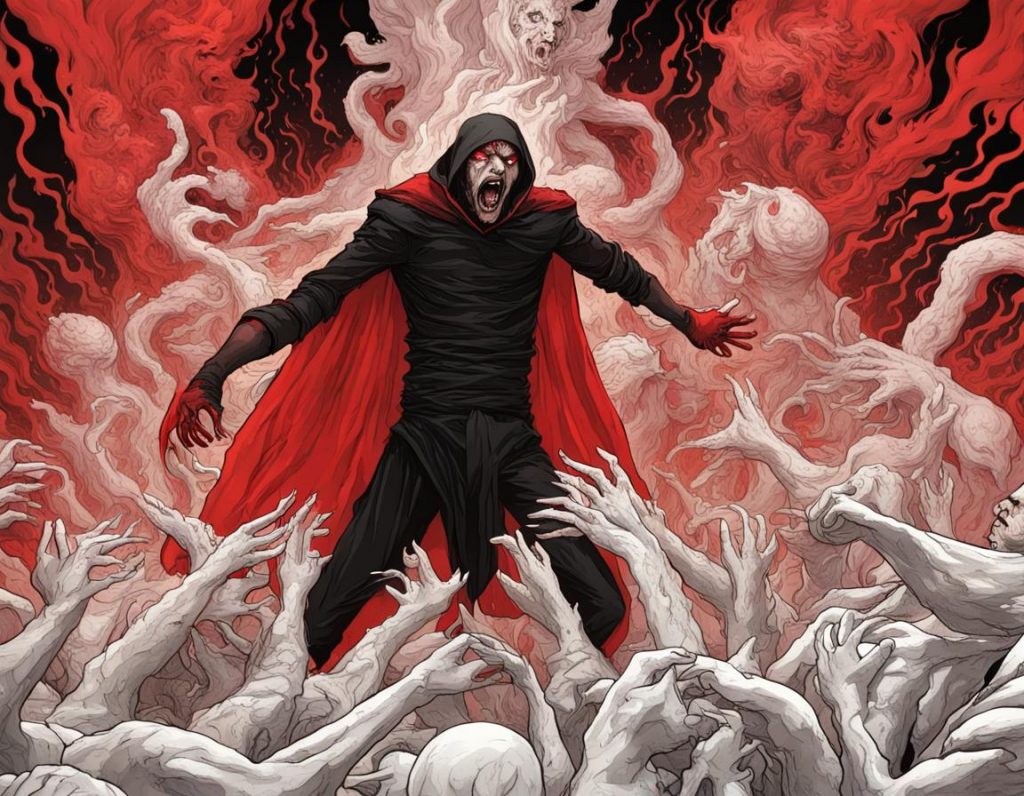
Various physical theories exist to explain the phenomena of the natural world. Far fewer theories exist to explain the phenomena of the spiritual world. This very basic essay seeks to explain the four elemental spiritual forces that operate on people’s lives.

This essay contends that there are two factors of utmost importance when it comes to determining the true nature of any spiritual force.

The first is whether the force causes a person to raise the frequency of their consciousness or to lower the frequency of their consciousness. Forces that raise the frequency of consciousness cause a person to act more like Socrates. Forces that lower the frequency of consciousness cause a person to act more like a wild beast.

The second is whether the force comes from an internal or an external energy. It’s not quite as simple as saying that internal forces come from the soul and external forces are material. This is because there are spiritual forces outside of oneself, on account that all of us are a fragment of consciousness that God cast into the Great Fractal for the sake of entertainment.

The best kind of spiritual force is that which rises up from within. This is also the hardest to harness. In principle, there are two major ways that a person can generate a spiritual force within themselves that takes them to a higher place. The first is meditation and the second is spiritual sacrament use.

Meditation works as a kind of alchemy, through which a dumb animal that identifies with its body transmutes itself into a fragment of consciousness that sees the body as something subordinate to its true essence. As the Bhagavad Gita states: “the self is not killed when the body is killed.” Through meditation one can distinguish the true self from the false self.

Spiritual sacrament use is also a kind of alchemy, only it’s more like being struck by lightning. With judicious psychedelic use it’s possible to transmute one’s soul from that of a beaten-down wretch to that of an angel of the Sun. ‘Psychedelic’ means ‘soul-revealing’, and many atheists have been transformed into spiritual people through a dose of psilocybin, mescaline or LSD.

Another positive spiritual force is that which pulls up from above. This is when a person is able to draw inspiration to raise their frequency from their environment. Sometimes climbing a mountain can lead to the sense of awe that leads people to believe in divinity. Others have drawn such inspiration from great works of art or architecture.

Being pulled up from above does not necessarily mean that God pulls people back to Godself. As mentioned elsewhere, the Will of God is to entertain the gods. Life is not a matter of learning or overcoming anything (if it was, God would have created us already learned). But the gods can be entertained by watching humans otherwise lost in the darkness becoming able to “see the light” and become spiritual.

The most dangerous force is that which sinks down from within. This happens when a person gives in to their bestial impulses. The soul takes on a lower frequency when a person chooses to act like a lower animal. It becomes darker and heavier. The face of the person often transfigures to reflect the inner nastiness.

Contrary to the usual Abrahamic moralising, sinking down because of inner factors is not necessarily a bad thing. The most important thing is to entertain the gods. Therefore, it might be correct on some occasions to indulge in the sloth, gluttony or lust of the lower frequencies. However, people should always be aware that, in so indulging, they are playing with danger.

The fourth force is that which pulls down from below. This is described in various ways. Some call it the Matrix, some the Control System, others Angra Mainyu. It consists primarily of threats and terrors. In principle, anything that depresses, demoralises, horrifies or humilates will pull a person’s frequency of consciousness down towards the bestial level.

In our unfortunate modern lives, where we are materially blessed and spiritually impoverished, almost the entire political establishment can be described as a spiritual force that rips people down. As readers of 1984 will know, the control system is incentivised to make the population suffer because suffering makes them easier to control.

Mastery of these forces means that one can rise up the Great Masculine Axis at will.

Failure to master these forces will mean that one gets dragged back and forth through the Great Fractal by powers beyond one’s comprehension.

*

For more of VJM’s ideas, see his work on other platforms!
For even more of VJM’s ideas, buy one of his books!

*

If you enjoyed reading this essay/article, you can get a compilation of the Best VJMP Essays and Articles from 2021 from Amazon as a Kindle ebook or paperback. Compilations of the Best VJMP Essays and Articles of 2020, the Best VJMP Essays and Articles of 2019, the Best VJMP Essays and Articles of 2018 and the Best VJMP Essays and Articles of 2017 are also available.

*

If you would like to support our work in other ways, subscribe to our SubscribeStar fund, or make a donation to our Paypal! Even better, buy any one of our books!

The Politics Of The 21st Century Have To Be Grounded In Known Psychological Science

Politics has been, since the beginning, a seat-of-the-pants enterprise. Although the West has produced Aristotle, Marcus Aurelius, Machiavelli and others, the modern Western leader reads nothing of these men, preferring to just make everything up as they go along. But in the age of advanced science, it’s possible to have a political philosophy grounded in empirical observation.

More specifically, it has to be grounded in known psychological science. Modern psychological science gives us insights into human nature that were completely unavailable to philosophers in times past. Aristotle knew nothing of sociobiology. A sociobiologist standing on Aristotle’s shoulders could give us a vision of our own nature that was broader and deeper than ever before.

A failure to understand human nature is the common theme running through all failed political ideologies.

Communism failed because its architects failed to understand that people are always at least a little bit selfish, and cannot simply be conditioned to behave otherwise by propaganda. A system set up on the basis that people are perfectly altruistic will inevitably collapse into corruption and widespread distrust when rhetoric doesn’t match reality.

Capitalism is failing because its architects failed to understand that people would rather drop out of the system than get worked to death paying for rents and taxes. A system set up on the basis that workers can be employed for 50 hour weeks without the ability to own homes, yet will still have the motivation to work, also doesn’t match reality.

Historically, political philosophy has not been grounded on an accurate view of human nature, because there was no formalised science of understanding human nature. Machiavelli might have been correct when he said that human nature doesn’t change from time to place, but not enough people listen to Machiavelli.

Today’s psychological science, however, can predict human behaviour with frightening accuracy. The Amazon, Google and FaceBook algorithms can predict your next purchase before you even think about it. They can tell you who you’re going to vote for before you’ve even decided. It’s a thousand times more advanced than the knowledge Karl Marx would have had access to.

A modern political philosophy must be grounded in what we now know about human nature. This means: grounded in a psychological science that has a particular emphasis on man’s origin as a naked ape (hat tip to Desmond Morris).

Fundamentally, such an approach understands that the human animal evolved social structures as part of the battle for resources that all animals must engage in. It has to be made explicit that political questions are usually just questions of resource distribution, the same questions that man-ape chieftains would have wrestled with even before civilisation. Unfair resource distribution stirs up very deep, primal instincts that can rapidly become destructive. Therefore it’s important to get politics right.

It has to be taken seriously, and that means scientifically.

The curious thing is that a properly scientific approach appears to favour neither the left nor the right.

Developmental psychology tells us that hitting children, and most other forms of corporal punishment, have extremely bad outcomes for those children. There are strong correlations between getting hit as a child and ending up with antisocial personality disorders or suicidal depression. Hitting kids is right up there with fucking them as one of the worst things you can do. Therefore it ought not to be legal.

Developmental psychology also suggests that societies would benefit from making life less financially stressful for mothers of newborns. In America, where it’s sink or swim, mothers of newborns are often put under extreme financial stress. This leads to much higher rates of child abuse and neglect in comparison to, say, the Scandinavian countries, where mothers of newborns receive adequate financial aid. The end result is more mentally damaged people. So a slight tax increase, with the money invested into early child care, is likely to pay for itself many times over.

Such findings might favour leftist policies, but other findings don’t.

Psychometrics tell us that intelligence is about 80% genetic, and therefore education can only raise it to a limited degree. So importing people from countries where the average IQ is 85, and expecting their kids to turn out the same as ours just because we put them in the same schools, is a recipe for national suicide.

Western immigration politics since World War II has been based on the assumption that all human groups are genetically the same, therefore can be exchanged for each other like so many replaceable parts. Psychometrics has given us a blackpill that we need to swallow: many populations with average IQs under 100 are never going to adjust to modern Western life. We have to stop importing them.

Evolutionary psychology says that multiculturalism is bound to fail because people stop co-operating once they no longer have meaningful bonds of kinship with their surrounding population. So large, multicultural cities like New York, Los Angeles or London could have been predicted to have ended up soulless free-for-alls, as they did.

Evolutionary psychology also tells us that individuals within the same family can vary greatly in IQ thanks to genetic recombination. Even if a group of parents all had IQs of 100, some 2% of their offspring would have IQs above 130, and a similar number would have IQs below 70. Their children might have a mean IQ of 100, but individuals will vary a lot from this average.

This natural variation in individual intelligence means that we cannot have, for instance, families in which every member was expected to become a doctor. Neither can we have racial exclusions such that members of certain races were banned from, or restricted to, certain professions. Such arrangements would be monstrously inefficient given natural variation in intelligence.

Ethology shows us that many different animals use drugs to get high, therefore a War on Drugs is unnatural. Altering the contents of consciousness through the use of psychoactives seems to be as natural as anything else is, perhaps reflecting the Elementalist belief that the world was dreamed up to entertain the gods in the first place. Banning the use of drugs, then, is as futile as banning sex. People will do it anyway.

Grounding a new vision of politics in psychological science could solve many problems. First and foremost it would solve the problems arising from basing a political philosophy on an inaccurate conception of human nature.

*

For more of VJM’s ideas, see his work on other platforms!
For even more of VJM’s ideas, buy one of his books!

*

If you enjoyed reading this essay/article, you can get a compilation of the Best VJMP Essays and Articles from 2021 from Amazon as a Kindle ebook or paperback. Compilations of the Best VJMP Essays and Articles of 2020, the Best VJMP Essays and Articles of 2019, the Best VJMP Essays and Articles of 2018 and the Best VJMP Essays and Articles of 2017 are also available.

*

If you would like to support our work in other ways, subscribe to our SubscribeStar fund, or make a donation to our Paypal! Even better, buy any one of our books!