
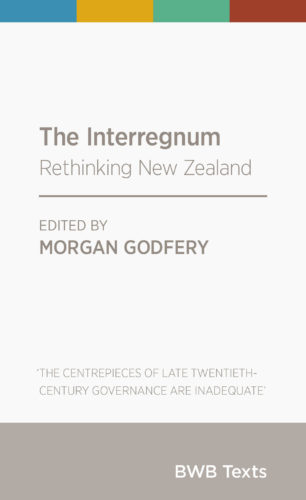
VJMP Reads: The Interregnum: Rethinking New Zealand VI

This reading carries on from here.

The sixth essay in The Interregnum is ‘Radical Kaupapa Maori Politics’ by Carrie Stoddart-Smith. Turning to maoridictionary.co.nz I discover that kaupapa means, in this context, something like ‘agenda’ (indeed, within the first page it has been defined as “something like first principles”), but the essay itself explores the various definitions of ‘Kaupapa Maori’.

At the core of this essay is the question that Maori have been asking themselves for 200 years. To what extent to we cling to the old ways, and to what extent to we abandon them for the sake of adaptation to a world that is different to what it was when the old days arose?

Many mainstream readers, conditioned to mainstream journalism, will find the tone of this essay jarring, as it is heavy on the kind of guilt-based sermon-style rhetoric that so many have learned to manipulate otherwise well-meaning audiences with.

It’s also full of the unnecessary race-baiting and shit-stirring that has become associated with the American style of race rhetoric, such as when Stoddart-Smith justifies the exclusion of non-Maori with “empowering Maori voices that continue to be silenced by the noise of history, and by the protestations of white New Zealand that insist on shouting us down and shutting us out.”

Unfortunately this dishonest, deliberately aggravating style of rhetoric is a throwback to the Cultural Marxism espoused in the introductory essay. Only “white New Zealand” is the enemy; the fact that Asian and Pacific Islander New Zealanders think much less of Maoris than white people do, not having had two centuries of living together, is ignored on account of not fitting the narrative (the fact that Asians and Pacific Islanders are harder to guilt trip may also be a factor).

It’s a shame that a confrontational and antagonistic stylistic approach was taken, because there’s plenty of philosophical value in this essay. In particular, Stoddart-Smith draws multiple parallels between kaupapa Maori and the anarchist philosophy of mutualism.

After all, pre-European contact Maori did not have a central government, and as a consequence they adapted to learn patterns of mutual support that helped them and their neighbours to survive. In some cases the agreements over which tribe had the rights to access what were very sophisticated and complicated, but the important thing was that they were mutually consensual, in contrast to today’s arrangement where representatives of the Queen enforce the law whether people like it or not.

If this side of things had been emphasised, this could have been a good essay. Unfortunately it’s full of common separatist canards like “colonialism embedded patriarchy in tikanga Maori” and the revisionist attempt to ignore He iwi tahi tatou, as if the historical nature of interactions between Maori and British settlers had been entirely involuntary on the part of the Maori, rather than mutually beneficial.

One feels that a sophisticated approach to redressing the historical wrongs done to the Maori people, and this essay falls a long way short of that. It is, however, a good example of Marxist agitprop.

In New Zealand, Growing Cannabis is Worse Than Raping Children With No Remorse

This month, Brian Borland (pictured) received a longer prison sentence for growing cannabis than Noel Edward Thomas Williams did for raping children and blackmailing their family

New Zealanders generally like to believe that they live in a fair society. We like to believe that those tasked with maintaining justice, like our District Court judges, act fairly and with compassion. But this is no longer possible if you look at how the New Zealand court system treated a man who grew an illicit medicine, compared to a literal child rapist, this month.

Brian Borland, of Daktory fame, was sentenced to four years and nine months prison for four cannabis charges earlier this month, while a few weeks later a Noel Edward Thomas Williams was sentenced to only four years in prison for literally raping a child and showing no remorse.

No Kiwi can fail to be disgusted by the absolute failure of our “justice” system to deliver anything like justice this November. Edwards was found guilty of raping a girl aged between 12 and 16 and indecently assaulting a child under 12, showed no remorse at any point and despite the judge saying “for a child this is the last thing that is wanted,” – in other words, this was the most evil thing that a man could ever do to an innocent child – he got less prison than a cannabis grower.

What’s wrong with our country when you can rape some children and blackmail them for decades, destroying them psychologically and showing no remorse even after being caught like an utter psychopath, and get less of a prison sentence than someone growing a medicinal plant?

VJMP Reads: The Interregnum: Rethinking New Zealand V

This reading carries on from here.

The fifth essay in The Interregnum is ‘Welfare and Precarious Work’ by Chloe King.

Unlike the other offerings so far, this essay actually resonates with people who are working class. Instead of waffling on about climate change and other shibboleths of the global elite classes, King focuses on real issues that affect real Kiwis: poor wages, poor security of work and a pitiful excuse for a social safety net.

This essay uses anecdotal examples of young Kiwis trying to make it in a workplace that is forcing them into ever worse conditions. The nature of work in New Zealand is becoming ever more stressful as things like the 90-day firing law undermine employment security, and the essay does a good job of showing how this leads to increased rates of mental illness.

It also correctly draws attention to the cruelty of the Fifth National Government. Paula Bennett’s welfare reforms now force people seeking a benefit to fill out a 48-page form of questions – obviously a considerable challenge to the kind of person whose literacy levels place them in precarious economic positions.

King also speaks to a very real sense of outrage when she writes about how mentally ill people are often bullied back into the workforce well before they are ready – a short-sighted approach whose shortcomings become obvious when the inevitable next mental breakdown occurs.

Describing something she calls “constricted choice”, King details a very real problem in the modern workforce: our choice of jobs has increased, but the average quality of those jobs has plummeted, meaning that Kiwis are essentially forced into taking poorly paid work out of duress. The fact that we have a wide choice of crap jobs doesn’t actually make it any better.

Ultimately, King hits the bulls-eye when she states simply that “Workers deserve to be paid fairly and treated with dignity and respect.” She is right when she points out that the nature of workplace relations in New Zealand have deteriorated to the point where the emphasis is on coercing workers into obedience rather than encouraging them.

The “politics of selfishness” is a very real thing, especially in New Zealand, and King rightly points out that she’s not asking for much when she posits that “no-one should work and be poor at the same time.” It’s not much to ask for, but we’re still not getting it, and the essay concludes with a call to collective action.

In summary, Chloe King’s piece strikes much harder and more accurately at the heart of the issue than the previous efforts in this book: poor living and working conditions right here, right now, not vague threats of what might happen in 50 years’ time. It is easy to get the impression that the left is going to do much better by proposing a universal basic income than it is by going on about climate change, and so for their sake they’d do better promoting voices like King’s.

VJMP Reads: The Interregnum: Rethinking New Zealand IV

This reading carries on from here.

The fourth essay in The Interregnum is ‘Climate Change and Just Transition’ by Edward Miller. Keeping with the theme of the book so far, Miller describes himself as “a political activist with a keen interest in global justice,” and declares the enemy as “the deeply held commitment of large businesses and governments to maintaining economic growth at all costs.”

Miller laments that neoliberalism has made conditions worse for the “most vulnerable of society,” and it is for them who Miller claims to speak. There is already a problem with this, as anyone who has spent time around the most vulnerable of society would know, and it’s that people with pressing, immediate problems couldn’t care less about things like “global justice”.

Writing of the need to sacrifice economic growth for the sake of lowering our carbon emissions, Miller suggests that he is completely engrossed in the bubble of middle-class privilege, like many Green supporters. The practical reality is that sacrificed economic growth means workers getting fired, hours being cut, health care being postponed or cancelled, and children going hungry – considerations often lost on the young and carefree.

Action on climate change is described as something “we so desperately need” – further evidence that Miller lives in an echo chamber. What we need are better wages, better houses, and better attitudes to mental healthcare and to child abuse. Problems with proximate causes and clear solutions. Focusing on problems with clear solutions will all us to ensure that our energies are not wasted from virtue signalling about issues we cannot affect.

Much like other commentators in this book so far, Miller attacks neoliberalism as if it was an evil that sprang from nowhere upon an unsuspecting world in the mid 1980s. This is perhaps to be expected of young writers who are yet to comprehend that history and the world existed before they were born, and were not things discovered by them.

But it’s difficult to take seriously a work that does not place neoliberalism in its context of the complete collapse of the Soviet Union and the West’s increasing awareness that Communism had directly led to the starvation of tens of millions of people. In the 1980s and early 1990s, Communism appeared to the world as a monstrous evil that had, after almost half a century, finally been defeated. It was natural that things move in the direction away from it.

Almost certainly, this movement away from Communism went too far, as political movements tend to do, and so neoliberalism does need to be balanced. But we don’t need to balance it with economic and social policies that have established historical precedents of failure.

The idea of returning the means of production to the masses via an unelected ideological elite that purports to speak for those masses is known to be suicidal, but Miller avoids this easy fantasy, making a successful point when he promotes the idea of a universal basic income by means of the Government printing money.

Unfortunately, the fate of those other men who have proposed debt-free Government-backed money (McKinley, Lincoln, Hitler, Kennedy, Gadaffi) is ignored here. Perhaps this book is not thick enough for the kind of investigation necessary for such a thing.