VJMP Reads: The Interregnum: Rethinking New Zealand I

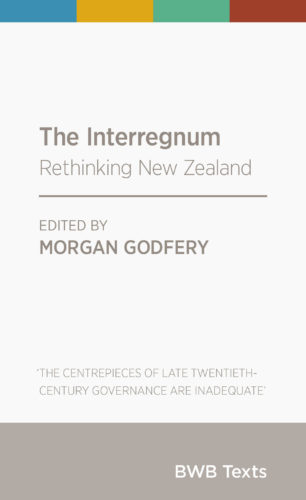
The Interregnum: Rethinking New Zealand is a small book of essays that is for sale at the Volume bookstore in Nelson, by Bridget Williams Books. The blurb on the back asks the question of whether New Zealand’s political settlement is beginning to fray, and purports to “interrogate” the future from a youth perspective.

The first essay, by editor Morgan Godfery, is called “The Voices of A New Generation” and opens by relating an anti-TPPA demonstration in Auckland. It breathlessly describes the excitement of thousands of diverse people coming together to oppose the signing of the multilateral trade agreement.

Reading this piece, something about it speaks to the lack of purpose that the young generation now has. The fight against apartheid seemed meaningful at the time; it seemed a great evil was being fought. A law that says that a large section of the population are second-class humans, for no other reason than skin colour, seems like the sort of arbitrary and cruel treatment that everyone should be against.

But can the same be said of international trade? Who really understands it well enough to decide? And so what if “trade agreements are signed”?

By the fourth page of this essay there is already a Marx quote, which bodes poorly. The reader gets the sentiment that the new voice here is going to be an echo of the same social justice warriors seen overseas. If not, why oppose something as vague and nebulous as the TPPA, instead of protesting about poor wages, poor housing, poor mental health outcomes?

The essay finds its feet when it hones in on the real enemy: neoliberalism. Godfery mentions the damage done to the national psyche by the Mother of All Budgets, and it feels like he speaks for many when he says that the children condemned to poverty by Richardson’s Budget are now adults, some of us with our own children.

But again, this speaks to the confusion in the New Zealand Left. What to make of the fact that the signing of the TPPA was protested under a National Government, with many prominent Labour supporters in attendance, and then the Labour Government went and signed it anyway? No-one knows yet if Labour will get criticised for their evident support of neoliberalism, or whether people will let it pass.

This introductory essay declares that the book is for those who have “a fierce desire to radically reshape politics.” It proposes that instead of focusing on “returns on investment”, that we return to a politics of “higher principles and values”.

This is all very well, but the question that strikes one is: whose higher principles and values? Because usually when the working class votes for people promising to govern by higher principles, it turns out that those principles only apply to a chosen few groups, and if you’re not one of them then you’re “privileged” (“privileged” means “untermensch” in social justice speak”.

We can see this now with Jacinda Ardern’s decision to give Manus Island “refugees” her highest priority, while saying nothing about the Kiwis suffering from the illegal status of medicinal cannabis. Unfortunately for medicinal cannabis users, official victim status has so far eluded them, and so they continue to be ignored.

Concluding with half a dozen mentions of the word “love”, this essay promises that the book will make for interesting reading for the sake of political philosophy. However, it’s not possible to believe that a book that opens by quoting several Marxists could be entirely trustworthy or honest, even if it is earnest.

It remains to see what these higher principles are.

Are Muslims Bigots, According to the Left?

The acid test for not being a bigot has, for decades, been one’s attitude to homosexuality – but most Muslims fail here

Throughout the Australia same-sex marriage referendum there was a constant refrain: Don’t be a stupid, vicious, hateful bigot, and make sure you vote Yes. Only through sheer bigotry could a person vote No. Only by way of an unprincipled, mindless, unforgivable hate of gay people could a person possibly be inspired to vote against love.

The entire Yes campaign was driven by a fear of far-right extremism. The spectre of white supremacism was even raised. Apparently skinheads and Nazis were ready to storm the streets to give marginalised homosexuals a kicking, cheered on by the same rich old white Christian people who have oppressed everyone else going back to the dawn of time.

But all of this “Love trumps hate”-style rhetoric backfired when it turned out that there were very strong correlations, measured at the electoral level, between being Muslim and voting against same-sex marriage. Notably, the West Sydney electorates with the largest numbers of Muslims were the same electorates to record the highest proportion of No votes.

Statistics showed us that Muslims hate gay people and don’t consider them worthy of equal rights. It’s as simple as that. After all, in Muslim countries they often hate them so much they kill them, so there’s no surprise whatsoever that in a multicultural Australia that grants religious freedom to Islam, some Australians will use that freedom to hate gay people.

This raises an obvious question: are Muslims bigots?

After all, we have just spent months being told that people who were against same-sex marriage were bigots, and that the bigotry of homophobia has to be exterminated from modern Australia at any cost.

Over and over, we are told that bigots have no place in modern society, that all political views considered bigotry will have to be relinquished, that if a person doesn’t relinquish a bigoted opinion they are evil, and can be considered identical to Hitler in kind if not in degree.

Moreover, any person holding a bigoted viewpoint is automatically so evil that it’s legitimate to abuse them, to shun them, to lie about them, and to altogether treat them as if they are subhuman for having committed an unforgivable moral failure out of no motivation but pure malice.

So what do we make of the fact that, as per the definition of bigot that the Left has been using up until now, Muslims are extremely bigoted?

The obvious response is to say that gay people knew that already. Muslims are, after all, Abrahamists, and Abrahamism has a scriptural command to murder homosexuals in the Book of Leviticus of the Hebrew Bible, the same place that most Christian anti-gay hate arises from.

The less obvious response is to be quietly grateful that the Muslims of West Sydney are not ten times greater in number, because that might have shifted the balance of the referendum to 49-51 against.

These West Sydney suburbs are, ironically, Leftist strongholds, so the hate that the Left is always accusing the working class of – of being exclusive, discriminatory, bigoted, cruel and malicious – is present in greatest concentrations within their own territories!

What Does it Mean For The Left That Muslims Hate Homosexuals?

The Australian same-sex marriage referendum demonstrated something unpalatable to the left – Muslims, even more than other Abrahamists, hate homosexuals

A horrific realisation is slowly dawning on Western leftists; something that, after the results of the Australian same-sex marriage referendum, can no longer be denied. The anti-conservative alliance that the Left has become claims to represent both homosexuals and Third World immigrants – but the problem is that most of those Third World immigrants despise homosexuals.

This column has previously raised the question of whether homosexuals can still be considered part of the victim class owing to the vast increase in their fortunes over the last four decades. Homosexuals are now over-represented in the New Zealand Parliament by a factor of 250%, and their average income is considerably higher than that of the average citizen in most Western countries.

Before the referendum, the Australian Left made a lot of noise about stopping white Christian bigots from spreading their homophobia and hate. So they got a lot of egg on their faces when it turned out that their beloved Muslims and Third World immigrants turned out to be the most strongly opposed to same-sex marriage.

This could eventually mean that homosexuals start to move their allegiances to the right.

Already it’s known that white people support conservative parties in much greater numbers than they do leftist/liberal parties, and since it’s really only white culture that accepts homosexuals, and considering that the average Western homosexual is wealthier than the average Western non-homosexual, the next logical step for the homosexual bloc is to shift allegiances to the right wing.

After all, it doesn’t really make sense for homosexuals in the West to facilitate the mass importation of people who consider them animals and who will vote to take homosexual rights away. Gay white men are already finding themselves increasingly more welcome in right-wing circles of employed middle-class people and increasingly less welcome in left-wing circles of brown-skinned religious fundamentalists.

No-one should be surprised to see a wholesale shift in gay loyalties in the West over the next few decades, from liberal to conservative. One could argue that it already has started to happen.

What this will mean for the Left is increased tension between factions, up until a point where that tension becomes insurmountable. You simply cannot have an alliance where one party wants to throw the other party off a rooftop by command of God, and so leftists will have to choose between homosexuals on the one hand and Muslims and Africans on the other.

What this will mean for the Right is also increased tension, but also an opportunity. The tension will arise from the fact that religious conservatives do not like homosexuals, but at the same time can see an opportunity to gain their support on account of having so much in common, and therefore will get a sniff of power.

What this should mean for the Left is a coming together under the banner of a shared value, such as universal compassion. Some would argue that this has been done already or at least has been intended to happen but it’s simply impossible when one faction wants to eradicate another one. Muslims and homosexuals cannot co-exist in one political movement, that is now clear.

If the Left is to survive the 21st century and provide a realistic alternative to globalist hypercapitalism, which is currently rampant, it has to stop being so soft and recognise that some boundaries are necessary to prevent total chaos. One of those boundaries might well be the blanket exclusion of people from cultures that do not place a high moral value on tolerance and compassion.

Technology Has Changed The Nature of Human Intelligence

Kraftwerk sang about the fusion of man and machine in the 1980s, but even they couldn’t anticipate how the Internet would change our brains

People used to have a reasonably clear idea of what intelligence is. As measured by school examinations, intelligence is primarily a matter of remembering and recalling disparate pieces of information and, for bonus points, knitting as many of these pieces as information as possible together into a pattern that can be communicated. This was the approach taken by the Chinese Mandarin schools, and it made perfect sense – until now.

It used to be that having a good memory was the most important thing. This is natural if you lived in a time of informational scarcity, as we did for most of our history. Nature didn’t offer a lot of second chances to remember things; if you didn’t remember that crocodiles were often seen in this river, or what your grandmother said about not sticking your hand in empty logs where snakes could be, you probably weren’t long for this world.

Most of the time none of us had any idea what the fuck was going on. Only during the last 5% of the human experience has anyone managed to get anything written down, and even then mass literacy has only been a thing for a hundred years or so, and even then only in wealthy industrialised countries. The concept of being overwhelmed by knowledge was impossible outside of the most rigorous monastic setting.

The Internet has turned this entire equation on its head. It is like a gigantic non-corporeal memory comprising the sum total of human knowledge, never further than a few clicks away. No-one really needs to memorise everything anymore, when they could spend that same precious study time learning to understand the fundamentals of their discipline better.

During most of the time that people have been students, it used to be that you could open your skull and allow it to be filled. Anyone taking the time to speak to you probably had your best interests in mind, and so an atmosphere of high trust existed, and students could be more receptive.

Now, the most important thing is being able to discern truth from bullshit. On the Internet, people are lining up to shovel shit into your head. Not only are there the advertisers who have been a plague on mass media since the 1950s, but there are government propagandists – both foreign and “your own” government, religionists with a new audience, corporate intelligence agents, social justice warriors and anyone else with a drum to beat.

So you have to be more discriminating. After all, there’s no point in being open minded when you’re continually exposed to things like Flat Earth, which really only makes a person more stupid the more they think about it.

The more lies and propaganda there are around, the more intelligence becomes about being able to quickly and cleanly distinguish lies from truth, and to avoid logical errors like the balance fallacy, in which a person gives credence to a false position merely because a lot of people are bleating about it.

Intelligence is now about figuring out when you’re being lied to. Can you tell truth from bullshit when it comes to vaccine claims, for example? How do you know? How do you really know?

Now more than ever, what distinguishes the smart from the slow is how to accurately grade the reliability of the information that comes into their awareness and not simply accept it because the television says so and not simply dismiss it because the Government says so. Now it’s all about the metainformation – the information about the information – which gives us a second dimension by which to measure knowledge.

This will lead to an evolutionary process in which people who adapt to the new paradigm of information being abundant and unreliable, instead of rare and reliable, will outcompete those in the old paradigm of mindlessly memorising things.

*

Vince McLeod is the author of the cyberpunk novel The Verity Key, a story based on his psychological research into whether it’s possible for devices to control people’s thoughts and actions by satellite.