The Four Kinds of Dark Age

The four types of Dark Age are the Age of Poverty, the Age of Violence, the Age of Ignorance, and the Age of Cowardice. There can be more than one of these ages occurring at any one time, and there can be none, but the invariable is that people suffer in a Dark Age for reasons outside of themselves. These four ages also correspond closely to the four masculine elements of clay, iron, silver and gold.

Humanity seems to have been cast into a world in which all four Dark Ages were in operation simultaneously and when we were little more than animals. One by one, we rose out of these Dark Ages and into a Golden Age, but most would argue that we have since degenerated again.

The Dark Age corresponding to the element of clay is the Age of Poverty. This is when people are unhappy because the basic necessities are hard to come by. A famine would be the typical example of an Age of Poverty, as would a depression. The natural state of humanity in the biological past – i.e. as some kind of ape-thing – could be described as an Age of Poverty.

In an Age of Poverty, children suffer from hunger and basic disease, clothing and housing is shabby and falling apart and getting through every day is a question of making the right sacrifices. There is no surplus, and everything keeps getting harder.

Corresponding to the element of iron is the Age of Violence. The obvious example of this is a war, where people are actively trying to kill each other for whatever reason. In an Age of Violence, people are unhappy because their basic physical security is under threat and this leads to immense anxiety and suffering.

The Ages of Poverty and Violence are related in that the elements that represent them are the two base elements. This suggests that these ages are dark for immediate physical reasons.

The element of silver corresponds to the Age of Ignorance. As silver is brilliant, shines and is reflective, so are those qualities lost in an Age of Ignorance.

Brilliant people become rare; the sort of mind necessary to make original scientific advancements or to produce great works of art, architecture or engineering become impossible to find. No-one shines creatively, instead being possessed of a zombie-like dullness that finds expression in anti-intellectualism and a kind of moronic pride in not reading or being educated.

In a real Age of Ignorance, all aspects of silver are mistaken for signs of either foppishness, passivity and faggotry (from the perspective of iron) or a cruel, detached, insectoid lack of emotional warmth (from the perspective of clay). The real benefits to the quality of life that intelligence brings are either not appreciated or actively despised.

Gold corresponds to an Age of Cowardice. The essence of this age is when men and women lose the Will to confront and to face up to the truth.

That silver and gold are valuable tell us that getting out of an Age of Violence is the most we can expect as a decency. Ages of Ignorance and Ages of Cowardice are ever-present threats owing to the valuable nature of the metaphysical elements that keeps them away.

Generally speaking, human culture devolves from the highest stage down to the lowest, a phenomenon that Plato observed in The Republic. One begins in an aristocracy, which might correspond to an absence of a Dark Age, with the various steps down the ladder of correct rule reflecting a Dark Age corresponding to rule without the next element down. Then comes an Age of Cowardice, when the philosopher kings no longer have the courage to assert their right to rule.

This Age of Cowardice leads to the high-spirited and assertive person taking over, which Plato referred to as a timocracy. This degenerates into an Age of Ignorance, when the rulers ignore the philosophers for so long that the importance of learning and knowledge is forgotten.

Inevitably this leads to poor political decisions being made, which leads to an Age of Violence as the frustration of the people reaches a boiling point. This can either clear out the incorrect rulers and replace them with a new aristocracy of philosopher-kings, or destroy all semblance of civilisation and return humanity to a truly primitive state – the Age of Poverty.

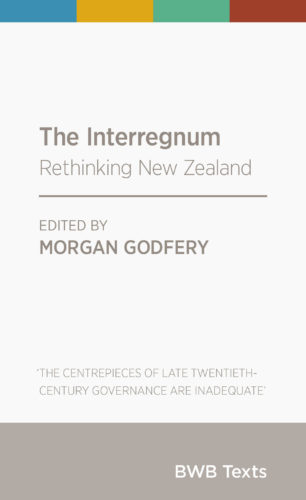
VJMP Reads: The Interregnum: Rethinking New Zealand VII

This reading carries on from here.

The seventh essay in The Interregnum is ‘Contributing to Public Life From Afar’, by Lamia Imam. If the essays so far had mostly managed to be worryingly Marxist without being alarmingly so, this essay leaps right into the deep end with no restraints at all.

In an effort that stretches credibility beyond breaking point, Imam complains about the difficulty she has found being accepted by New Zealanders as one of our own, despite literally being an anchor baby who spent almost all of her formative years overseas.

Echoing the complaints of Golriz Ghahraman, who also spent most of her formative years overseas being raised by non-Kiwis, Imam describes being born in New Zealand only to move away with her parents while still a toddler, only to wonder why she isn’t welcomed with open arms when she decides that she is a New Zealander many years later when she briefly returns to study (before shifting off again).

The question she does not confront is: why should Kiwis form close social bonds with people who are liable to up and leave the country forever, rendering that social investment worthless? If a person has all of their family overseas, and are themselves getting educated overseas, the likelihood of them still being here in 25 years is very low, at least in comparison to anyone else.

Really this essay should be seen for what it is, which is an effort to destroy the social bonds between New Zealanders for the sake of making us more easily exploitable by the international globalist class of which Imam is a member. To this end, it uses a number of globalist rhetorical devices that have previously been successfully employed towards the destruction of the Western working class.

One of the most obvious of these is crying about the “racism” she has faced on account of being Muslim (which is, of course, not a race). Another is the astonishing claim that people who don’t consider her to sound like a Kiwi on account of her admitted lack of a Kiwi accent are “ignorant”.

Claiming to be “hyper-aware of her privilege”, Imam appears to make no effort whatsoever to understand the thinking of the New Zealanders she claims to be her countryfolk. Relating an incident where a highly distressed man at a Community Law Centre “started screaming at me about immigrants, and specifically Muslims… ruining his job prospects,” absolutely zero effort is made to commiserate with one of the many Kiwis who have lost out from globalism.

Instead she complains that “acceptance was hard to come by,” as if the rest of us ought to have been grateful for the presence of a Muslim immigrant – a sight that has heralded the impending destruction of communities and nations all around the world for 1,300 years.

It seems that, according to Imam, Kiwis no longer have the right to decide for themselves what a Kiwi is. That can apparently now be decided by people who have lived three years of their life in New Zealand and who do not have Kiwi ancestors. Now you can just step off a plane and say you’re a Kiwi and that’s as good as anyone else can do.

As a reader I wondered how welcoming Imam would be if I turned up at the funeral of a wealthy family member, declared myself to be one of their tribe and demanded a share of the family fortune? Would I also find that “acceptance was hard to come by”?

In the end, I gave up when I read “Ordinary Kiwis supposedly do not care about identity politics, which suggests to me that they don’t have an identity.” No-one who, while claiming to be a Kiwi, writes something that stupid is worth reading.

In summary, this poorly-written effort rambles, does not employ logic and frequently contradicts itself, but the essay does raise many questions that are yet to be meaningfully discussed in the West, such as: who are we allowed to exclude?

Answering those question is not for The Interregnum. This book that preaches inclusivity as the highest of virtues has expressly excluded right-wing and working-class voices.

Fair enough on excluding the right-wing, if one wants to restrict the dialogue to the voices of the young, but why provide a platform for a jetsetting middle-class professional woman while denying a platform to working-class white people? It seems very strange that a book can claim to be speaking for the underdog but deny that underdog the right to speak about the issues that are causing them to suffer.

Generation X’s Most Bitter Realisation

Instead of seeing the next generations as inheritors of a world that they were duty-bound to steward, The Baby Boomers see the young as resources to be exploited

Some things have been part of life for so long that we’ve taken them for granted. We take for granted that parents pass wealth onto their children in the form of knowledge and silver; we take for granted that technological and social improvements mean that the quality of life increases for every generation that passes; we take for granted that each generation has an obligation to the leave the world in order for the one that comes after it. Generation X has come to bitterly realise that some of these assumptions are no longer true.

The most bitter realisation of Generation X is that we will be the first generation in history to inherit a lower standard of living than the previous generation enjoyed. The Baby Boomers ticked up so much debt on the intergenerational credit card that they can never pay it back themselves, even if they intended to. We will pay it back through the sweat of our own labour so that our parents can enjoy a lengthy retirement, the vast majority of them still fit to work.

What is currently taking place is the greatest theft in history: the Baby Boomer’s theft of the production of the Generation Xs and Millennials, who will lose a large proportion of their wages to pay back the debts their parents accumulated, and for rents on houses that they can never own, merely so that those parents could experience an unprecedented level of comfort.

They did this by giving themselves tax cuts without cutting spending, so that our nations had to borrow to pay for basic social services, many of which the Baby Boomers themselves used more frequently on account of being elderly. All over the world this was done, not just New Zealand; everywhere an excuse was found for the increase in borrowing.

At the same time, the wages of the next generation were squeezed between having to pay back massive student loans that the Baby Boomers were not themselves subjected to, competing with foreign labour to a degree that the Baby Boomers were not themselves subjected to, and forking out for ever-scarcer affordable housing to a degree that the Baby Boomers were not themselves subjected to.

So not only did the Baby Boomers ensure that they enjoyed the highest standard of living ever recorded by one generation in human history, they did so explicitly at the expense of the generations who would follow, saddling them with a debt so heavy that even war reparations would be less burdensome.

They ticked up this unique standard of living for themselves on the national credit card, and simply left us to pay the debt off, which will take half a century. For most Western nations, cleaning up this mess will involve trying to integrate millions of individuals from very strange and often barbaric cultures, people that the Baby Boomers let into our countries because they didn’t want to pay us proper wages like they themselves had been paid.

The question that will define the soul of Generation X is whether we do the same thing to the generations after us out of bitterness and resentment for what our parents put us through, or if we treat the generation after us fairly out of a belief that we learned something from the greed of our parents.

FaceBook Contains The Seeds For Its Own Destruction In Its “Community Standards”

As the yang contains the seeds of the yin that will eventually grow to overwhelm it, so does FaceBook contain the seeds for its own destruction in its totalitarian “Community Standards”

Social media is becoming an ever more difficult place to express oneself, with the list of things that you’re not allowed to say growing by the week. FaceBook (otherwise known as FaecesBook) is arguably the worst offender, and is getting worse all the time. Unfortunately for them, the seeds of their own destruction are sown by their aggression against free expression.

More and more people are finding themselves “zucked”. This means they are banned from FaceBook for a set length of time because of transgressions against the mysterious “Community Standards”: an ephemeral set of ever-shifting laws against saying certain things, on the grounds (presumably) that some might find the speech offensive.

In doing so, FaceBook has forgotten who made it popular in the first place. It wasn’t people who were worried about community standards – to the contrary, it was the sort of person who flocked to the Internet as a place to speak freely. It was the cool people who made FaceBook a fun place to talk about things that were hard to talk about in real life, for whatever reason.

These people are not going to tolerate being banned for 30 days for using words like ‘faggot’ or ‘nigger’: two things which ought to be punished by no more than mild social disapproval, without need for recourse to a higher authority. Cool people don’t put up with that sort of crap; cool people will simply find another platform (such as www.minds.com), upon which they can still express themselves freely, and without being encumbered by arbitrary restrictions imposed by some moralising, prudish control freaks.

The author was recently banned from FaecesBook for three days for writing the word ‘fags’. It wasn’t written as a slur, but as the opposite. It was part of the phrase “God Hates Fags”, in the context of mocking religious fundamentalists who hate homosexuals and who are boneheaded enough to protest homosexuality by holding up signs that presume to speak for God.

So it doesn’t even matter if you make a comment in support of homosexuals by mocking those who only are homophobic because they think God told them to be. Use of the word ‘fag’ or ‘fags’ is verboten, so utterly verboten that it is a crime for which there is no defence.

On another occasion I was zucked when a troll in a group I was in accused the group of being full of people who believed that Hitler did nothing wrong. I responded with “But Hitler didn’t do anything wrong” – a comment so clearly a joke that no-one except for the most socially retarded idiot sperglord could have thought otherwise. That’s no defence in the eyes of FaceBook, though, for who all thoughtcrime must be ruthlessly punished.

Perhaps I should have been banned for making such an obvious joke? It would have been much fairer.

It makes one wonder – has Zuckerberg ever been to a pub? Has he ever been out in public, and heard how people speak in real life when they’re trying to relax and make some light humour? ‘Fags’ is hardly a problem. What is a problem is the ever-increasing creep of intrusive advertisements on FaceBook, a platform where the vast majority of the content is created by users who could go anywhere else.

Or is the plan to make FaceBook a gigantic safe space, much in the same way that television currently is? Because the obvious problem with this approach is that FaceBook got its initial momentum from being the precise opposite to a safe space, and if it tries to be the United Nations of Internet forums it will end up just as despised and derided as the UN is.

FaceBook is already dying, but it might take several years for the obvious signs of its irreversible decline to become undeniable. It is, in effect, going through the inevitable life cycle of Internet forums, in which the fourth stage – Destruction – is marked by the controllers of the forum bringing in more and more and more rules in an attempt to recapture the glory days, without them being aware that it is the very application of all these rules which has driven the glory away.

The application of ridiculous Community Standards that not even the average grandmother can abide by without getting banned will be the death of FaceBook.