
Anarcho-Nihilism

There are two popular strains of anarchism that are often conflated. The first accords with the more traditional definition of anarchy as “without rulers”; the second is when a person supports anarchy just because they want to see the world burn. This essay gives a name to this latter tendency, with the intent of making a clear distinction: anarcho-nihilism.

It isn’t easy for most people out there to tell the difference between an anarchistic sentiment against being ruled and anarcho-nihilism.

For one thing, a sentiment against being ruled inevitably brings a person into conflict with the ruling class, who tend to think that they have achieved their position by divine right. The ruling class can usually only hold its position by creating the perception that they are uniquely qualified to rule. Someone who is against being ruled, and someone who just wants to trash everything, are therefore similar in that they both oppose the ruling class.

This means that both usually find themselves socially outcast for not following orders in a sufficiently timely and enthusiastic manner.

For another thing, both anarchists and anarcho-nihilists accept that there is going to have to be a lot of destruction before this shit can get sorted. The Establishment is well entrenched: they own all the media, all the politicians, and all the lackeys with guns. Their fingers are in every pie, and any efforts to prise them out will be violently resisted, sometimes pre-emptively. There is going to have to be a lot of destruction.

The major difference is that the anarcho-nihilist has no plans for what to do after the destruction phase. That phase – the building and creating phase – is not important to them, in much the same way that neither building nor creating appeal to nihilists. What motivation could one have to build anything when no meaning exists?

A normal anarchist will have thought things through a bit further than just the destruction phase. Indeed, if the ‘anarcho’ prefix denotes the complete destruction of the current system, then the suffix denotes what a person’s preferred next move is. An anarcho-capitalist wants to get rid of the current system so that they can make money, an anarcho-communist wants to get rid of the current system so that they can co-operate, a mutualist wants to get rid of the current system so that they can trade, and an anarcho-homicidalist believes that humans know intuitively how to govern themselves fairly and how to build a society if not impeded by enslavers.

Someone who hasn’t thought things through this far might be an anarcho-nihilist.

Often, an anarcho-nihilist will be driven by a peculiar bitter resentment, sometimes because of a personality disorder. The fact that an immediate shockwave of destruction would cause a tremendous amount of misery is not a drawback to such a person – indeed, it could be the whole reason for why they support it.

The real difficulty with anarcho-nihilists, from an anarchistic perspective, is that no bonds of any kind can be formed with nihilists. In order for people to have a common bond of any kind, they must have at least one belief in common. Someone who believes in nothing is hard to trust – after all, what’s stopping them from turning on you like a wild animal?

Another way of making the distinction is that an intelligent anarchist will strive to find the correct balance of inducing chaos to the establishment and building a new, voluntary and peaceful order. The anarcho-nihilist doesn’t worry about order: they just want chaos and more chaos for the sake of it. There is no order that they will agree to.

The problem with this attitude from a practical point of view is that some laws are in place to contain natural disorder, they just go too far. For instance, a law proscribing a side of the road that traffic has to drive on is hardly tyrannical. The problem arises when you are fined $2,000 for harmlessly crossing the centre line by six inches when there was no oncoming traffic.

Overcoming anarcho-nihilism is extremely difficult, because it is not usually a position taken because of political philosophising – it’s usually a position taken because of a spiritual failure. Therefore, the path out is not obvious.

*

If you enjoyed reading this essay, you can get a compilation of the Best VJMP Essays and Articles of 2017 from Amazon for Kindle or Amazon for CreateSpace (for international readers), or TradeMe (for Kiwis).

An Anarcho-Homicidalist Explains the Last 50 years of Workplace Relations

The social contract is held in place by a fine balance. Perhaps most famously expressed as the 13th-century ultimatum given by English barons to the despotic King John that led to the Magna Carta, it can summarised as: treat us well or we’ll chop your head off. This is to say that, the king has the right to be the king, but if he becomes tyrannical then the rest of us reserve the right to overthrow him.

This social contract is not unique to humans – it’s a natural feature of life for all social animals, perhaps most apparent in observing the political machinations of male chimpanzees. The alpha male chimpanzee might get his pick of the females, and he might even get to preoccupy more than one female at any one time, but if he gets too greedy, and tries to monopolise all of them, then the betas will band together from a solidarity borne of mutual frustration and tear him to pieces.

After all, no matter how strong the alpha is, it’s extremely difficult to beat two other healthy, fit males if those two males have sufficient solidarity to work together as a unit. Over the recent ten or so million years, our ancestors evolved to adapt to this brutal calculus. This instinct manifests as a rudimentary sense of justice, which provokes righteous anger if it is violated, such as by a greedy or tyrannical alpha that doesn’t share.

We have inherited similar sentiments from our common ancestor with the other apes, and they have expressed themselves as the multifarious political machinations that humans have contrived over the millennia. The ultimate intent behind all of this manoeuvering is the genetic imperative to get the maximum amount of pussy, which is essentially a question of getting the maximum amount of resources, this being primarily what attracts the females of sexually reproducing species.

Key to understanding anarcho-homicidalism is understanding the eternal truth of this equation.

The amount of pay that a worker gets in 2018 A.D. is the result of a negotiation. The negotiation reflects the amount of relative leverage that the worker has compared to the employer. For the most part, this is a question of the best alternative to a negotiated agreement. For thousands of years, it was understood that if the employer class offered the workers a deal that was so poor that they could not maintain their own basic dignity, as King John had done, this was effectively an attempt to enslave, and in such a case the workers would have the right to kill that enslaver.

This changed about 50 years ago, with the 1968 Revolution. Ever since that tumultuous year, which marked that the Great Pendulum had definitely swung back from the right that caused World War II to the left, Westerners have been conditioned to be nice. All of the problems of the Great Wars, we were told, stemmed from human nastiness. Now we have to be nice, nice, nice – all the time!

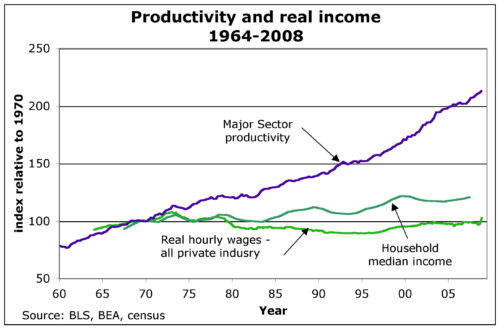
At the same time that the human masses were decoupled from their natural instincts to sometimes be nasty in defence of their basic interests, wages decoupled from productivity (as can be clearly seen from the graph at the top of this essay). Every member of the ruling class, in particular economists and politicians, will tell you that this is a coincidence. But the anarcho-homicidalist knows that it is no coincidence.

Basically, we’ve become so domesticated that not only have we lost the desire to kill our enslavers, which was the one thing holding our half of the bargain in place, but we’ve forgotten that it’s even a legitimate option. Because we’re no longer willing to kill, we’ve lost all of our negotiating leverage. In the age of nice, employers can simply play the working masses off against each other in a race to the bottom, knowing full well that there’s no tipping point at which they will feel too humiliated and revolt.

As a natural consequence, wages have plummeted.

Worst of all, we’re getting nicer and nicer, as most of us are now so powerfully conditioned against violence by a merciless school system that we resemble Alex from A Clockwork Orange after his exposure to the Ludovico technique. The very thought of rebellion is terrifying to a population no longer allowed to write ‘faggot’ on FaceBook, and where protesting the wrong religion will get you beaten to death in prison. One can therefore expect that our negotiating position will continue to weaken.

This is where the philosophy of anarcho-homicidalism becomes necessary: to restore the lost half of the negotiating equation. Those who consider themselves fit to rule need to learn, once again, to fear those who they presume to command. Because, no matter what your ruler says, it’s always, always, always permissible to kill someone trying to enslave you.

Anyone who is incapable of understanding this is already a slave!

*

This essay is an excerpt from The Anarcho-Homicidalist Manifesto, written by Viktor Hellman and due for release by VJM Publishing in the autumn of 2019.

All Of Us Carve A Niche Out Of Nature With Violence

Humans are part of Nature, and therefore human nature is also red in tooth and claw

The Internet is full of people trying to score points from each other in the eternal game of oneupmanship that all social species engage in. In the West, with our heavily Jesus-based culture of masochism, we demonstrate that we are better than other people by showing how much violence and injustice has been done to us in the past. The more we are like martyrs, the better.

Our cult of victimhood impels us to emphasise how badly our ancestors suffered at the hands of The Man, whether these ancestors be women, lower classes or other races. It also impels us to emphasise how our own ancestors did no wrong, unless they were misled by some enemy without or betrayed by an enemy within.

It’s as if each one of us holds the power to act as an instrument of karma, and past injustices done to us give us the right to do injustices to other people. And like so much of modern society, it’s absolute horseshit.

Native people often describe an idyllic past in which they all lived in peace and in perfect harmony with Nature, but the truth is infinitely more violent. Although many native peoples had sophisticated cultural strategies for minimising the carnage of warfare (such as ritualising it), it’s clear from any scientific perspective that all human groups are guilty of using violence, and must be.

This can be proven by simply looking around at the laws by which Nature operates. The price for being peaceful is not to suffer persecution – it’s to be dead. A will to engage in peaceful conduct is not necessarily going to be reciprocated by other people, and almost certainly will not be by wild animals, and if it isn’t, there might not be much one can do about it.

It is impossible to occupy any niche in Nature without violence, because for every niche one might occupy within Nature there is another organism willing to use violence to drive one out of it. This is true of whatever level of the Great Fractal one wants to look at it on.

There are no creatures out there that can survive without preying on either other creatures or on plants. Any creature that wishes to attend to its own basic metabolic needs is forced to conduct violence against other life to get energy or nutrients.

This is not only true in the immediate food-gathering sense but in the long term mating sense as well. Males of sexually reproducing species must attract their females through demonstrating a capacity for resource acquisition, and this is done through acquiring and defending a territory, which is almost impossible to do without violence.

In order to build a house, a person has to cut down trees in the forest to clear a space, destroying the habitat of all of the creatures that dwelt within. But more importantly, in order to defend that space against the forms of life that would occupy it, that person has to be ready to kill.

All manner of parasites, like bugs, spiders, weevils etc. have to be killed for the sake of food security and to avoid destruction of property; all vermin like mice and rats have to be killed for similar reasons; larger animals have to be killed lest they destroy the property; humans have to be killed lest they take over and try to enslave one.

Almost wherever the reader is sitting in the world right now, someone was killed for it at some point in the past. Someone will have died so that someone else could secure rights to that land, even if it was before recorded history. For your ancestors to have carved out a niche in this place, where food has to be hunted and agriculture demands the destruction of ecosystems, someone and (not or) somethings had to be killed.

All of us are descended from killers. Every single one of us. There’s simply no other way to occupy a niche within Nature in the first place. If being descended from peaceful people awards some sort of moral superiority when it comes to discussing political issues, there are none of us still living who can claim it.

Anyone claiming that their ancestors were peaceful by nature or that they are genetically disinclined towards violence is a liar.

*

If you enjoyed reading this essay, you can get a compilation of the Best VJMP Essays and Articles of 2017 from Amazon for Kindle or Amazon for CreateSpace (for international readers), or TradeMe (for Kiwis).
Generation X’s Most Bitter Realisation

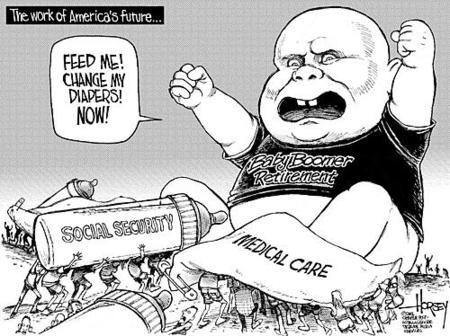
Instead of seeing the next generations as inheritors of a world that they were duty-bound to steward, The Baby Boomers see the young as resources to be exploited

Some things have been part of life for so long that we’ve taken them for granted. We take for granted that parents pass wealth onto their children in the form of knowledge and silver; we take for granted that technological and social improvements mean that the quality of life increases for every generation that passes; we take for granted that each generation has an obligation to the leave the world in order for the one that comes after it. Generation X has come to bitterly realise that some of these assumptions are no longer true.

The most bitter realisation of Generation X is that we will be the first generation in history to inherit a lower standard of living than the previous generation enjoyed. The Baby Boomers ticked up so much debt on the intergenerational credit card that they can never pay it back themselves, even if they intended to. We will pay it back through the sweat of our own labour so that our parents can enjoy a lengthy retirement, the vast majority of them still fit to work.

What is currently taking place is the greatest theft in history: the Baby Boomer’s theft of the production of the Generation Xs and Millennials, who will lose a large proportion of their wages to pay back the debts their parents accumulated, and for rents on houses that they can never own, merely so that those parents could experience an unprecedented level of comfort.

They did this by giving themselves tax cuts without cutting spending, so that our nations had to borrow to pay for basic social services, many of which the Baby Boomers themselves used more frequently on account of being elderly. All over the world this was done, not just New Zealand; everywhere an excuse was found for the increase in borrowing.

At the same time, the wages of the next generation were squeezed between having to pay back massive student loans that the Baby Boomers were not themselves subjected to, competing with foreign labour to a degree that the Baby Boomers were not themselves subjected to, and forking out for ever-scarcer affordable housing to a degree that the Baby Boomers were not themselves subjected to.

So not only did the Baby Boomers ensure that they enjoyed the highest standard of living ever recorded by one generation in human history, they did so explicitly at the expense of the generations who would follow, saddling them with a debt so heavy that even war reparations would be less burdensome.

They ticked up this unique standard of living for themselves on the national credit card, and simply left us to pay the debt off, which will take half a century. For most Western nations, cleaning up this mess will involve trying to integrate millions of individuals from very strange and often barbaric cultures, people that the Baby Boomers let into our countries because they didn’t want to pay us proper wages like they themselves had been paid.

The question that will define the soul of Generation X is whether we do the same thing to the generations after us out of bitterness and resentment for what our parents put us through, or if we treat the generation after us fairly out of a belief that we learned something from the greed of our parents.