
What Would the Average Hourly Wage Be in New Zealand If Wages Had Kept Up With House Prices?

New Zealand is torn by inter-generational tension right now. The young have no hope of finding houses they can afford and the old simply blame them for being too lazy to work hard enough to afford one. However, the numbers show that workers today get a much worse deal than they did 30 years ago. This article looks at what the average wage in New Zealand would be if it had kept pace with the price of houses since the late 1980s.

This graph from the Trading Economics website tracks the increase in the New Zealand Average Hourly Wage over the past 30 years. We can see that the average hourly wage in New Zealand, as of the beginning of 2018, is $31.03. The Reserve Bank of New Zealand website contains many interesting statistics and graphs, many of which can be downloaded from this link. This article will combine both sources.

In March of 2001, the House Price Index (from the RBNZ link above) stood at 700.2. At this time, the average hourly wage was $17.70. So if a person wished to purchase a $300,000 house, suitable for a growing family, they would have to have capital equal to 16,949 hours of work at the average wage.

According to this article by Human Resources Director, Kiwis work an average of 1,762 hours a year (this figure was for 2014, but for cultural reasons this figure does not change much over time). This means that, in March of 2001, buying a house suitable for raising a family in required capital equal to 9.62 years of full-time work at the average wage.

How does that compare to today?

After seventeen years of red-hot growth, the House Price Index now stands at 2480.8. This represents an increase of 254% over those seventeen years, and it means that a $300,000 house in March 2001 now costs $1,062,000 (all growth factors assumed equal). As mentioned above, the average hourly wage in New Zealand has increased from $17.70 in that time to $31.03, which represents an increase of 75%.

In other words, in January of 2018, buying a $1,062,000 house, suitable for raising a family in, requires capital equal to 34,224 hours of working at the average hourly wage. This is equivalent to 19.42 years of work at the average hourly wage.

We can see, then, that when measured in terms of a person’s ability to purchase a house suitable for raising a family in, the average New Zealander is less than half as wealthy as they were only 17 years ago. To have the same house buying power that it had in 2001, an average wage in New Zealand would now have to be $62.65 per hour.

People working in 1989 – when the majority of Baby Boomers would have been in the workforce – had it even better still. In December of 1989 the House Price Index stood at 453.5; the average hourly wage stood at $13.07 in the first quarter of that year.

So our standard family home that cost $300,000 in 2001 cost a mere 64.8% of that price in 1989, whereas the average wage in 1989 was 73.8% of what it was in 2001. Put another way, the average house suitable for raising a family in cost $194,400 in 1989, which represented capital equal to 14,873 hours of labour at the average wage. This was equivalent to a mere 8.44 years of saved labour.

The average house price has gone up 447% over the past 30 years in New Zealand; the average hourly wage has gone up 137% in that time. So to have the same house-buying power as the average New Zealand worker in 1989, a Kiwi in 2018 would have to get paid $71.50 an hour. This would allow them to buy a decent house after saving around 14,000 hours of the average wage, which is the standard of living that the average worker had in 1989.

In summary, the average New Zealand worker has lost almost 60% of the house-buying power of their wage over the past 30 years.

Buying a decent house in 2018 costs savings equal to 19.42 years of work at the average wage; 30 years ago buying an equivalent quality of housing cost savings equal to 8.44 years of work. So if a Kiwi left home at age 18 in 1970 and saved half of their income on the average wage they could own a house by age 35; a Kiwi who left home at age 18 in the year 2000 and saved half of their income on the average wage can’t expect to own one before they turn 57.

Despite tiny relative savings on consumer electronics, it’s obvious that the standard of living for young people is much lower nowadays than it was 30 years ago. The fact that wages haven’t come close to keeping up with housing costs is the main culprit.

*

Dan McGlashan is the man with his finger on the statistical pulse of New Zealand. His magnum opus, Understanding New Zealand, is the complete demographic analysis of the Kiwi people. Available on TradeMe for $35.60.

Who Owns The New Zealand Media?

In more sophisticated countries, informed citizens go to considerable lengths to detect any biases among the people reporting the news. This is necessary to make sure that one develops a balanced, nuanced and independent opinion. Kiwis don’t generally bother with such things, preferring instead to believe everything we’re told like the good little lambs we are – except for this article.

It’s often remarked upon, by foreign visitors, that New Zealanders blindly believe everything they hear in the news. Conditioned into obedience by a brutal state education system that encourages bullying, social and emotional abuse, Kiwis are too afraid to question anything even vaguely resembling an authority, such as a television.

Given that we don’t question what the media is trying to tell us, it’s worthwhile figuring out who owns our media, because these same people effectively own our beliefs and opinions. In other words, let’s find out who own our minds.

We can find a ranked list of the major players in New Zealand cyberspace from Alexa. The two major internet portals in New Zealand are the New Zealand Herald and Stuff. You could confidently argue that the New Zealand online mediascape was an effective duopoly, with NZH and Stuff the only real players.

New Zealand Media and Entertainment (NZME) controls the New Zealand Herald brand, ranked by Alexa as the 9th biggest website in New Zealand. NZME is a large media conglomerate (by NZ standards, anyway), as can be seen from the list of newspapers they own at the bottom of their company page.

Finding out who owns NZME is not straightforward, because they are a publicly traded company on both the New Zealand and Australian stock exchanges. Helpfully, their own investor relations page lists their top 20 shareholders, but this doesn’t lead very far. All of the major shareholders are banks or holding companies for banks.

Number one on the list is Citicorp Nominees Pty Ltd, which is based in Sydney. According to Bloomberg, this company is a subsidiary of Citicorp Pty Ltd, which has been incorporated since 1954 and “provides a range of banking and financial products and services to retail, small business, corporate, and institutional clients primarily in Australia.”

One would think that this would surely be the end of the trail, but no. Citicorp Pty Ltd is itself a subsidiary, this time of Citigroup Holding (Singapore) Private Limited. This too, is a subsidiary: of Citigroup Asia Pacific Holding LLC, itself a subsidiary of Citi International Investments Bahamas Limited, itself a subsidiary of Citi Overseas Holdings Bahamas Limited, a child entity of Citigroup Inc.

Citigroup is a gigantic American bank, one large enough to be considered “too big to fail”, with its origins in the City Bank of New York, chartered in 1812. The closest Citigroup has to an owner, at 7.06% of the shareholding, is Vanguard Inc., “One of the world’s largest investment management companies” (as per their company page). In second place, at 4.76% of the shareholding, is State Street Corporation, another investment management bank. Third, with 4.51%, is BlackRock Inc., yet another global investment management corporation.

So that line of investigation doesn’t lead to any specific names, but neither is it any easier trying to figure out who is behind any of the other of New Zealand Media and Entertainment’s major shareholders.

J P Morgan Nominees Australia Ltd is at third place on the NZME shareholder’s list, with 12.69%. Finding out out who owns JP Morgan Nominees Australia Ltd is no easy task, as the article linked here demonstrates. One passage from the linked article reads “Unfortunately, it is practically impossible to track down the identities of those underlying shareholders through the various financial structures that hold shares for each other and on behalf of each other.”

If it’s practically impossible to find out who owns NZME, what about finding out who owns Stuff, the 3rd largest website in New Zealand?

Investigating this is just a shorter path to the same place. The Stuff brand is owned by Fairfax New Zealand Limited, a subsidiary of Fairfax Media Ltd., which is also publicly traded on the ASX. As it turns out, the second-largest shareholder of Fairfax Media Ltd. is none other than Vanguard Inc.

They only own 2.26% of the shares, however, so can only give us a clue as to the ownership of Fairfax Media Ltd. Looking down the list of funds and institutions that own shares in Fairfax, there’s little more than a pile of asset management companies, wealth funds and banks. As with Vanguard, BlackRock also appears on the list of major owners of both Citigroup and Fairfax Media Ltd.

The story with television media is little different to the story just described with print and online media. The New Zealand television market is, like the print and online media markets, an effective duopoly between Television New Zealand (TVNZ) and MediaWorks New Zealand.

TVNZ is Government-owned, but is almost entirely funded by commercials and is therefore little different to any other commercial broadcaster. MediaWorks New Zealand, for its part, is entirely owned by Oaktree Capital Management, which is (you guessed it) another global investment and wealth management fund.

In summary, no-one has any fucking idea who owns the New Zealand media, apart from the small niche carved out by TVNZ and the independents. Trying to pin it down to any one person is like trying to catch shadows in a jar. The best one can say is that the New Zealand media is ultimately controlled by global wealth management funds and corporations and their nominated representatives.

Being owned by such institutions tells us that the New Zealand media is run for profit and probably has little agenda other than commercial. In other words, there is little in the way of direct political propaganda or slanted editorial content, but one can expect the quality of the journalism to degrade to that which appeals to the lowest common denominator in society. Indeed, it has.

The astute reader will have drawn a connection between all of this bank ownership and the never-ending series of “I became a homeowner at age 21”-style stories. The reason for this is the banks benefit directly from a shallow, consumerist, disposable culture in which it’s considered normal for people move away from their parents and get a massive mortgage so that they can pay hundreds of thousands of dollars of interest to a gigantic, parasitic investment corporation.

In other words, the owners of the New Zealand media directly make money from consumerist culture, in particular from people taking out loans to buy shit that they don’t need. This is why all manner of wasteful, extravagant and unnecessary consumer purchases are advertised, and normalised, by the New Zealand media.

*

If you enjoyed reading this essay, you can get a compilation of the Best VJMP Essays and Articles of 2017 from Amazon for Kindle or Amazon for CreateSpace (for international readers), or TradeMe (for Kiwis).

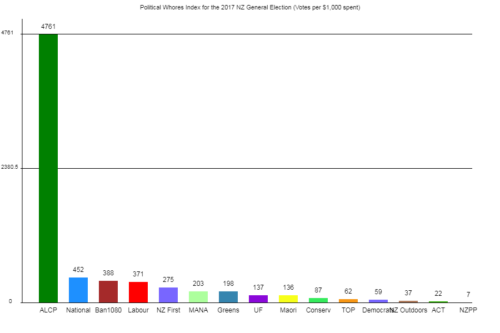
The 2017 New Zealand Political Whores Index

A bar chart of the Political Whores Index, calculated as votes received in the 2017 General Election per $1,000 spent

The New Zealand Electoral Commission has now returned its list of party expenses for the 2017 General Election. This enables us here at VJM Publishing to update 2014’s Political Whores Index. 2017’s Political Whores Index tells us who tried to earn a place in Parliament, and who tried to buy one.

The logic of the Political Whores Index works like this. Political parties spend money at election time to get media exposure, because the more media exposure a party gets, the more votes it gets. This is usually easier and cheaper than actually talking to people and hearing their concerns. Effectively, parties just turn on the media funding tap and votes come out.

The correlation between dollars spent on campaign expenses for the 2017 General Election and votes received is 0.95, which pretty much tells us that our democracy is for sale. The more money you can spend, the more votes, is the hard and fast rule.

So all of our political parties are whores, but it can be said that the more money a party spends and the fewer votes they get, the more of a whore they are. This can be considered whoring because the parties that do it try to buy votes by transmitting a manufactured impression through the media, rather than honestly trying to build goodwill among the people by meeting and talking to them so that they can form their own impression.

This willingness to whore oneself out instead of honestly building a positive reputation among the New Zealand people can be expressed as a ratio of dollars spent on election expenses to votes returned by the populace. As was true of our effort in 2014, which saw the ACT party crowned the whoriest party in New Zealand and the Aotearoa Legalise Cannabis Party the most honest one, we will present those ratios in an ordered list.

In the following table, PWI stands for ‘Political Whores Index’ and is calculated by dividing the number of votes each party received in the 2017 General Election by the declared party expenses for each party contesting the 2017 General Election (in dollars), multiplying the remainder by 1,000, then rounding to the nearest whole number.

In other words, it represents the number of votes won per $1,000 spent.

PARTY $ SPENT VOTES PWI
ALCP 1696 8075 4761
National 2546742 1152075 452
Ban1080 7749 3005 388
Labour 2580523 956184 371
NZ First 679095 186706 275
Internet 2322 499 215
MANA 17921 3642 203
Greens 818525 162443 198
United Future 12963 1782 137
Maori 225552 30580 136
Conservative 71764 6253 87
TOP 1013714 63261 62
Democrats 13761 806 59
NZ Outdoors Party 43508 1620 37
ACT 601487 13075 22
NZ People’s Party 274541 1890 7

For the second election running, the Aotearoa Legalise Cannabis Party was, by far, the least whoriest of all the parties that contested in 2017. They returned a staggering 4,761 votes for every $1,000 spent – unarguable evidence that cannabis law reform is an issue that the New Zealand people are demanding. As shown elsewhere, cannabis law reform is the issue that unites real Kiwis.

No other party achieved so much as 10% of this ratio. Many will be surprised to hear that the National Party was second, with 452 votes for every $1,000 spent. In short, the electorate wasn’t particularly displeased with how National was running things, despite that National lost power. Yes, there was widespread misery among the poor and we have the highest youth suicide rate in the world, but people who vote don’t care much about that.

The Ban 1010 Party was 3rd, just edging out Labour, who won 371 votes for every $1,000 spent. It’s curious, perhaps, that Labour and National are both doing quite well by this measure, as they are both mainstream parties. But this simply speaks further to how there was no real appetite for change among Kiwis. People weren’t particularly interested in upsetting the apple cart.

The New Zealand First Party did moderately well, gathering 271 votes per $1,000 spent. Unlike 2014, this was considerably poorer than the National and Labour parties, probably reflecting Winston Peters’s decline as a public speaker, as many of their votes in 2014 were gained through town hall meetings.

The Green Party were the whoriest of the four major parties. They only got 198 votes per $1,000 spent. So they spent about as third as much as National for about one-seventh of the votes. This tells us that the electorate has partially turned against the Green Party message, despite their strong support of the cannabis law reform issue. It may have been that the Green proposal to raise the refugee quota drove a lot of Maori and working class voters to Labour and New Zealand First.

The Opportunities Party was a poor return on investment, although as it was essentially a vanity project it could not be said to have failed simply on that basis. With wall-to-wall saturation coverage on FaceBook and other Internet portals, they spent over a million dollars for a little over 60,000 votes, thereby achieving a PWI of 62 votes for every $1,000 spent.

It’s illuminating to compare the PWI of The Opportunities Party with that of the ALCP. The Opportunities Party spent almost 600 times as much as the Aotearoa Legalise Cannabis Party, and won less than 8 times the number of voters. Considering that most TOP voters were voting for legal cannabis anyway, this figure shows that TOP was really a joke party that tried to buy its way into Parliament.

Speaking of joke parties that try to buy their way into Parliament, the Conservative Party scored a PWI of 87, only slightly better than TOP. This tells us that the 5% threshold is really an outstanding idea, because it prevents wealthy, narcissistic freaks from assembling a coterie of arselickers and simply spending so much money on media exposure that they can brainwash the mentally weakest twenty thousand of the population into casting a vote for them.

Worst of all, however, was the New Zealand People’s Party. Also the vanity project of a rich Baby Boomer, they pissed away over quarter of a million dollars for a paltry 1,890 votes. This left them with a PWI of 7, which means that their message was 660 times less appealing to the New Zealand people (all factors equalised) than that of the ALCP.

MANA (203), United Future (137) and the Maori Party (136) all had reasonably poor PWIs, but were still significantly higher than the “fuckwit” parties.

Ultimately, the Political Whores Index suggests that the New Zealand people are quite happy with our current arrangement of two major parties and two minor ones, because none of the more radical parties were able to gain any particularly high level of traction for their amount of electoral spending. It was mostly dollars in, votes out.

Just give us some real cannabis law reform.

*

If you enjoyed reading this essay, you can get a compilation of the Best VJMP Essays and Articles of 2017 from Amazon for Kindle or Amazon for CreateSpace (for international readers), or TradeMe (for Kiwis).

Should There Be A Ministry of Men’s Affairs?

Life is so much harder for men in New Zealand that they kill themselves at almost three times the rate of women

Many people were shocked, and many were not, by Julie Anne Genter’s comments this week about old white men. Speaking to Cobham Intermediate School pupils, Genter made the point that some of these old white men “need to move on and allow for diversity and new talent.” These statements were made in her capacity as Minister for Women, but if you look at the statistics, it seems like there’s more need for a Minister for Men.

The reason for a Ministry of Women’s Affairs was ostensibly to close the gaps between the well-being of women and men. Since the advent of Abrahamic religion in the West, women have been forced into a subservient role, being forced to take the blame for the fall of man as well as for invoking the horror of Nature. Biblical passages such as Timothy 2:12 instructed Christendom that “I do not permit a woman to teach or exercise authority over a man; she is to remain quiet.”

Ever since these male supremacist religious cults invaded the West, our women have been forced to endure structural abuse. Divorce was banned, forcing women to endure permanent relationships with violent men. Prostitution was banned, denying women natural opportunity for economic advancement. Abortion was banned, forcing women to carry unwanted children to term or else risk a back-alley abortion from a “doctor” with no licence.

By any objective measurement, women had the worst of it for a very long time, and, when we realised this, we tried to make up for it with things like feminism and Ministries for Women’s Affairs. What we’ve been slow to realise is that, now that advantage is mostly a matter of obedience to the political, educational and commerical authorities, women have it better than men in many regards.

Most obviously, women have a much easier time of things in academic settings. Page 38 of the document linked in this paragraph demonstrates that women get better grades in literacy, and page 42 shows that they also get better grades in numeracy. This disparity is even worse for men at university level, which New Zealand women are 40% more likely to participate in.

When men had higher university participation rates than women, the media couldn’t keep quiet about how sexist and evil this state of affairs was. Indeed, this was one of the stated reasons for bringing in a Ministry of Women’s Affairs in the first place. An inequality of outcome in terms of education and gender was simply impermissible, immoral, outrageous.

In 2015, 527 New Zealanders killed themselves, of who 384 were men (72.8%). That means for every Kiwi woman who feels so rejected by society that she is compelled to take her own life, there are almost three Kiwi men who feel the same way. This is greater than the gap between Maori and non-Maori suicide rates, which is itself considered a large enough gap to be a national tragedy that demands immediate action (indeed, there is a Ministry of Maori Development).

So if society is so bad for Maori people that they need their own Ministry, as evidenced by suicide rates, and if society was so bad for women that they needed their own Ministry, as evidenced by tertiary participation rates, then surely there is sufficient cause to say that New Zealand men need someone looking out for them as well?

It’s absurd to claim that women are disadvantaged compared to men because men earn 20% more, when at the same time men are killing themselves at almost 300% the rate of women. It’s doubly absurd when it’s considered that women are benefitting immensely from the way that the pension system is set up, at the expense of predominantly male workers.

If the experience of being a man in New Zealand is so much less pleasant than the experience of being a woman that it carries triple the risk of suicide, it’s time to take steps to redress the balance by instituting a Ministry of Men’s Affairs to make up for all the privilege that women hold.

*

If you enjoyed reading this essay, you can get a compilation of the Best VJMP Essays and Articles of 2017 from Amazon for Kindle or Amazon for CreateSpace (for international readers), or TradeMe (for Kiwis).