
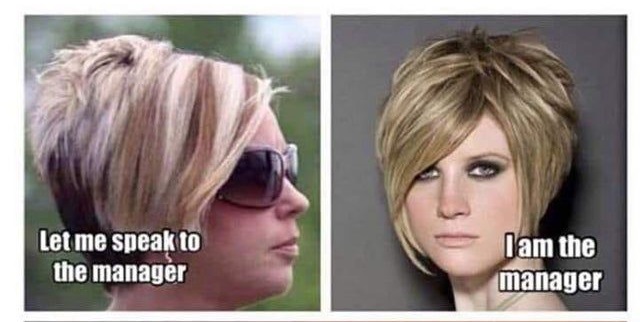
Clown World Chronicles: Who Is ‘Karen’?

Clown World, it is oft lamented, is beset by Karens. Middle-aged women with deep feelings of entitlement are making everyone’s lives harder, but there seem to be more and more of them as society decays further. These Karens are avatars of Karen herself, the Elder God of the Negative Feminine.

A Karen is typically a middle-aged woman with a fashionable haircut and aggressive clothing. She is demanding, aggressive, bossy and rude. She is seldom violent, but that’s precisely why she’s so terrifying – the damage she wreaks is in the invisible, metaphysical realm, and so is harder to defend against.

Retail workers, more than any other, fear the Karen. She will complain that her coffee wasn’t made right, and if you’re not apologetic enough she will ask to speak to the manager. Like a spoiled princess, the Karen thinks the world revolves around her, and she expects others to behave accordingly. A failure to do so is met with rage.

The nightmare scenario is to have a Karen as a boss or a wife. Her vanity is such that one cannot engage with her without becoming drained.

Karen is one of the Elder Gods. Her realm is the space beyond the Roastie on the negative feminine axis. The fundamental energy of the negative feminine is narcissism, and Karen shares with the Roastie a deep self-absorption. If a Roastie continues on her path of manipulating and self-obsessed attention whoring, she is liable to grow into becoming a Karen.

In Clown World terms, the Roastie transforms into a Karen once Chad is no longer interested in fucking her. Normally, by this stage, a healthy woman will have developed enough devotion to transition into a Waifu. The Karen has failed to do so. She is not devoted to a family – it’s still all about her.

The root cause of Karen’s shitty behaviour lies in her dismay that she doesn’t attract male attention like she used to. Instead of moving on gracefully, she exerts herself to remain the centre of attention. She hasn’t figured out that the attention she once received was a consequence of physical characteristics that are now irrecoverably lost. As such, she cuts a tragic and terrible figure.

None of this is to imply that Karen is despised. To the contrary, Karen is both feared and revered, much like the goddess Kali in the Hindu pantheon, and much like the Roastie who is her younger manifestation. Her good will is strenuously courted by the citizens of Clown World, who know that she is the favoured daughter of the Merchant.

A widespread belief holds that good fortune can be had by appeasing the Karen. After all, the majority of followers of the Clown World pantheon are young, and so they are likely to have Karens as managers. Karens are often promoted into managerial roles on account of that the company is often owned by the Merchant. This relationship is one of the Five Alliances of Pain.

The difference between the Karen and the Waifu is stark.

The Karen is fundamentally opposed to the Waifu, who is the Elder God of the Positive Feminine. The Waifu is the metaphysical representation of devotion, and as such is selfless. The Karen is the exact opposite. The Karen cannot find, or is unwilling to recognise, true rectitude. Absent rectitude, she has nothing to be devoted to. Absent devotion, she becomes something bestial.

The Karen is also fundamentally opposed to the easy-going Boomer, who is the Elder God of the Positive Masculine. The Boomer has demonstrated physical rectitude in his chadly youth, and now he demonstrates spiritual rectitude by going with the flow and not clinging to his desires. The Karen is the exact opposite here, too.

In summary, the Karen is a spirit that represents the energy of the divine feminine if it becomes twisted towards egotism as it ages. She is an almost demonic figure to anyone who becomes stuck with her, but can deliver great blessings of fortune to anyone manly enough to win her good favour.

*

This article is an excerpt from Clown World Chronicles, a book about the insanity of life in the post-Industrial West. This is being compiled by Vince McLeod for an expected release in the middle of 2020.

*

If you enjoyed reading this essay, you can get a compilation of the Best VJMP Essays and Articles of 2019 from Amazon for Kindle or Amazon for CreateSpace (for international readers), or TradeMe (for Kiwis). A compilation of the Best VJMP Essays and Articles of 2018 and the Best VJMP Essays and Articles of 2017 are also available.

*

If you would like to support our work in other ways, please consider subscribing to our SubscribeStar fund. Even better, buy any one of our books!
Writing Characters of Silver

The fifth element from the bottom of the spiritual hierarchy is silver. This is the stage a character reaches when they have enough spiritual energy to begin to shine. A person enters the realm of silver once they start to value non-physical treasures. In doing so, they make it possible for people to co-operate on a level above that of the family.

The lustrous nature of silver is what gives it its greater value. Like copper, silver has also been used as a currency for thousands of years, only silver was more desired, and therefore more valuable. Silver is rare and valuable enough that the presence of it can change the energy of an environment. This is true both physically and metaphysically.

A character will begin to enter the realm of silver once they come to appreciate the limitations of the realm of copper. Usually this occurs once they start losing interest in the opposite gender, at least in the sense of starting a family with them. Once they move past that and start thinking about groups of families, they move into the realm of silver. It is characters of silver who hold villages and towns together.

Note that a character of silver loses interest in the opposite gender because they transcend them, not because they start to dislike them. Hating the opposite gender marks one out as belonging to the baser elements. A character of silver is the sort of character who starts to prefer reading books to courtship and romance. As such, getting laid loses relative importance.

In this sense, silver represents knowledge, or intellectual capital. The realm of silver is the realm of psychology. As such, it is rare. The vast majority of the world is preoccupied with surviving, or with getting money or sex, or at least having a good time. To value knowledge for its own sake is rare and precious.

The archetypal character of silver is a librarian. Surrounded by books, each one containing the accumulated wisdom of a lifetime, is where the character of silver feels most at home. The power of silver is that one book can organise a force powerful enough to resist a thousand knights. Thus, silver is higher than and more valuable than copper or iron.

To the ancients, silver represented the Moon, which itself represented the divine feminine principle. Thus, silver came to be associated with the divine feminine. The apogee of silver is in outsmarting a character of iron. The story of Odysseus outsmarting the Cyclops is an archetypal example, as is the fable of Aesop where the Sun outsmarts the wind.

One association of silver and of the Moon is of coldness. The realm of silver is for hard-headed logical thinkers. It’s for those who can trap their chess opponents with sophisticated strategems. In the biological world, the element of silver is best represented by the spider, who spins a silvery web that entraps those of lesser intelligence.

This alchemical representation is from where we get the expression ‘silver-tongued’. This refers to someone with intelligence but no higher spiritual sense. To be silver-tongued is to be able to speak eloquently and persuasively, without necessarily being inspired by any deeper spiritual sense. Many would describe a character of silver as ‘glib’.

The archetypal occupation of a character of silver is a lawyer. A classic modern representation is Al Pacino’s character in The Devil’s Apprentice. Other examples of characters of silver in fiction are Faust‘s Mephistopheles, Loki in the Norse Pantheon or Shakespeare’s Shylock.

Another typical occupation is politician or merchant. The distinctive characteristic of a character of silver is that they do not need physical wealth because they can extract it from other people at any time. Any real character of silver ought to be able to turn up in a new town and weasel his way into the local power structure.

This reveals the dark side of the characters of silver. They have their own conceit, known as the Conceit of Silver, which is the act of mistaking one’s metaphysical capacity for one’s moral capacity (this is shared with characters of mercury, only the latter suffer from it to a lesser extent). Thus, they come to believe that their intellectual aggression or wealth gives them the right to rule over other people.

The reality is that neither knowing a great deal of information nor having a great deal of money confers any righteousness. Neither have any real value if not guided by a refined moral sense. Characters of silver do not inherently understand this, and those that do are on their way towards entering the realm of mercury.

A character of silver might have trouble conceding this point. Although they are illuminated compared to characters of copper, iron, tin and lead, they are not perfect. Characters of silver are entirely capable of being petty, vain and narcissistic, on account of that they are just close enough to perfect to mistake themselves for it.

Typical of this dark side of the characters of silver is intellectual arrogance. Being intelligent but not possessing true humility, the character of silver often has a deep-seated desire to be acknowledged as an intellectual authority. This is not usually a problem if they genuinely are an authority in the subject matter. In cases where they are not, they are capable of misleading great numbers of people, and causing awful damage.

The character of silver often resents the character of mercury, who is truly intelligent. This can lead the character of silver to try and trick the character of mercury, usually by memorising enormous amounts of information under which to bury their opponent. Characters of silver are masters of rhetoric. Although they are intelligent enough to see the truth, they don’t necessarily recognise the need to speak it.

Related to this, characters of silver are often found as cult leaders, pretending to be characters of gold. They might not be of the gold, but characters of silver are still illuminated enough to attract a considerable following from among those who recognise their higher value. Their capacity to accumulate knowledge means that they can often correctly diagnose problems – it’s just that their solutions, not coming from a moral foundation, are lacking.

Despite all this, most characters of silver are good people and all are motivated by less petty concerns than characters of copper, iron, tin and lead. Characters of silver will almost never abuse children or animals, and neither are they prone to lashing out violently or becoming drug addicts. Their flaws are easily forgiven on account of the weight of their virtues.

Generally speaking, characters of silver are held in high regard by decent people for the order they help to impose upon society. Because of their knowledge, their lives tend to be well-run, and their communities tend to be well-organised. A character of silver in your story could well be one that has a great influence on the protagonist or antagonist.

*

This article is from Viktor Hellman’s The Alchemy of Character Development, the sixth book in VJM Publishing’s Writing With Psychology series. This book will show you how to use alchemy to create deep, realistic and engaging characters for your creative fiction.

*

If you enjoyed reading this essay, you can get a compilation of the Best VJMP Essays and Articles of 2019 from Amazon for Kindle or Amazon for CreateSpace (for international readers), or TradeMe (for Kiwis). A compilation of the Best VJMP Essays and Articles of 2018 and the Best VJMP Essays and Articles of 2017 are also available.

*

If you would like to support our work in other ways, please consider subscribing to our SubscribeStar fund. Even better, buy any one of our books!
How God And Evil Can Coexist

One of the great philosophical and theological conundrums is how God and evil can coexist. This question has been discussed for over 2,500 years, and no resolution has been agreed upon. This essay will describe how the conundrum is resolved by the philosophy of Elementalism.

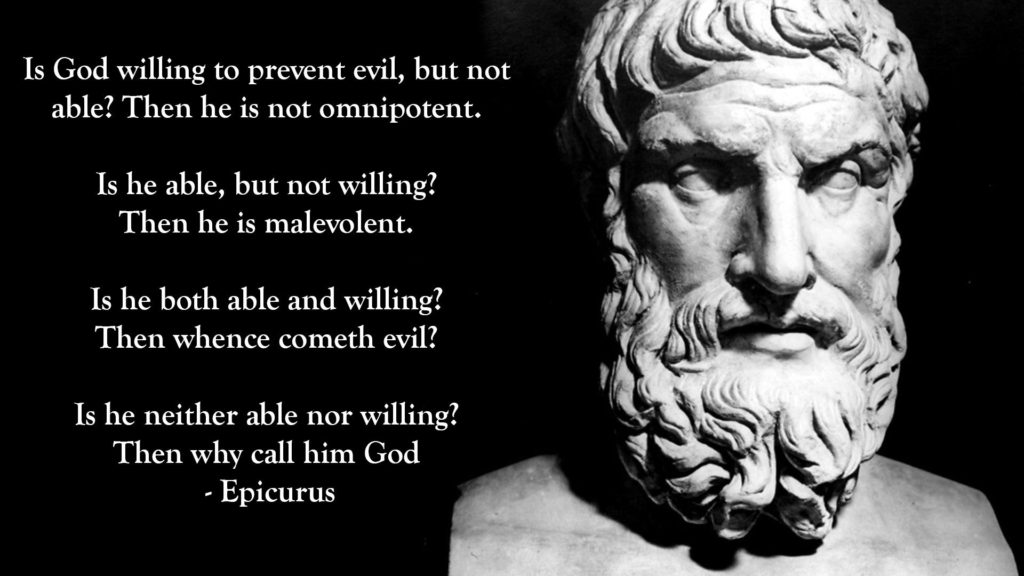
This conundrum is usually expressed in the words of Epicurus (see image at top of page). Believers in God often make the claim that God is both omnipotent and omnibenevolent. This creates a paradox in the mind of non-believers, on account of that evil and suffering exist in the world.

If God is unable to prevent evil, then God cannot be omnipotent. If God is able, but not willing, then God cannot be omnibenevolent. This paradox could be called Epicurus’s Fork, on account of that the believer in God cannot easily reconcile their belief in God’s omnipotence and omnibenevolence with the fact that evil and suffering exist.

Reconciliation of this paradox is easy for the Elementalist, however.

The first thing to state is that Elementalists have a particular conception of God and creation. The Elementalist believes that all individual consciousnesses are fragments of God, and therefore God is not something separate to ourselves. It’s more accurate to say that we, collectively, are God.

Likewise, Elementalists have a different conception of creation. The material world is not something that we woke up in – the material world is a dream that we collectively manifest through our will and karma. More specifically, our experience in the material world is considered to be an infinitely small subsection of something called the Great Fractal.

So how does that relate to the coexistence of God and evil? The answer lies in understanding what existence would be like without the illusion of a material world.

Our consciousnesses only feel suffering because we identify with our bodies. Our bodies are transitory phenomena, and like all transitory phenomena they are in a constant state of flux. This flux is usually painful. As a consequence, we need to act to balance it out. When our bodies get hungry we eat, when they get tired we sleep, when they feel pain we need to attend to it.

Without the illusion of a physical body in a physical world, our consciousnesses would exist in a state of perfect bliss, united with God. Absent a body, we would not have any cause to feel pain or fear of death. Absent a mind, we would not have any cause to feel anxiety or fear of the future. The only thing that would exist would be consciousness.

And it would be as boring as shit.

What would it be like to not suffer? It would be to live a life that was utterly devoid of meaning. Without the possibility of suffering, it wouldn’t matter what actions we chose. Every choice would lead to an identical outcome, at least as far as suffering is concerned. As such, our choices would be totally meaningless. We’d simply drift senselessly through life, like a leaf on a river.

This absence of meaning is the root of spiritual suffering, a worse affliction than any physical suffering could be. People rarely kill themselves from physical suffering, but they kill themselves from spiritual suffering every day. The physical suffering inherent to life, then, is not the worst thing in the world. Neither is the emotional suffering that is also inherent to life on account of that we cannot possibly satiate all of our desires.

We might have to act like physical and emotional suffering is ultimately terrible in order to give life meaning, but the reality is that an absence of meaning would be an even greater suffering.

It’s possible, then, for an omnibenevolent God to allow a minor suffering in order to prevent a major one. If the meaninglessness that accompanies existence in a state of perfect bliss can only be overcome by casting individual fragments of consciousness into a world of eternal misery, then so be it. Cast us, O God, into eternal misery!

At this point, some people will ask: “If Elementalists think that suffering is good, what’s stopping them from deliberately acting to increase suffering? If suffering gives life meaning, then why not go around raping and murdering? After all, it would create plenty of meaning in people’s lives as they struggled to resist you.”

Such questioners must be referred to the Law of Assortative Reincarnation. Elementalists believe that the energy one expresses into the world becomes the energy of one’s consciousness, and that the energy one receives from the world is a reflection of that same consciousness. As within, so without, and as without, so within.

An Elementalist would only act to increase the level of suffering in the world if they themselves wished to incarnate in a world of beings who behaved in that manner. Because this is extremely unlikely, it’s also extremely unlikely that an Elementalist would knowingly act to cause more suffering. The Elementalist belief is that there is enough suffering in the world naturally to give everyone’s life meaning, and so it doesn’t need to be added to.

In summary, Elementalists see no contradiction in believing in an omnipotent and omnibenevolent God despite the presence of evil. It doesn’t matter that a will to cause suffering exists in this world, because that will ameliorates a greater suffering: that of living a meaningless life.

*

If you enjoyed reading this essay, you can get a compilation of the Best VJMP Essays and Articles of 2019 from Amazon for Kindle or Amazon for CreateSpace (for international readers), or TradeMe (for Kiwis). A compilation of the Best VJMP Essays and Articles of 2018 and the Best VJMP Essays and Articles of 2017 are also available.

*

If you would like to support our work in other ways, please consider subscribing to our SubscribeStar fund. Even better, buy any one of our books!

Writing Characters Of Copper

With a moderate amount of spiritual energy, a character becomes a character of copper. At this level, someone will have roughly half of the spiritual spectrum below them and half above them. A character of copper has developed a sense of love or compassion. As such, they are of a significantly higher frequency than the three base elements.

Copper has several noteworthy characteristics compared to the base metals of lead, tin and iron.

Most apparently, copper is colourful. Lead, tin and iron are all grey, but copper is a shiny reddish brown. This makes it desired. A necessary aspect of characters of copper is that they start to become desirable to other characters. Copper is described as a semi-precious metal. This reflects the fact that copper was once used as a currency.

Copper was associated with the goddess Venus in the ancient world. Hindu Yogis associate it with the heart chakra, from where people learn to express compassion. A character at the level of copper can begin to hear whispers of the Word of God. Consequently, they are able to follow their hearts, instead of needing to be led or directed.

In that copper occupies the centre of the spiritual ladder, it represents the union of opposites. In uniting above and below, copper serves as that which brings different elements together in joy. This gives it a harmony with the party-loving element of tin, only copper is less debauched. The characteristic action of copper is a man and woman coming together to make love – at the level of copper one no longer merely has sex, as the baser elements do.

The realm of copper, then, is the realm of courtship, chivalry and romance. This is the realm in which a physically dominant person begins to value something other than physical control. Here they learn to yield to people despite being able to kick their arses. It begins when rising spiritual energy cannot go further towards the masculine and so moves upwards and back towards the feminine. As such, it is where true compassion begins to enter the spiritual ladder.

It could be argued that boundary of the transition into copper comes when the physically dominant character realises that further advancement can only come in metaphysical realms. The character of copper learns that they can tactically choose to yield to the baser elements in the short term, for the sake of being better able to assert themselves in the long term.

The word copper gives us the word ‘capricious’, this being perhaps the characteristic quality of a beautiful woman, around who the world revolves in many ways. A character of copper, knowing themselves to have more value than the base elements, can become capricious if it goes to their head. A beautiful woman who knows that she is desired can come to make unreasonable demands on her suitors.

The combination of tactically yielding to the baser elements and being a beautiful woman suggests motherhood. The attitude of copper is the attitude of a mother towards her young child. The raw, biological essence of copper can best be appreciated by observing the lengths that the females of mammalian species will go to protect their offspring. The baser elements do not have a concept of self-sacrifice for a higher goal.

Thinking in these terms, the difference between copper and lead becomes obvious. A woman at the level of lead will breed without any concern for the well-being of her offspring, whereas a woman at the level of copper will make sure that any offspring she has are well cared for. In life history theory, this approximates very closely the difference between the r-selected and the K-selected.

The difference between copper and iron also becomes clear. A character of iron might be tough, loyal and honourable, but ultimately they fight for fighting’s sake. A character of copper, on the other hand, can have the aforementioned qualities plus the capacity to fight for a higher value. The character of iron finds their greatest expression in killing; the character of copper prefers to capture his enemies so as to ransom them off.

The characteristic neurotransmitter of copper is oxytocin. This is the “love drug” that leads to the formation of pair bonds. The formation of pair bonds creates a space for the higher elements to come into being. A character of copper will have a greater capacity for love than any of the baser elements. This capacity causes them to be cherished.

As is true with characters of iron, there is nothing stopping a character of copper being of either gender.

A male character of copper might be a chivalrous knight. Having proven himself in the realm of iron, the knight might have realised that further achievements in that realm are meaningless. As such, he aspires to achieve in a new realm – that of the nobles. Seeing the nobles display chivalry inspires him to imitate them.

A female character of copper could be a young mother or a striking beauty. If the former, her overriding concern will be the welfare of her family, which distinguishes her from the often neglectful or cruel mothers of the baser elements. If the latter, her beauty might be such that other men come to desire her so powerfully that they compete for her attention. In this sense, a female character of copper will invoke Aphrodite.

It’s worth noting that copper, although yielding to iron as tin does, does so in a different manner. Tin yields on account of that it is softer and is indifferent. Copper yields on account of that it takes a longer-term view. Where iron charges ahead out of rashness, and tin cowers back out of timidity, copper intelligently sums up the situation and makes the correct decision. This is a quality that copper shares with all of the precious metals.

If a character of copper is really a character of copper, they ought to be able to stay one step ahead of characters made of the baser elements. The baser characters might be able to get the jump on a character of copper, of course, but they must do so by underhanded means (or luck). Characters of copper can fight, but like characters of silver they prefer to find other ways to impose order upon the world.

The more precious elements still have an intellectual and spiritual edge over the characters of copper, however. The characters of copper might have intelligence and compassion, but at their frequency it’s hard for them to express either beyond the boundaries of the immediate family. Once issues of higher learning come into play, the character of copper has to yield.

Characters of copper love the idea of being matchmakers. Having risen above the baser elements, they are no longer motivated purely by egoic instincts. As such, they don’t get jealous when two other people form a pair bond. A character of copper, unlike the baser characters, understands that love and goodwill between two people makes the lives of all around them easier, and so they encourage it.

The archetypal situation of copper might be a middle-aged matriarch of the minor aristocracy arranging a marriage between her daughter and a famous knight. After a great party, involving many characters of tin who add a bawdy touch to provide a contrast, they all live happily ever after. It’s not until a character starts to value education that they enter the realm of silver.

*

This article is from Viktor Hellman’s The Alchemy of Character Development, the sixth book in VJM Publishing’s Writing With Psychology series. This book will show you how to use alchemy to create deep, realistic and engaging characters for your creative fiction.

*

If you enjoyed reading this essay, you can get a compilation of the Best VJMP Essays and Articles of 2019 from Amazon for Kindle or Amazon for CreateSpace (for international readers), or TradeMe (for Kiwis). A compilation of the Best VJMP Essays and Articles of 2018 and the Best VJMP Essays and Articles of 2017 are also available.

*

If you would like to support our work in other ways, please consider subscribing to our SubscribeStar fund. Even better, buy any one of our books!