
Writing Characters Of Gold

The highest possible spiritual level is the element of gold. This represents perfection. Gold is the most precious of the metals known to the ancients. As such, its presence had the greatest influence on their behaviour. Gold is very much the fulcrum around which the world turns, and for this it has long been worshipped.

In the ancient world, gold represented the Sun, the life-giving force. The Sun was also worshipped by all of the ancients at some point or other, most notably in the Roman cult of Sol Invictus. This was due to the realisation that if the Sun did not return to the world after the Winter Solstice then all life on Earth would perish.

In an alchemical sense, gold represents God. The uppermost pole of the alchemical spectrum belongs to God, and the raising up of any of the lesser elements is to imbue them with God’s energy. Characters of gold, then, are divine. Characters of mercury might be messengers of God’s will, but characters of gold are direct expressions of it.

Viewed metaphysically, a character of gold is every bit as important to the world as the light of the Sun. Without the moral rectitude afforded by the character of gold, the human race would regress into a pre-civilised state. We would go back to being animals, God’s light being entirely absent. The characters of gold, and their messengers in the characters of mercury, are the force that imposes moral order upon the world.

The real power of the element of gold is its subtlety. Being perfect, it need not use any force or coercion. It is already in accordance with the Will of God, and consequently it acts without resistance. Its power is exemplified in the fable of Aesop, in which the Sun and the wind compete to induce a man to take off his coat. The Sun wins, because its gentle power does not inspire resistance.

The essential characteristic of characters of gold is radiance. Whereas the characters of silver are learned and the characters of mercury brilliant, the characters of gold radiate a divinity that comes from a consciousness that is perfectly attuned to the Will of God. They are wise – a quality that is not appreciated by all, although all benefit from it.

This radiance will set all of the other characters in their presence at ease. Being around a character of gold will incline the anxious to calmness, the angry to peace and the lustful to temperance. The ambitious characters of mercury will switch to enjoying their lives rather than exulting themselves. This is the power of the character of gold – to create peace.

In contrast to the characters of iron, who dominate with physical force, and to the characters of silver, who dominate with psychological force, the characters of gold dominate with spiritual force. They have no need to twist other characters’ arms or trick them with contracts; they influence the world by living in accordance with the Tao. This causes other characters to look up to them.

A character of gold will be one that other characters tend to speak about very fondly. This is a reflection of the generous personal warmth that the characters of gold exude. The character of gold will recognise the gold in others. As such, it will feel good to be around them.

The greatest motivation of the character of gold is to alleviate the suffering of all sentient beings. This is true to a lesser extent of the characters of mercury, silver and copper, but only the character of gold represents the perfect expression of this. The character of gold wants for nothing more than an end to the suffering in the world, and they are happy to put themselves second to this goal.

Gold is the most malleable of all metals. This softness is one of its prime characteristics. A character of gold will seldom be prickly, bad-tempered, abusive or impatient. If directly insulted, they will be extremely slow to take offence or to show anger. This may not work out to their advantage when other characters, interpreting the situation through their own base lens, come to think them weak.

This malleability is such that, in the physical word, one gram of pure gold can be beaten into a sheet one square metre in size. That the tiniest piece of gold can create something that shines so brightly captures the essence of metaphysical gold. The smallest amount of it is potentially enough to completely upend the order of the world.

Concomitant with this softness is a reluctance to cause divisions or separations. However, gold is still a metal, and still has enough of an edge to cut if necessary.

The ability to expand itself beyond the capabilities of the other elements is reflective of the ability of characters of gold to see the bigger picture. A character of gold will never be motivated by short-term instincts. They have perfected themselves to the degree that impulses not in accordance with their true will no longer arise.

Characters of gold, despite their glorious radiance, are entirely capable of being destroyed by the envy of baser characters. Characters of iron can run a sword through them; characters of silver can destroy their social standing. In no sense are characters of gold superheroes with special powers. They are simply people of a higher spiritual frequency to all the others.

A character of gold can be of any age. Young or old doesn’t matter because alchemical gold is an expression of the spirit. As long as they are good, they are gold. In practice, a character is more likely to be of the gold if they are either very young or very old, because the former will not have been corrupted yet and the latter will have entire lives to mine for wisdom.

In practice, it will be almost impossible to portray a character of gold with true accuracy if the author themselves are not of the gold. This doesn’t matter, as long as the reader can be induced to believe that the character of gold is perfect.

Perhaps the closest example fiction has seen to a character of gold is that of Michael Valentine in Robert Heinlein’s Stranger In A Strange Land. A modern real life example might be Jiddu Krishnamurti, an ancient one Socrates.

A character of gold in your story might be a legend that informs your story world, rather than an actual character that appears and speaks lines. They might be the legendary founder of the state in which your protagonist resides, someone whose perfection has created a space for an entire nation to thrive.

A character of gold might otherwise be someone who only makes a fleeting appearance, and that to change the direction that a character or the story is going in. Like Gandalf in Lord of The Rings, they appear to move the other characters in the direction of absolution.

Characters of gold have warm feelings towards characters of all of the baser elements, but they have a special fondness for the characters of mercury, who are their messengers. Characters of gold are often in opposition to characters of silver or below, on account of that the latter are frequently acting under the influence of baser instincts.

*

This article is from Viktor Hellman’s The Alchemy of Character Development, the sixth book in VJM Publishing’s Writing With Psychology series. This book will show you how to use alchemy to create deep, realistic and engaging characters for your creative fiction.

*

If you enjoyed reading this essay, you can get a compilation of the Best VJMP Essays and Articles of 2019 from Amazon for Kindle or Amazon for CreateSpace (for international readers), or TradeMe (for Kiwis). A compilation of the Best VJMP Essays and Articles of 2018 and the Best VJMP Essays and Articles of 2017 are also available.

*

If you would like to support our work in other ways, please consider subscribing to our SubscribeStar fund. Even better, buy any one of our books!

Clown World Chronicles: Who Are The ‘Alt Centre’?

The Taoists are fond of telling us all that, even in the darkest of times and places, there is always a spark of light that will expand to illuminate the entire world. The same is true of Clown World. Despite that things are grim and that the trends suggest they will get worse, there are a small number of men and women who represent the light shining in the darkness. They are the alt centrists.

Understanding alt centrism first requires that one understand the alt right and the alt left, and that means understanding the Fourth and Fifth Acceptances and the Fourth and Fifth Rejections.

The alt centre accepts that the alt right has a point when they say that multiculturalism has failed on a number of levels, that mass Muslim and African immigration has brought misery to the West and that Clown World is primarily a spiritual phenomenon. In other words, the alt centre shares many of the masculine sentiments that the alt right possesses.

The alt centre, however, rejects the alt right’s proposed solution to Clown World, which is segregation. The alt centre considers this a denial of life. Ultimately, the desire for segregation is motivated by a will to cruelty (this doesn’t necessary apply in places like South Africa). This Fourth Rejection is held at the same time as the Fourth Acceptance, which accepts that multiculturalism has failed.

Likewise, the alt centre accepts that the alt left has a point when they say that neoliberal capitalism has failed on a number of levels, and that inequality has increased to the point where the social fabric is becoming torn and civilisation is starting to break down. This is known as the Fifth Acceptance in alt-centrist thought.

Also likewise, the alt centre rejects the alt left’s proposed solution to Clown World, which is forced wealth redistribution and anti-white resentment. The alt centre explicitly rejects all slave moralities under the Second and Fifth Rejections. Intersectionality is explictly rejected under the Fifth Rejection. Collective resentment is not a solution.

This might sound like a contradictory set of opinions to hold, especially to anyone who is used to letting the mainstream media define what’s what. But the alt centrist embraces these apparent contradictions. Simple rhetoric is for simple minds, and the political scene doesn’t need any more dumb people in it.

It isn’t easy to describe the demographics of alt centrists, because a person only becomes one if they see the flaws and merits in all of the other positions. As such, alt centrists are hard to distinguish by race, sex or social class. The most one can say is that they are not the same demographics that are commonly found in Establishment institutions.

It’s certainly true that alt centrists tend to be intelligent, because a person needs to have a certain level of historical knowledge to have noted the positives and negatives of the other five political positions. But intelligence, or at least education, is not enough. There are plenty of great intellects justifying the horrors of all of those other positions.

Alt centrism is more a matter of wisdom than intelligence. As such, it does not attract followers on the basis of education or ideological fashionability. Alt centrism is more a position one comes to once one has become too wise to fall for the rhetorical and emotional trickery of the other five positions. When a person is no longer swayed by appeals to order, or freedom, or peace, or revenge, or justice, that person can become an alt centrist.

A person is most likely to become an alt centrist if they have amassed an uncommon amount of life experience.

If a person has done a lot of world travel, they will have experienced a great variety of other cultures, and will no doubt have noticed some good things and some bad things about each one. If they are wise, they will have allowed this to influence them, so that they became good where other people were good but resisted becoming bad where other people were bad. This will have made them a more well-rounded person.

This is also true of people who have moved between social classes over the course of their lives, or whose occupations have brought them into contact with a large number of people from a variety of classes. The more reality one has been exposed to, the greater the power one has to correctly mold oneself into the desired form.

Alt centrism works in a similar fashion. The alt centrist is one who has tried out all the other political positions, and found them all wanting. They have argued for monarchy, they have argued for revolution, they have argued for capitalism, they have argued for neoreaction and they have argued for social justice. So they are aware of the shortcomings of each, but they also know why people are inclined to assert these positions.

This almost Luciferian approach is in harmony with alt centrists’ fundamental belief in the value of independence and freethinking. As such, it is rare to find them in popular mass movements. An alt centrist is liable to support a universal basic income and drug law reform at the same time as opposing open borders and affirmative action. So they don’t fit into boxes neatly enough to be someone else’s tools.

Fitting with their anti-Establishment sentiments, alt centrists tend to be against modernism. Being also against totalitarianism, they are happy to hearken back to the distant past, to the Classical Age, whether the Greco-Roman, the Chinese or the Hindu one. People who read Plato, Aristotle, Confucius, Chanakya and Chuang Tzu are often alt centrists.

In summary, the alt centre are Clown World’s good guys. They outright reject political fanaticism on account of that it ignores the human will to avoid suffering, but they are just as fanatical about increasing their intellectual and spiritual depth. They are the philosopher-kings whose revolution overthrows tyranny and institutes a new Golden Age. Let us hope that one day they can lead us out of Clown World.

*

This article is an excerpt from Clown World Chronicles, a book about the insanity of life in the post-Industrial West. This is being compiled by Vince McLeod for an expected release in the middle of 2020.

*

If you enjoyed reading this essay, you can get a compilation of the Best VJMP Essays and Articles of 2019 from Amazon for Kindle or Amazon for CreateSpace (for international readers), or TradeMe (for Kiwis). A compilation of the Best VJMP Essays and Articles of 2018 and the Best VJMP Essays and Articles of 2017 are also available.

*

If you would like to support our work in other ways, please consider subscribing to our SubscribeStar fund. Even better, buy any one of our books!
The Elementalist Conception Of Time

As with many other philosophical questions, Elementalism has its own ideas about the question of time. Most people take it for granted that there is such a thing as time and that it just kind of ticks along. Upon thinking about it, though, things are no longer as straightforward. This essay explains the Elementalist conception of time.

Most people assume, as if naturally, that space and time exist and that we move around in them. Space is three dimensional (the x, y and z axes), and time adds another dimension of movement, so spacetime can be said to be the four-dimensional space in which we all live. We are born at one point in spacetime and, over the course of our lives, move through it.

This materialist conception of time brings with it a number of logical quandaries.

Quandaries such as: when did time begin? Time seems to run as an arrow flies, unstoppably from one point to the next, but when and how did it start? If time started some fourteen billion years ago, with the Big Bang, what happened before then? Did time exist? If not, how could the material universe possibly have started?

Is time an inherent property of the Universe or does it exist as the result of the will of some divine creator? If an inherent property of the Universe, what makes it progress at the speed it does, and not a greater or a lesser speed? Why progress at all? And – most frightening of all – if it begins and progresses then will it end?

All of these questions create a great number of logical dilemmas in the minds of materialists and non-Elementalists. But an Elementalist, who believes that consciousness is the prima materia and that it explores the Great Fractal to entertain the gods, has no such dilemmas.

To the Elementalist, time is an illusion. Simply put, it doesn’t exist. It’s an illusion brought about by the movement of consciousness through the Great Fractal at a certain rate. Because the perceptions that occur to consciousness appear to change in a rule-based manner, the impression is created that time exists and flows at a uniform rate. The reality is somewhat different.

The illusion of a moving picture, on film or on television, is made by displaying a number of frames every second (usually 25), in quick succession. If these frames are displayed rapidly enough, the image on the screen will appear like it is moving, an illusion known as beta movement. The images aren’t really moving – they just appear to, as if in a flipbook.

Our consciousnesses navigate the Great Fractal in a similar manner.

It sounds incredible, but the reality is that our perceptions cycle through a cosmically large number of static universes in extremely short order. Entire universes blink in and out of perception a such a speed that it feels like we’re moving through them fluidly. But in fact, this movement is no more fluid than that of a horse running in a motion video. It’s also an illusion.

The Great Fractal, in its unspeakably majestic, all-encompassing nature, is static. Because the fragment of consciousness that each of us possesses can only be aware of a tiny section of it, and because the tiny section that we are aware of keeps changing, it seems like time exists. And it does, in a sense. But not in the sense that most people are used to thinking of it.

In reality, there is only one ever-present and unchanging now, and consciousness exists there. In this eternal now, perceptions change, and that’s all that time is. The contents of consciousness are ever-changing, but consciousness itself is not, serving as an unwobbling pivot around which the entire drama of material existence unfolds.

This perception of time sounds entirely radical to the materialist mind, but for a Buddhist, a Taoist or a Hindu, everything written here so far is familiar. It has to be understood that the common Western perception of time follows naturally from the common Western assumption of materialism – and this assumption is neither accurate nor rational.

Dilemmas like the Grandfather Paradox are easily solved by the Elementalist. Not believing that time is one-dimensional, there is no “go back in time”. A world in which your grandfather lives and gives rise to one of your parents exists in the Great Fractal, and will always exist. Therefore, a life in which your grandfather gave rise to you is, and will forever be, lived by a fragment of consciousness somewhere in the Great Fractal.

Somewhere in the Great Fractal are worlds in which your grandfather is killed, but this doesn’t negate the fact that there are still an infinitude of worlds in which he was not killed. Therefore, you could kill your grandfather a million times and it wouldn’t change a thing. He would still exist in the Great Fractal, so consciousness would still be aware of him, and would still perceive lives in which he existed and gave rise to progeny.

Likewise, dilemmas about how time started and where it will end are easily resolved. To the Elementalist, there is only one eternal now, and in that now we navigate the Great Fractal. Knowing that time is an illusion, questions about how it started or where it will end are meaningless. Consciousness exists outside of time and is more fundamental than it. Therefore, time is a function of the contents of consciousness only.

In summary, Elementalists have an entirely different conception of time to that of the ordinary materialist. Not only do they not believe in time in the sense it is usually understood, but neither do they believe in any of the conclusions drawn by materialist philosophers of time. For the Elementalist, all these dilemmas really do have elemental solutions.

*

If you enjoyed reading this essay, you can get a compilation of the Best VJMP Essays and Articles of 2019 from Amazon for Kindle or Amazon for CreateSpace (for international readers), or TradeMe (for Kiwis). A compilation of the Best VJMP Essays and Articles of 2018 and the Best VJMP Essays and Articles of 2017 are also available.

*

If you would like to support our work in other ways, please consider subscribing to our SubscribeStar fund. Even better, buy any one of our books!

Should The Mainstream Media Abandon Kayfabe?

‘Kayfabe’ is a professional wrestling term which means acting like what you are doing is real, although it isn’t. The professional wrestlers have since abandoned kayfabe, choosing now to present themselves as sports entertainment instead of as serious competitors. This essay asks: should our mainstream media follow suit?

In the early days of professional wrestling, people took things a lot more seriously than they do nowadays. Life was much more brutal a century ago, and people were far less given to flights of fancy. As such, the vast majority of people wanted to watch real wrestling matches between two fit, determined men out to triumph over the other. Although professional wrestling was fake, this couldn’t be admitted.

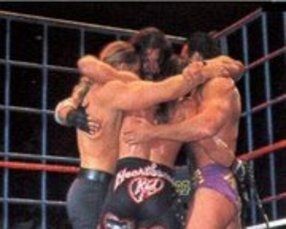
By the 1990s, when life had become easy, people had come to take things less seriously. It no longer seemed important to pretend that the matches were real and that the outcomes were not fixed. The definitive moment came in 1996 when superstars Kevin Nash, Scott Hall, Shaun Michaels and Triple H all embraced in the middle of the ring after a match, when, according to the WWF coverage, they all hated each other (see image above).

In professional wrestling, where the wrestlers are playing characters, the actual wrestlers are usually great friends. After all, they have to trust each other very closely in performing their dangerous physical stunts, and this combined with the inherent danger of the job leads to a strong sense of camaraderie. Their feuding and battling is just an act, one that is now admitted to. Kayfabe has now been abandoned.

A convincing argument can be made that it’s time for the mainstream media to follow suit, and to admit that what they say does not reflect reality. Should they come out and admit that the product they sell is not information, but dramatic entertainment portrayed as political conflict? Is it time for the mainstream media to abandon kayfabe?

In professional wrestling, it’s understood by all that Vince McMahon runs the company, and his primary interest is making money by producing a quality entertainment product. So no-one pretends the matches are real anymore, they just go along with it as if it were pantomime. The sporting media reports on it as if it were entertainment, and it’s understood as such.

When two politicians clash, however, the mainstream media portrays it as if they genuinely hated each other. Election debates are presented to the populace as if they were heavyweight title fights, with two sides going head-to-head for an accolade that only one of them can possess. The television journalists describe mere insults as if politicians were ripping into each other like pit fighting dogs.

The story we’re sold is that all sides are ready to beat each other’s brains out. In reality, every single politician has a mutual interest in keeping the gravy train going, and this sentiment is shared with the owners of the mainstream media. For the political class, it’s very much them against the people whose taxes keep them in luxury. They will choose to put each other first before the plebs, anywhere and always.

Evidence for this assertion comes from how closely members of the political class interact with each other when the cameras aren’t rolling. They populate think tanks together, they party with each other, they marry each other. Politicians might ostensibly represent interests that are implacably opposed to each other, but the reality is that almost all of them come from the ruling class, and represent the interests of that class above any other.

This is why New Zealand Prime Minister Jacinda Ardern, of the Labour Party, can have a cousin named Shane Ardern, who is a Member of Parliament for the National Party. It’s no contradiction that one family can produce MPs for both sides of the fence, because Parliament is a ruling class institution, and the Arderns are a ruling class family.

The average man in the street had figured out 20 years ago that professional wrestling was fake, but is only just figuring out today that the mainstream media is equally as fake. Yes, the mainstream media is just as scripted, dishonest and utterly unreal as any professional wrestling show. Now that this is widely recognised, it’s time to admit it.

It should be openly accepted by the mainstream media that they are the employees of their owners, the international finance and banking interests. As such, they are presenting a program that serves the interests of those owners. Their product is drama, in particular drama between different political actors and/or factions. They aren’t selling objective information, or an objective overview of what’s going on in the nation and in the world.

The WWF, its acronym redolent of the Olympic wrestling federations, rebranded as the WWE and started calling itself “sports entertainment”. It’s time for our mainstream media to do something similar – to stop pretending that their role is to inform or to hold power to account, and to start calling itself “journalistic entertainment”.

*

If you enjoyed reading this essay, you can get a compilation of the Best VJMP Essays and Articles of 2019 from Amazon for Kindle or Amazon for CreateSpace (for international readers), or TradeMe (for Kiwis). A compilation of the Best VJMP Essays and Articles of 2018 and the Best VJMP Essays and Articles of 2017 are also available.

*

If you would like to support our work in other ways, please consider subscribing to our SubscribeStar fund. Even better, buy any one of our books!