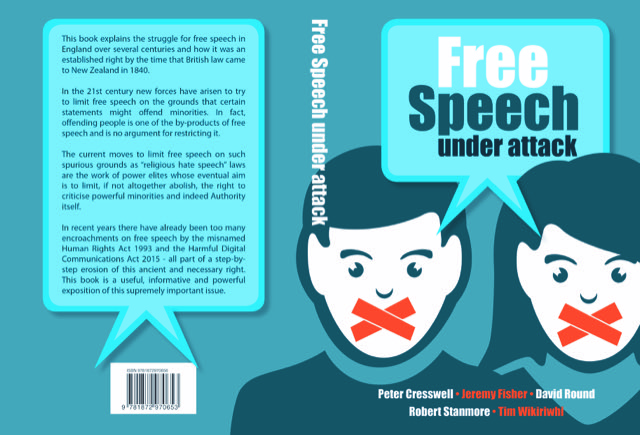
Chapter Seven in Free Speech Under Attack is ‘Banning a Political Pamphlet’ by Tim Wikiriwhi. This is a polemic against Andrew Little’s efforts to introduce hate speech legislation and to ban the 1Law4All pamphlet about the Treaty of Waitangi. Here, Wikiriwhi – himself Maori – supports the sentiments of the pamphlet by agreeing that the British settlement of New Zealand was a net positive for the Maori people.
This essay is quality in its invective, describing Peter Dunne as an “obsolete politician” and making use of the adjective “ham-fisted”. It demolishes the social justice warrior case that British colonisation lowered the quality of life in New Zealand, and makes an impassioned case for the value of free speech. The SJWs won’t be able to scream “Racist!” at Wikiriwhi, so they will likely ignore him.
The Treaty of Waitangi and British colonisation, bringing the advantages and restraints of civilised government to New Zealand for the first time, were the best things that ever happened to New Zealand and the Maoris benefitted enormously from them.
Chapter Eight is ‘Islam and Free Speech’ by Robert Stanmore. This essay discusses the various measures taken by Muslims to shut down free speech in the guise of preventing blasphemy. Stanmore recounts Muslim attacks against free speech in several Western nations, whether by using violence, intimidation or the law. He (correctly) points out that the Koran encourages Muslims to kill non-believers.
Stanmore encourages us here to learn from the example of Britain and Canada, where Muslims are numerous enough to influence the law by threat. In the vast majority of cases, Muslim immigrants show no sign of willingness to conform to the expectations of their host nations, and show every sign of willingness to force their hosts to conform. This is a danger we should be extremely wary of.
Chapter Nine continues in a similar vein. This short chapter is called ‘The Fraud of Islamophobia’. Here, Stanmore recounts the multiple admonitions to violence found in the Koran, and how Muslims are reluctant to reject these verses. Disappointingly, he ignores the violence inherent in the Bible, and the murderous way that Christianity itself has spread.
Stanmore even makes the laughable assertion that Christianity is inherently a peaceful religion akin to Buddhism or Hinduism. Despite these errors, he is able to list a number of scriptural horrors within the Koran that suggest Islam is not compatible with a modern Western way of life. A “religious hatred” law is unacceptable.
Chapter Four of Free Speech Under Attack is ‘How Speech Became Violence’ by Peter Cresswell. This essay echoes the warnings about leftist totalitarianism that VJM Publishing (among many others) has issued. Here Cresswell outlines the development of the concept of hate speech in New Zealand.
Putting hate speech on the agenda appears to be a leftist plot to introduce mass censorship. The anti-fascists have become the fascists. The modern Left is entirely in opposition to free speech. In fact, they are trying to destroy speech entirely, and with it people’s ability to communicate. Creswell concludes with an admonition to stay vigilant against those who would take freedom away.
Chapter Five is also by Cresswell, and titled ‘Identity Politics: the Threat from the “Azza” Group’. Cresswell begins by talking about the threat of identity politics and how it influenced the Christchurch mosque shootings. Identity politics is a modern tribalism that rejects the power of reason. This tribalism brings with it a savage and primitive way of thinking.
This tribalism has been specifically encouraged as a “formula for dissent, disagreement and disruption” by those who would start a revolution. Cresswell identifies the philosophy of Herbert Marcuse as instrumental in inspiring the attempts to revolutionise language. The concept of intersectionality must also take much of the blame.
Chapter Six is ‘Politicising a Massacre’ by Robert Stanmore. This refers to the Christchurch mosque shootings, after which all kinds of parties painted their enemies with being associated with Brenton Tarrant. Stanmore reflects on the hypocrisy of Jacinda Ardern wearing a hijab when it is a symbol of the subjection of women. The firearms ban was also bad legislation.
VJM Publishing gets a mention here, as one of the bloggers harassed by the New Zealand Police as part of their Operation Whakahumanu intimidation campaign. Stanmore also points out Ardern’s general hypocrisy on the subject of racism, and the danger of Andrew Little’s zeal to introduce hate speech laws. He also makes an argument that VJM Publishing has made before, that shutting down free speech will make terror attacks more likely, not less.
In Industrial Society and its Future, author Ted Kaczynski analyses at length the psychology of the modern leftist. One of the phrases he uses is ‘oversocialisation’. It’s necessary to understand this concept if one is to understand Clown World behaviour.
‘Socialisation’ is what psychologists call the process of being conditioned into one’s place in society. The human animal has changed little over the past 20,000 years, so all babies are born savages. Only by a lengthy process of mimicry and conditioning, spanning many years, do they learn to behave in a manner acceptable to civilisation.
During the socialisation process, people learn to resist their natural violent and sexual impulses. We learn to seek consent before engaging in either. We even learn to pre-empt violence by being polite and forgiving. The socialisation process transforms us from barbarian to civilised.
Many behavioural problems stem from being undersocialised, particularly with regards to the aforementioned violent and sexual impulses. A person who is undersocialised may not be aware that they cause harm to other people by forcing their urges on them, or they may not care. In this sense they are like wild animals.
However, as Kaczynski understood, many behavioural problems also stem from being oversocialised. It has been noted elsewhere that the socialisation process creates an urge to conform. Problems arise in Clown World society because people are more socialised than ever. This has led to a stronger urge to conform than ever.
Before Clown World, people did many more things to unsocialise themselves. They went hiking, hunting, fishing, camping or just for a walk by themselves through their neighbourhood streets. This time away from other people offered a chance to come back to reality, to be socialised by Nature.
There, they learned from observing the various animals, birds, fish and insects, and from observing the daily and the seasonal changes in the environment, how Nature works. Truths such as the fact that all forms are transitory, or that no two things are the same, or the importance of kin, became deeply internalised.
Even when at home, people used to spend much more time alone on account of that there was no social media to connect them to anyone else. A lot of that time was spent working on projects alone, with no-one observing and judging. The result of this moderate level of socialisation was a healthy, balanced self-esteem.
Today, a person is socialised through screentime from the moment they wake up to the moment they go to bed. The largest change of all is that they now get instant feedback on all of their thoughts and behaviours. As such, the average person worries more than ever before about what other people think of them.
This preoccupation with what other people think of them has led to an extreme form of neuroticism. This has had society-wide consequences. One of the most prominent is an increased psychological malleability. The average person is now so neurotic that the slightest sign of approval from an authority grants a powerful sense of relief. This conditions them to seek approval even harder.
The oversocialisation process has produced a large number of people who are completely unable to think outside the box, a generation of teacher’s pets. They are too afraid to say or do anything original in case someone expresses disapproval. This disapproval would represent a mortal wound to their egos.
As Kaczynski put it, “the oversocialized person is kept on a psychological leash and spends his life running on rails that society has laid down for him.” It can be understood from this that oversocialisation is akin to a form of brainwashing. Clown World is – even though it’s not spoken aloud – a totalitarian system, and as such it seeks to control every last thought of its subjects.
Explaining oversocialisation goes a long way to explaining why there are so many baizuos, gutmenschen, soyboys and other weaklings in Clown World. Many of these people would have been normal if they’d spent more time in the wilderness hiking or hunting. But because they have always been immersed in the urban world, the natural world is known to them only by YouTube.
It’s not that the world needs more violence and uninvited sexuality. What it does need is a higher quality of socialisation, instead of quantity. Instead of a paranoid state of permanent moral alertness, we need to learn to know ourselves, so that we can intelligently transmute our impulses into correct action.
The chief problem is that the rulers of Clown World are perfectly happy with oversocialisation. In a society as corrupt as this one, the greatest threat to the ruling class comes not from the outside, but from the people. So the rulers are more interested in keeping the masses down than they are in strengthening the nation to resist external threats.
The answer is not anarcho-primitivism but a return to a more nature-based way of living. Clown World will end sooner or later, probably when the cheap oil runs out, which will make big city consumerism impossible. This might see the population of the West move out of the cities and spread across the land, going back to a village model.
*
This article is an excerpt from Clown World Chronicles, a book about the insanity of life in the post-Industrial West. This is being compiled by Vince McLeod for an expected release in the middle of 2020.
The term ‘abolitionism’ refers to the political movement that sought to abolish chattel slavery. It was a popular term in the 19th century, when first the British and later the Americans made it illegal to own other people. However, as this essay will examine, the battle against slavery merely shifted to a different front – the metaphysical one.
Controlling slaves physically is a major undertaking. They have to be shackled so as to not escape the plantation, and beaten or whipped so as to not shirk labour. Plantation owners in the antebellum South found themselves spending a great deal of their profits on keeping their slaves in line. Slave rebellions were common.
Eventually, the slave owners realised, it was unnecessary to keep people in chains and shackles when they could simply control their minds and their spirits. Controlling the minds and spirits of the slaves meant that the slave owners controlled all of their actions anyway, without having to physically abuse them and generate resentment or risk rebellion.
The enslavement of the mind and the spirit is linked to the Silver Right and the Golden Right of alt centrism. Simply put, a people cannot be free unless they’re both free to think for themselves and free to reconnect with God. The metaphysical abolitionist demands the removal of any obstacle preventing these two goals from being achieved.
Enslaving the mind, however, is the expertise of the Western ruling class. This they achieve through control of the popular narrative.
Ever since the publication of Edward Bernays’s Propaganda in 1928, the ruling elites have structured the education and media systems to both condition people to feel bad for questioning the popular narrative, and to feel good for enforcing that narrative on those who question it. The end product is a country of willing slaves, as submissive as any other herd animal.
The first step to inducing a population into trusting the mainstream media is to pacify them through the education system. 12 years of schooling is enough to condition most people into believing that questioning the popular narrative is an act of evil, and only by going along with it can happiness be found. It’s a simple matter of punishing those who ask questions and rewarding those who submit.
Controlling the popular narrative through the mainstream media means that Western elites control the permissible boundaries of thought. By normalising certain topics of discussion through repeated media exposure, they abnormalise others. The term ‘Overton window’ refers to that range of political positions that have been thus legitimised.
Any idea expressed in the mainstream media is legitimate; any idea not expressed in the mainstream media is illegitimate. If the elites really don’t like an idea, they simply instruct the talking heads on the television to describe supporters of that idea as ‘conspiracy theorists’. By discouraging unwanted lines of reasoning, the elites can keep people going around in circles, chasing mental phantoms like rats on a wheel.
The results of this widespread brainwashing are easily noted. The ruling elites merely have to broadcast the necessity of something over the television, and the masses will fall unquestioningly in line. If a talking head on the television says that Saddam Hussein was behind 9/11, the masses will demand his destruction. If the talking head says to wear a mask to prevent coronavirus, the masses obey.
The metaphysical abolitionist opposes all of this. Metaphysical abolitionism demands that people be allowed to think freely. So a metaphysical abolitionist will reject the importance of mainstream schooling, will discourage the consumption of the mass media and will encourage people to consume alternative media of all kinds. Their favourite thing is people getting together, away from normies, to discuss what the truth really is.
However, even if we did manage to break the psychological conditioning that enslaves our minds, there is a greater challenge.
Our minds may have been enslaved for a hundred years, but our spirits have been enslaved for even longer – ever since Christians destroyed the Eleusinian Mysteries in the 4th Century A.D. Since then, we’ve been the slaves of those who would tell us lies about God. The metaphysical abolitionist opposes this and wishes for the spirits of all people to be free.
In the same way that the ruling elites can engender intellectual submission by restricting intellectual expression to a range of harmless ideas, they can engender spiritual submission by restricting spiritual expression to a range of pointless superstitious dogmas. The humiliation engendered by forcing people to worship an idol of Rabbi Yeshua ben Yosef instead of God has the effect of inducing passivity. With spiritual slavery follows slavery of every other kind.
Although humans have been using spiritual sacraments such as cannabis and psilocybin to reconnect with God for thousands of years, their use is mostly illegal in the modern West. The laws prohibiting them are explained to us as laws protecting the people’s mental health, but this is a total lie.
The truth is that cannabis and psilocybin are illegal because they are spiritual sacraments.
All spiritual people know that the truth will set you free, so those who would enslave the spirit must tell lies. Spiritual sacraments such as cannabis and psilocybin teach people the spiritual truths about reality: that consciousness is eternal and that God not only exists but also wishes the best for us. These sacraments have been made illegal so that the common people remain blind to the lies of the elites.
Spiritually speaking, the vast bulk of the population divides neatly into two halves: the slaves who follow whatever mainstream religion is pushed on them as children, and the malcontents who, recognising the mainstream dogma to be lies, reject the question of spirituality entirely. Genuine spiritual seekers – those who reject both the “Christian” label and the “atheist” label – are thus marginalised.
Metaphysical abolitionism demands that the human spirit be as free as the human body. This requires that people have free access to whatever spiritual sacrament they feel will help them reconnect with God. All spiritual sacraments must be legal and readily available: cannabis, psilocybin, LSD, DMT – the lot.
In summary, the metaphysical abolitionist advocates for free speech, free thought and for the annihilation of dogmatic religious strictures. This is to advocate for free minds and free spirits. The abolition of chattel slavery has been achieved already, at least in the West. It’s time to achieve the abolition of a much more insidious form of slavery, that of our minds and spirits.