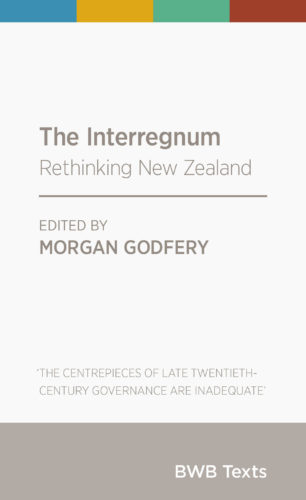
The tenth, and last, essay in The Interregnum is ‘Politics of Love’, by Max Harris. Like the other essays in this collection, it speaks from an unashamed youth perspective, such as when Harris complains of the “stale language” of the current political discourse.
This essay is about the politics of love, and it opens by defining what love is to Harris: “a feeling of deep warmth that is directed outwards towards an object, such as another person.” There is nothing objectionable about his definition of love; indeed it seems fairly comprehensive, especially when he writes that “the idea of love is closely tied to relationships and the connections between people.”
Predictably, given the Marxist leanings of the previous essays in this book, this essay quickly moves on to a declaration that the politics of love would necessitate “a willingness to accept a greater number of refugees.”
But one wonders why it is that emphasising the aspect of love leads naturally to the conclusions that Harris takes it to.
Why not, for example, stop all immigration to New Zealand from the Third World on account of love for the people already in New Zealand, whose living standards drop when Third Worlders move into their locales? Isn’t it entirely possible that my love for the people of New Zealand impels me to want to see them safe from robbery, rape and murder – the crimes that mass Third World immigration has brought to Europe and America?
Doesn’t our love for young New Zealand girls and women drive us to keep them safe from the rampant sexual abuse and harassment that is now part and parcel of the female experience in Europe?
Doesn’t our love for the homeless and mentally ill already in New Zealand drive us to take care of them as a priority, before we spend money importing irreparably damaged people from the other side of the world to jump in front of them in the queue?
Doesn’t our love for the hardworking taxpayer who has busted his back his whole life drive us to ensure that he can retire at a fitting age, instead of having to work into senescence to pay for gibs?
The essay makes a plea for more solidarity, but how is that possible when diversity is also increasing? It points out that New Zealanders already feel disconnected – so how will importing tens of thousands of “refugees” help? It will only add to the ethnic chaos, making us feel even more disconnected.
But Harris, and people like him, would happily call me hateful for asking those questions.
The brain generates consciousness and therefore the death of the physical body means the extinction of all awareness – so buy buy buy!
Materialism – what is it good for? To give it its due, it’s a very useful paradigm to adopt if one wants to conduct an experiment in any of the physical sciences. The monkey who first realised that fire could be started from the friction of a hard wood on a soft one derived an enormous advantage over the monkeys who were still doing dances to try to please the lightning gods.
More recently, materialist science such as physics and chemistry led to Anglo-American dominance of the sea trade routes, as the adoption of first coal, then oil, then uranium allowed these powers to keep a naval force in operation that was orders of magnitude more powerful than what was possible under sail. Mastery of these sciences also allowed these same powers a decisive military advantage in terms of weaponry.
All well and good – but what is materialism bad for? Many, many, many things. Unfortunately, materialism has strengthened beyond being a mere scientific approach. It’s not even a worldview anymore. In our blind 21st century, materialism must be accorded the status of a legitimate religion. This has had profound effects on the political, scientific and intellectual discourse of all nations.
Like any dominant religion, the presuppositions of materialism can no longer be questioned in polite society. It’s possible to talk about “the” biological basis of consciousness as if it were already an established fact that consciousness has a biological basis. Asking how it is that it’s known that consciousness has a biological basis elicits, in materialist circles, a similar response to going into a church and demanding the priest prove his contention that the Bible is the Word of God.
It’s just not the done thing.
And so it’s possible for one of the world’s most prominent intellectuals, Sam Harris, to discuss consciousness with a supposed expert on the subject for over an hour without either of them questioning the dogma of the “biological basis of consciousness”. That the brain generates consciousness and not the other way around is assumed from the beginning, and all subsequent data has to be shoehorned into this framework or discarded.
Ironically, the podcast mentions that consciousness had hitherto been the purview of philosophers, in a passage exclaiming how good it was that other disciplines are now considering it. The reason why this had been the case is now obvious – because physicists, chemists and neurobiologists are incapable of the logical reasoning necessary to truly consider the question. This logical failure leads to errors like assuming right off the bat that the brain generates consciousness, the type of error that philosophers generally don’t make.
Listening to a supposed expert in neuroscience ramble on about the biological substrates of consciousness is every bit as depressing as listening to some old priest ramble on about whether or not we’re allowed to drink wine on Sundays. Both charades are dependent on one gimmick: take for granted the biological basis of consciousness and we can explain everything (says the neuroscientist), take for granted the eternal truth of the Bible and we can explain everything (says the theologian).
The worst part of it is that – just like Abrahamism, Nazism, Communism and Marxism – materialism has also rotted the minds of the people who have come to believe in it. Like a cancer, it has given rise to a number of bad things, all of them ultimately caused by the belief of materialist individuals that the death of their brain inevitably means the extinguishing of their consciousness.
Materialists are generally indifferent to the condition of the world after they die. Let’s just rape it now is their motto. After all, if their consciousness is extinguished upon the death of the brain, there is no logical reason to act in a manner custodial to the life that comes after you. There won’t be any way it affects you, so why bother?
Materialists are also easily manipulated by death anxiety. People who know that the consciousness survives the death of the physical body can laugh in the face of death, because they know that death will not occasion a traumatically significant change from the state of existence that pertained before death.
This latter point is why materialist cultures like the British fight wars all over the world while non-materialist ones such as the Indians do not. A Brit can easily be terrified into doing what you tell him because of the fear of invasion or economic disaster or God’s judgment or some other catastrophe; the Indian will just laugh.
For Western culture to survive, we have to cast off the spiritual sickness that we inherited even as we assumed scientific and military dominance. We have to move past materialism and the ludicrous contortions of reasoning that it forces people to undergo.
Psychedelic drugs and meditation are the cures for the memetic cancer that has been growing in the West for a few centuries.
*
If you enjoyed reading this essay, you can get a compilation of the Best VJMP Essays and Articles of 2017 from Amazon for Kindle or Amazon for CreateSpace (for international readers), or TradeMe (for Kiwis).
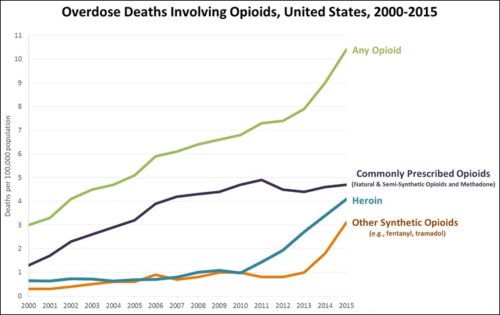
Opioids kill 1 in every 10,000 Americans every year, but they’re fully legal
One of the most awful aspects of being a medicinal cannabis user is getting lied to by doctors and mental healthcare workers who deny the emotional and spiritual benefits of cannabis use. The problem isn’t that they won’t help you get hold of cannabis medicine (because there are plenty of people who will) – it’s that they refuse to have an honest conversation with you about the benefits and side-effects of using it.
It’s impossible, in most places, for a sick person who uses medicinal cannabis to expect that their doctor will listen honestly to what they have to say. If the patient mentions the benefits of their cannabis use, the doctor will insist that the patient must be mistaken when they believe that cannabis helped them. Even if the doctor goes as far as conceding that cannabis has some medicinal value, they will almost always attribute all manner of ghastly side-effects to using it.
Worst of all, it’s impossible to change the mind of your doctor by presenting evidence from jurisdictions that have legalised medicinal cannabis. It doesn’t matter that medicinal cannabis was made legal in California in 1996 after the doctors there looked at the evidence – those doctors are simply presumed to be wrong, and recklessly so. End of story.
This refusal to speak honestly with patients is, from the patient’s perspective, a dehumanising experience. It’s a way of saying that your experience can be discounted, because you are worth less than a normal human being. With almost every other medicine it’s possible to tell a doctor that it alleviates your suffering and have it considered enough to get a prescription.
This is even true of opioids, which kill 1 in every 10,000 Americans every year, and which have been so recklessly overprescribed that the opioid crisis now has its own Wikipedia page.
Not so with cannabis. Somehow cannabis has the mysterious property of causing suffering that only doctors, politicians and pharmaceutical company lobbyists are able to see. A patient might feel that their suffering is reduced from using medicinal cannabis, but unfortunately for them, they are not considered full human beings on account of the claim that cannabis causes psychosis. Therefore, their belief that cannabis alleviates suffering can be dismissed on account of it being a belief held by a psychotic person.
It’s a vicious Catch-22: you might feel that the cannabis takes your suffering away, but this can be trumped by the declaring that using cannabis robs you of your ability to reason, and then anything you say can be dismissed as the ravings of a lunatic.
If a person is suffering psychologically, and they take a substance that they believe to be medicinal, and their experience of using this substance is that it ameliorates psychological suffering, then how can anyone else possibly presume to judge otherwise?
It might be that the side-effects of using some particular medicines are so great that, on balance, it’s better to look for an alternative than to prescribe them, but significant side-effects from cannabis use are non-existent.
The feeling from the patient’s perspective is that doctors are saying that ameliorating your suffering, in particular, is not worth pursuing because you are not valuable. Elderly Baby Boomers are getting stuffed full of opioids at the first murmur of complaint, but if anyone else wants to use some cannabis they have to risk several years in prison.
*
If you enjoyed reading this essay, you can get a compilation of the Best VJMP Essays and Articles of 2017 from Amazon for Kindle or Amazon for CreateSpace (for international readers), or TradeMe (for Kiwis).
Humans are part of Nature, and therefore human nature is also red in tooth and claw
The Internet is full of people trying to score points from each other in the eternal game of oneupmanship that all social species engage in. In the West, with our heavily Jesus-based culture of masochism, we demonstrate that we are better than other people by showing how much violence and injustice has been done to us in the past. The more we are like martyrs, the better.
Our cult of victimhood impels us to emphasise how badly our ancestors suffered at the hands of The Man, whether these ancestors be women, lower classes or other races. It also impels us to emphasise how our own ancestors did no wrong, unless they were misled by some enemy without or betrayed by an enemy within.
It’s as if each one of us holds the power to act as an instrument of karma, and past injustices done to us give us the right to do injustices to other people. And like so much of modern society, it’s absolute horseshit.
Native people often describe an idyllic past in which they all lived in peace and in perfect harmony with Nature, but the truth is infinitely more violent. Although many native peoples had sophisticated cultural strategies for minimising the carnage of warfare (such as ritualising it), it’s clear from any scientific perspective that all human groups are guilty of using violence, and must be.
This can be proven by simply looking around at the laws by which Nature operates. The price for being peaceful is not to suffer persecution – it’s to be dead. A will to engage in peaceful conduct is not necessarily going to be reciprocated by other people, and almost certainly will not be by wild animals, and if it isn’t, there might not be much one can do about it.
It is impossible to occupy any niche in Nature without violence, because for every niche one might occupy within Nature there is another organism willing to use violence to drive one out of it. This is true of whatever level of the Great Fractal one wants to look at it on.
There are no creatures out there that can survive without preying on either other creatures or on plants. Any creature that wishes to attend to its own basic metabolic needs is forced to conduct violence against other life to get energy or nutrients.
This is not only true in the immediate food-gathering sense but in the long term mating sense as well. Males of sexually reproducing species must attract their females through demonstrating a capacity for resource acquisition, and this is done through acquiring and defending a territory, which is almost impossible to do without violence.
In order to build a house, a person has to cut down trees in the forest to clear a space, destroying the habitat of all of the creatures that dwelt within. But more importantly, in order to defend that space against the forms of life that would occupy it, that person has to be ready to kill.
All manner of parasites, like bugs, spiders, weevils etc. have to be killed for the sake of food security and to avoid destruction of property; all vermin like mice and rats have to be killed for similar reasons; larger animals have to be killed lest they destroy the property; humans have to be killed lest they take over and try to enslave one.
Almost wherever the reader is sitting in the world right now, someone was killed for it at some point in the past. Someone will have died so that someone else could secure rights to that land, even if it was before recorded history. For your ancestors to have carved out a niche in this place, where food has to be hunted and agriculture demands the destruction of ecosystems, someone and (not or) somethings had to be killed.
All of us are descended from killers. Every single one of us. There’s simply no other way to occupy a niche within Nature in the first place. If being descended from peaceful people awards some sort of moral superiority when it comes to discussing political issues, there are none of us still living who can claim it.
Anyone claiming that their ancestors were peaceful by nature or that they are genetically disinclined towards violence is a liar.
*
If you enjoyed reading this essay, you can get a compilation of the Best VJMP Essays and Articles of 2017 from Amazon for Kindle or Amazon for CreateSpace (for international readers), or TradeMe (for Kiwis).