
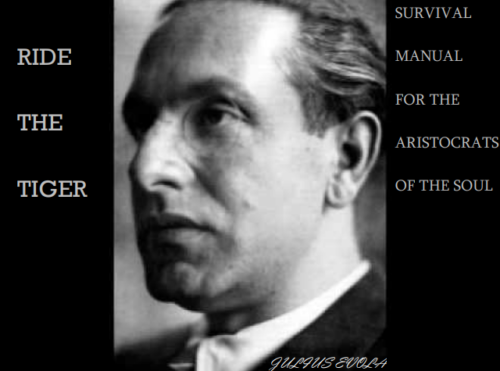
VJMP Reads: Julius Evola’s Ride the Tiger V

This reading continues on from here.

The 13th essay in Ride The Tiger is called ‘Sartre: Prisoner Without Walls’. This essay is very short – only three pages – and concerns itself with the attitude that one ought to take towards inherent freedom. Criticising Sartre’s conception of man as “condemned to be free”, Evola decries the idea that ultimate freedom is any kind of curse, describing this attitude as characteristic of the deep nihilism of the 20th century.

Sartre’s conception of life is, in Evola’s estimation, a fundamentally negative one in that one considers the human experience akin to being a prisoner without walls. For Evola, this maudlin attitude is not appropriate, for it brings with it suffering. Something more is needed.

The 14th essay is called ‘Existence, “Α Project Flung into the World”‘. Here Evola continues to outline his misgivings with existentialism, despite giving it credit for accurately describing the dilemma of the human condition. Existentialism also gets credit for moving beyond primitive solutions like religion and scientific materialism.

As mentioned previously, Evola’s main problem with existentialism is metaphysical. The varieties of existentialism that do not give a satisfactory answer to metaphysical questions are no better than nihilisms. For this reason, the maxim “existence precedes essence” must be rejected. A person is that which transcends the mere physical form; if not, existence is nothing more than morphing randomly into various shapes. Transcendence cannot and will not be found outside the self.

The idea of anxiety over lost choices, opportunities and paths is, for Evola, ridiculous – and materialistic. The transcendent principle ought to exclude such thoughts. The nature of things cannot usefully be said to be sinful in and of itself. Much better to adopt the ancient Greek view of cultivating appreciation of the beauty of limits and form.

The 15th essay is called ‘Heidegger: “Retreating Forwards” and “Being-for-Death” – Collapse οf Existentialism’. The problem with Heidegger, Evola contends, is that his philosophy is motivated principally by a fear of death, in particular the death of the false self, or I. It’s better to disavow identification with the I, and to choose instead to identify with the transcendent, than to march to the drumbeat of death.

Here Evola continues with his criticisms of existentialist philosophy, accusing it of promoting a bleak, sombre and submissive attitude towards the world, one of resignation. Jaspers offers no other solution but faith. In fact, none of the existentialists have offered a satisfactory solution to the problems of nihilism as outlined by Nietzsche. “Existentialism is a projection of modern man in crisis”.

Neither is faith satisfactory, for that is essentially no different from the “Catholic existentialism” that has already been rejected on account of positing the transcendent outside oneself. It must be accepted that God is dead. Transcendence ought not be conceived of as the ‘other’; rather one should begin from the point of transcendence and consider the world from that perspective.

In any case, all of these men, religious and existentialist alike, are written off as petit bourgeoisie, writing about petit bourgeoisie concerns. The real philosophy comes from the men who have survived the “storms of steel and fire” of the early 20th century: those who have been tested. These are the men who understand the true nature of things; they understand “being able to be destroyed, even, without thereby being wounded”.

*

If you enjoyed reading this essay, you can get a compilation of the Best VJMP Essays and Articles of 2017 from Amazon for Kindle or Amazon for CreateSpace (for international readers), or TradeMe (for Kiwis).

Masculine Conservatism and Feminine Conservatism

One male, one female, but both represented a very masculine, active conservatism

Contemporary political philosophy suffers from an inability to accurately define terms. Political discussion has been so inundated with lies from all quarters that no-one any longer knows what anyone else is really talking about. This essay makes an attempt to make sense of conservatism by teasing it apart into recognisably masculine and feminine strands.

Like its synonym ‘right-wing’, conservatism is usually equated with a will to keep things the same as they are now. This seems to be naturally implied by the root verb ‘to conserve’. In most cases, this makes a lot of sense. The balance of power has traditionally been held by men, by the religious and by the wealthy, and these are generally the same people who promote and support conservatism.

In some cases, however, it makes less sense. Why, for example, would a conservative support mass immigration to America of low-skilled Mexican workers? Such an action not only fails to conserve the status quo but actively disrupts it. Why also would a conservative support the introduction of government surveillance measures like the PATRIOT Act? Such an action also marks a distinct change of attitude on the part of the American Government towards the people.

One solution to this dilemma is to think in terms of vertical or horizontal dominance hierarchies. Another potential solution follows from the understanding that conservative attitudes divide neatly into two major strains. The basic dichotomy could be considered between active conservatism (or masculine conservatism) and passive (or feminine) conservatism.

The core tenet of masculine conservatism is that people have a moral obligation to take action to impose order; in other words, an obligation to take action to reduce chaos. This is a missionary, evangelical form of conservatism in that it goes out into the world looking for disorder to impose itself upon. It’s an extremely popular sentiment in the New World, because the immigration histories of these countries selected for people willing to impose order upon chaos, on account of that the New World had so much chaos.

Done correctly, this masculine conservatism can lead to a person being able to maintain a complex system at high performance for a long time. A doctor who makes a diagnosis is operating to reduce the chaos in their patient’s body; a mechanic who makes a diagnosis is operating to reduce the chaos in their client’s vehicle.

The core tenet of feminine conservatism is that people have a moral obligation to not change anything, to maintain the status quo. This strand of conservatism is the one that makes appeals to “tradition” so as to justify not changing anything. Change is here seen as disruptive, destructive, stressful – and fundamentally unnecessary.

In an ideal situation, these two impulses overlap so much as to be indistinguishable. After all, if things are already in good order, there’s no pressing reason to change anything, and therefore a desire for the status quo is a desire for good order. Moreover, in such a situation, a desire for good order is a desire for the status quo, so a conservative can simply copy what their forebears did to succeed.

In the situation we have inherited, these two impulses are far away from harmonious co-operation. Another way of expressing this disharmony is to consider it in terms of fault lines within the conservative movement. Anti-conservative forces might target the loci of these divisions between masculine and feminine with agitprop intended to further the divide.

There are two ways to do this. The first is to draw attention to a situation of persisting disorder, because one half of the conservatives will want the situation to persist and the other half will want the disorder to be resolved. The second is to draw attention to a situation of disintegrating order, because one half of the conservatives will see this disintegration as a natural process and the other half will want to retain that which is at risk of being lost.

The two strands of conservatism that this essay considers masculine and feminine are extremely powerful – if they work in unison – but, if they don’t, the overall system is fragile and highly vulnerable to direct pressure from the outside.

*

If you enjoyed reading this essay, you can get a compilation of the Best VJMP Essays and Articles of 2017 from Amazon for Kindle or Amazon for CreateSpace (for international readers), or TradeMe (for Kiwis).

The Ultimate Evil Is To Continue To Exist

To live is to destroy

You! You are an aggressor! There is no way that you can exist on this planet otherwise. All of us have to carve a niche out of Nature, with violence or treachery, for there is simply no other way to survive. So malicious are you that you commit the ultimate evil – to continue to exist!

Every living creature has a need to metabolise in order to stay warm. This metabolisation requires energy, which means food, which means a need to eat, which means a need to kill. In order to live, you have to kill!

Every bit of food you have ever eaten was a living being that had to be killed so that you could eat it! What right do you have to assert the primacy of your own existence over that of another being, over a fellow creation of God? The morally correct thing to do, in order to avoid bringing suffering into the world, is to lie down and starve to death!

Worse, as a mostly hairless ape, you also have a need for shelter – and there’s no other way to build a house than by carving a space out of Nature for yourself. This means destroying the habitats of other creatures.

150 square metres of floor space means 150 square metres of land on which no forests can grow, and through which no streams can run. It’s 150 square metres worth of trees that had to be chopped down, with all the bird and insect life supported by it destroyed.

Neither can you escape your own energy needs. Driving a car around consumes oil – a finite energy source, and one that has to be extracted at the price of more environmental damage. Reading this website requires electricity, which requires energy. All the goods in your house were shipped to you by transportation methods that required energy.

Collectively, these demands meant even more coal mines put down, even more oil wells sunk, even more valleys wiped out by hydroelectric dams. To use energy is to render parts of the Earth to chaos!

There’s nothing you can do about any of these things! To continue to exist is to destroy – for only through destruction can one continue to exist!

To reproduce causes even more damage. The facts are stark: the single most ecologically destructive move a person can make is to bring another human being into the world – a human who will have to eat, to shelter themselves and to use energy, and at ever-increasing appetites!

Worst of all, merely to keep existing means you run the risk of bringing more conscious life into the world to suffer. Even if you don’t intend to breed, you might meet a certain person who causes a massive dump of some hormone to be released by your brain and then you fall in love and nek minnit you have eight children, all of whom must find their own way to come to terms with the fact that they are mortal creatures in a world of ceaseless slaughter!

If you should stop existing, on the other hand, not only does it become impossible to bring more conscious suffering into the world in the form of human offspring, but one also vacates a niche within the biosphere that can (and will) be occupied by gentler, kinder forms of life.

Think of the biomass of the worms that would eat your corpse!

You should be killed!

*

If you enjoyed reading this essay, you can get a compilation of the Best VJMP Essays and Articles of 2017 from Amazon for Kindle or Amazon for CreateSpace (for international readers), or TradeMe (for Kiwis).

Buddhism is Incompatible With Abrahamism, But Fully Compatible With Luciferianism

The apotheosis of Buddha came not through grovelling, sadomasochism and superstitious entreaties, but from lucid, rational and brave introspection

The fashionable talk today is about interfaith dialogue. All of sudden, everyone’s trying to emphasise what the world’s various religious traditions have in common. Some even go as far as to say that all religions worship the same God. Despite the absurdity of most of this fashionable lip-flapping, this essay will argue that, at least, Buddhism is compatible with Luciferianism.

Some say the reason for this interfaith dialogue is that talking leads to fewer misunderstandings, which leads to less violence. Leaving aside the fact that Abrahamism causes 99%+ of the world’s religious violence anyway, the problem with Abrahamism is that the more one learns about it, the less one respects it. Even worse, the more time one spends around its followers, the less one respects it.

On the face of it, there are several major ways that Buddhism appears utterly incompatible with Abrahamism. On the other hand, although Buddhism could never find peaceful co-existence with Abrahamism, it could find it with Luciferianism.

The major tenet of Buddhism is that one acts in a way that minimises the suffering of other sentient beings. The principle behind this is compassion, in that the suffering of those other beings is an important thing that ought to be taken into consideration. A related teaching is the interdependence of all things, which cultivates an appreciation of the effects that one’s actions have on the well-being of other creatures.

There are no such concepts in Abrahamism. Working to reduce suffering is incidental to following the directives of God – if homosexuals are to be put to death then so be it. God says so. It matters not whether this action reduces or increases the suffering in the world. Likewise, women have to be put in their place, and non-believers persecuted. Compassion doesn’t come into it; all that matters is submission.

Luciferianism doesn’t really have set instructions for what to do about the suffering of other conscious beings. Cruelty, however, is seen as petty, small-minded, even bestial. The Abrahamic insistence on male infant genital mutilation appalls the Luciferian, who tends to see it as a gross violation of power with superstitious origins.

This attitude of submission (and of forcing submission) is another way in which Buddhism is not compatible with Abrahamism. For example, Buddha said:

“Don’t blindly believe what I say. Don’t believe me because others convince you of my words. Don’t believe anything you see, read, or hear from others, whether of authority, religious teachers or texts. Don’t rely on logic alone, nor speculation. Don’t infer or be deceived by appearances. Find out for yourself what is true and virtuous.”

This is an extremely Luciferian attitude. Here, Buddha appears to be saying explicitly not to worship him, not to see him as something higher. A Luciferian would understand that one cannot take another person for an authority on how we all got here or what we’re doing, while a Buddhist might contend that the nature of God is irrelevant.

By contrast, Abrahamism preaches submission to dogma. Questioning the priest is not the done thing, because he speaks with the authority of God. Whereas a Buddhist teacher will sit at the front of a class and take questions, which are answered honestly, the Abrahamist preaches from a raised pulpit, and takes no questions. Questions imply free-thinking, which is a sin because it correlates negatively with submission.

Buddhism doesn’t demand that anyone bow down to anyone else. There is no self-appointed “God’s Representative on Earth”. A Buddhist would not give any credence to anyone claiming to speak for God, for any reason – the Pope has no more spiritual authority than a schizophrenic street prophet. The shiny silver that high priests are bedecked with will not convince a Buddhist that they know what they’re talking about.

What matters to the Luciferian, like the Buddhist, is a methodology by which truth might be discerned. Abrahamism is not a methodology – it is a dogma. Where the Luciferian and the Buddhist might meet on equal terms to discuss strategies and tactics of mutual interest, the Abrahamist presumes to dictate the truth, and the right to enforce submission to this truth with violence.

It seems like Buddhism appeals to the same sort of people as Luciferianism. It may be that both traditions arose to meet the challenges of their time and place: Buddhism with immense physical poverty, and Luciferianism with suffocating environments of spiritual lies, misdirections and untruths.

Buddhism deals with the lies of the senses and the mind, and Luciferianism with the lies of the Abrahamists. They are both master moralities, in contrast to the slave philosophies of the desert.

*

If you enjoyed reading this essay, you can get a compilation of the Best VJMP Essays and Articles of 2017 from Amazon for Kindle or Amazon for CreateSpace (for international readers), or TradeMe (for Kiwis).