

Category: drugs
Charlie Manson: So Close And Yet So Far
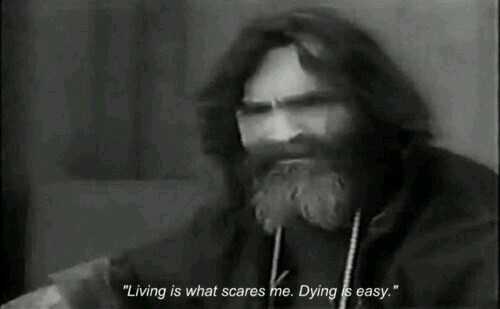
Charles Manson: thought by some to be a genius, thought by many to be a maniac. Only a select few realised that he was both. In his actions relating to the infamous Family killings, Manson almost showed humanity a new way of relating to power, but a poor choice of target disqualify his actions from being considered anarcho-homicidalism.
Much like Adolf Hitler, Manson kept a coterie of devoted followers on account of an extraordinary level of charisma and penchant for giving lectures about the degeneracy into which the outside world had fallen. Also much like Adolf Hitler, Manson had a lot of excellent ideas that lacked execution, with consequences that the world would not forget.
One of the excellent ideas that Manson had was that people ought to rise up and challenge the control system, on account of its incredible corruption and the lies and destruction that it has wrought upon the Earth. Rising up against liars and thieves who have wormed themselves into positions of authority is the basis of anarcho-homicidalism, and no doubt Manson played on natural anarcho-homicidalist sentiments when he persuaded Watson et al. to do what they did.
Nobody can stand in judgement, they can play like they’re standing in judgement. They can play like they stand in judgement and take you off and control the masses, with your human body. They can lock you up in penitentiaries and cages and put you in crosses like they did in the past, but it doesn’t amount to anything. What they’re doing is, they’re only persecuting a reflection of themselves. They’re persecuting what they can’t stand to look at in themselves, the truth. – Charles Manson
Some might argue that Manson was an anarcho-homicidalist, on account of that much of his stated ideology was anarchic, and so the homicidal actions of the Family were also anarchism. It could indeed be argued that the Family actions were anarchic, because behaving in that manner is demonstrating very clearly that one has no rulers, but actions only constitute legitimate anarcho-homicidalism if they are conducted against someone making an attempt to enslave another.
It’s not really fair to target members of the cultural elite on that basis alone, for the reason that they are not the ones holding the reins of power. Sharon Tate was an actress – an influential position admittedly – but no-one took orders from her. She didn’t threaten anyone into coercion; she didn’t try to enslave anyone. She was just a pretty face that people paid money to look at for a few hours.
There was perhaps an element of jealousy in Manson’s selection of target, in that he had found it difficult to break into Los Angeles cultural circles, and so chose to target those who had. Such motivations cannot be considered anarcho-homicidal in any real sense, because they didn’t target anyone who held real coercive power, and were not motivated by the ideal of liberation.
This absence of coercive power meant that the people the Manson Family killed were not aggressors in any real sense, and therefore killing them could not be justified in self defence.
If Manson had targeted politicians instead, things would be very different. America was embroiled in the Vietnam War in 1969, and the Government was drafting young men to fight it without their consent, on pain of imprisonment. Killing any prominent warhawk or supporter of the Vietnam War would have been a legitimate act of anarcho-homicidalism, and would have been much more effective than abusing the draftees when they returned.
Charles Manson and his Family had more or less the right idea; their major error lay in the selection of a target that was not directly trying to enslave them.
Referendum or Legalisation?

Misdirected Estrogen
Everyone’s familiar with the joke about the woman who decides not to have kids and inevitably ends up with piles of cats. Like many popular jokes, there’s an element of taboo truth to it: women have a certain level of estrogen to discharge and if they don’t have children they will often substitute a cat to be the subject of their nurturing instincts. This process plays a role in global politics as well.
This is all very natural – evolution, of course, selects for the kind of woman who breeds, and the kind of woman who breeds will usually have a massive dump of estrogen hit them near the end of their reproductive cycle. This estrogen will make them compulsively seek after a “warm fuzzy” feeling that results from being nice – a behaviour that has obvious evolutionary benefits for a breeding female who has children in need of nurturing.
All well and good if she does have children, because the woman will then try and be nice to her child in order to meet its developing needs, which will help to ensure that it grows up mentally and physically healthy. Even if she doesn’t have children she can look after other siblings or cousins, so this hormonal development still makes sense.
In our world, where the family structure has been shattered, women in their late 30s and 40s often have no children upon which to lavish all their nurturing instincts. At the same time, there are many cats in need of good homes, so the two things are a natural fit. All in all, this works out pretty well. Women get to enjoy the company of cats while the cats get to have homes.
Where it doesn’t work out well is when that misplaced estrogen gets directed onto refugees.
It first became fashionable to advocate for mass resettlement of refugees in the same places where it first became fashionable to delay motherhood. This is not a coincidence. Women who have delayed motherhood will look for any reason to try and generate for themselves the estrogen-based warm fuzzy that their breeding peers will be full of on a daily basis.
Unfortunately for us, the modern career woman is too busy for cats and so the entirely natural desire of a female to take care of a vulnerable being has been displaced from the children she hasn’t had to the surplus offspring that someone else has had. This usually means refugees, because the poor and mentally ill people already in the country are not fashionable at the moment, and in any case they’re usually stinky and old.
So instead of raising a well-adjusted child they often choose to invite a permanent psychiatric casualty into their communities. This psychiatric casualty, even if they do not commit any crimes, will almost certainly pay nothing back into the pool for the general upkeep of society, and so represents a massive loss compared to the opportunity cost of a fully-functioning adult raised by healthy locals.
Doubly unfortunately, there’s no way of talking rationally to any person with this feminine impulse to dote on a vulnerable being (not only childless women but also male feminists and beta males trying to virtue signal to get laid) because people who get hooked on the warm fuzzies of looking after a helpless creature are every bit the drug addict as any crackhead. They will ceaselessly strive for bigger and bigger hits, sacrificing more and more to achieve them.
This is not a bad thing when it’s making sure that the next generation of our people are healthy. When it gets misdirected to undermining our own culture by inviting permanently crippled people in to absorb economic opportunities that were intended for our own people, then it gets bad.
Unfortunately, our controllers know full well that things like this are going to be happening and they have anticipated it all. That’s why they have a product ready to sell us before we even know we have the desire to buy it.