The Cannabis Legalisation And Control Bill: A Weak But Realistic Compromise

The Government released news this week about the exact form of the cannabis referendum question at next year’s General Election. The Cannabis Legalisation and Control Bill, currently in draft form, will serve as the basis for next year’s referendum question. Long-time cannabis law reform campaigner Vince McLeod, author of The Case For Cannabis Law Reform, gives his thoughts on the proposal.

The proposed law is weak, but it’s a realistic compromise with the forces of evil.

Most importantly, it makes the possession of up to 14 grams of cannabis, a small homegrow and licensed retail cannabis sales all legal. As far as the cannabis-using community is concerned, this achieves most of the long-stated goals of cannabis legalisation. It’s broadly in line with what other states and territories in North America have introduced.

Section 18 of the Cannabis Control Bill will allow up to 14 grams of cannabis to be possessed in a public place, and for cannabis to be smoked at home. People are allowed to possess more than this if they are transporting it from one person’s home to another. There appears to be no limit on how much cannabis one is allowed to possess at home.

This will mean that it will no longer matter if a Police officer smells cannabis on you in public or while during a visit to your house. Evidence of cannabis will no longer, by itself, be a sufficient cause for the Police to attack you. Even if the case of smoking cannabis in public, which will still be illegal, the punishment is only a $200 infringement fee.

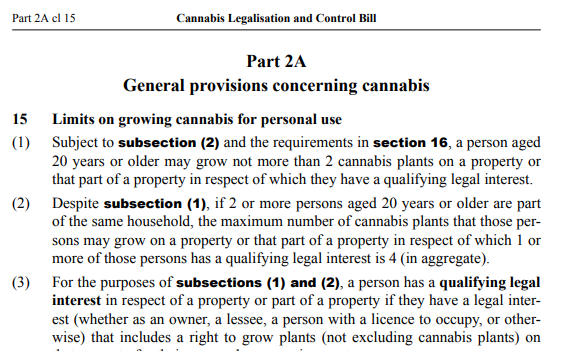
Section 15 of the Bill will allow for two plants to be grown at home per person, and up to four plants to be grown per household.

Two plants is not a lot. However, if you grew four plants in a small grow tent under a 600W light you could get ten or twelve ounces per grow. Assuming that you’re able to get hold of clones, this would mean ten or twelve ounces every eight to ten weeks. In other words, a household could meet its demands for recreational cannabis easily enough by growing it themselves.

Moreover, there is no proposed restriction on the size of the two plants, as has been the case in some North American jurisdictions. This suggests that people will be allowed to put down a couple of honking sativas in an outdoors greenhouse and get them both up to ten feet tall. Such an arrangement would make it legal to grow a year’s worth of cannabis in one season, sparing the need for the environmentally-unfriendly grow tents.

Section 19 of the Bill allows for recreational cannabis sales. Purchases will be limited to 14 grams per day, but this is at least two weeks’ worth by any reasonable measure. Aside from this, it appears the proposed model will be fairly similar to the cannabis cafe model that has existed in the Netherlands since the 1970s.

In other words, it appears that the proposed model is intended to allow for recreational cannabis sales in cafes in a similar fashion to how alcohol is already sold in pubs. Section 49 of the Bill makes reference to “consumption licences” which will allow certain premises to allow people to consume cannabis in public. Such premises will not be allowed to also sell alcohol, and will therefore follow closely to the Daktory model that Dakta Green has already established in New Zealand.

Despite these major wins, the Bill has a number of flaws from the perspective of the average member of the cannabis-using community.

Nowhere in the Bill has provision been made for running a mother plant that clones can be taken from. If one household can only have four plants, it makes having a mother plant that one can take clones off difficult. Against this criticism, however, is that it appears the Bill will allow for retail sale of feminised seeds.

It’s also a mistake to set the legal limit at 20. For one thing, it implies that cannabis is more dangerous than alcohol, which is entirely false. For another, it means two years where young Kiwis will be legally allowed to drink booze but not smoke weed, which will mean two years of exposure to the more destructive of the two drugs. Legal cannabis has been shown to lower rates of alcohol use overseas, and the sooner an alternative to alcohol was available the better.

Perhaps unsurprisingly, the Bill doesn’t address our right to use cannabis for spiritual purposes. Absolutely zero acknowledgement is made of the fact that cannabis is a spiritual sacrament, but this is not unexpected if one considers that New Zealand has been ruled by completely godless people since the turn of the century, and that for their sort spirituality is mental illness.

Also predictably, there is no provision for an official Government apology for conducting a war against them without their consent. The War on Drugs has been the worst human rights violation to occur in the West since World War II. The Government’s role in this war has involved decades of lying to the public about the effects of cannabis and putting people who defy them in cages. Their conduct has been obscene, and an apology should be part of legalisation – but it won’t be.

Perhaps worst of all, the Government is still committed to minimising cannabis use from the standpoint of cannabis use being inherently harmful. It’s possible that they have calculated that legalising cannabis would make it possible to strangle cannabis culture through ever-increasing taxes and red tape, as they have almost successfully done for tobacco. More likely, however, is that they have shifted thinking so that cannabis is now (rightly) grouped with alcohol and tobacco and not heroin and methamphetamine.

There are many possible criticisms of the Bill, but ultimately it is definitely worth supporting. All of the legitimate criticisms relate to aspects of cannabis law that could best be fine-tuned after the referendum has been passed.

Realistically, what the proposed Cannabis Leglisation And Control Bill means is an end to the fear. It would be taking away that dark, nauseating feeling that comes with being marked as a criminal. People smoking or growing cannabis at home will no longer have to fear saying the wrong thing or inviting the wrong person to their house, and the net result will be a reduction in the suffering of the New Zealand people.

*

If you enjoyed reading this essay, you can get a compilation of the Best VJMP Essays and Articles of 2018 from Amazon for Kindle or Amazon for CreateSpace (for international readers), or TradeMe (for Kiwis). A compilation of the Best VJMP Essays and Articles of 2017 is also available.

*

If you would like to support our work in other ways, please consider subscribing to our SubscribeStar fund.
The Government Should Legalise Cannabis For The Rugby World Cup

Kiwis are rejoicing at the news that our owners have permitted us extended hours to drink alcohol on licensed premises while Rugby World Cup games are on this Spring. It’s true that anything that facilitates New Zealanders coming together in a spirit of goodwill is a good thing, and VJM Publishing applauds this move for the sake of the nation’s mental health. The really great move, however, would be to legalise cannabis for the Rugby World Cup.

A famous half-truth about New Zealand culture is that rates of domestic violence spike every time the All Blacks lose. The full truth is that domestic violence rates spike when the All Blacks win, too, because every time the All Blacks play, men get together and drink alcohol. When they do this, a certain proportion of them will end up bashing their wives and girlfriends (or kids, parents, brothers/sisters etc.).

Alcohol is great fun, and the value it has in facilitating socialisation and enjoyment of life cannot be measured. It’s impossible to quantify the quality of life improvements that follow having a really excellent time partying with alcohol, or the warm memories that come from having a great time drinking with friends, or the value of the friendships made because alcohol broke the ice.

On balance, alcohol is a good thing – but the negatives of it are considerable nonetheless.

As mentioned in Chapter 12 of The Case For Cannabis Law Reform, alcohol is present in an estimated 30% of domestic violence incidents that the Police attend, and is believed to be responsible for 3.9% of all deaths in New Zealand. Including sicknesses caused by it and lost work days to hangovers or other alcohol-related conditions, the monetary cost of alcohol use runs into the billions.

Again, in no way is this to make the argument that alcohol is bad or should be further restricted. The problem is that there is no recreational alternative to it. You’re not allowed to go into town and watch the All Blacks at a cannabis cafe, and you’re not allowed to sit in a town square and watch a public big screen while smoking a joint. You’ll get arrested and put in a cage.

If you want to socialise with other people this Rugby World Cup, you get the same deal as at all other times. Drink alcohol or just fuck off back home.

Imagine a Rugby World Cup where Kiwis could come together without being pressured into consuming alcohol in order to socialise. This would finally mean that there was a recreational alternative for all those people who knew that they weren’t good on alcohol (arguably some 20% of the population).

It’s not a secret that the participants in most of those 30% of domestic violence incidents will be people who already know that sometimes they don’t behave well on alcohol. Imagine if these people were able to use a recreational substance that allowed them to be part of the festivities but which did not have the side effect of inducing them to get violent or aggressive. Many of them would take it – to everyone’s benefit.

Liberalising drinking hours for the duration of the Rugby World Cup might lead to more violence, sexual assaults and people killed in car wrecks, but it need not do so. If the purpose of liberalising such laws is to create a festival atmosphere for the duration of the tournament (and nothing can bring the country together like a Rugby World Cup), then it is possible for us to have our cake and eat it.

The way to achieve this is to legalise cannabis for the duration of the Rugby World Cup.

This would not mean a repeal of cannabis prohibition, at least not yet. What it would mean is a moratorium on arrests for public outdoors cannabis use for the duration of the tournament (or at least for as long as the All Blacks are still in it). We could pass a law that said, while the World Cup was in progress, Police would ignore public possession, use and personal trading of cannabis (although commercial enterprises would still be illegal).

This would mean that people could smoke cannabis in public as they can now smoke tobacco. They could meet in bonds of love, and share good cheer with a smile and a laugh, as alcohol users are permitted to do.

One can confidently predict the result of such a move, because one can observe how people behave in places where cannabis is already legal. Making cannabis legal for the duration of the Rugby World Cup would serve to create a relaxed, convivial, celebratory atmosphere for what is arguably the Kiwi nation’s most cherished quadrennial religious festival. It would create many good memories.

This will have several benefits over and above creating a festive atmosphere. It would also show New Zealanders that they don’t necessarily have to shit and piss their pants in fear at the thought of cannabis law reform. If cannabis users were given the opportunity to show that their behaviour was preferable to drunks they would probably take it. It would allow for a much better-informed cannabis referendum debate.

*

If you enjoyed reading this essay, you can get a compilation of the Best VJMP Essays and Articles of 2018 from Amazon for Kindle or Amazon for CreateSpace (for international readers), or TradeMe (for Kiwis). A compilation of the Best VJMP Essays and Articles of 2017 is also available.

The Case For Cannabis: Prohibition Does Not Serve The Good of Society

Cannabis prohibitionists have a fallback position when none of the usual rhetoric succeeds. It’s a vague appeal to some kind of “good of society”. This argument encompasses a variety of different sentiments, most of them fear-based. As this article will examine, this argument is no more true than any of the others.

At the time this article was being composed, it was in the news that a Dunedin man named Harley Brown had just been sentenced to two years and three months in prison for growing over a hundred cannabis plants. Meanwhile, another man named John-Boy Rakete had been sentenced, two weeks previously, to two years and two months in prison for bashing a man into a coma from which he is expected to never recover.

Imagine going to prison for growing a medicinal flower at the same time as a gang member who beat someone into a vegetable state, and seeing that gang member get out of prison before you. It sounds like something out of a Kafka novel, but it’s the reality of our current legal approach to cannabis. Can it fairly be argued that this arrangement serves the good of society?

It’s hard to see where the benefit to society is in this arrangement. Brown will be incarcerated at the cost of $100,000 per year, which is greater than the total value of the cannabis plants he had, even if this value is calculated using Police maths. As a result of his incarceration, a number of people will be made to suffer without the medicine they would otherwise have had.

How does this serve the good of society?

Rather than serving the good of society, prohibition puts us at each other’s throats. The friends and family of Harley Brown will probably have contempt for the system for the rest of their lives. Most people who compare the two cases above and their respective sentences will conclude that something is fundamentally rotten with our justice system, which appears to dish out punishments with no consideration given to how much suffering the perpetrator may have caused.

The good of society is served by alleviating the suffering of the people in that society. Education is a public good because ignorance causes suffering. Healthcare is a public good because disease causes suffering. Infrastructure is a public good because mobility restrictions cause suffering. Anything that is genuinely a public good alleviates suffering somewhere.

Prohibition serves no such good. As has been demonstrated in the previous chapters of this book, it doesn’t prevent suffering, but, to the contrary, it causes suffering. There is no social good served by arresting people who aren’t harming any one. Neither is any good served by imprisoning these people. Least of all is any good served by lying about how cannabis causes harm to the community.

The ultimate reason why cannabis prohibition does not serve the good of society is that the people will never accept not being allowed to use cannabis. The people will always intuitively feel that they have the right to use cannabis, because it alleviates suffering, because it’s a social tonic and because it can connect people to God. Because of this, prohibition can only ever cause conflict between the people and those tasked with enforcing it.

The idea that people will eventually “come to their senses”, realise that cannabis is a dangerous drug, and stop using it, is nonsense. Cannabis prohibitionists have gone all-in on this puritanical delusion, and they have lost. It’s time to admit that reality does not reflect the idea that cannabis is dangerous, or that the harms of cannabis are in any way ameliorated by making it illegal.

The good of society is best served by honesty. Honesty is one of the most fundamental virtues, because it’s only through honest discussion that we can come to see the world accurately. Without being able to see the world accurately, we will make mistakes that lead to conflict.

This honesty would cause us to have a look at Colorado, where they legalised cannabis in 2012. In Colorado, none of the terrible things that the prohibitionists predicted came to pass. There wasn’t an outbreak of violence or other crimes, there wasn’t an epidemic of cannabis addiction and it didn’t become easier for young people to get. Everything continued the same as normal, only there was much more money on account of it no longer being wasted on enforcing prohibition.

Legalisation would serve the good of society much better than prohibition. A system of legal cannabis would not only increase social cohesion by removing one of the major wedges that drives us apart, but it would also increase the respect that the average person has for the Police, the Justice System and the Government. Not least of all, it would save us a ton of money.

*

This article is an excerpt from The Case For Cannabis Law Reform, compiled by Vince McLeod and due for release by VJM Publishing in the summer of 2018/19.

The Case For Cannabis: Prohibition Is Cruel

There are a lot of differing political philosophies in the world, and they disagree on a great many matters. The closest we’ve been able to get to a universally agreed-upon value is that the Government ought to act to minimise human suffering. This article will make the argument that prohibition ought to be relaxed because it is cruel.

Cruelty is a malicious disregard for the suffering of other sentient beings. It was cruel to perform electroshock therapy on people without their consent. It is cruel not to summon medical help when one encounters a person in distress. It was cruel to not allow homosexuals to express their genuine regard for each other. Cannabis prohibition falls into the same category.

Some people will argue that not being allowed to use cannabis doesn’t constitute cruelty because it’s not really a big deal. There are many other things that we’re not allowed to do, so what does it matter if cannabis is another one of those things?

But that’s looking at it around the wrong way. People naturally live, and part of life is to explore what comes your way. People will naturally use cannabis, because others will offer it to them. Some of those people will find they really like it, perhaps even enough to use it daily. Punishing people for an act that they do naturally – especially when that act harms no-one – is an act of cruelty.

It’s cruel to cage a bird, or keep a cat inside, because it’s a violation of their natural instincts to be free. The natural instincts of a human being is to explore consciousness. Isn’t it, then, an act of cruelty to prevent them? Preventing a human from exploring their consciousness is as unnecessarily restrictive as keeping a cat or dog in a small cage for their whole life.

Forcing people to follow arbitrary laws and dictates is cruel, because it makes those people feel like they are of less value than those imposing the rules. Putting someone in a cage where they suffer intensely from being in close physical contact with extremely dangerous people, just because they don’t follow those arbitrary decrees, is beyond cruel. Yet, that is what our system does in the pursuit of enforcing cannabis prohibition.

Perhaps the worst cruelty is that done to the family members of those who are incarcerated for cannabis offences. For a family member who is relying on certain other members of their family for income or support, it seems almost egregious for the state to incarcerate those others on account of a cannabis offence.

It’s unlikely that many cannabis prohibitionists would like to explain to a small child how the supposed dangers of cannabis are so great that it necessitates putting their parent in jail. They would much rather prefer that social workers and Police officers explained that to the children of parents imprisoned for cannabis offences. This cowardice exposes that cannabis prohibition is underpinned by an absence of compassion.

Some people ought to think about what sort of world they want to live in, because the compassion or cruelty of the laws under which we live have an impact on whether people act to ameliorate each other’s suffering or not. The legal system, whether we like it or not, sets the standard for whether we are compassionate or harsh towards those who really crash out.

Passing a law that says a person has to go in a cage if they grow a medicinal plant sets a precedent for what the appropriate level of compassion in our society is. And it’s a low one. Locking people up for using medicinal flowers shows that we are a brutal people. It shows that even if a person can provide a fair reason for using a medicinal substance, the Government can just bulldoze through and imprison them anyway.

Some of the older prohibitionists might like to consider that they themselves will soon be in need of compassion, because their bodies will continue to decline towards death. In a person’s final few years, they are just as dependent on the goodwill of others as they are in their first few years. If one is old, therefore, it’s to one’s own benefit to normalise compassion and empathy.

Even if the argument is made that the point of the cannabis laws is to prevent suffering (by way of preventing addiction and mental illness), the reality is that there are hundreds of millions of cannabis users who are happy to tell you that their use of cannabis prevents suffering. It’s cruel not to listen to these people, to tell them that their claims of being helped by cannabis are delusions and that they should be in a cage for their own good.

Ultimately, this argument asserts that there’s enough cruelty in the world, and that we don’t need any more. Cannabis should be legalised because it’s cruel to punish people for using a medicinal flower that doesn’t harm anyone. This would contribute to a world with less suffering in it – something that we all benefit from.

*

This article is an excerpt from The Case For Cannabis Law Reform, compiled by Vince McLeod and due for release by VJM Publishing in the summer of 2018/19.