
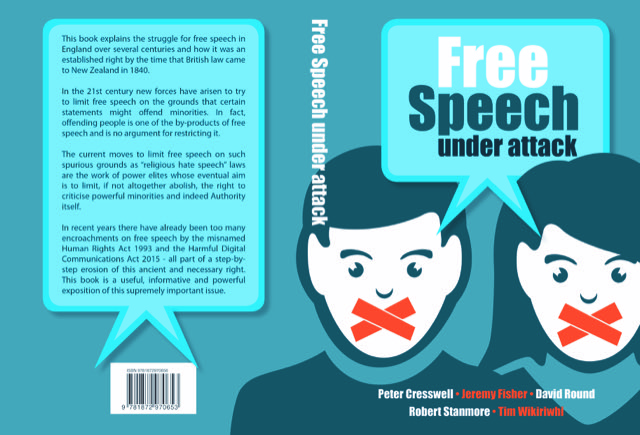
VJMP Reads: Free Speech Under Attack V

This reading carries on from here.

The 13th chapter in Free Speech Under Attack is ‘Speaking Controversially’ by Robert Stanmore. This essay begins by looking at the controversy over Israel Folau when he quoted a Bible verse promising eternal punishment to sinners. Stanmore cites Mark Latham as stating that corporate elites are intruding upon workers’ rights by punishing them for what they say on social media outside of work hours.

This also happens in New Zealand, as shown by the example of Ray White Real Estate, who sacked two of their agents for social media posts critical of Islam. Given that a large proportion of the population is critical of Islam, and for very good reason, this seems like an excessive and callous response. Stanmore concludes by claiming that the possibility of offence being taken is a fair price to pay for free speech.

Chapter 14 is ‘Free Speech and Universities’ by David Round. Here, Round recounts how the Education Act guarantees academic freedom. The primary concern of universities is to develop intellectual independence. But the general societal trend is towards intolerance of free speech and free expression. Round wisely points out that today’s generation is both tolerant in some ways and intolerant in others when compared to their grandparents.

Round details the social media attacks against himself and his reputation for supposed racism, and the efforts made by cancel culture to shut down the Canterbury University Law Revue and Don Brash’s scheduled speaking appointment at Massey University. He also discusses the attempts made by Muslim and Chinese interests to buy influence in Western universities through making donations.

Chapter 15 is ‘Silencing the Public on Immigration’ by Robert Stanmore. This is another short essay, at only five pages. Stanmore begins by noting the unprecedented increase in Third Worlders moving to the West, and by pointing out that these moves are happening without the consent of the local populations.

Stanmore states, correctly, that the United Nations is inescapably opposed to the interests of individual Western nations. Free speech is, unfortunately, far from a universal human value. He also discusses the evil of the United Nations Compact on Migration, and how our Government kept it secret from us. He ends with an appeal to learn from the experience of Europe and only allow immigrants who are compatible with our way of life.

*

If you enjoyed reading this essay, you can get a compilation of the Best VJMP Essays and Articles of 2019 from Amazon for Kindle or Amazon for CreateSpace (for international readers), or TradeMe (for Kiwis). A compilation of the Best VJMP Essays and Articles of 2018 and the Best VJMP Essays and Articles of 2017 are also available.

*

If you would like to support our work in other ways, please consider subscribing to our SubscribeStar fund. Even better, buy any one of our books!
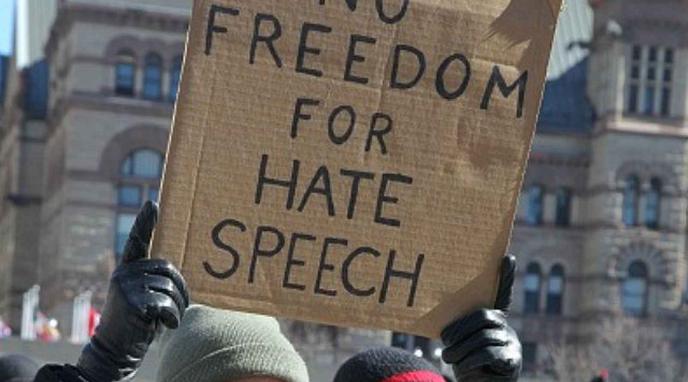
If You Think National Will Roll Back “Hate Speech” Laws, You’re Stupid

Libertarians across New Zealand were dismayed by news last month that Jacinda Ardern’s Labour Government intends to press ahead with so-called “hate speech” legislation. This is widely expected to entail European-style restrictions that could see a person imprisoned for saying that mass immigration is like an invasion, as French author Renaud Camus was earlier this year. But those putting their hopes in the National Party to fix it will be disappointed.

Right-wingers, in general, were also dismayed at Ardern’s confirmation that the Sixth Labour Government will introduce “hate speech” laws if they are re-elected on the 17th of this month. The conservative argument is that free speech is a fundamental part of New Zealand culture, and there’s no good reason to throw this away.

Judith Collins responded by saying that National “would not add further” to the loss of free speech, but would not commit to rolling back any free speech violations that the Labour Government might commit. Neither did she affirm that free speech was a fundamental Kiwi value that needed to be defended.

The reality is that National can sense a political advantage in acting as if they are in favour of free speech, but they don’t really care about it, for two major reasons.

The first is that they’re not, in any sense, a libertarian party. In fact, they are transparently authoritarian in several ways. National likes to pose as if they’re against government interference into the private lives of citizens, in contradistinction to Labour, who want a nanny state. But if they were libertarian they would work to legalise cannabis.

Being in favour of legal cannabis is no longer a radical position for a right-wing party in the Anglosphere. 55% of American Republicans are in favour of cannabis legalisation, and even a state as Republican as Alaska, where Donald Trump beat Hillary Clinton 51%-37%, now has legal cannabis. Part of the reason for this is the libertarian streak possessed by American right-wingers.

This libertarian streak doesn’t exist in New Zealand conservatism, which is why we are some 20 years behind America when it comes to cannabis. But the absence of these libertarian sentiments among New Zealand conservatives suggests that they won’t make an effort fighting for free speech either. Why would someone who thinks you should be in a cage for growing medicinal cannabis fight for your right to free speech? They wouldn’t.

The second major reason why National don’t care about free speech is because they are influenced by people who are against it.

British Conservative Leader Boris Johnson is bringing in draconian anti-free speech laws under the guise of child safety. The proposed bill will make it illegal to cause “online harms”. The Centre for Policy Studies declared their opposition to the bill, stating that it was wrong to let an unelected communications regulatory body decide what people were allowed to write on the Internet.

If the British equivalent of the National Party is restricting free speech in the same way that the New Zealand Labour Party intends to do, that is evidence that the moves are not inspired by left-wing or big government sentiments but by globalist ones.

Because the National Party is just as beholden to globalist interests as Labour is (even if those interests are slightly different), there’s no reason to think that they would be much different to Labour when it comes to free speech. Globalist interests want few things more than to shut down criticism of mass immigration – the less resistance, the higher house prices can be pumped, the more mortgage profits can be raked in.

In fact, one can predict that even if National wins the election this month they will introduce some kind of free speech restrictions anyway. There is transparently a wider globalist agenda to abolish free speech and, with it, dissent and criticism in general. This agenda has arisen because we are in the democracy to tyranny part of the political cycle.

No matter who wins this month’s election, New Zealand will lose our rights to free speech, as we have already lost our firearms rights and our rights to use spiritual sacraments. And in the same way that neither Labour nor National rolled back firearms restrictions or restrictions on the use of cannabis and psilocybin, nor will either party roll back any restrictions on free speech that might get passed in coming years.

*

If you enjoyed reading this essay, you can get a compilation of the Best VJMP Essays and Articles of 2019 from Amazon for Kindle or Amazon for CreateSpace (for international readers), or TradeMe (for Kiwis). A compilation of the Best VJMP Essays and Articles of 2018 and the Best VJMP Essays and Articles of 2017 are also available.

*

If you would like to support our work in other ways, please consider subscribing to our SubscribeStar fund. Even better, buy any one of our books!

VJMP Reads: Free Speech Under Attack IV

This reading carries on from here.

Chapter Ten in Free Speech Under Attack is ‘China’s Sinister Influence’ by Robert Stanmore. In this essay, Stanmore describes the Chinese influence on free speech suppression in Australia and New Zealand. China is even worse than Islam, in Stanmore’s estimation. China has the money to buy off the Western free press. It has already bought the New Zealand National Party.

Stanmore recounts how China uses their network of Confucius Institutes to influence university culture in China’s favour. They also use a scheme called the Confucius Classroom Program to bring propaganda to primary and secondary students. New Zealand is in a dangerous situation because both National and Labour are beholden to China, although National more so.

Chapter Eleven is ‘”De-platforming” speakers’ by Tim Wikiriwhi. He defines deplatforming as when a speaker is prevented from using a platform because those in authority don’t want to let that speaker expound their views. Wikiriwhi recounts how Bruce Moon, Stefan Molyneux and Lauren Southern were deplatformed by authoritarian leftists afraid of criticism of their immigration policy.

Wikiriwhi quite rightly points out that censorship achieves little but introduce darkness and ignorance to a political discussion. He also, quite rightly, draws attention to the immense scale of Muslim rape gangs in the Western World, an issue that should be discussed. The essay ends with an appeal to the fundamental value of free speech and how governments should not interfere with what the people say or hear.

Chapter Twelve is ‘The Thug’s Veto’ by Peter Cresswell. This is easily the shortest essay in this book, at only four pages. Cresswell defines the Thug’s Veto as when people use the threat of violence or chaos to get an event they disapprove of shut down. This is a small part of what is more generally known as cancel culture.

Cresswell here points out that laws against “hate speech” are tantamount to laws against criticising evil. Moreover, it’s apparent from the beginning that such laws will not be applied evenly. Left-wingers will escape censure for levels of hate that right-wingers will be hammered for. Those pushing for hate speech laws are fighting for irrationality, and are against reason.

*

If you enjoyed reading this essay, you can get a compilation of the Best VJMP Essays and Articles of 2019 from Amazon for Kindle or Amazon for CreateSpace (for international readers), or TradeMe (for Kiwis). A compilation of the Best VJMP Essays and Articles of 2018 and the Best VJMP Essays and Articles of 2017 are also available.

*

If you would like to support our work in other ways, please consider subscribing to our SubscribeStar fund. Even better, buy any one of our books!

VJMP Reads: Free Speech Under Attack III

This reading carries on from here.

Chapter Seven in Free Speech Under Attack is ‘Banning a Political Pamphlet’ by Tim Wikiriwhi. This is a polemic against Andrew Little’s efforts to introduce hate speech legislation and to ban the 1Law4All pamphlet about the Treaty of Waitangi. Here, Wikiriwhi – himself Maori – supports the sentiments of the pamphlet by agreeing that the British settlement of New Zealand was a net positive for the Maori people.

This essay is quality in its invective, describing Peter Dunne as an “obsolete politician” and making use of the adjective “ham-fisted”. It demolishes the social justice warrior case that British colonisation lowered the quality of life in New Zealand, and makes an impassioned case for the value of free speech. The SJWs won’t be able to scream “Racist!” at Wikiriwhi, so they will likely ignore him.

The Treaty of Waitangi and British colonisation, bringing the advantages and restraints of civilised government to New Zealand for the first time, were the best things that ever happened to New Zealand and the Maoris benefitted enormously from them.

Chapter Eight is ‘Islam and Free Speech’ by Robert Stanmore. This essay discusses the various measures taken by Muslims to shut down free speech in the guise of preventing blasphemy. Stanmore recounts Muslim attacks against free speech in several Western nations, whether by using violence, intimidation or the law. He (correctly) points out that the Koran encourages Muslims to kill non-believers.

Stanmore encourages us here to learn from the example of Britain and Canada, where Muslims are numerous enough to influence the law by threat. In the vast majority of cases, Muslim immigrants show no sign of willingness to conform to the expectations of their host nations, and show every sign of willingness to force their hosts to conform. This is a danger we should be extremely wary of.

Chapter Nine continues in a similar vein. This short chapter is called ‘The Fraud of Islamophobia’. Here, Stanmore recounts the multiple admonitions to violence found in the Koran, and how Muslims are reluctant to reject these verses. Disappointingly, he ignores the violence inherent in the Bible, and the murderous way that Christianity itself has spread.

Stanmore even makes the laughable assertion that Christianity is inherently a peaceful religion akin to Buddhism or Hinduism. Despite these errors, he is able to list a number of scriptural horrors within the Koran that suggest Islam is not compatible with a modern Western way of life. A “religious hatred” law is unacceptable.

*

If you enjoyed reading this essay, you can get a compilation of the Best VJMP Essays and Articles of 2019 from Amazon for Kindle or Amazon for CreateSpace (for international readers), or TradeMe (for Kiwis). A compilation of the Best VJMP Essays and Articles of 2018 and the Best VJMP Essays and Articles of 2017 are also available.

*

If you would like to support our work in other ways, please consider subscribing to our SubscribeStar fund. Even better, buy any one of our books!