
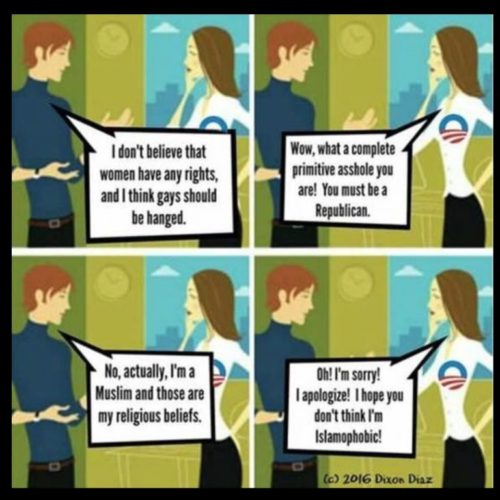
Why is it So Fashionable to Defend Islam?

It’s extremely fashionable right now, in some circles, to make a show of defending the virtues of Islam and of Muslims. Strangely, in those very same circles, it’s extremely unfashionable to defend the very same moral values supported and asserted by Islam and Muslims. This essay attempts to make sense of this curious contradiction.

Let’s be clear: Islam is an ideology of hate. Its holy scripture makes it very clear that Allah commands the subjugation of non-Muslims, women and homosexuals. There are numerous admonitions to violence in the Koran, and it is widely accepted – even by Muslims – that Mohammed, the Perfect Man, chopped the heads off 600 Jews on one particular day.

An extremely odd, but common, phenomenon nowadays is of people claiming to be enlightened humanists while defending Islamic ideology. In truth, defending Islam in the name of Enlightenment values is insanity. It doesn’t make any more sense than defending the same fundamentalist Abrahamism that the great thinkers of the Enlightenment valiantly struggled against for 300 years in its guise of Christianity.

This point can’t be overemphasised: the people defending Islam right now are attacking the same people who criticised fundamentalist Christianity for being supremacist, xenophobic, misogynistic and homophobic! In other words, the defenders of Islam are attacking the same people who won us our freedoms from fundamentalist Abrahamism. Freedoms that took hundreds – in some cases, thousands – of years to establish.

So what if the Muslims take over and install a new patriarchy ten times worse than the old one, the gutmenschen cry, like they did in Lebanon and a hundred other places? At least no-one called us racists!

The question has to be asked: why is it suddenly so fashionable to make a big show out of defending such a disgusting ideology, one which would see women stripped of the right to vote and homosexuals thrown from rooftops? This phenomenon can be explained in four major ways: some sensible, some not.

Much of the sentiment behind shrieking “Nazi!” at people who criticise Islam appears to come from a desire to avoid another genocide. The logic appears to be that the white working classes, twisted with the malice and hate natural to people of that station, are only one excuse away from stuffing millions of Muslims into gas chambers. All that’s needed to light a spark to this powderkeg is hate speech from some Islamophobic demogogue.

If anyone is allowed to criticise Islam openly, the reasoning goes, the working class will inevitably chimp out and everyone will get carried away until we’re beating out the brains of Muslim children in the street Lord of the Flies-style. Obviously it’s mostly just middle-class wankers who think like this, but there are a fair number who defend Islam on this reasoning.

Part of it is also pure submission. As this column has pointed out previously, terrorism works, and many cowards have calculated that it’s better not to criticise Islam in case doing so paints a target on the back. The hope of many Westerners is, as the old phrase has it, that “the crocodile will eat them last”. No need to go out like Theo van Gogh, after all.

A third reason is more narcissistic. Some people believe that by accusing someone else of unvirtuous conduct they draw positive attention to themselves, as if by making the accusation they must automatically be innocent of the same. It’s a narcissistic sentiment because it holds that by casting other people down into shame, the accuser brings glory upon themselves.

Leaving aside the obvious application of Haggard’s Law, this virtue signalling is the sign of a true dickhead. It can be observed every time that someone defends Islam by accusing its critic of making their criticism from a place of dumb hate or prejudice, as if Islam could not possibly be criticised on any other basis. It’s no less petty than ripping another person down for not being au fait with any other meaningless fashion.

The major explanation as for why people defend Islam, however, is simply our old favourite, human retardation. Many of these defenders have neither read the Koran nor studied Islamic history in any detail, and they simply aren’t aware of the amount of blood shed by people encouraged by these supposedly holy words. If they are aware, they blithely write it off as “no worse than Christianity”.

Some other retards have observed that most people who hate all other races also hate Muslims, and so, in the manner of retards, have reasoned themselves to the conclusion that anyone who dislikes Muslims must be a racist. Failing to realise that one can distinguish a racist from someone who doesn’t like Islam simply by asking a person their opinion of brown-skinned apostates, these retards tend to reflexively bleat about racism every time they hear a person express any misgiving whatsoever about the religion.

Unfortunately for lovers of peace and reason, it appears that defending Islam is currently fashionable for many reasons, which means it will continue to be defended for a long time yet, which means there will be many more terror attacks on Western soil before we wake up. Sit tight.

*

If you enjoyed reading this essay, you can get a compilation of the Best VJMP Essays and Articles of 2017 from Amazon for Kindle or Amazon for CreateSpace (for international readers), or TradeMe (for Kiwis).

Why Right-Libertarianism Is Full Of Autists

Many have had the experience of being surrounded by right-libertarians and realising that they have absolutely no clue about how other people think, and that this lack of insight inevitably dooms their political philosophy. It’s now apparent to many that the right-libertarian movement is chock full of autists. This essay will argue that right-libertarianism and autism overlap so heavily because they are both highly masculine mindstates with a shared evolutionary genesis.

Right-libertarians often like to paint a picture of how excellently everything would work if there was no welfare. In their minds, the welfare system only incentivises failure. If it was removed, they claim, people would work harder and pull themselves out of poverty rather than “relying on the Government”. Human suffering would decrease as a consequence.

What’s perfectly clear, to the 99% of the population who aren’t right-libertarians, is that this approach completely fails to account for the reality of human behaviour. Pulling the rug out from under tens of millions of struggling people at once would lead to chaos and violence in short order, and the thought that private security could manage enemy odds of hundreds to one is laughable.

Human suffering would increase sharply – and quickly – if we got rid of the welfare system, and a person doesn’t have to be a Dickens scholar to know this. We can simply observe the widespread misery in all times and places that don’t have one. Therefore, no-one will ever get rid of the welfare system, any more than they’ll ever get rid of the law against theft, and for similar reasons. Why don’t right-libertarians understand this?

One approach has it that the major difference between male and female psychology is that the masculine mind is systemising, while the feminine mind is empathising. The logic here is that men and women evolved to fit different niches in the biological environment: the male to the hunting niche, and the female to the gathering and nurturing niche.

Another theory has it that the major difference is that the male brain is autistic while the female brain is psychotic. This is apparent in several ways – chiefly the fact that boys are diagnosed with autism at many times the rate of girls, but also by genetic studies that show that autists tend to inherit from their fathers a disproportionately high number of genetic markers relating to brain development.

Yet another theory points out that men tend to vote for right-wing parties more than women do (a theory supported by the research of our very own Dan McGlashan), and from this draws the conclusion that men are naturally more conservative or orderly than women are.

What all these theories have in common is a realisation that men are not particularly empathetic. After all, the male brain has not evolved to be empathetic. For a hunter, empathy is not useful – in fact, it could even be detrimental if it caused the hunter to hesitate before landing a killing blow. All that really matters is the systemising ability to figure out how to get into position to land the killing blow. That is what is rewarded.

The male adaptation to a hunter’s niche is probably the underlying cause behind both high male rates of autism and of supporting right-libertarian parties. Essentially it’s a matter of a large swathe of people, predominantly men, lacking the brain capacity to imagine what it’s like to be another creature, and thereby coming to support a political movement that simply discounts such experience as a non-factor.

Females, for their part, tend to be neither hunters, autists nor right-libertarians. Their niche required more empathy, because it fell to them to do the bulk of the child-rearing and attending to the sick or old. It’s therefore not easy for women to ignore the suffering endured by other conscious beings. Women (like psychotics) tend to find it stressful when another conscious being is suffering; men (like autists) do not.

In order for a person to become a right-libertarian, they have to be usually masculine, in the sense that they have to have an unusually low amount of empathy for the countless millions who would suffer under their political system. Moreover, they have to keep supporting this system despite the overwhelming opposition from sensible people. These qualities are very similar to the tenacity and stubbornness that autists are infamous for, and probably because of a shared origin in masculine brain structures.

*

If you enjoyed reading this essay, you can get a compilation of the Best VJMP Essays and Articles of 2017 from Amazon for Kindle or Amazon for CreateSpace (for international readers), or TradeMe (for Kiwis).
Why Immigration Is a Weapon Of The Parasitic Rich

The parasitic class has many different strategies for destroying the mutual trust among the people – and opening the borders achieves several of them at once

Many were surprised, and many were not, by the news that the New Zealand Bus Drivers Union was opposing the request of Ritchies to import 110 indentured servants in the form of “migrant bus drivers”. Those who were surprised were those who thought that the union, being comprised ostensibly of leftists, ought to support bringing third-world people in to compete with the indigenous working class, because leftists are supposed to be all about solidarity for poor brown people.

Those who were not surprised were those who understand how reality works. The reality is that Ritchies put in such a low bid for the bus drivers’ contract that they couldn’t fill the positions with Kiwi staff, because the supply of people willing to work at wages that they can’t live off is almost nil. There is now an established precedent, however, for Kiwi employers who can’t find enough local suckers to subsidise their parasitic lifestyles: immigration.

Much like American employers with illegal Mexicans, Kiwi employers have cottoned on to the fact that maximising profitability is a function of minimising wages, and that minimising wages is a function of the leverage the employer has in the negotiation, and that this leverage is vastly increased if the worker is illegally in the country or wholly dependent on the whims of the employer for future work.

Not only does immigration give the local ruling class great power by populating the land with people dependent on them, but it also strengthens their economic position by destroying the leverage that local workers have in employment negotiations. This destruction of leverage is achieved by destroying the amount of trust that people have for each other, because solidarity is necessary to resist the depredations of the parasitic class and solidarity is primarily a matter of trust.

Game theory* tells us about the factors necessary for the evolution of trust.

The first is repeated interaction. People rarely trust others if they believe that they will never meet that other again, and for good reason: it makes sense from a game theory perspective to be more likely to exploit a person who you will never see again, for the reason that they will not be able to take revenge.

The greater the flow of people, the less repeated interaction there is. At one extreme end, there is very little solidarity in an airport terminal, for the reason that the vast majority of interactions here will not be repeated. At the other extreme, there is immense solidarity among members of a pioneer family deep in the Canadian wilderness, for the reason that virtually all interactions will be repeated.

The second important factor is the capacity for social interactions to be non-zero-sum games. In other words, trust only develops when social interactions result in clear mutual benefit. If either side feels like they lost out from the exchange, trust will dissipate.

Many people will make the claim here that immigration grows the overall size of the pie, for the reason that each new immigrant, even if they take up a job, creates at least one job’s worth of demand for other goods and services. This argument is often touted as a counter to the “Lump of Labour Fallacy” and, to that end, it has merit. But this argument ignores the impact of social status on a person’s well-being.

Social status is a zero-sum game in the sense that the higher one person is up the dominance hierarchy, the lower someone else must be. Low social status is extremely stressful – perhaps it wouldn’t have to be experienced as such in an ideal world, but we don’t live in one. In our world, a native person having to accept a lower social status than an immigrant is regularly experienced as a humiliation, for the reason that the native feels pushed out, as if by a cuckoo hatchling.

In a social environment where immigration means that the natives have to accept lower positions (such as an unemployment benefit in lieu of a living wage, as in the case of the indigenous bus drivers in the opening paragraph), there will naturally and understandably be resistance from those natives. This means that forcing it on those natives, against their will, will inevitably have the effect of causing those natives to hate the immigrants instead of trusting them.

The third important factor for the development of trust is to have low levels of miscommunication. As everyone who has spent any time on the Internet knows, clarity and precision are the cornerstones of communication, and when you have hordes of jabbering retards you end up having arguments and fights.

The greater the diversity, the greater the levels of miscommunication. This is because you have more languages and dialects to contend with, and any given person has an upper limit as to how many of these various forms of communication they can master. Exceeding this limit – which is guaranteed to happen if diversity keeps increasing – will cause miscommunication to happen.

Increasing the rates of immigration has the effect of bringing a diverse range of different forms of communication into everyday life, which increases the likelihood of someone misunderstanding someone else. So the greater the levels of immigration, the greater the levels of miscommunication and therefore the lower the levels of trust.

Who benefits from all this destruction of trust? The cheaters. The very same parasite class who entreats the Government to let them import indentured servants instead of paying a fair wage to local workers who are looking for employment. They benefit immensely from the destruction of trust, because an environment of distrust makes the people less able to organise to resist the hoarding of wealth, and this shifts the balance of power in favour of the wealthy.

The greatest trick the rich ever pulled on the poor was to convince them to open the net of solidarity so wide that no-one in it has anything in common with each other any more. The circle of trust has been cast so wide that it has fallen apart, and the traditional ways of re-forming bonds of trust have been destroyed or are severely discouraged.

This makes about as much sense as opening your pantry for the neighbourhood rats and mice to come and take their fill, on the grounds that rodents are disadvantaged compared to humans and therefore solidarity with other humans is a form of supremacism.

* For an outstandingly brilliant demonstration of the basic principles of game theory as it pertains to trust, see http://ncase.me/trust/

*

If you enjoyed reading this essay, you can get a compilation of the Best VJMP Essays and Articles of 2017 from Amazon for Kindle or Amazon for CreateSpace (for international readers), or TradeMe (for Kiwis).

Should There Be A Ministry of Men’s Affairs?

Life is so much harder for men in New Zealand that they kill themselves at almost three times the rate of women

Many people were shocked, and many were not, by Julie Anne Genter’s comments this week about old white men. Speaking to Cobham Intermediate School pupils, Genter made the point that some of these old white men “need to move on and allow for diversity and new talent.” These statements were made in her capacity as Minister for Women, but if you look at the statistics, it seems like there’s more need for a Minister for Men.

The reason for a Ministry of Women’s Affairs was ostensibly to close the gaps between the well-being of women and men. Since the advent of Abrahamic religion in the West, women have been forced into a subservient role, being forced to take the blame for the fall of man as well as for invoking the horror of Nature. Biblical passages such as Timothy 2:12 instructed Christendom that “I do not permit a woman to teach or exercise authority over a man; she is to remain quiet.”

Ever since these male supremacist religious cults invaded the West, our women have been forced to endure structural abuse. Divorce was banned, forcing women to endure permanent relationships with violent men. Prostitution was banned, denying women natural opportunity for economic advancement. Abortion was banned, forcing women to carry unwanted children to term or else risk a back-alley abortion from a “doctor” with no licence.

By any objective measurement, women had the worst of it for a very long time, and, when we realised this, we tried to make up for it with things like feminism and Ministries for Women’s Affairs. What we’ve been slow to realise is that, now that advantage is mostly a matter of obedience to the political, educational and commerical authorities, women have it better than men in many regards.

Most obviously, women have a much easier time of things in academic settings. Page 38 of the document linked in this paragraph demonstrates that women get better grades in literacy, and page 42 shows that they also get better grades in numeracy. This disparity is even worse for men at university level, which New Zealand women are 40% more likely to participate in.

When men had higher university participation rates than women, the media couldn’t keep quiet about how sexist and evil this state of affairs was. Indeed, this was one of the stated reasons for bringing in a Ministry of Women’s Affairs in the first place. An inequality of outcome in terms of education and gender was simply impermissible, immoral, outrageous.

In 2015, 527 New Zealanders killed themselves, of who 384 were men (72.8%). That means for every Kiwi woman who feels so rejected by society that she is compelled to take her own life, there are almost three Kiwi men who feel the same way. This is greater than the gap between Maori and non-Maori suicide rates, which is itself considered a large enough gap to be a national tragedy that demands immediate action (indeed, there is a Ministry of Maori Development).

So if society is so bad for Maori people that they need their own Ministry, as evidenced by suicide rates, and if society was so bad for women that they needed their own Ministry, as evidenced by tertiary participation rates, then surely there is sufficient cause to say that New Zealand men need someone looking out for them as well?

It’s absurd to claim that women are disadvantaged compared to men because men earn 20% more, when at the same time men are killing themselves at almost 300% the rate of women. It’s doubly absurd when it’s considered that women are benefitting immensely from the way that the pension system is set up, at the expense of predominantly male workers.

If the experience of being a man in New Zealand is so much less pleasant than the experience of being a woman that it carries triple the risk of suicide, it’s time to take steps to redress the balance by instituting a Ministry of Men’s Affairs to make up for all the privilege that women hold.

*

If you enjoyed reading this essay, you can get a compilation of the Best VJMP Essays and Articles of 2017 from Amazon for Kindle or Amazon for CreateSpace (for international readers), or TradeMe (for Kiwis).