
Why the 2018 Labour Budget Was so Underwhelming

The 2018 Budget, like the 2000 one, was extremely tight; the 2020 Budget will be a lolly scramble, as the 2002 one was

“Yet, for all the hype, [the Finance Minister and the Prime Minister] were at pains to reassure big business and employer groups that this was above all a ‘fiscally responsible’ budget. Its commitments to social spending would not jeopardise Labour’s intention to maintain a surplus, they emphasised…” The two Labour Party politicians mentioned here are Grant Robertson and Jacinda Ardern, speaking in 2018 right? Wrong – they are Michael Cullen and Helen Clark, speaking 18 years ago in the year 2000.

The quote in the opening paragraph comes from this article from 2000, discussing the first Budget of the new Fifth Labour Government. Other quotes of interest from the same source are: “the increases fall far short of what is required to address the acute levels of social and economic inequality now embedded deep within the social structure”, “The majority of families forced to rent from private landlords will be no better off than before” and “Labour and the Alliance have done nothing to restore the vicious cuts to unemployment benefits and welfare that were implemented by the National Party”.

So if you’ve been listening to the Sixth Labour Government explain why this year’s Budget helps almost no-one and you’re starting to realise that you’ve heard this exact same bullshit story before, sit tight while we explain why – and what’s going to happen next.

After nine of years of neglect, including closing down rape crisis centres and overseeing the world’s highest youth suicide rate, the Fifth National Government was finally – although narrowly – voted out of power. The Sixth Labour Government came to power with a strong commitment and mandate to do something about the rape and pillage of the New Zealand populace by the plutocrats.

So the 2018 Budget surprised many commentators with how weak it was. The consensus described it as “National-lite”, and, indeed, it did almost nothing to help anyone. Many asked themselves why it was that an incoming Labour Government would deliver such a weak Budget. Didn’t they want to create the impression that they were doing something to help? Why miss this golden opportunity to set things right?

The answer to this conundrum comes from examining the 2002 Budget, which was released a few months before the General Election that year. That year’s Budget sent the New Zealand business community into paroxysms of rage.

The Employers & Manufacturers Association complained that “The huge $3.31 billion increase in new spending in the Budget for the next financial year is more than double the increase in new spending for the past two years combined”, and then National Party leader Bill English was enraged by “Labour and their higher operating balances, as well as higher taxes, increasing debt and billions of taxpayers’ dollars invested overseas”. There was even money for pure luxury items like refugee resettlement.

These increases impressed the population, as they were the first real relief Kiwis had been given in 18 years of relentless neoliberalism, and they duly returned the Labour Party to power. Kiwis contrasted this big spend-up with the cruelty of the National Party Budgets under Ruth Richardson, and the Nats were duly slaughtered, falling to 21% of the votes, their lowest result in 100 years.

It was a lesson for all, not least the Labour Party.

So the reason why the Sixth Labour Government did next to nothing to fix the nine years of neglect that the Fifth National Government put us through is simple: they’re saving the lolly scramble until just before the 2020 General Election. You can almost guarantee that, when the 2020 Budget rolls around, the grip of the New Zealand ruling class around the throat of the population will be loosened just enough to enable us to express our gratitude by returning Jacinda Ardern’s Government to power for a second term.

This is not a nefarious new trick, dreamed up by a crack team of political consultants – it’s straight out of the Helen Clark playbook. We can confidently predict another weak Budget in 2019 before the conspicuous generosity of the 2020 one, and we can also almost guarantee that if Labour wins a second term this would see us having two more weak Budgets in 2021 and 2022 before another lolly scramble in time for the 2023 General Election. Then, if they win a third, there will be weak Budgets in 2024 and 2025 before yet another lolly scramble in 2026.

This pattern is no less predictable than the General Electoral Cycle itself is, and could even be said to be part of it. Plus ça change, plus c’est la même chose.

*

If you enjoyed reading this essay, you can get a compilation of the Best VJMP Essays and Articles of 2017 from Amazon for Kindle or Amazon for CreateSpace (for international readers), or TradeMe (for Kiwis).

How to Detect An Anti-White Bigot

Everyone’s obsessed with making a show of fighting bigotry nowadays. Paradise could have befallen the Earth by now, we are told, if only haters didn’t oppress the disadvantaged. The problem with this attitude is that many anti-white bigots have slipped under the radar in the guise of social justice warriors. As this essay will examine, the easiest way to detect an anti-white bigot is by observing hypocritical double standards.

There’s little reason to be prejudiced against anyone unless you hate them. Hating someone may or may not be justified at any given moment, but an inevitable consequence of hating someone is that you will judge them by high standards, while allowing people you don’t hate to get away with low standards. This reveals itself primarily as hypocrisy.

So one way that anti-white bigots give themselves away is in the explanations they give for individual success. For instance, high achieving Asians or Jews are credited with working hard and being from a culture that values scholastic dedication, but high achieving whites are considered merely the beneficiaries of a white supremacist system.

By itself, that means nothing, but anti-white bigots will also make the claim that low achieving whites have failed morally by not valuing education enough, or because they lacked the discipline to study hard or are naturally just dumb, whereas low achieving blacks and browns have been failed by that same white supremacist system.

An objective person would credit both high-achieving Asians and high-achieving whites with having earned at least some of their personal accomplishments, because even with the easiest of upbringings it takes a lot of will to dedicate oneself to learning. If high Asian or Jewish achievement need not be explained by structural racism or exploitation of dark-skinned people, then there’s no reason to attribute white achievement to such things either.

Either that, or they would excuse the failure of low-achieving whites with the same appeal to social and environmental factors that they appeal to when they excuse the failure of black and brown people. After all, it genuinely is a lot harder to succeed when you face prejudice from society – but low-achieving white people have inevitably encountered as much difficulty on account of class prejudice as equally low-achieving brown and black people have encountered on account of race prejudice.

Another way to detect an anti-white bigot is that they will make accusations of racism when unwarranted – but only if a white person is speaking. If a Malaysian says that Muslims are terrorists because of the troubles in the South, or a Chinese says that Muslims are terrorists because of the troubles in the West, the anti-white bigot will say nothing. But if a white person points out that the Koran condones and encourages terrorism, the anti-white bigot will start the attacks.

By contrast, the anti-white bigots will excuse all manner of racism or bigotry from non-white people. This is especially notable in the case of attitudes to homosexuality or gender equality. Anti-homosexual bigotry is rife among brown and black communities, which is believed to contribute heavily to the high rates of youth suicide in those communities. Anti-white bigots will excuse this, however, by saying that these communities have somehow absorbed the prejudice from white people.

A third way to pick an anti-white bigot is that they will blame all white people for actions that are or were committed by a minority of white people, such as owning slaves, or bombing the Middle East. Related to this that the anti-white bigot will often blame a much larger amount of the world’s suffering on white people than what is fair or reasonable. For instance, it will often be claimed that Africa would be a peaceful and highly technologically advanced society if only white people hadn’t ruined it all.

When one gets down to the bottom of it, if a person claims to hate white people, what they often really mean is either that they hate the white working class (because they look down on them) or they hate the white ruling class (because they have caused so much historical damage). A class prejudice is expressed as a racial prejudice and thereby misunderstood.

A real anti-white bigot will make no distinction. They will still blame middle-class white people for the crude violence, abuse and neglect of the white working-class, and they will still blame working-class white people for the greed and duplicitousness of the white middle-class. Even more tellingly, both will be asked to carry the blame for the historical misdeeds of the white upper classes.

In summary, detecting an anti-white bigot is little different to detecting any other kind of bigot. They will hold the object of their hate (white people) to an unrealistically high moral standard, while allowing those who they don’t hate to be judged by a very low moral standard. The greater the double standard, the greater the prejudice.

*

If you enjoyed reading this essay, you can get a compilation of the Best VJMP Essays and Articles of 2017 from Amazon for Kindle or Amazon for CreateSpace (for international readers), or TradeMe (for Kiwis).
Moral Outrage is a Crude Thrill But an Addictive One

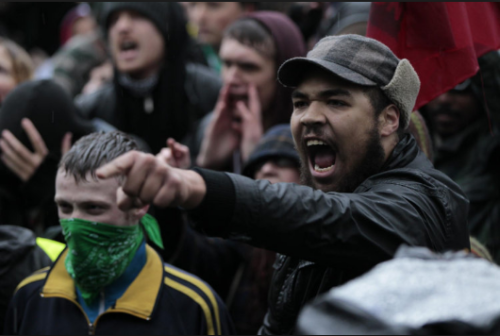
It’s evident from the body language of virtue signallers that they exult in the feelings of moral superiority provided by their aggression

It’s possible to become addicted to a wide range of different thrills. Adrenaline, oxytocin, endorphins, dopamine and a slew of other neurotransmitters all create a very specific kind of pleasurable buzz that a person can easily become hooked on. This essay examines the most fashionable addiction in current year: the addiction to moral outrage.

Moral outrage belongs to the class of ego thrills. Within this class are all actions that lead to pleasure on account of letting you think, even if only for a short moment, that you’re better than other people. Belonging to this class are a large number of activities relating to competition and domination.

Alchemically speaking, there are three ways that one person can dominate another person, and these correspond to the three orientations of bravery. One can dominate physically, one can dominate mentally, or one can dominate morally.

Dominating physically is generally looked down upon as an activity befitting children and thugs. Dominating mentally is the obsession of the young adult learning to be a man of silver, and incredible amounts of energy are expended to this end at universities, but most people soon grow out of that.

Dominating morally is where the real self-aggrandisement comes into play, because if this can be achieved then the other forms can be dismissed as less worthy or meaningful. It doesn’t matter if someone dominates you physically or mentally, because you can claim that the act of domination is itself immoral by virtue of being aggressive, and that therefore you, in fact, dominated them where it counts – morally!

As it happens, the modern world gives us plenty of opportunity to get a kick out of moral outrage. So much so that some people may have become clinically addicted to the thrill. Much like smoking cigarettes or snorting cocaine, working oneself into a towering moral fury has a near-immediately gratifying payoff and is therefore more likely to become habitual.

Signs of addiction can be seen in the compulsive bleating of “Racist!” whenever someone criticises a group of people that contains some black or brown individuals. Here, the person getting a buzz off moral outrage doesn’t bother to wait to make sure that the person they’re attacking really is a racist, because that might mean that they don’t get to accuse anyone and so don’t get the buzz.

Other signs include getting outraged at things that are entirely natural, such as the gender pay gap. Taking something that’s clearly the result of female choice and spinning it to make out like there’s a massive anti-female conspiracy to drive down wages is the kind of thing that could get someone a diagnosis of paranoia in other contexts, but when politics are involved no pile of bullshit is too high.

In truth, moral outrage is a form of bullying. It’s a way of running another person down because of their perceived lack of virtue, and this moral shaming is little different to shaming someone for being fat, poor or slovenly. The main distinction is that it is more passive-aggressive than physical bullying.

The driving force behind moral outrage is a combination of slave morality and mob mentality. The slave morality is always a feature because people susceptible to moral outrage have inevitably been told what their morals are, and usually told early enough in life that, by adulthood, they’re convinced their behaviour is natural. The mob mentality, likewise, is always a feature because people need to whip each other up into a frenzy to generate the self-righteousness necessary for a truly gratifying state of moral outrage.

The question then arises: should crude expressions of moral outrage be banned, or at least socially discouraged? It’s possible to combat them by making the virtue signaller look bad themselves.

For instance, virtue signallers shrieking “Racist!” when they hear criticism of Islam could be discouraged by being told how stupid they are for not being able to see the difference between dislike of a religion and dislike of a race. After all, the two concepts are radically different – the first is a meme complex, the second is a gene complex. It could fairly be pointed out that someone unable to tell the difference is pretty thick.

Even better, when someone is aggressively expressing their moral outrage at you, is to ask that person if they think they’re better than you on account of their beliefs. Of course they think they are, which is why they’re outraged in the first place – but if they admit that, they immediately lose their moral high ground on account of confessing to egotism.

*

If you enjoyed reading this essay, you can get a compilation of the Best VJMP Essays and Articles of 2017 from Amazon for Kindle or Amazon for CreateSpace (for international readers), or TradeMe (for Kiwis).

21st Century Christianity and Its Manifestations

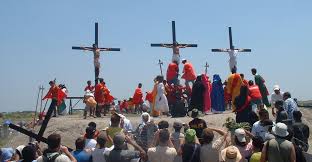
Opinions on how to treat homosexuals wax and wane with social fashion, but masochism is an eternal element of Christianity

Christianity hasn’t died yet, and it never will, for there will always be a niche for slave morality anywhere there is interpersonal conflict. Fittingly for the receptive, yielding principle that it represents, Christianity has morphed into a near-infinite variety of different doctrines depending on the time and place in which it was trying to be relevant. This essay examines the characteristics of 21st century Christianity.

The sort of person who finds themselves attracted to a slave morality such as Christianity remains the same as ever, much like human nature itself. Their essential characteristic is resentment, and their essential motivation is the destruction of that which inspires envy in them. They are like pathological horizontalists, who want to level every dominance hierarchy out of resentment for not being able to climb them.

The Christianity of our century has found an equivalent for all of its ancient tenets and dogmas. For instance, in this new manifestation of Christianity, America are the Romans. Representing the men of iron, America has a vast military empire that brings humiliation and subjugation to its rivals. Anything that happens in the world, no matter where and no matter who to, can be blamed on American influence.

An Islamic suicide bomber who walks into a mosque in Pakistan and kills a hundred other Muslims has nothing to do with America. But neo-Christians will say that it’s still America’s fault because they “destablised” the country somehow, or because America gave money to some unsavoury politician somewhere alsong the line, or because the CIA financed the bomber, or equipped the bomber etc.

The neo-Christians rarely know anything about the Sunni-Shia divide and how murderous it has become. They don’t appreciate that a Muslim has a hundred times more to fear from a fellow Muslim than he does from the average American. It doesn’t matter to them. All Muslims are low status, and therefore they are elevated above the wealthy, c.f. “The first shall be last and the last shall be first.”

Similarly, the Original Sin is no longer sexual desire, because that has been fully monetised by now. The Original Sin is now racism, with racism being defined as solidarity with white people. All (white) people are guilty (of racism), and all have fallen short of the glory of (the colour-blind) God. We have all had thoughts about how we liked white people better, therefore we are all guilty of Original Sin, and are thereby associated with the Great Adversary of 21st century Christianity: Adolf Hitler.

The only solution for this Original Sin is self-flagellation. However, because corporal punishment isn’t fashionable in the Soy Era, this self-flagellation has to take a metaphysical form, and so the 21st century Christian gets their masochistic thrills from disparaging their own family, nation, race, class etc.

It has to be emphasised that Christianity doesn’t care for material concerns, and it never has. Inherent to Christian dogma is the meme that the cult comes above all other considerations, such as family, nation or class. So it’s natural for the 21st century Christian to say things like “White people have a uniquely brutal history of imperalism and racism.”

It’s therefore no accident that Christian churches are often behind the political impetus to allow hordes of Muslim and African refugees – who will never integrate – into the West. For thing, the Muslims also worship the God of Abraham, so they’re fundamentally on the same side as the Christians anyway, but more importantly, their arrival degrades the strength of the national bonds that people have with each other.

These national bonds are competing paradigms of solidarity to neo-Christianity and therefore have to be attacked so that it can take a central role in everyone’s life. Like its Abrahamic brothers in Islam and Judaism, Christianity is a totalitarian ideology, and it seeks to control every last aspect of the people under its thrall. This is why Jesus is quoted as saying in Matthew 10:34 that “Do not suppose that I have come to bring peace to the earth. I did not come to bring peace, but a sword.”

All other culture must be bulldozed out of the way to make sufficient space for Abrahamic universalism. This belief is as common among the 21st century Christian as is was of the Taliban who erased Afghanistan’s history of Buddhism, or of the Jews who rewrite Western history to glorify themselves and to hide their own crimes. All other bonds of friendship or brotherhood must be smashed, so that the God of Abraham stands unchallenged above the world.

*

If you enjoyed reading this essay, you can get a compilation of the Best VJMP Essays and Articles of 2017 from Amazon for Kindle or Amazon for CreateSpace (for international readers), or TradeMe (for Kiwis).