
Category: cannabis
Why New Zealand is Now Behind Zimbabwe On Cannabis Law Reform

For all the gloating about how incredibly progressive New Zealand is on issues relating to race and sexual orientation, we Kiwis sometimes fail to notice that we are lagging behind the rest of the world on many other human rights issues. Incredibly, New Zealand is more backwards than Zimbabwe now when it comes to cannabis law reform. This essay examines why.
You read correctly: New Zealand is now behind Zimbabwe on cannabis law reform. The despotic Southern African state announced recently that both individuals and companies can apply to the Minister of Health for a licence to grow medicinal cannabis. You don’t have to be dying, as is the criteria in New Zealand.
So how did our human rights decay to the point where Zimbabwe is beating us on major human rights issues like medicinal cannabis law reform?
Crucial to understanding this is understanding that the National Party has always been the pisshead’s friend. When drinkers wanted pub hours extended for the 2015 Rugby World Cup, the National Party was eager to help. But when Kiwi medicinal cannabis users petitioned them for nine years to allow them equal rights to people in California, they were utterly unmoving, despite the evidence in the research journals and from the examples set overseas.
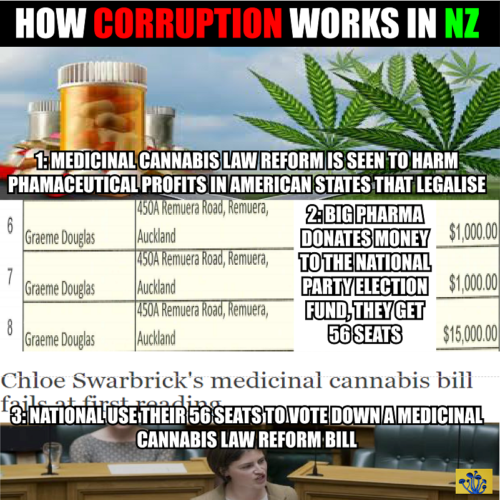
When the Electoral Commission revealed the list of each party’s donations last month, it became clear why New Zealand is now more backwards than Zimbabwe when it comes to cannabis law reform. Simply put, the National Party has whored itself out to the same alcohol and pharmaceutical interests that have opposed cannabis medicine from the beginning.
In 2017, the National Party got $41,945 in donations from Stoneyridge Vineyard, $25,438 from Gibbston Valley Winery, $16,700 from Spirits NZ and $42,000 from Graeme Douglas of Douglas Pharmaceuticals, whose morphine product is competing with medicinal cannabis for the billion-dollar analgesic market. This totals $126,083 in donations from industries that are implacably opposed to cannabis law reform.
The National Party spent around $2,500,000 on their 2017 General Election campaign, which means that these donations are reasonably small in the overall scheme of things, amounting to only c. 5% of the total spending. But this has to be contrasted with the fact that the Aotearoa Legalise Cannabis Party, the only party seriously promoting the will of the 80% of Kiwis who want a change to the cannabis laws, spent less than $1,700.
In other words, anti-cannabis forces spent over 70 times as much on bribing National Party MPs as pro-cannabis forces spent in total during the 2017 General Election. Little wonder, then, that National Party MPs unanimously voted against Chloe Swarbrick’s bill that would have allowed sick Kiwis to grow their own medicinal cannabis at home without fear of prosecution.
This all sounds very cynical but unfortunately, this is how the game is played in politics, which belongs ultimately to the paradigm of silver. Our politicians are literally whores – this is a truth universally acknowledged by anyone who has had cause to observe the politically ambitious at close range for any length of time. They will say whatever someone wants to be said for money, so their tongues are for hire as much as those of any streetwalker.
Despite all that, this situation may not last. The experience of American states that have liberalised their cannabis laws (beginning with medicinal cannabis in California in 1996), suggests that money talks both ways.
East Coast medicinal cannabis operation Hikurangi Enterprises recently raised $2,000,000 in their share offering and were heavily oversubscribed – so much so that the crowdfunding site handling it crashed twice. Considering that most people who are interested in medicinal cannabis are sick and therefore poor, being able to raise two million dollars speaks to a tremendous level of support among the population.
What this means is that, sooner or later, there will be a player with extremely deep pockets who wants to break into the New Zealand cannabis market, and this player will see fit to make a “donation” to a reformist party in return for that party supporting some form of repeal of cannabis prohibition. It will probably be a while before this donation matches the six-figure sum that the booze and pills industries are spending on keeping medicinal cannabis illegal, but the gap ought to keep closing.
New Zealanders have fewer rights to access medicinal cannabis than people in Zimbabwe, and the reason for it is alcohol and pharmaceutical industry bribe money going to the National Party. Until we can remove this blatant corruption from our political system, sick Kiwis can only access their medicine in secret.
*
Vince McLeod is a former Membership Secretary of the Aotearoa Legalise Cannabis Party and author of the Cannabis Activist’s Handbook.
Legalising Cannabis Would More Than Fix The Hole in New Zealand’s Education Budget

Every week the Labour Party goes back on another one of its election promises, claiming that there’s much less money in the budget than anyone realised and so they won’t be able to fund anything: not education, not health, not welfare. What the criminal bullshitters in the Government don’t admit is that they could save 400 million dollars every year, starting tomorrow, simply by legalising cannabis.
The net benefits of repealing cannabis prohibition are no longer disputable. Eight US states now have fully legal cannabis, with further legalisation referendums to come, and no-one has any regrets. According to calculations by the New Zealand Treasury, this country is flushing $400,000,000 down the toilet every year in order to enforce a law that the New Zealand people do not want. That’s no small sum of money.
Education Minister Chris Hipkins has come out and said that there is a $1,100,000,000 shortfall in the education budget. The linked article cites Hipkins as claiming that “Over the next three budgets, $929m was needed to cover the cost of new schools and classrooms and to meet the cost of the Christchurch rebuild. The remaining $166m was needed for urgent remediation and demolition of classrooms and buildings that are unusable.”
In the linked article, Hipkins blames the former National-led Government for neglecting capital spending on educational buildings, claiming that Labour is not going to be able to meet its election promises as a consequence. But it’s absolutely absurd that the Labour Government is crying about funding shortfalls when it’s wasting such an incredible amount of money on conducting a War on Drugs against the New Zealand people.
According to the Treasury’s own calculations, if we legalised cannabis today, we would save $1,200,000,000 over the course of the next three Budgets, primarily through not having to fund the Police and “Justice” Systems to piss all that money up the wall on persecuting medicinal cannabis users. So it makes no sense at all for Labour to cry about a shortage of money when it’s wasting incredible sums on enforcing a law that the New Zealand people don’t want.
A study conducted in Colorado from last month has shown that even if one accounts for the increases in social costs that come in the wake of legalisation, there is still a large net gain to the economy. Moreover, “The researchers found no evidence that legal cannabis contributed to increased homelessness or increased youth use of marijuana.”
There are other costs to cannabis prohibition that don’t fall into the $400,000,000 of damages. By withholding a widely-recognised exit drug from people struggling with opiate addiction, we are literally killing the most vulnerable New Zealanders. Studies of American states that have liberalised their cannabis laws have shown that, given the choice between opiates or cannabis, many people with severe pain disorders prefer to use cannabis. This has led to thousands fewer deaths from opiate overdoses.
It’s absolutely insane that our school buildings are falling into disrepair, our hospitals have mold on the walls, and that our rape crisis centres are being closed down, all because of a lack of funding, when we’re wasting over a billion dollars every electoral cycle on cannabis prohibition. If the Labour Party were any less neoliberal than the National Party they replaced, they would open an honest discussion on the subject with the stated intention of legalising cannabis as Colorado did in 2012.
*
If you enjoyed reading this essay, you can get a compilation of the Best VJMP Essays and Articles of 2017 from Amazon for Kindle or Amazon for CreateSpace (for international readers), or TradeMe (for Kiwis).
Our Mental Health System Shouldn’t Run on WINZ Logic
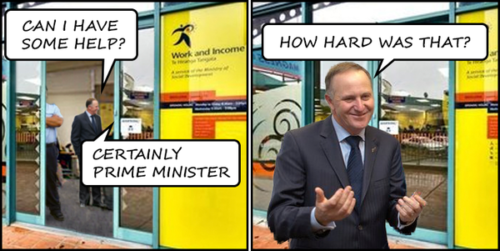
A lot of people complain about the way WINZ treats its clients, but their logic makes a certain sense. By verbally and psychologically abusing many of the people who come to them for help, WINZ staff sharply reduce demand for WINZ services and thereby save taxpayer money. This is called WINZ logic, and our mental health system runs by the same principles.
WINZ logic seems to appeal to the vast majority of New Zealanders. We like to consider ourselves a people who have “hardened up”, and who don’t need faggy things like welfare. Moreover, the high levels of diversity in our society mean that those at the top are unwilling to pay taxes for the greater good, because those taxes won’t be helping people like them. So we make sure that WINZ runs an extremely tight ship, where there is absolutely no wastage.
Somewhere along the way, someone working at WINZ realised that many of their clients could easily be discouraged from seeking WINZ services. Many people who need WINZ services are socially outcast or psychologically damaged, and so they are easily disheartened by abuse. If these people were spoken to like thieving, bludging, malingering scum, instead of being treated like fellow humans who need help, they were less likely to come back and ask for more money.
Ultimately, the essence of WINZ logic is this: the more unpleasant the experience of being a WINZ client can be made, the fewer resources WINZ clients will collectively consume.
With ever-tightening social welfare budgets under nine years of a National-led Government, treating the clients badly became the default way to distinguish between the deserving and the undeserving poor. If someone really needed a benefit, WINZ logic claimed, they’d keep coming back despite the mistreatment. So treating the clients badly achieves the twin goals of saving money while still helping the needy.
Unfortunately, our mental health system works on the same logic. In order to save money, patients are systematically verbally and emotionally abused by support workers. They don’t admit to this, and nowhere is it written that this is official policy, but it’s apparent from collating the experiences of many users of the mental health services that this is the case.
The logic appears to be that it’s better for a hundred schizophrenics to starve in the street than it is for one person to perhaps get a benefit that they didn’t 100% need. After all, a severely mentally ill young person who is unlikely to work again is liable to cost the country up to half a million dollars in benefit payments alone over the course of their lives. If people like this could be convinced to commit suicide instead, the potential savings could run into the hundreds of millions.
This might sound implausible to some, but it’s a natural consequence of neoliberal reasoning. Human life has a dollar value. If mentally ill people can’t contribute to the tax farm, and if we can’t just kill them directly, we have to encourage them to kill themselves. This reasoning was introduced to New Zealand by Ruth Richardson in the 1991 Budget and it’s now an indelible part of our culture. After all, we already have “by far the highest youth suicide rates in the developed world”.
If this wasn’t true, then the experience of being a user of the mental health services would be entirely different. One would be treated much like a person ill with a physical illness – as a fellow human being who had had something unfortunate happen to them and required care in order to recover to normal function. Doctors would answer your questions honestly. Consultations would work towards improving your mental health rather than merely assessing your work readiness.
Further evidence for this comes from the refusal to acknowledge cannabis medicine. Despite the fact that there was enough evidence for the medicinal value of cannabis for California to make it legal already in 1996, New Zealand politicians and doctors still have their heads up their arses. Now even Zimbabwe has legal medicinal cannabis.
What this approach to cannabis tells the mentally ill in New Zealand is that the mental health system isn’t really interested in helping them. It’s just: “Take these sedatives and get back to picking cotton.” It wouldn’t matter if 100,000 people all lined up to tell doctors that cannabis had helped them sleep or had helped with anxiety, depression or suicidal ideation. No-one’s listening, no-one cares.
Our mental health system shouldn’t run on the WINZ logic of withholding aid to as many people as possible. It should be recognised that an investment in a person’s mental health now will have excellent returns in both their future productivity and future unwillingness to use mental health services. The emphasis should be on treating them well so that they can get better and we can save money over their lifetime, not treating them like shit to save money this month.
*
If you enjoyed reading this essay, you can get a compilation of the Best VJMP Essays and Articles of 2017 from Amazon for Kindle or Amazon for CreateSpace (for international readers), or TradeMe (for Kiwis).