
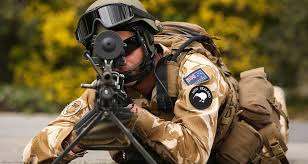
New Zealand is a Military Outpost Masquerading as a Country

New Zealand: plenty of money for guns, no money to feed kids

Many of the decisions made by New Zealand politicians are baffling to the average Kiwi. How can it be possible that we can find $400 million a year to enforce cannabis prohibition, which the people don’t want, but we can’t find $100 million to feed our own children, which the people definitely do want? This essay explains why so many of these decisions are made: New Zealand is not a real country, but a military outpost masquerading as one.

Key to understanding this is understanding the guns and butter model of government spending. Essentially, we can measure the degree to which a government acts as a steward of its people – compared to using them as tools to achieve the economic ambitions of the ruling classes – by measuring how much of the nation’s production is diverted to consumer goods as opposed to military goods.

Understanding this helps explain why our Government would approve a $20 billion military spending bill while rejecting a $100 million proposal to feed hungry New Zealand children.

Why is buying weapons two hundred times more important than feeding our own children?

The answer is grim, and dark. New Zealand isn’t really a country, in the sense that other countries are countries. We’re not an association of families that formed a tribe and then met other tribes to form a clan and then made peace with other clans to form a nation. Most of us just washed up here, many of us without the consent of the people who already lived here.

It’s obvious that New Zealand itself has no need to spend $20 billion on armaments, any more than Iceland does. But to think like this is to commit the error of seeing New Zealand as an actual nation, whose will is that of individual New Zealanders and made manifest through its leaders, like European nations. That isn’t how it is.

The accurate way to conceptualise New Zealand is as an Anglo-American military outpost in the South Pacific, something like a forward operating base for moneyed interests that mostly operate out of the City of London, who have enslaved the New Zealand population by way of a debt-based central banking system.

Most Kiwis don’t understand the geostrategic importance of the archipelago they live on. It’s very easy to look at a static map and think that New Zealand is a long way from anywhere, and therefore that it can’t have much strategic value. This way of thinking reflects a myopia that’s typical of New Zealanders. The truth is much more involved.

Firstly, whoever controls New Zealand controls Australia, in effect, because controlling New Zealand enables one to project force into the East and South of Australia, which is where all the people live. The Japanese Empire realised that landing an expeditionary force in Northern Australia and then marching to Sydney was not practical, and so their Imperial Navy’s invasion plans assumed a prior invasion of New Zealand. It just makes sense.

Secondly, whoever controls Australia controls Asia. This is because Northern Australia serves as a staging ground for the projection of power into South Asia, in particular naval power into the South Asian Sea, which is necessary in order to keep the main sealanes open (and therefore the global economy humming). Given that the Anglo-American Empire already has effective bases in Japan and the Philippines, being able to project power into the Southern South China Sea is the last piece of the puzzle.

Seen like that, it’s obvious why the New Zealand Government would vote for guns sooner than food for its own children. Because New Zealand isn’t a real country, there’s no incentive for the Government to act in the interest of increasing the well-being of its people – the Government doesn’t represent those people. New Zealand is first and foremost a military outpost run by imperial interests, and as such the mental health of its citizens is far from the top priority, as evinced by our OECD-leading homelessness and youth suicide rates.

If growing up poor, scared or traumatised means that a person will be more useful in a military capacity, then that is what the Government will encourage. Inequality correlates positively with psychopathy, with America being the obvious example. The rulers of New Zealand have also calculated that an underclass of poor and desperate people will make it much easier to recruit the necessary numbers for a professional volunteer armed force, and have structured society accordingly.

Hermann Goering once said “Guns will make us powerful; butter will only make us fat.” Understanding this sentiment is the key to understanding the spending decisions of the New Zealand Government.

The New Zealand ruling class is simply not interested in keeping the population in good physical or mental health, which is why nothing is ever done about our suicide rate or housing crisis. All that matters is keeping the population in a state of war readiness in case it should later be necessary to use them to achieve some geopolitical objective.

The cannabis laws follow the same principle. Every idiot knows that it’s worse for the people to have alcohol legal than to have cannabis legal, given the plague of violence, sex crimes and drunk driving deaths that follow in the wake of alcohol use. So why have that legal, while criminalising a recreational alternative that doesn’t make people aggressive, impulsive and violent? The answer is, sadly, because our ruling class wants broken, damaged, fearful and violent people.

Unfortunately for us, the reason why New Zealand is not run along the lines of Switzerland or Japan or even South Korea is because our supposed leaders are beholden to foreign interests. We are not an independent nation, and we will never be, for our independence would pose too great of a threat to the military position of the Anglo-American Empire. Kiwis are, as Dwight Eisenhower put it when he warned us of the Military-Industrial Complex over 55 years ago, hanging from a cross of iron.

*

If you enjoyed reading this essay, you can get a compilation of the Best VJMP Essays and Articles of 2017 from Amazon for Kindle or Amazon for CreateSpace (for international readers), or TradeMe (for Kiwis).
The New Zealand Government Has Been Separating Children From Their Cannabis-Growing Parents for Decades

This is no worse than what our own Government is doing to us

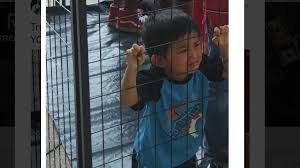
Today’s mass media assault on consciousness involved emotional images from America of Mexican children in cages. The ensuing outrage was based around the fact that when a Mexican family is apprehended crossing the American border illegally, the children are temporarily separated from their parents. Although this is regrettable, what the media is ignoring is that the New Zealand Government has been doing the same thing to its own citizens for decades.

For one thing, it’s standard practice for the New Zealand Government to separate children from their parents if those parents are going into custody for breaking the law. In this regard, the New Zealand Government’s normal actions are no better than what the American Government is doing. Even worse than this is the fact that many of those parents are going to jail for offences that don’t harm anyone, unlike (arguably) illegal immigration.

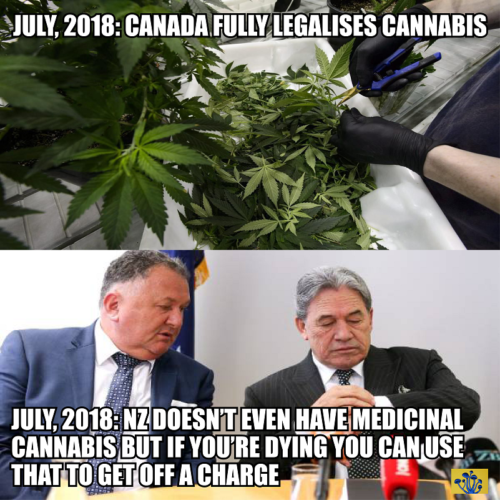
The fact that cannabis is a medicine is a fact near enough to universally acknowledged by the young people of the world, even if Baby Boomer politicians have been slow to understand it. However, cultivation of it remains a crime punishable by up to seven years imprisonment in New Zealand, despite that the plant has a wide range of medicinal effects and is used all over the country to alleviate needless suffering.

Because cannabis is so good for alleviating suffering – taking away pain, nausea, insomnia among other maladies – people continue to grow it, despite the law. But because of the law, a significant number of these people end up being apprehended by Police and sentenced to prison.

Many of the medicinal cannabis growers who have been put in prison over the past 40 years have had children. Those children were forcibly separated from their parents by the New Zealand Government for the sake of enforcing a law that should never have been a law.

So all the perfectly natural dismay that Kiwis have been induced to feel at what the Mexican children at the American border are forced to endure – a traumatic forced separation from their parents as a consequence of an arbitrary law enforced by armed men – could just as well arise as a result of thinking about what Kiwi children have to go through as a result of cannabis prohibition.

In fact, our own children have it worse, because they will often not get to see their parents again for a long time.

So if people in New Zealand are going to get upset because of an outrage that the global corporate media manufactured in order to target a conservative American President, let’s get equally upset about similar and equally evil actions in New Zealand.

Every time a New Zealander gets put in prison for a cannabis offence that has harmed no-one, leaving a child on the outside who is now missing a parent, we ought to react with the same outrage towards our own Government as we had today for the Trump Administration. If we’re going to expend energy on outrage let’s at least direct it somewhere where it can do some good.

*

If you enjoyed reading this essay, you can get a compilation of the Best VJMP Essays and Articles of 2017 from Amazon for Kindle or Amazon for CreateSpace (for international readers), or TradeMe (for Kiwis).
Can North Korea Teach the West How to Have A Humane Cannabis Policy?

Our media has been giving us the Two Minute Hate about North Korea for over two decades. Anyone who has read 1984 knows that most of the reason for this is to distract from the crimes of our own politicians and industrial leaders. One of these crimes is the War on Cannabis: Western Governments could learn from the North Koreans how to have a humane, honest and fair cannabis policy.

For the past 40-50 years, Western Governments have conducted a War on Drugs against their own people, without the consent of those people. Trillions have been spent during these decades to persecute tens of millions of Western citizens, many of whom had not caused any harm to anyone. This mass human rights abuse – because that’s what it is – continues to this day, despite small wins for the people in some areas.

This War on Drugs has been justified with a rhetoric so clumsy and corrupt that even a 1930s-era propagandist would be embarrassed by the lack of subtlety. From the infamous “Reefer makes darkies think they’re as good as white men” to “Cannabis use causes psychosis” to today’s horseshit stories about how buying cannabis is supporting Mexican narcoterrorism, no more hamfisted effort has ever been made to sell anything.

For roughly half a century, Western families have been ripped apart from having one of their family members sent to prison for a cannabis offence. Tens of millions have been forced into a traumatic encounter with the Police and justice or prison systems, treated as criminals when most were mentally ill and needed help. In America in 2016, there were 574,641 people charged with the crime of simple cannabis possession.

One would expect then, that the punishment for cultivating cannabis in a place as fundamentally evil as North Korea would be horrifically draconian and senseless. If it’s up to seven years imprisonment in New Zealand it must surely be life in prison or even execution there.

To the contrary – far from scheduling cannabis as belonging to the most dangerous category of addictive drugs with no medicinal value as America does, North Korea doesn’t even consider cannabis a drug. Not only are people free to cultivate it without sanction, but it grows freely by the roadside in many places, being a weed and not being subject to eradication programs. North Koreans are free to harvest and smoke it every single day – and they do.

Many would personally be happy to trade all the supposed Western freedoms to drink booze, watch television and chase loose women for the freedom to smoke cannabis, have quality conversations with intelligent people and at the end of the night still be capable of maintaining an erection. So one has to ask: who’s actually better off?

The thawing of relations between the West and North Korea might have implications for cannabis policy in the West. Those Westerners who are still labouring under primitive superstitions such as “cannabis causes brain damage and therefore people should go to prison for it” might learn something from the more enlightened approach taken by the North Korean Government.

Perhaps North Korea could send advisors to the West to educate our politicians about how large industries conspired to make cannabis illegal for the sake of wiping out a competitor, and that keeping it prohibited is actually an immoral thing to do. These North Koreans could also be tasked with going through our Police and justice system employees to root out the sadists who believed that imprisoning someone was ever a fair or reasonable response to drug possession, because they are morally defective and cannot be trusted to serve the public.

*

If you enjoyed reading this essay, you can get a compilation of the Best VJMP Essays and Articles of 2017 from Amazon for Kindle or Amazon for CreateSpace (for international readers), or TradeMe (for Kiwis).