

The Case For Cannabis: A Criminal Record is A Disproportionate Punishment

Cannabis possession or cultivation are currently crimes, which means that a criminal record is a common result from being arrested for a cannabis offence. Our justice system, however, is supposed to operate on the principle that “the punishment fits the crime”. This article will argue that getting a criminal record for anything to do with cannabis is grossly disproportionate, considering the severity of the crime.

Having a criminal record makes a person’s life a lot harder. Many employers will filter out applicants with criminal records before they even seriously consider them. This is true of almost every job that requires any real responsibility. This means that a future of poverty, or at least severely limited economic opportunities, is a common consequence of getting a criminal conviction.

Of course, having a criminal record is supposed to make people’s lives harder. A criminal is a person who has declared that they are unable or unwilling to abide by the rules of decent society, and it’s fair that they’re marked as such for the safety of other people. We’re not allowed to chop people’s hands off anymore, so there’s no other way to clearly mark a person as a member of the criminal class other than to give them a record.

The problem is that cannabis use isn’t a crime like a real crime is. Real crimes have victims. It’s fair that a criminal record marks a person who has acted with gross disregard or malice towards life and towards suffering. But a person who grew some medicinal cannabis plants has not shown any callousness or ill will. If anything, they should be rewarded for taking actions to alleviate suffering in the face of discouragement from the law.

Becoming unemployable because of a criminal record is one thing if you are a murderer, rapist or fraudster. In cases like these, it’s probably fair for the vast majority of employers to rule such people out from the beginning. But a person who used cannabis, even if they grew it, has not done anything to warrant being placed in the same class as those who have callously brought harm to others.

In any case, that’s not where the punishment ends. Most fair people can agree that it’s unnecessarily brutal for a person with a cannabis conviction to have trouble finding work for the rest of their lives, but it’s also extremely hard to travel with a criminal conviction. Many countries – Canada and America among the most notorious – regularly refuse to let people in if they have a criminal record, reasoning that they have failed to demonstrate sufficient good character.

These two punishments tie in with each other. Many jobs nowadays involve international travel, and this pattern looks set to continue as the world continues to globalise and integrate. This means that, in order to be able to perform an increasing number of jobs, one needs to be free to travel internationally. A person with a criminal conviction preventing them from travel is effectively disqualified from all of these jobs.

Forty years ago, when the War on Drugs was just ramping up, the sort of person who got a cannabis conviction probably wasn’t likely to travel overseas anyway. But in 2019, being restricted from overseas travel for life is a heavy punishment indeed.

It’s worth noting here that a criminal record also affects the wider family. An adult whose employment and travel opportunities are restricted will have trouble providing not only for themselves, but also for their families. So the children of people who grow up with cannabis convictions are also punished.

All of this constitutes obscene cruelty, especially when it is considered that cannabis is a medicine, and that most people who grow it do so to alleviate suffering.

It was once – falsely – believed that cannabis caused a lot of harm. When it was thought that cannabis was a dangerously addictive drug that destroyed peoples minds, then giving someone a criminal record for cannabis may have made some vague kind of sense. Now that we know that cannabis prohibition was built on false premises, it is apparent that giving someone a criminal record for dealing with it is unfair.

In this case, the correct thing to do is to formalise this state of affairs, and as soon as possible, by repealing cannabis prohibition. We can no longer, in good faith, argue that giving someone a criminal conviction is a punishment that fits the suffering caused by the supposed crime.

*

This article is an excerpt from The Case For Cannabis Law Reform, compiled by Vince McLeod and due for release by VJM Publishing in the summer of 2018/19.

The Case For Cannabis: Law Reform Would Bring Sense to Workplace Drug Testing

One of the worst things about cannabis prohibition is not that it gives people to opportunity to mistreat each other, but that it coerces them into doing so. The fact that cannabis is illegal means that people are essentially forced into taking particular measures when they come into contact with it. These measures often unfairly impact a number of people, which is another reason why the cannabis laws ought to be changed, as this article will examine.

Right now, in many places across the West, there is a common but extremely cruel phenomenon taking place. It is that of all of the people losing their jobs because of being forced to take a urine sample at work, and having it turn out positive for cannabis.

The logic goes like this. Many jobs, in particular those involving the operation of heavy machinery, cannot be performed safely by those under the influence of drugs. This goes for not only alcohol and cannabis but for many other substances. These jobs require a sober mind, because anyone not sober could easily kill themselves, someone else, or do millions of dollars worth of damage.

Fair enough. But because it’s not always possible to rely on a person to come to work sober, some insurance companies, as a condition of granting insurance, make it necessary for the company seeking insurance to perform drug tests on their employees so that they can remove the ones who are working under the influence of some drug, thereby making the workplace safer.

This is fair-ish, but where it truly crosses the line into unfairness is the fact that instead of testing for cannabis impairment, the urine tests test for the presence of certain metabolites that are present in the urine if the person has used cannabis at some point in the recent past, perhaps even 30 days (or more). So the urine test can only determine if you have used cannabis recently, not whether you’re impaired at the time of the test.

This means that “failing a drug test” has got little to do with whether or not your ability to do your job safely was impaired. Many people who get fired for failing a drug test are not even impaired at the time the test was taken. So a lot of people are getting discriminated against, unfairly, on account of cannabis use that probably isn’t even affecting their ability to perform their work duties safely.

In many cases, the employer is perfectly fine with this arrangement. Any employee who uses cannabis is more likely to be a freethinker and therefore disobedient, or more likely to demand a higher wage. A urine test that reveals both a tendency towards freethinking and evidence of having committed a crime is a perfect excuse to fire someone, but the option shouldn’t be available.

If cannabis became legal, some things would change with regards to this arrangement. Of course, cannabis law reform wouldn’t suddenly make it legal to go to work stoned. Every workplace would still be obliged to meet the same health and safety standards as before. The most likely difference is that it could become possible that any employer drug testing their staff was legally mandated to use swab tests to test for impairment, and not urine tests to test for the presence of metabolites indicating use within the past 30 days.

Generally employers prefer to do a urine sample because it’s cheaper, but if cannabis were legal, an employee might be able to bring a case for unfair dismissal to court if they were fired for the presence of metabolites in the urine. Such a case might well rule that, if cannabis is legal, such an action constitutes unfair dismissal, and therefore the employer is obliged to use a swab test to test for impairment instead.

It could be argued that employers would actually benefit from this policy as well. In the modern workplace, finding staff is harder than before on account of the increased need for training and education. If a person wants to work, there’s no reason why the fact that they smoked a bong two weeks ago should prevent them. The reality is that they’re probably safer than someone who is hungover.

It would be better for everyone for the law to change so that some sanity could be restored to the issue. If cannabis were legal, than the workplace standard would be a swab test for intoxication, not a urine test for the presence of metabolites. This would mean that it was possible to make a distinction between stoned people, who shouldn’t be in certain workplaces, and people who have used cannabis recently, who are no less safe than anyone else.

*

This article is an excerpt from The Case For Cannabis Law Reform, compiled by Vince McLeod and due for release by VJM Publishing in the summer of 2018/19.
The Case For Cannabis: Legalisation Would Not Increase Rates of Cannabis Use

A common prohibitionist double-whammy is to argue that cannabis should remain illegal because, if it were made legal, people would use it more, and because its use is harmful, legalisation would therefore lead to more harm. This article will not argue whether cannabis is harmful (this is done elsewhere), but will simply summarise what the evidence suggests: that legalisation will not increase rates of cannabis use.

It seems intuitively obvious that making cannabis illegal lowers the rate of cannabis use. After all, the whole point of making it illegal was to make it harder to get, and if it were legal people would be able to buy it from shops.

Fair enough, but the statistics show a different story.

The truth is that cannabis cultivation is so common (believed to account for 1% of electricity consumption) that pretty much anyone who wants to get hold of it can, except for times of unusually high demand. This means that the cannabis market is already saturated – and this can be demonstrated with reference to real-world examples.

The most obvious counterpoint to the argument that legalising cannabis will increase rates of use is the fact that rates of cannabis use are not higher in places where it is legal.

In the Netherlands, 8% of the adult population has used cannabis at some point in the last 12 months. This rate is lower than in Australia (10.6%), where cannabis is illegal, and much lower than in New Zealand (14.6%), where cannabis is also illegal. In countries such as Israel and Ghana, the rate of cannabis use is higher still. Cannabis might not be technically legal in the Netherlands, but in practice anyone who wants to buy it from a shop can do so.

If legalising cannabis will inevitably cause rates of use to increase, how can it be possible that rates of use are lower in a place where it is legal, where getting supplied is as simple as walking into a shop? If the link between cannabis being legal and higher rates of cannabis use is so certain, we could expect to see higher usage rates in all the places where it is legal, and lower usage rates in all the places where it is illegal. In reality, any such correlation is hard to discern.

The truth is already known to anyone who has ever been to the Netherlands. Cannabis is easy to get hold of, yes, and the Police won’t harass you for it, that’s true, but the bulk of the population would rather drink alcohol anyway. Cannabis law reform didn’t turn a large number of non-drug users into cannabis users – a small number of alcohol users became cannabis users, and the rest stayed the same.

The absence of a correlation between the legal status of cannabis and the rate of use within a jurisdiction is not the only place that statistics disprove the idea that legalisation will lead to more cannabis use.

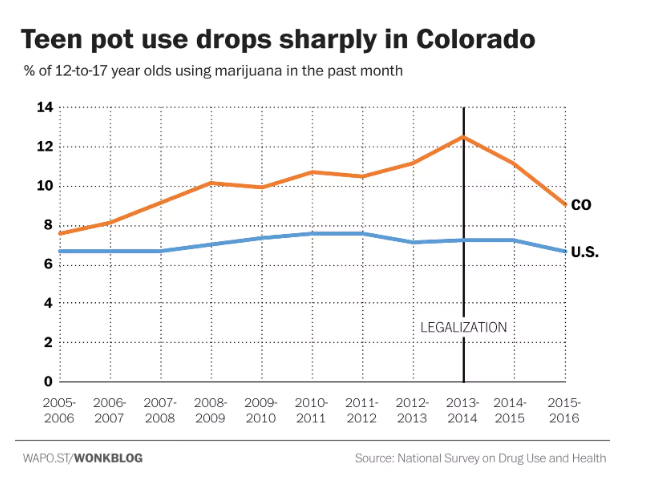
A poll by the Colorado Department of Public Health found that cannabis use rates declined among teenagers after legalisation, with rates of teenage use in Colorado lower than the American national average. Another study, the National Survey on Drug Use and Health, supports the idea that teenage cannabis use rates actually declined after it was made legal.

In fact, the latter study suggests that teen cannabis use rates declined in the majority of states that recently made cannabis legal. It may be, as some have suggested for decades, that the Government lying about the effects of cannabis and exaggerating its dangers was what led to many young people becoming attracted to it. Had there never been an unjust law prohibiting cannabis, it’s possible that the rebellious section of society would never have felt obliged to defy it.

At this point it could be countered that, even if teenage usage rates of cannabis go down, and even if this was the most important thing, adult rates of cannabis use might still increase if cannabis were legalised, and that this might lead to more harm. Leaving aside the fact that this argument has already been countered in the first part of this article, it doesn’t even apply here.

There is little doubt that some people will replace recreational alcohol use with recreational cannabis use if it were legal to do so. Technically, this would mean that the rate of cannabis use would increase, but the rate of recreational drug use would remain the same. Moreover, the rate of harm caused by recreational drug use would decrease if some people replaced boozing with cannabis, on account of that alcohol is more harmful.

Ultimately, the argument that cannabis legalisation would lead to more suffering through increased rates of cannabis use is in error, for multiple reasons. A review of the statistical data shows that cannabis use is not higher in places where it is legal, and also that rates of teen use have declined in American states that have made it legal.

*

This article is an excerpt from The Case For Cannabis Law Reform, compiled by Vince McLeod and due for release by VJM Publishing in the summer of 2018/19.

The Case For Cannabis: Prohibition Makes the Police Less Effective

Of all of the side-effects of cannabis prohibition, one of the most insidious is the suffering caused to the population by decreased bureaucratic and institutional effectiveness. This occurs across a range of Government agencies, but none as severely as the criminal justice system. As this article will examine, cannabis prohibition makes the Police less effective and less able to do their jobs properly.

A lot of successful Police work depends on input from the community, because the Police frequently rely on tips from people who know about crimes. Criminals aren’t always tight-lipped, and sometimes they talk about their crimes when they shouldn’t (especially to women). Many more crimes get solved as a result of someone who knew the perpetrator ratting them out than as a result of detectives finding clues with magnifying glasses.

This is why reports of crimes in the media frequently come with an appeal from Police to witnesses or anyone who knows the perpetrator to come forward. Realistically, this is the best that the Police can do in many cases. It’s easy to see, then, that policing depends on having good relations with the community, and a sense of mutual trust.

If cannabis is illegal, then any individual cannabis user is going to be very wary of the Police, and for good reason. They will be highly averse to having officers come to their house, and will be highly averse to making contact with the Police. After all, they are criminals themselves.

It’s easy to imagine this from the perspective of a cannabis user. Why would a cannabis user who has just witnessed a crime call the Police, when doing so greatly increases the risk that said cannabis user gets arrested themselves? If the Police want to talk to them, then the cannabis user is going to have to present themselves with no sign that they use cannabis, or risk getting arrested.

This makes the Police less effective because they can no longer rely on the voluntary co-operation of cannabis users. Prohibition shifts people who use cannabis from the set of potential Police allies to the set of Police opponents.

This also isn’t the only way that cannabis makes the Police less effective.

A British study showed that one million manhours of Police time was spent every year on enforcing cannabis prohibition. This accounts for all the arrests, all the time spent booking and processing people and the following up of tips. Adjusting for the size of the country, that suggests that somewhere between 70,000 and 80,000 manhours are wasted in this manner every year in New Zealand.

The fact of the matter is that the general Police budget is limited, and the manhours used to enforce cannabis prohibition come out of that general Police budget. So 70,000 hours spent harassing people for cannabis is 70,000 hours not spent following up burglaries, assaults, thefts and the other petty crimes whose enforcement depends on general funding.

In the wake of the Christchurch mosque shootings, it emerged that shooter Branton Tarrant had never had his firearms licence checked by the Police. He had come to New Zealand with an Australian firearms licence and used that to purchase weaponry, and at no point was it ensured that he had his firearms safely locked away, or even that he was in a sound mind to own them.

This is not to argue that the Christchurch mosque shootings would have been prevented if cannabis was legal. The point is that Police effectiveness is a matter of correctly apportioning their limited manhours to enforcing the laws of New Zealand. Should they decide that a certain amount of spending is necessary to enforce cannabis prohibition, then they cannot escape the opportunity cost of not having the funding to fully enforce certain other areas.

Cannabis prohibition should be repealed for the sake of making the Police force more effective. Not only would this allow for a decrease in the mistrust held by sections of the population towards the Police, but it would also allow the Police to expend their resources more efficiently, by freeing up at least 70,000 manhours currently wasted on enforcing cannabis prohibition.

*

This article is an excerpt from The Case For Cannabis Law Reform, compiled by Vince McLeod and due for release by VJM Publishing in the summer of 2018/19.