Good Riddance Jim Bolger, You Evil Bastard

I was overjoyed this week by the news that former New Zealand Prime Minister Jim Bolger finally did something decent and died. Predictably, the hagiographies have already begun to flow, the most absurd of which claiming that he was a champion of the underdog. I want to state the viewpoint from the bottom of society.

I was nine years old in 1990, when Bolger came to power. I supported National in that election because their logo was blue, and blue was my favourite colour. Some of my family voted for him because the television told them to. We soon regretted it.

Because my family was working-class, we were impacted heavily by the reforms of the Fourth National Government. My father abandoned our family when I was two, and so my mother had to raise my brother and I on welfare. This wasn’t much. When Bolger and the Fourth National got in, they gave us Ruthanasia. This involved cutting welfare support, including the Family Support, which was the difference between our family making it and not making it. The stress of balancing the household budget drove my mother into a mental institution a few months after the cuts.

The stress of my mother being in a mental institution caused my own latent psychiatric problems to break out as insomnia. This was at age nine and my nervous system is yet to recover at age 44. There are thousands – perhaps tens of thousands – of us whose lives were destroyed in such ways by Bolger and his government of neglect.

Bolger personified everything evil about Anglos in general and New Zealand in particular: titanic greed mixed with indifference to human suffering. His Fourth National Government taught me that National voters and supporters get off on cruelty. Like a child pulling the wings off a fly, causing harm to the vulnerable makes them feel powerful, and that’s why they do it and will keep doing it.

I do not hate Bolger completely, however, because he taught me a lot of valuable lessons.

The most valuable lesson I learned was my value to New Zealand’s ruling class, which was nil. The Fourth National Government’s utter indifference to the poor, like we were an inconvenience the country would be better off without, is something I never forgot. Thus I have always done what I felt like in my life, with little consideration for wider society. This has not been criminal, but only because I did not want to be a criminal. Many other people I know from families that got Ruthanasiaed (including my own) became criminals. They, like me, reasoned that they don’t live in a society, just a big snake pit, so why not put their own needs above everyone else’s?

Schooling and media, together with government, create the impression that we’re all on one great team, and therefore sacrifices you make for the collective will be repaid by the collective. But in reality we’re cattle on one great tax farm. The system tolerates you as long as you’re paying in, but, when you need a payout, the system would rather you disappeared.

Many people read about events like World War One, and read about how working-class men were fed to enemy machine guns, and assume that things are different now and that no such thing could happen again. Thanks to Jim Bolger, I am aware that the contempt of the ruling class for the working classes is a permanent fixture of politics. The ruling class truly do hate the poor. They would feed us to machine guns tomorrow if they thought they would profit from it.

Thanks to these lessons, I have not been surprised by the actions of other National Party governments. I was not surprised when John Key slashed funding to mental health care, consigning hundreds of Kiwis to deaths by suicide and thousands of others to lives of despair. Neither was it any shock to me when Judith Collins forced the other National MPs to bloc vote against cannabis law reform at the referendum. I knew that the harm caused to medicinal cannabis users was a feature, not a flaw, of cannabis prohibition. And when Luxon got in and cut benefits under urgency, shovelling billions into the pockets of wealthy landlords, it was about what I expected.

Because of my opposition to mass Third World immigration, I am often pegged as right-wing. But, because of Jim Bolger, I have never voted for a right-wing party in my life, and I never will. I will never even vote for a centrist party that I suspect might support National (such as New Zealand First). I may or may not vote for the mainstream left either, but they aren’t automatically ruled out like National and co. are. The thought that my vote might help another Fourth National Government come to power evokes horror.

There is a wave of dark nihilism passing through New Zealand because of Jim Bolger. Many of the under-40s feel that society doesn’t exist, and that life is every man for himself. These people are essentially psychopathic in orientation, and the blame for this lies on Bolger and the harm he caused to this country. These youngsters have just internalised the selfishness of their elders.

*

For more of VJM’s ideas, see his work on other platforms!
For even more of VJM’s ideas, buy one of his books!

*

If you enjoyed reading this piece, buy a compilation of our best pieces from previous years!

Best VJMP Essays and Articles of 2023
Best VJMP Essays and Articles of 2022
Best VJMP Essays and Articles of 2021
Best VJMP Essays and Articles of 2020
Best VJMP Essays and Articles of 2019
Best VJMP Essays and Articles of 2018
Best VJMP Essays and Articles of 2017

*

If you would like to support our work in other ways, make a donation to our Paypal! Even better, buy any one of our books!

The Fourth Acceptance Of Alternative Centrism

The Fourth Acceptance of alternative centrism is the acceptance that the Alternative Right is correct when they speak of the importance of truth.

It’s a broadly accepted truism that truth is the first casualty of war. This is because a propaganda campaign begins as soon as any war does; all sides in the war are forced to do propaganda to maintain morale, to attract allies, and to demoralise the enemy.

The process described in the previous six chapters of this book is war by any other name. The three positions of the Establishment jostle for relative control over the masses, fighting and killing each other to win that control. Eventually they realise that they have more in common with each other than with the masses. So the fulcrum of war shifts: from one of the Establishment against itself, to one of the Establishment against their own people. This is the beginning of totalitarianism.

The process described in the previous six chapters of this book also explains why there are so many lies in modern politics. If the Establishment is waging a war against the people it is ruling over, it follows logically that they are also lying to them. And it does.

The Establishment tells all kinds of lies in shoring up its position in opposition to those they rule over. Everything from the divine right of kings to the need for mass digital surveillance is a justification, however flimsy, of Establishment rule. But all of these narratives serve one singular purpose: to entrench the power of the Establishment at the expense of everyone else.

After a while, the people who have been shut out of the Establishment come together. In the same way that the different people within the Establishment realise they have more in common with each other, so too do the people shut out of the Establishment. Those initially shut out of the Establishment are usually motivated by anger at having been lied to. Hence the Fourth Acceptance of Alternative Centrism is the acceptance of the importance of truth.

For obvious reasons, the Establishment doesn’t admit that it’s waging a war against its own people. But the people figure it out anyway. Perhaps the best ever exposition of the war of the political establishment against its own people is 1984. Orwell’s magnum opus has variously been mistaken as a critique of Communism or Nazism in particular. In truth, it’s a critique of totalitarianism is general.

In 1984, the resistance against Big Brother is similar to the Alternative Right in reality. They are courageous, free-thinking desperadoes. In 1984, nothing happens: O’Brien helps break up any resistance before it can get anywhere. In reality, a variety of outcomes are possible (although it must be noted that most revolutions fail; the Establishment starts with the strongest position and usually wins).

In any case, 1984 describes how the Establishment lies to people about almost everything, reasoning that the more ignorant the people are, the stronger the position of the Establishment. ‘Ignorance Is Strength’ is one of the three mottos of Big Brother. The more lies the Establishment can tell the people, the more confused and off-balance those people are, and the less able to get the sure footing needed to mount a resistance.

The initial formation of the Alternative Right is a reaction against this cathedral of lies.

The Alternative Right is more masculine than the other positions for a variety of reasons. For one, the right itself is more masculine. Order is primarily a male concern. For another, it’s the masculine which is the revolutionary. The feminine tends to be passive and more accepting of tyranny (as has been noted as far back as Aristotle). Yet another reason is that those who stand up against the Establishment are hated, at least initially. So those who first rise up have to be willing to endure hate.

These reasons are why the Alternative Right today is characterised by active clubs. Those reacting to the failure of the Establishment to impose an acceptable order feel the duty to impose that order themselves. Thus they seek to recreate what the Establishment Right should ideally have been: masculine, in the sense of possessing both the ability and the will to impose order upon chaos. The paramilitary nature of active clubs shows they are alternative power structures in embryonic form.

This masculinity is also why the Alternative Right is obsessed with degeneracy, the concept of degeneracy and correcting popular moral philosophy. They aren’t merely looking to reimpose a lost physical order, but also a lost spiritual one. Thus they are metaphysically masculine as well as physically. This quality of masculinity, taken to excess, is why the Fourth Rejection arises.

The metaphysical masculinity is why the Alternative Right has a deep appreciation for occultists, wizards, prophets and knowledge-workers of all kinds. Anyone who seeks the truth with such fervour that they must pay a price is considered a hero. Socrates and Odin are two prime examples here. Getting killed by the Establishment for speaking the truth, as Socrates did, is ultimate.

If the First Acceptance is about the importance of order, the Alternative Right is the reaction to what they consider disorder. The Alternative Right considers that the Establishment is in dereliction of duty, in that they have failed to impose an acceptable level of order. In this sense, the Alternative Right is as much a reaction to the chaos of the Establishment Left as the Establishment Centre is.

Questions of order are why immigration is such a particular sticking point. The most elementary form of order, on the national level, is the national border. The globalist establishment of the West today is running a policy akin to open borders. This has convinced the Alternative Right (primarily) that the elementary order is now lost, which inspires much of their rage. The lies told to maintain open borders policies are particularly infuriating to the Alternative Right, hence why the Alternative Right prioritises truth so highly.

In the revolutionary sense, the Alternative Right has a lot in common with the Establishment Left. This reflects a paradox within both the Alternative Right and Alternative Left: they freely adopt parts of the opposite if they feel like it (a process that leads inexorably to Alternative Centrism). The reason for the shared commonalities is that both the Establishment Left and the Alternative Right are, in a sense, reactions to the Establishment Right. The difference is in the proposed solution: the Establishment Left proposes chaos, the Alternative Right proposes a new form of order.

The Alternative Right also targets many of the same supporters as the Establishment Left: the young revolutionary who wants action and excitement. The “Beefsteak Nazi” phenomenon is a classic example of this.

The Alternative Right doesn’t respect the Establishment Left though, seeing them as dishonest failures who sold out. They see the Establishment Left as claiming to represent the working class, but actually representing a degenerate middle class. The Alternative Right aspires not to wage class warfare, but to be a new aristocracy. They are not ashamed of this and are honest about it.

The uncompromising emphasis on truth, to the exclusion of other considerations, can seem cruel to those of the other positions. Thus, as with the other Acceptances, the Fourth Acceptance leads to the Fourth Rejection. The neo-masculinity of the Alternative Right is countered by the neo-femininity of the Alternative Left.

*

This chapter is from The Alternative Centrist Manifesto, the upcoming work of political philosophy that offers the answers to the political problems of the West.

*

For more of VJM’s ideas, see his work on other platforms! https://linktr.ee/vjmpublishing
For even more of VJM’s ideas, buy one of his books! https://www.amazon.com/author/vincemcleod

*

For more of VJM’s ideas, see his work on other platforms!
For even more of VJM’s ideas, buy one of his books!

Understanding White People For Non-Whites

The vast majority of anthropological studies are written from the perspective of white people trying to understand the rest of the world. This article attempts the converse: explaining to the rest of the world why the white man behaves the way he does. There are four factors which, in combination, make him unlike any of the other races of the world.

Uncivilised

The first point to understand is that whites have not been civilised for very long. Human civilisation (as we would recognise it) began in the strip between Sumer and the Indus Valley some 6,000 years ago. From there, it gradually spread to other places. It took a long time to get to some parts of Europe.

The Greeks may have had high civilisation since Homer, but when their spiritual descendants in the Roman Empire first came to Britain, they found the Britons living in conditions resembling today’s Sentinel Islanders. When Julius Caesar was writing his memoirs about Britain, the inhabitants of Britain knew nothing of writing systems. Today’s Northern Europeans and their descendants (who represent the majority of what the rest of the world understands by “white people”) have only been civilised for a dozen centuries or so.

This has been enough to bring the gifts of civilisation to other peoples and places. As a New Zealander, I deeply appreciate what the white man did to civilise these lands, where mass cannibalism was practiced as recently as 200 years ago. The fact remains, however, that people of Anglo descent have only been civilised for 1,000 years, in comparison to the 5,000+ years of most of humanity.

As a result, the white man is still barbaric in several ways. In several other ways, he isn’t (e.g. attitudes to animal welfare), which complicates things. But the generally warlike nature of the uncivilised man is still present in white people. He can discharge it through watching combat sports or rugby, but, as with blacks, the general violence of whites is permanently simmering just beneath the surface.

Intelligent

Many people attribute intelligence to civilisation. This is completely false. Intelligence is not a conditioned phenomenon but a natural one. In fact, human beings in a state of Nature are at least as intelligent as civilised ones. Intelligence, in actuality, is almost as hereditary as height. Many highly educated and highly motivated people have made immense efforts to increase the intelligence of their offspring, only to fail.

Intelligence, in groups, is mostly a function of the climate in which that group’s ancestors evolved. The general rule is: the colder that climate, the more intelligent one will be. This is the basis of Richard Lynn’s Cold Winters Theory. The only other human populations to have evolved in such a cold climate are the Far East Asians in China, Korea and Japan, who are at least as intelligent as white people. The major difference here is that these populations have been civilised for 4,000 years or so, much longer than the 1,000 years of Northern Europe.

Thus, the white man is both uncivilised and intelligent. This is a rare combination that he shares with the Mongols and few others, as the vast majority of the world’s intelligent races were civilised long ago. So the white man possesses an unrivaled desire and capacity for war, which is why his wars have determined world history for several hundred years, and why he’s at war right now in Ukraine.

Creative

The creativity of the white man has built most of the modern world. His technology has shaped our everyday world. His music, cinema, literature, video games and Internet culture has shaped our minds likewise. It’s hardly an exaggeration to say that it’s a white man’s world, and everyone else is just living in it. This creative energy makes the white man not merely a cunning barbarian but also an extremely powerful one.

This creativity is a combination of the aforementioned two factors. His intelligence gives him the capacity for creativity, and his uncivilised nature gives him the will for it. Asians might share the white man’s capacity for creativity, but seem to be content not using it; once every few centuries, an Asian will build a temple that rivals anything a white could build, but only so often. Africans might share the white man’s will to be creative, but, lacking his intelligence, most African creations are childish and without value. Thus, the white man’s level of creativity is highly unique.

This creativity also makes the white man, from the perspective of others, a highly chaotic element. Non-whites (with some exceptions) are generally happy to run empires that don’t change much for hundreds of years. The white man is not. He is not even satisfied with creating the United States. Elon Musk, perhaps the world’s foremost current representative of the white race, dreams of going to Mars. Other races can’t predict what the white man will attempt next.

Spiritually lost

White people gradually lost their religion after Paul. The degeneracy of the Roman Empire led to multitudes of abandoned, neglected wretches. In their hate, these wretches turned to Paul’s slave religion, which promised their enemies in the Roman Establishment would be brought low. As the degeneracy spread, the Roman Empire gradually succumbed.

The death blow came with the treason of Theodosius in 380 CE. With the conversion of the Roman Empire to Jewish religion, the rest of Europe gradually followed over the next 1,000 years, a time known as the Dark Ages. European scientific and artistic culture returned with the Renaissance, but unfortunately the spiritual culture remained stymied by the Clown World Fork: only soulless atheism or mindless Christianity have been permitted. Neither has been close to fulfilling.

Absent a fulfilling religion, the white man possesses a hunger that he cannot satiate with material goods. But he tries. This lust for material goods inspired all of his colonial activities and inspires his colossal levels of consumption. Despite all this, he remains unhappy, like a hungry ghost.

Pharmaceuticals are now a USD40,000,000,000 global market annually, most of which are consumed by the white man in trying to escape his existential misery. But until such a time as the white man rediscovers his ancient spiritual traditions (or adopts a new one, such as Elementalism), he is lost and will suffer, and will cause those around him to suffer.

Conclusion

The white man is currently the main character of history, in the sense that he holds the initiative of history, the Spear of Destiny. Thus, the rest of humanity is reacting to him. However, the white man doesn’t know what he’s doing. Until he rediscovers a genuine spiritual tradition, he will remain a chaotic, powerful and dangerous element on the world stage.

*

For more of VJM’s ideas, see his work on other platforms!
For even more of VJM’s ideas, buy one of his books!

*

If you enjoyed reading this piece, buy a compilation of our best pieces from previous years!

Best VJMP Essays and Articles of 2023
Best VJMP Essays and Articles of 2022
Best VJMP Essays and Articles of 2021
Best VJMP Essays and Articles of 2020
Best VJMP Essays and Articles of 2019
Best VJMP Essays and Articles of 2018
Best VJMP Essays and Articles of 2017

*

If you would like to support our work in other ways, make a donation to our Paypal! Even better, buy any one of our books!
The Third Acceptance Of Alternative Centrism

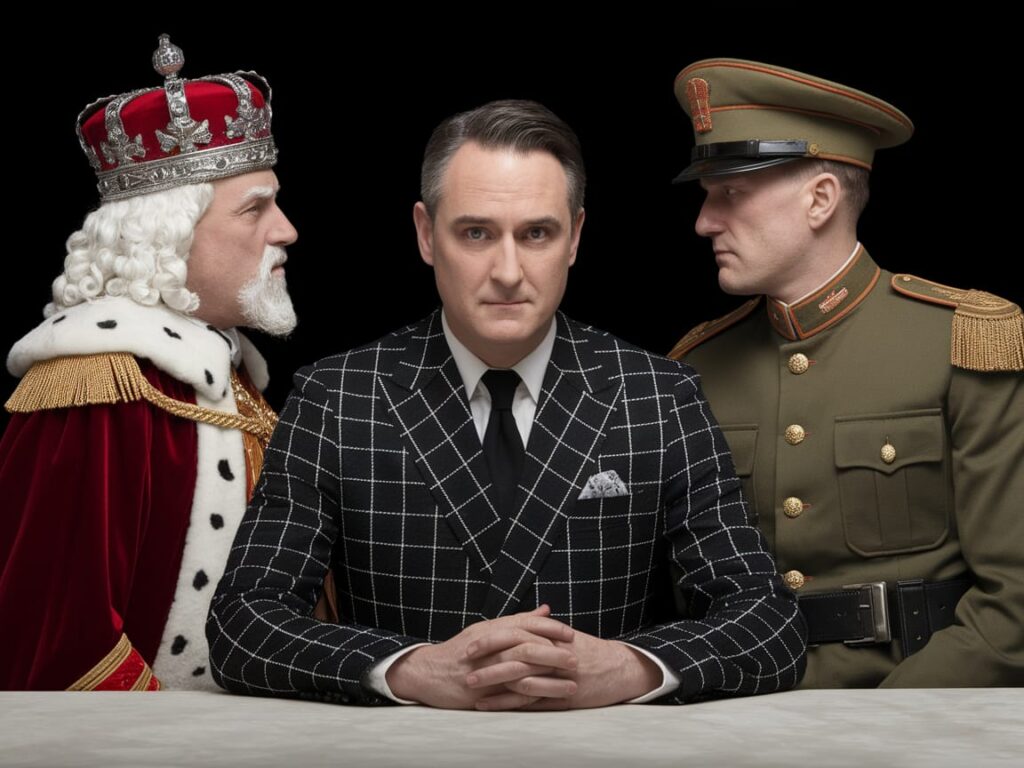
The Third Acceptance of alternative centrism is the acceptance that the Establishment Centre is correct when they speak of the importance of peace.

The Establishment Right and the Establishment Left love to fight. Both feel that they have a legitimate right to rule and are willing to assert that right with force. Thus, much of the march of history is one ruling class fighting a would-be ruling class, back and forth, over years, decades and centuries. Whether it’s nations or classes doesn’t matter. The war to impose order and to be free from someone else’s imposed order goes on and on. Without a peacemaking force that brings both sides to the negotiating table, either side will escalate conflict as soon as they perceive themselves to have an advantage.

This leads to endless war. The logic of extremism is war – the more extreme, the less room for negotiating, thus the more force and aggression. Both the Left and the Right see the will to negotiate peace as weakness. But without peace, nothing gets built, everything gets destroyed. If the Establishment Right and the Establishment Left were the only players in history, it would be a never-ending battlefield, where peace was only achieved by the strong and even then was always temporary. They would lay waste to every facet of civilisation in their fervour to get an edge over the enemy.

When the major political forces act like this, no-one can be wealthy. All wealth is commandeered for the various war efforts, and then destroyed in the war itself. Bombings, artillery strikes and battles destroy buildings and infrastructure. Medical costs from war are extreme, and wounded veterans are much less likely to go on to produce an economic surplus. And of course dead people can’t produce any wealth at all.

Worst of all, the infighting risks that one gets conquered by outsiders. Outside forces that would steal a nation’s wealth take notice when that nation’s Establishment Right and Left are fighting each other. They then swoop in to wipe out the survivors.

This process leads to the rise of the Establishment Centre. The Establishment Centre is not interested in arguments about how the Establishment Right represents quality (or order/stagnation) and the Establishment Left quantity (or freedom/chaos) and blah blah blah. They have little time for the abstract, let alone the metaphysical. They are immensely practical – and equally godless.

The really good thing about the Establishment Centre is that they succeed in getting the other wings of the Establishment to agree on the value of peace, and thereby to negotiate instead of fight. In so doing, they end the cycle of violence between those two wings. This gives them a very special role in the historical development of human society. If the Establishment Centre can negotiate peace between the other wings of the Establishment, prosperity inevitably follows.

Solon might have been the first Establishment Centrist in Western history. He was brought to power at a time when there was immense discord between the wealthy and the poor in Athens. The city-state was on the brink of civil war on account of widespread debt slavery. Both sides trusted him to be an impartial arbiter between them.

The genius of Solon was that he was able to find an acceptable balance between the excessive order of his predecessor Draco, and the excessive chaos of the disadvantaged who wanted to redistribute everything. This did not satisfy the extremists on both sides, but it satisfied enough of the moderates of both sides that they agreed peace was better than further conflict. The influence of Solon’s reforms led directly to the Golden Age of Athens, and he is remembered as one of the Seven Sages of Athens.

The Third Acceptance, then, accepts that peace is more valuable than either excessive order or excessive freedom, and that peace is usually best found by finding the right balance between order and freedom. This Third Acceptance is the key to understanding why the Establishment itself is so enduring – its centre acts to correct any excesses that might form in either wing, so that the overall edifice remains balanced.

In today’s modern democracies, the Establishment Centre often ends up taking control by virtue of controlling the balance of power. Because the most stubborn, irrational and antisocial elements drift to the wings (this is as true of the Alternative as it is of the Establishment), the Establishment Centre often finds itself with more reasonable and intelligent people than either wing. As such, they often come to be seen as the natural leaders of the Establishment.

In New Zealand, this phenomenon is seen with Winston Peters, leader of the pseudo-nationalist New Zealand First party. As an Establishment Centrist, he often finds himself holding the balance of power with 6-7% of the vote. This means that he can play the Establishment Right and Establishment Left off against each other to get the best deal. It also gives him veto power over the makeup of the government. This position in the centre is so powerful that, even after 30 years of broken promises and sleaze, he still cannot be dispensed with. European countries with similar systems often have similar problems.

The phenomenon is not as obvious in America and Britain, because America has a two-party system and Britain has a First Past the Post-style system. Consequently, the largest party in any general election in either country seldom has to rely on the support of the Establishment Centre. It could be, and has been, argued that such an arrangement is inherently unstable and leads to warmongering (the history of America and Britain since the founding of the Federal Reserve certainly supports this argument).

The Establishment Centre, in whatever time and place, is usually full of merchants. If no aristocrats are available to stop the timocrats from fighting, the oligarchs have to step up and find the way to a peace agreement. The Right and the Left might criticise the merchantry as unprincipled, but the merchants themselves would counter that firmly-held principles lead only to bloodshed. Better for everyone to just chill out and trade.

Generally this arrangement has indeed brought peace. It could be argued that historical examples of lengthy peace were often examples of times when the Establishment Centre was in charge. The times of the greatest expansion – and profits – of the British Empire was the time inbetween the Napoleonic Wars and World War I, when men like Nathan Rothschild had the greatest influence. After World War II, another lengthy peace followed the Establishment Centre’s assertion of liberal democracy.

The alternatives to the Establishment Centre finding peace are continual crackdowns and oppression under the Establishment Right, revolutionary chaos under the Establishment Left, or endless warfare under them both. So the Establishment Centre often ends up coming to power, as Solon did, with a mandate from the rest of the Establishment to negotiate peace. The Third Acceptance accepts that this process is natural and good.

There is a problem with eternal peace, though – it leads to the Establishment coming together against the people. This is a unique form of corruption that manifests as degeneracy. It is this process of degeneration and its results that are rejected by the alternative centrist in the Third Rejection.

*

This chapter is from The Alternative Centrist Manifesto, the upcoming work of political philosophy that offers the answers to the political problems of the West.

*

For more of VJM’s ideas, see his work on other platforms!
For even more of VJM’s ideas, buy one of his books!

*

If you enjoyed reading this piece, buy a compilation of our best pieces from previous years!

Best VJMP Essays and Articles of 2023
Best VJMP Essays and Articles of 2022
Best VJMP Essays and Articles of 2021
Best VJMP Essays and Articles of 2020
Best VJMP Essays and Articles of 2019
Best VJMP Essays and Articles of 2018
Best VJMP Essays and Articles of 2017