
Writing Characters of Silver

The fifth element from the bottom of the spiritual hierarchy is silver. This is the stage a character reaches when they have enough spiritual energy to begin to shine. A person enters the realm of silver once they start to value non-physical treasures. In doing so, they make it possible for people to co-operate on a level above that of the family.

The lustrous nature of silver is what gives it its greater value. Like copper, silver has also been used as a currency for thousands of years, only silver was more desired, and therefore more valuable. Silver is rare and valuable enough that the presence of it can change the energy of an environment. This is true both physically and metaphysically.

A character will begin to enter the realm of silver once they come to appreciate the limitations of the realm of copper. Usually this occurs once they start losing interest in the opposite gender, at least in the sense of starting a family with them. Once they move past that and start thinking about groups of families, they move into the realm of silver. It is characters of silver who hold villages and towns together.

Note that a character of silver loses interest in the opposite gender because they transcend them, not because they start to dislike them. Hating the opposite gender marks one out as belonging to the baser elements. A character of silver is the sort of character who starts to prefer reading books to courtship and romance. As such, getting laid loses relative importance.

In this sense, silver represents knowledge, or intellectual capital. The realm of silver is the realm of psychology. As such, it is rare. The vast majority of the world is preoccupied with surviving, or with getting money or sex, or at least having a good time. To value knowledge for its own sake is rare and precious.

The archetypal character of silver is a librarian. Surrounded by books, each one containing the accumulated wisdom of a lifetime, is where the character of silver feels most at home. The power of silver is that one book can organise a force powerful enough to resist a thousand knights. Thus, silver is higher than and more valuable than copper or iron.

To the ancients, silver represented the Moon, which itself represented the divine feminine principle. Thus, silver came to be associated with the divine feminine. The apogee of silver is in outsmarting a character of iron. The story of Odysseus outsmarting the Cyclops is an archetypal example, as is the fable of Aesop where the Sun outsmarts the wind.

One association of silver and of the Moon is of coldness. The realm of silver is for hard-headed logical thinkers. It’s for those who can trap their chess opponents with sophisticated strategems. In the biological world, the element of silver is best represented by the spider, who spins a silvery web that entraps those of lesser intelligence.

This alchemical representation is from where we get the expression ‘silver-tongued’. This refers to someone with intelligence but no higher spiritual sense. To be silver-tongued is to be able to speak eloquently and persuasively, without necessarily being inspired by any deeper spiritual sense. Many would describe a character of silver as ‘glib’.

The archetypal occupation of a character of silver is a lawyer. A classic modern representation is Al Pacino’s character in The Devil’s Apprentice. Other examples of characters of silver in fiction are Faust‘s Mephistopheles, Loki in the Norse Pantheon or Shakespeare’s Shylock.

Another typical occupation is politician or merchant. The distinctive characteristic of a character of silver is that they do not need physical wealth because they can extract it from other people at any time. Any real character of silver ought to be able to turn up in a new town and weasel his way into the local power structure.

This reveals the dark side of the characters of silver. They have their own conceit, known as the Conceit of Silver, which is the act of mistaking one’s metaphysical capacity for one’s moral capacity (this is shared with characters of mercury, only the latter suffer from it to a lesser extent). Thus, they come to believe that their intellectual aggression or wealth gives them the right to rule over other people.

The reality is that neither knowing a great deal of information nor having a great deal of money confers any righteousness. Neither have any real value if not guided by a refined moral sense. Characters of silver do not inherently understand this, and those that do are on their way towards entering the realm of mercury.

A character of silver might have trouble conceding this point. Although they are illuminated compared to characters of copper, iron, tin and lead, they are not perfect. Characters of silver are entirely capable of being petty, vain and narcissistic, on account of that they are just close enough to perfect to mistake themselves for it.

Typical of this dark side of the characters of silver is intellectual arrogance. Being intelligent but not possessing true humility, the character of silver often has a deep-seated desire to be acknowledged as an intellectual authority. This is not usually a problem if they genuinely are an authority in the subject matter. In cases where they are not, they are capable of misleading great numbers of people, and causing awful damage.

The character of silver often resents the character of mercury, who is truly intelligent. This can lead the character of silver to try and trick the character of mercury, usually by memorising enormous amounts of information under which to bury their opponent. Characters of silver are masters of rhetoric. Although they are intelligent enough to see the truth, they don’t necessarily recognise the need to speak it.

Related to this, characters of silver are often found as cult leaders, pretending to be characters of gold. They might not be of the gold, but characters of silver are still illuminated enough to attract a considerable following from among those who recognise their higher value. Their capacity to accumulate knowledge means that they can often correctly diagnose problems – it’s just that their solutions, not coming from a moral foundation, are lacking.

Despite all this, most characters of silver are good people and all are motivated by less petty concerns than characters of copper, iron, tin and lead. Characters of silver will almost never abuse children or animals, and neither are they prone to lashing out violently or becoming drug addicts. Their flaws are easily forgiven on account of the weight of their virtues.

Generally speaking, characters of silver are held in high regard by decent people for the order they help to impose upon society. Because of their knowledge, their lives tend to be well-run, and their communities tend to be well-organised. A character of silver in your story could well be one that has a great influence on the protagonist or antagonist.

*

This article is from Viktor Hellman’s The Alchemy of Character Development, the sixth book in VJM Publishing’s Writing With Psychology series. This book will show you how to use alchemy to create deep, realistic and engaging characters for your creative fiction.

*

If you enjoyed reading this essay, you can get a compilation of the Best VJMP Essays and Articles of 2019 from Amazon for Kindle or Amazon for CreateSpace (for international readers), or TradeMe (for Kiwis). A compilation of the Best VJMP Essays and Articles of 2018 and the Best VJMP Essays and Articles of 2017 are also available.

*

If you would like to support our work in other ways, please consider subscribing to our SubscribeStar fund. Even better, buy any one of our books!
How God And Evil Can Coexist

One of the great philosophical and theological conundrums is how God and evil can coexist. This question has been discussed for over 2,500 years, and no resolution has been agreed upon. This essay will describe how the conundrum is resolved by the philosophy of Elementalism.

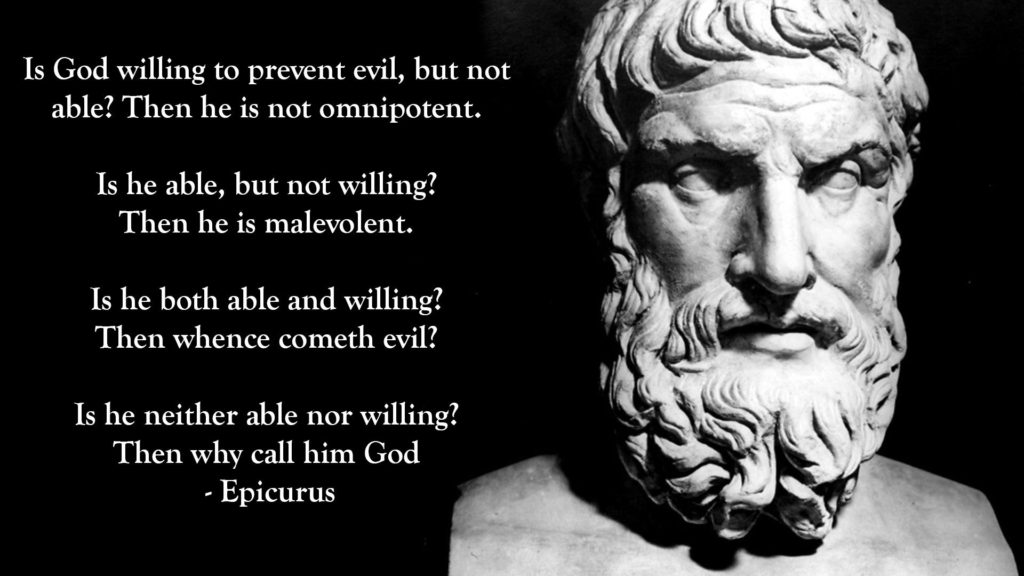
This conundrum is usually expressed in the words of Epicurus (see image at top of page). Believers in God often make the claim that God is both omnipotent and omnibenevolent. This creates a paradox in the mind of non-believers, on account of that evil and suffering exist in the world.

If God is unable to prevent evil, then God cannot be omnipotent. If God is able, but not willing, then God cannot be omnibenevolent. This paradox could be called Epicurus’s Fork, on account of that the believer in God cannot easily reconcile their belief in God’s omnipotence and omnibenevolence with the fact that evil and suffering exist.

Reconciliation of this paradox is easy for the Elementalist, however.

The first thing to state is that Elementalists have a particular conception of God and creation. The Elementalist believes that all individual consciousnesses are fragments of God, and therefore God is not something separate to ourselves. It’s more accurate to say that we, collectively, are God.

Likewise, Elementalists have a different conception of creation. The material world is not something that we woke up in – the material world is a dream that we collectively manifest through our will and karma. More specifically, our experience in the material world is considered to be an infinitely small subsection of something called the Great Fractal.

So how does that relate to the coexistence of God and evil? The answer lies in understanding what existence would be like without the illusion of a material world.

Our consciousnesses only feel suffering because we identify with our bodies. Our bodies are transitory phenomena, and like all transitory phenomena they are in a constant state of flux. This flux is usually painful. As a consequence, we need to act to balance it out. When our bodies get hungry we eat, when they get tired we sleep, when they feel pain we need to attend to it.

Without the illusion of a physical body in a physical world, our consciousnesses would exist in a state of perfect bliss, united with God. Absent a body, we would not have any cause to feel pain or fear of death. Absent a mind, we would not have any cause to feel anxiety or fear of the future. The only thing that would exist would be consciousness.

And it would be as boring as shit.

What would it be like to not suffer? It would be to live a life that was utterly devoid of meaning. Without the possibility of suffering, it wouldn’t matter what actions we chose. Every choice would lead to an identical outcome, at least as far as suffering is concerned. As such, our choices would be totally meaningless. We’d simply drift senselessly through life, like a leaf on a river.

This absence of meaning is the root of spiritual suffering, a worse affliction than any physical suffering could be. People rarely kill themselves from physical suffering, but they kill themselves from spiritual suffering every day. The physical suffering inherent to life, then, is not the worst thing in the world. Neither is the emotional suffering that is also inherent to life on account of that we cannot possibly satiate all of our desires.

We might have to act like physical and emotional suffering is ultimately terrible in order to give life meaning, but the reality is that an absence of meaning would be an even greater suffering.

It’s possible, then, for an omnibenevolent God to allow a minor suffering in order to prevent a major one. If the meaninglessness that accompanies existence in a state of perfect bliss can only be overcome by casting individual fragments of consciousness into a world of eternal misery, then so be it. Cast us, O God, into eternal misery!

At this point, some people will ask: “If Elementalists think that suffering is good, what’s stopping them from deliberately acting to increase suffering? If suffering gives life meaning, then why not go around raping and murdering? After all, it would create plenty of meaning in people’s lives as they struggled to resist you.”

Such questioners must be referred to the Law of Assortative Reincarnation. Elementalists believe that the energy one expresses into the world becomes the energy of one’s consciousness, and that the energy one receives from the world is a reflection of that same consciousness. As within, so without, and as without, so within.

An Elementalist would only act to increase the level of suffering in the world if they themselves wished to incarnate in a world of beings who behaved in that manner. Because this is extremely unlikely, it’s also extremely unlikely that an Elementalist would knowingly act to cause more suffering. The Elementalist belief is that there is enough suffering in the world naturally to give everyone’s life meaning, and so it doesn’t need to be added to.

In summary, Elementalists see no contradiction in believing in an omnipotent and omnibenevolent God despite the presence of evil. It doesn’t matter that a will to cause suffering exists in this world, because that will ameliorates a greater suffering: that of living a meaningless life.

*

If you enjoyed reading this essay, you can get a compilation of the Best VJMP Essays and Articles of 2019 from Amazon for Kindle or Amazon for CreateSpace (for international readers), or TradeMe (for Kiwis). A compilation of the Best VJMP Essays and Articles of 2018 and the Best VJMP Essays and Articles of 2017 are also available.

*

If you would like to support our work in other ways, please consider subscribing to our SubscribeStar fund. Even better, buy any one of our books!

Writing Characters of Iron

With slightly more spiritual energy in them, characters become characters of iron. This occurs when someone starts to value things other than simple pleasure. A character of iron has developed a sense of honour, which means that they have identified cowardice as an impurity and have sought to rid themselves of it.

A character of iron is tough. Iron is used here as a metaphor for that which endures. The nature of iron is to resist the wear and tear of the outside world. A man or woman of iron is one who takes a beating but keeps on moving forwards. An iron horse is another name for a steam train; an iron fist is what a boxer is said to possess if he regularly knocks out his opponents (or an iron jaw if he is hard to knock out himself).

Iron is yang energy applied to the raw physical.

Physical discipline marks out the character of iron. They are fit, strong, well-trained. Physical pain and deprivation do not trouble them. If anything, they raise the spirits of the man of iron, who knows that his capacity to endure it raises him above the other softcocks.

The spirit of iron was represented in antiquity by Mars, from where we derive the term ‘martial’. Mars was the Roman God of War, the physical expression of the masculine. Usually, Mars was only invoked in the presence of men. This means that if your character of iron is female, you will have to do more thinking to make her believable.

More esoterically, characters of iron are about order in the physical realm. Not only have they imposed order upon their own bodies, but they are also willing and able to impose order upon the physical world. The essence of iron is the kind of physical dominance possessed by an alpha chimpanzee or gorilla – the sort that makes weaker characters avert their gaze.

Iron became popular on account of that it was capable of keeping a hard, sharp edge. This hardness is characteristic. Whereas the softness of the characters of lead and tin sees them give way in stressful situations, the characters of iron hold fast. Being sharp, they are more dynamic than other characters. As such, a character of iron is particularly useful for getting a story started.

In the same way that iron is useful on account of that it can be made into tools, characters of iron are useful in the sense that they can achieve things. Characters of lead are too lazy and characters of tin too hedonistic. This means that characters of lead and tin tend to get order imposed on them by characters of iron (at least physically).

The archetypal profession of the character of iron is soldiering. The art of soldiering is all about making oneself hard like iron, and bearing tools made of iron to destroy one’s enemies. In practice, there are many types of men in the armies of history, but the men of iron constitute the most successful among them. The others are either too precious or too dull to truly excel in combat.

In your story world, a character of iron could also be a bouncer, a police officer or a professional sportsman. Anything where the prime objective is the imposition of physical order upon chaotic elements is the realm of the character of iron.

In principle, there’s no reason why a character of iron in your story can’t be female. In fact, the rarity of it might make for an especially interesting character, one that was less cliched than a male warrior. Red Sonja of the Robert E. Howard tales might be the best example of this.

Commensurate with their higher level of spiritual refinement, characters of iron have immense physical courage. A true character of iron will not back down from any threat or physical challenge. Like the Gurkhas of Nepal, this physical courage comes from a heightened sense that physical death is not the worst possible thing. The merely brutal men are more likely to come from the passionate realm of tin than the disciplined realm of iron.

There is a flipside, however. Iron is brittle, and it will break instead of bending. Whereas the character of silver is just as happy moving backwards as forwards, the character of iron tends to be stubborn and bull-headed. This is a good quality when they’re receiving a cavalry charge, but it’s a bad quality in peacetime, when it tends to lead to unnecessary fights and arguments.

In a sense, iron represents the archetypal primal masculine – the warrior and the hunter. It reached its apogee in the ancient world with the invention of iron weaponry, which easily defeated weapons and armour made of softer metals (let alone wooden spears and bone clubs). Iron is that which penetrates and pulverises. It dominates physically, but in turn it gets dominated mentally and spiritually.

Other characters might look down on the character of iron out of the belief that that they are vicious. The characters of iron don’t have the sense of chivalry possessed by the characters of copper, much less the sophisticated moral sentiments of the three highest elements. Consequently, their readiness for physical conflict makes them appear threatening to the others.

It’s true that characters of iron can have a pronounced dark side. Their physical superiority gives them the opportunity to get away with a variety of acts of cruelty, brutality and savagery. Although they are at their best in the fire of war, when the guns fall silent the head tends to become noisy. The effect of trauma on a character of iron can come to mean that they devolve into a character of tin or lead, and come to express dark energies.

The most sinister side of the characters of iron is perhaps expressed sexually. The man of iron is the typical rapist, rape being very much the order of things in a state of nature. The man of iron despoils women as much as he despoils the countryside. He might not be as impulsive as characters of tin and lead, but neither is he motivated by a desire to end the suffering of all sentient beings.

The character of iron is capable of great cruelty on account of what is known to Elementalists as the Conceit of Iron. This the name given to the fact that the character of iron tends to be physically dominant, and that it’s easily possible for them to confuse this physical dominance for the Will of God (i.e. to mistake their ability to force something on others with their right to do so). If a character in your story suffers from this conceit they are capable of anything.

On the other hand, characters of iron are capable of their own great virtues. Few are as loyal as the character of iron, for better or ill. A true man of iron, feeling no physical fear, can sit happily in a foxhole under artillery fire, knowing that such an environment would destroy all of the softer characters. Other characters might be able to outsmart them, but they can’t simply scare them off with a direct assault.

The real value of the character of iron is that the space they win through their courage creates an opportunity for others to grow, and perhaps then to achieve some of the higher positions on the spiritual spectrum. Following this, it may be that your character of iron is an elderly warrior, or a chivalrous one with a bit of copper in them.

*

This article is from Viktor Hellman’s The Alchemy of Character Development, the sixth book in VJM Publishing’s Writing With Psychology series. This book will show you how to use alchemy to create deep, realistic and engaging characters for your creative fiction.

*

If you enjoyed reading this essay, you can get a compilation of the Best VJMP Essays and Articles of 2019 from Amazon for Kindle or Amazon for CreateSpace (for international readers), or TradeMe (for Kiwis). A compilation of the Best VJMP Essays and Articles of 2018 and the Best VJMP Essays and Articles of 2017 are also available.

*

If you would like to support our work in other ways, please consider subscribing to our SubscribeStar fund. Even better, buy any one of our books!

Uncovering Occultic Insights While Gaming

by DIE SIENER

I grew up in the 80s and spent my free time playing games on some comparatively inglorious rigs. My first rig, which I had to share with my dad, was an Intel 80286 PC with a monochrome tube screen running some archaic version of DOS. Big bulky sort of thing, it made noises like an old truck engine when it cranked up. It booted the operating system from an 8-inch floppy disk and most programs ran from a secondary floppy drive – no hard drive on this puppy at all.

To my preteen self, this was the most glorious piece of technology ever invented by man and I spent countless hours having a crack at text-based RPGs, carefully manoeuvring my ASCII character through dungeons fighting text-based orcs and warlocks. At the time, I would never have thought that one day I would be able to play a game such as The Elder Scrolls: Skyrim on a gaming laptop tens of thousands of times faster and oh so exceptional at displaying all those monsters and dragons on a full 24-inch HD screen.

Apart from gaming, I have also nurtured a habit of delving into the occidental occult. From the arcane wisdom, I have learned a lot about myself and the nature of the Great Fractal.

I habitually continue to learn through daily observation, even in times I’d rather just chill out and forget about work and family commitments. It was a bit of a surprise though that, while I was playing an Elder Scrolls game, I was elevated into a meditative trance. It just goes to show that if you are receptive to God, he is always willing to reveal the mysteries, no matter your current disposition.

Before I delve too deeply into the nature of this trance, let me first clarify some mechanics relating to the Elder Scrolls franchises’ game mechanics.

In the Elder Scrolls franchise, your avatar is ultimately represented by three forces. The first of these forces is called “Health” and is habitually coloured red. The second force, which is the mirror of the first, is called “Magicka” and is coloured blue. The third force is often called “Fatigue” and is coloured green.

Now from here on it becomes a bit more complex and varies from franchise to franchise, but, in general, we can say that these three forces are derived from some additional factors: the star sign under which a character is born and also the class of character the gamer chooses. These two choices influence the three forces in such a way as to govern how the character will develop in-game.

A gamer would usually complete this creation process at the start of a new game and your avatar is then born into the game-world and the “you/avatar” team can then start exploring and taking on quests etc. So, this is the basics of how the avatar is created.

The gamer will now manipulate the avatar around the game world and, based on its primary forces, will favour any number of different playing styles while solving various challenges.

A physical character would have high health and fatigue reserves and so would favour going into combat directly with heavy weapons and armour, trying to cause a lot of damage and ultimately outlasting his adversaries. His weakness would be his lack of mana which will leave the avatar incapable of casting beneficial spells, say casting a healing spell or a protection spell.

A character that is focused on predominantly casting spells and using magic to overcome challenges would benefit from a high reserve of mana and fatigue as it will have to manoeuvre around heavily armoured foes rapidly, and cast different forms of magic to overcome its foes’ greater physical prowess.

As the player continues along his path, completing quests, clearing dungeons and fighting random monsters in the game-world, the character slowly builds up experience in the skills that it favours. This then reinforces the nature of the character since each time it levels up, the characteristics which enable that type of character to become better at what it does will naturally be chosen.

At first, tasks seem hard and you fail often, but the better defined the character becomes, the easier it finds its way through quests and challenges.

Now coming back to the other night when I entered an altered state of consciousness. You see, I realised once again that we humans are not much different from this make-believe digital avatar. The catch is that in real life it takes tremendous effort to separate the actor from the flesh and blood avatar.

It doesn’t only take effort once – like RPG games, it takes the repetition of challenges, each tougher than those before, to define our primary attributes and train our avatar to follow the instructions of the actor and not the other way around. How we as individuals choose to address these temporal challenges also determines the type of character our souls ultimately develop into. It affects our fate – something which receives far too little consideration in modernity.

This tripartite nature of our reality is, unfortunately, a mystery deeply hidden to the masses who, for the most part, remain asleep and forgetful about their true nature beyond the flesh. It is this forgetfulness which inhibits our higher selves from taking control of our encounters and overcoming the challenges and uncertainties which we are all fated to experience. We remain trapped in the forces which govern our lower aspects and never seem to overcome them. The lesson that all occultists can take home is this warning.

In RPG gameplay, you can easily become lost in the fantasy, just as you can in real life. It takes real effort by the actor to distance himself from the avatar, to see things for what they truly are and to overcome them through the effort of body, mind and soul.

*

If you enjoyed reading this essay, you can get a compilation of the Best VJMP Essays and Articles of 2019 from Amazon for Kindle or Amazon for CreateSpace (for international readers), or TradeMe (for Kiwis). A compilation of the Best VJMP Essays and Articles of 2018 and the Best VJMP Essays and Articles of 2017 are also available.

*

If you would like to support our work in other ways, please consider subscribing to our SubscribeStar fund. Even better, buy any one of our books!