
VJMP Reads: Anders Breivik’s Manifesto XVI

This reading carries on from here.

In this section (pages 1294-1413), Breivik describes what he predicts will happen when a European civil war kicks off, sometime around 2070 A.D. Chillingly, he is clear about his belief that democracy has already failed. He points out that if Europe is to remain a democracy then it is already lost, because demography has already gone so far as to shift the power into Muslim hands.

After all, if Muslims become a numerical majority anywhere then it is no longer a matter of fighting – they will be able to simply vote any aspect of Islamic culture into law. It is a curious fact of the modern public discourse that few commentators are willing to speak about what will happen if current demographic trends continue, even though the historical example of Lebanon has been clearly described by many, not just Breivik.

A particularly odd paranoid streak, common in European nationalists, comes through in this section when Breivik lists the crimes of the American Empire. This list is not as exhaustive as his list of the crimes of Islam, but it emphasises a point that is not easy for people in the New World to understand: namely, that the idea of “The West” is a New World concept and European nationalists are quite happy thinking of Europe by itself as a self-sufficient system.

Interestingly, here Breivik puts a precise monetary value on his willingness to get rid of Muslims. He states that, when the inevitable deportations begin, every Muslim will be offered 1kg of solid gold to voluntarily go away. $15 billion Euros to get rid of a population of 1 million is a fine exchange in his mind.

The plans for a cultural conservative revolution here are comprehensive. Breivik writes about the need to reform education so that children are taught that Islam is a hate ideology on par with Nazism. Re-educated is the preferred method for dealing with Marxists, unless of course they are “Category A, B or C traitors”.

Again underlining Breivik’s inability to understand irony, he writes “Crusading is not just a right, but a duty according to Canon Law,” which is precisely the mentality that he is accusing Islam of and which he uses to justify his action. Much like the jihadists he excoriates, Breivik claims that “in the context” of the Islamic invasion of Europe, any action could be considered self-defence, echoing Osama Bin Laden’s justification for the 9/11 bombings.

This section then takes a rather bizarre turn, with a series of cut-and-pastes on religious themes such as the ability of the Christian cross to act as a unifying symbol for all Europeans, how the Lord demands that his followers be warriors, and a fire and brimstone laden spiel about the hell that awaits atheists after death.

Here Breivik mentions explicitly that he considers himself a warrior of Christ and that if he is killed in action he expects to get into the Christian heaven as a martyr.

This section finishes with a c.50 page “interview” with himself, in which Breivik responds to anticipated criticism. Here he again expresses his disdain for Nazism, calling it a “hate ideology” and saying that he could expect the Nazis to turn on conservatives like him as soon as the Marxists were dealt with.

Breivik makes a very compelling argument here. The Marxists claim to oppose Nazism on the grounds that declaring a person to be subhuman and then treating them as such is grossly immoral, yet anyone who doesn’t agree with the Marxist doctrine on every point, no matter how evidently ludicrous and self-defeating, is themselves treated as subhuman. Already the Austrian Government is putting elderly ladies in prison for the utterly preposterous non-crime of “Holocaust denial”.

It’s hard not to appreciate the accuracy of this criticism of the Left’s behaviour.
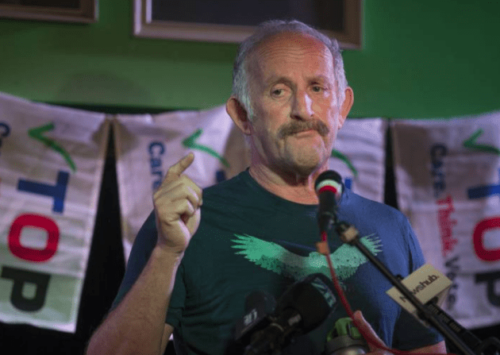
What’s Defective in the Brain of Gareth Morgan?

Most Kiwis have now had occasion to listen to Gareth Morgan and have realised that there’s something missing from his brain

New Zealanders have had a collective experience this year – 97.6% of us have seen Gareth Morgan on television or social media and thought to themselves “There’s something fucking wrong with that guy.” Even by the mediocre, ignorant, bombastic standards of the puffed-up pissants who comprise New Zealand’s political class, Morgan stands out as a particularly vile specimen. This article takes a psychological perspective to examine what might be wrong with the man.

Having a go at someone on the occasion of the sudden death of a beloved pet, as Morgan did upon the death of Jacinda Ardern’s cat this week, is about as worthy of admiration as having a go at someone on the occasion of the death of a grandparent. It’s a really low thing to do, and a person wouldn’t normally think to do it unless something was missing from their brain. After all, many pet owners consider their animal friends a legitimate part of the family.

Imagine if Sam Morgan suddenly died and Jacinda Ardern had a go at Gareth on social media, taunting him on account of the damage Sam did to the environment with frequent international air travel. It would be the most appallingly unprimeministerial conduct ever witnessed in the history of the country. The whole nation would be united in agreement that someone who behaved like that was not fit to run a pub, let alone lead a country, on account of lacking basic compassion.

That this sort of conduct is not beneath Morgan won’t surprise the large numbers of people who have observed him speak and got a creepy vibe from the man, as if he was someone who you wouldn’t leave alone in a room with a pet or a small child.

Probably the reason for this is that Morgan, like most individuals who give other people the creeps, has a very low opinion of the importance of other people. As evidenced by his proposal to buy a section of Awaroa Beach, Morgan considers other people lesser beings, their opinions less worthy, their feelings less valuable.

This is not news to anyone who criticised Morgan’s refugee policy on one of his billions of sponsored FaceBook threads, and was verbally abused as a consequence.

It is cause to believe that Morgan has utterly failed at what a psychologist would call the development of a Theory of Mind – in other words, Morgan has absolutely no idea what’s going on in other people’s heads.

This hypothesis is supported by Morgan’s rude, crude, almost autistic dismissals of other people’s viewpoints. Like most narcissists, Morgan responds firstly with disbelief and rage when people disagree with him, and then when this cools becomes snarky and contemptuous. No effort at creating a common understanding with another person is made – you agree with the truth as divined by Saint Gareth or you are simply subhuman.

No amount of explaining could get it into Morgan’s head that most people are appalled by a tax plan that calls for taxing the family home. For the vast majority of people, their tenure of dwelling is their basic security in life: their castle and their home base. Of course, someone with hundreds of millions who can buy a house with pocket change cannot understand these sentiments, but the telling thing is that Morgan made no effort to – anyone who disagreed was simply a misinformed idiot.

Neither does he seem to have the faintest idea how much joy people get out of cats, and therefore the great anti-depressant effect that cats have on the people that spend time around them. He seems to have completely failed to understand that most cat owners see their cats as fellow beings of a similar order of importance to other people. This is pretty weird, all things considered, because there are very few people who are mentally defective on such issues of empathy.

Probably the main reason for this failure is that Morgan just doesn’t care. Judging by his behaviour on the campaign circuit, other people are, for him, just tools to be used in the achievement of a greater objective.

In other words, Morgan shares a failure to develop a theory of mind with all manner of criminals, psychopaths and dictators, who, like him, are missing the basic empathy that makes people truly human.

VJMP Reads: Anders Breivik’s Manifesto XV

This reading carries on from here.

In this section (pages 1235-1290), Breivik turns to the question of how to consolidate and organise European conservative groups. This is mostly to be achieved through the promulgation of what Breivik calls the “Vienna School” of ideology, so named because it was in Vienna where the last great expression of a European will to not be ruled by Islam took place.

For Anglo readers, some of Breivik’s philosophy will appear very curious. Some of this originality is a consequence of being European, such as his desire to resist “excessive US cultural influence”. He also believes in the idea of partitioning South Africa in two countries, with one for the Europeans. These sentiments he shares with many other European thinkers, not all of whom are right-wing.

Fundamentally, as is repeatedly emphasised, Breivik is looking for space away from what he considers hate ideologies. These hate ideologies are all as bad as each other in Breivik’s mind, and he claims to oppose any such ideology based on hate: “A multiculturalist is just as bad as a Nazi, which again is just as bad as a true Muslim, a communist or a fascist.”

The four most prevalent hate ideologies in the modern world, against which all nationalists and patriots much stand, are according to Breivik:

1. National Socialism (anti-Jewish hate ideology, racist in nature).
2. Islam (anti-Kafr hate ideology, Christians, Jews, Buddhists, Hindus, Atheists etc).
3. Communism (anti-individualism, anti-freedom).
4. Multiculturalism (anti-European hate ideology, anti-white racism).

Sometimes Breivik’s argumentation is so reasonable that one is forced to consider whether or not he may have become demented after composing this document. For instance, he correctly points out that it isn’t a good or honourable idea to fight the hate of multiculturalism with the hate of Nazism, and one ought to strive to find an ideology without hate. He also points out that young people should not be considered “lost causes” just because the media labels them racists, a level of tolerance severely at odds with his infamous actions.

Much of this section is taken up with talk about the “seven fronts” of peaceful activism, which involve ways of promoting a cultural conservative message and resisting the hate ideologies of Communism and Multiculturalism while acting within the law at all times, and how people in these fronts must officially deny support for the “eighth front” of armed resistance.

Breivik gives a sense of having left no stone unturned when he writes at length about the reality of time in prison for anyone really interested in being a member of the eighth front. How to conduct oneself in prison in order to undermine Islam is discussed at length.

The most interesting thing to take away from this section is the question Breivik raises when he talks about the need for reasonable cultural conservative movements. He makes the claim that multiculturalists have sown the seeds for their own downfall by making moderate cultural conservatism impossible, because this has driven a large number of impressionable young people into the embrace of hate ideologies like Nazism.

This might be the aspect of Breivik’s philosophy that people will have the most difficulty understanding. He has the historical understanding to foresee a counter-reaction to leftism, and he knows that the greater the excesses of one age, the greater the excesses of the counter-reaction. So he is a voice of moderation in a very real way, somehow managing to be a centrist on the paranoid and aggressive axis.

Interestingly, however, Breivik puts the responsibility of creating this reasonable cultural conservative movement on his readers. He argues that any unwillingness to do so will inevitably result in impressionable youth having their social needs met by more insidious movements.

Why Kiwis Hate the Police II

Many forget that the warrant of a New Zealand Police officer is not to enforce the law but to keep the peace

Consider this thought experiment. You’re driving down a state highway at 100km/h, with some cannabis in your car. Going around a bend, you see a Police car upside-down in a river with no person in sight. Obviously the driver failed to take the corner, and is almost certainly in dire need of immediate medical help. The question is: do you stop and help, or do you just drive on past?

Most Kiwis would argue that the correct answer is clearly to stop and help. After all, it’s a medical emergency, and the Police couldn’t possibly be so unreasonable as to charge a person with a cannabis offence if someone’s life was on the line. Surely discretion would be used in such an instance.

These Kiwis would have more faith in the Police than Caleb Smith, of Greymouth. His story, which hit the news yesterday, has appalled New Zealanders. Smith made a suicide attempt, and part of the Police response was to search his house, discover some cannabis plants, and charge him with a criminal offense. He now has three criminal convictions.

This incident is very enlightening when considered in the context of broader relations between the public and the Police. The reaction of most New Zealand citizens when reading about the conduct of the officers in the Caleb Smith story is horror, disgust and outrage, but that isn’t the worst thing.

The worst thing is the effect stories like this have on public perceptions of New Zealand Police officers.

Stories like Caleb Smith’s tell the reader that the sort of person who becomes a New Zealand Police officer is the sort of person who is willing to go up to another Kiwi at their lowest point – in the midst of a suicide attempt – and kick him in the guts, making his life far more difficult for no benefit to the public good, and without the consent of the New Zealand people. It’s a person willing to be cruel simply for the sake of it, using their uniform as a shield to evade responsibility.

Like a dog, they just do what they’re told without consideration. At least, this is how the Police naturally start to appear in the eyes of the population they are supposed to be keeping safe when that population read about such incidents.

Cries of “They’re just doing their jobs!” don’t change the sentiments that stories like Smith’s make Kiwis start to have towards Police officers. In fact, mindlessly following orders is as contemptible as anything else – and people know this.

At the end of the day, every Police officer has the free will to refuse to enforce laws that are unjust, and if they choose not to exercise that free will they cannot complain of the consequences.

It is the duty of every sentient being to consider whether their actions cause suffering to leave the world, or whether their actions bring suffering into the world. That Police officers enforce a law on the Kiwi people that causes great suffering, and that they do so without the consent of those people – who do not approve of that law – is worthy of contempt.

If Police officers choose to enforce a law, even when doing so requires them to willfully add more suffering to the life of one of their fellows who is already suffering severely, then it’s only natural that the people come to hate them.