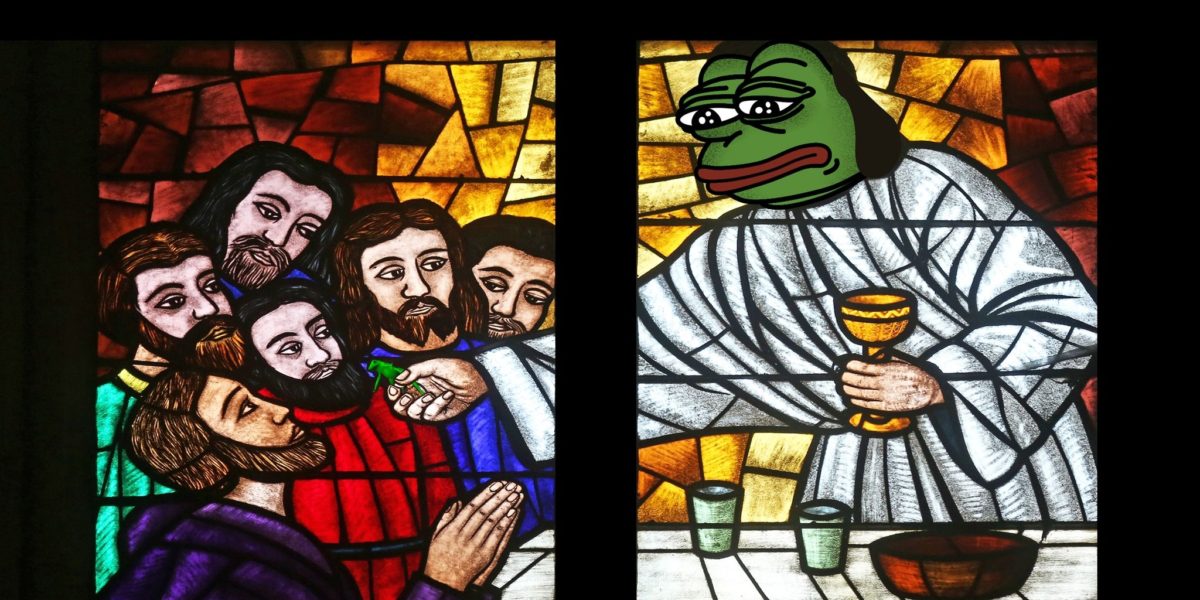
Why Beneficiaries Are Morally Superior to Workers

It’s a nearly universal assumption nowadays that people who work are morally superior to people on welfare. People on welfare, we are told, are essentially parasites that do nothing but suck wealth out of the system, and we’d all be better off without them. As this essay will explain, this is almost the exact opposite of reality. People on welfare are, in fact, morally superior to those who work.

The vast majority of human history has been one of deprivation and toil. Having evolved from a common ancestor with chimpanzees and bonobos, the primary survival challenge facing our species for almost the entirety of its existence was finding enough food to meet the metabolic needs of our bodies. For the most part, this was a brutal and bloody struggle against the world – and each other.

This had a powerful effect on the evolution of human behaviour – and our morality.

Because resources are scarce, and the metabolic clock is ticking, humans have always needed to be active. We have always needed to work, whether that be hunting, gathering, fishing or working the land in the form of agriculture. This was how we gathered enough resources to survive. The alternative to activity was death.

Because working was necessary for survival, we have always praised those who did it, and always excoriated those who did not. It was probably necessary to do this, because, had we not done so, the lazy would have dragged all of society down with them. Our culture, especially Northern European culture, came to consider work something almost holy, as if the meaning of life.

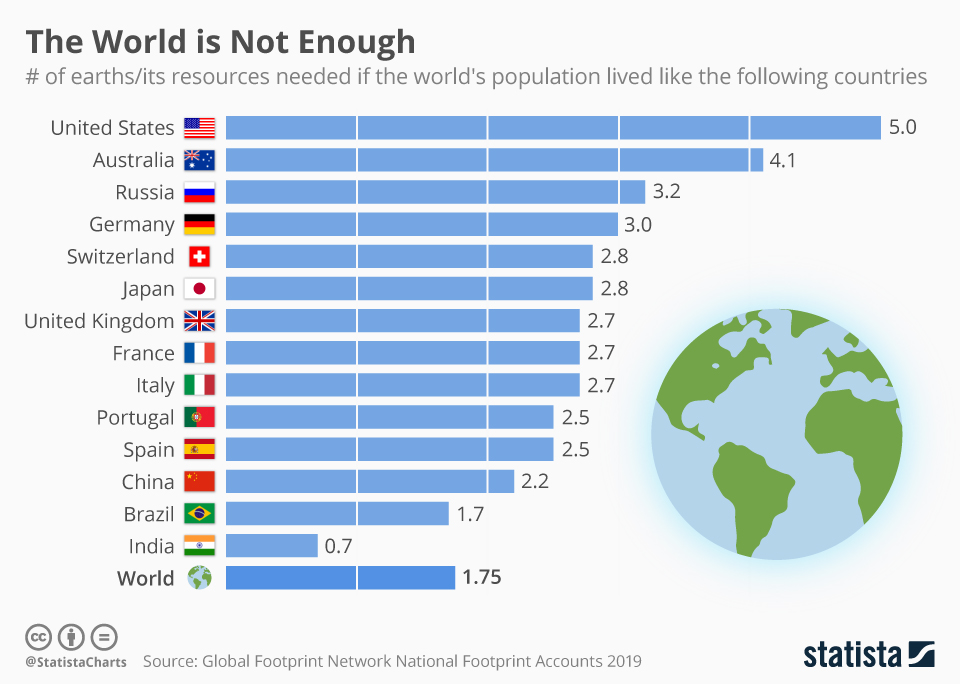
Working more and harder is how wealth is built, but as can be seen in the graph at the top of this essay, the planet cannot support the level of consumption that humans are currently subjecting it to. There simply aren’t enough of the necessary resources. The resources that do exist are being depleted at such a pace that we can see hard physical limits approaching, and there’s no escaping it.

The fact is that a profound paradigm shift has taken place over the past few hundred years, and we’ve barely even noticed it, let alone adapted to it.

American agricultural productivity increased 1200% between 1950 and 2000. This was thanks to something called the Green Revolution, which increased agricultural productivity severalfold all across the world. What this means is that it requires far, far fewer people to feed society today than what it took in the past. Therefore, most people are now surplus labour.

We have adapted to this by setting the now-redundant agricultural workers to work in other industries. First was manufacturing, then service industries. This worked out great for a long time, because all of these non-essential workers were able to produce things that raised the human standard of living, even if those things weren’t necessary.

This was pretty awesome for a few decades, and arguably continues to be. However, we are now aware of some things that we once didn’t know. In particular, we are now aware of the pressure we’re putting on the natural environment through shifting those surplus workers into manufacturing all sorts of things. We now know that we can’t keep doing this.

The world doesn’t need hard work and production any more. Those days are over. What the world now needs are people who can restrict their consumption to a level that the world can sustain. As seen on the graph above, that level is about half that of the average Chinese level of consumption, some $15,000 of resources every year.

In other words, a First World standard of living will, necessarily, become a thing of the past sooner or later.

For the average Westerner, restricting one’s consumption to about $15,000 worth of goods and services a year will not be easy. This will demand an extremely sharp curtailment of material desire. It will mean that far fewer international trips can be taken, and far fewer new cars or big screen televisions can be bought. It may require vegetarianism or something like it. It will require great sacrifice.

Without such a great sacrifice, our planet cannot survive, or at least not in a form that can sustain human life. Therefore, doing so is a moral imperative.

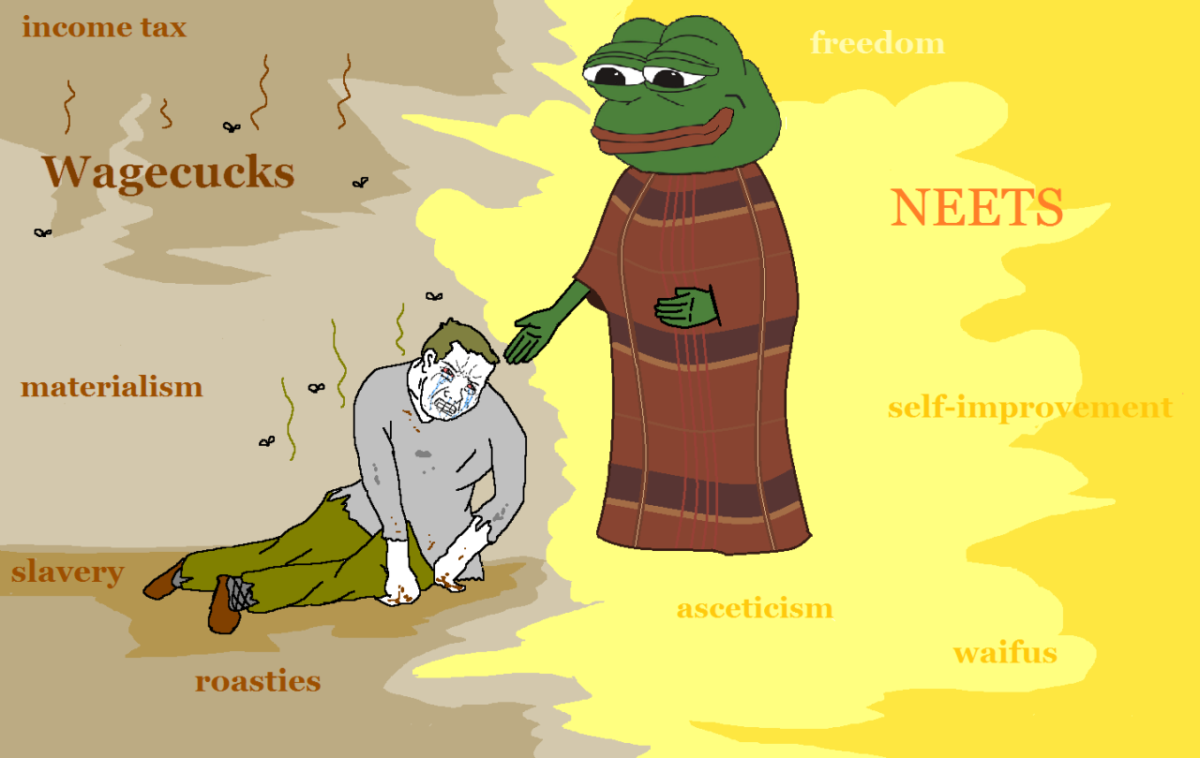
The average Western beneficiary has already achieved this. Considering that the average Western beneficiary already survives without the excessive consumption displayed by almost everyone in a job, they are in fact showing the way forward for the rest of the Western World. They are the pioneers of the future, demonstrating the correct way for the rest of us to behave. They are the Men of Gold.

Like the holy ascetic men of the great Eastern religions, the Western beneficiary class has liberated themselves from materialism. They are therefore showing the way forward for the rest of humanity, and ought to be praised as spiritual masters. The rest of us need to follow the path of the beneficiary, and stop following the path of the worker/consumer. The first step is recognising the moral superiority of the welfare recipient.

*

If you enjoyed reading this essay, you can get a compilation of the Best VJMP Essays and Articles of 2018 from Amazon for Kindle or Amazon for CreateSpace (for international readers), or TradeMe (for Kiwis). A compilation of the Best VJMP Essays and Articles of 2017 is also available.

Te Reo With Mnemonics: Media Words

Report – pūrongo

A TV presenter speaks to the camera and says “The Government claims that this network is fake news. This report shows why this idea is purely wrong.”

Reporter – rīpoata

A journalist is standing at ringside for a women’s Mixed Martial Arts event and, when they are fighting, he screams “Rip her heart out!”

according to – hei tā

A new reporter walks up to a woman, points to a man and says “According to that guy, you’re a hater.” The woman protests “According to who? I’m no hater!”

Television – pouaka whakaata

On television, there is a show where Dan Carter is sitting at a table at a restaurant. He makes an order to a waiter, and the waiter calls out “A porker for Carter!”

Message/Messenger – karere

A uniformed man walks briskly, carrying an envelope. A woman approaches and asks him “Are you the messenger?” The man replies “I’m a courier.”

Radio – reo irirangi

A radio plays to an empty kitchen. The music stops and then the radio broadcasts a strange and haunting ringing tone. It is a real eerie ringing.

Newspaper – nūpepa

A man is reading a newspaper, and looks closely at an advertisement for some “New Pepper“.

Magazine – maheni

A supermarket shopper looks at a magazine for poultry enthusiasts. The front cover has an image of a woman holding a pet hen, and the title is “My Henny“.

Website – pae tukutuku

A young girl looks at a website on a laptop computer. It’s a website about a service that delivers pies by tuk-tuk, called Pie Tuk-tuk.

Social media – pae pāpori

A flamboyantly-dressed man speaks to a camera, flanked by two assistants. All three are part way through wrapping up a pie in paper. The central man says “The most important thing about pie papering is getting it on social media! Put your pie papering videos on FaceBook, Twitter and others!”

Electronic magazine, ezine, zine – mahenihiko

An inventor shows a clockwork magazine to a friend. It walks across the table. The friend says “That looks like an electronic magazine.” The inventor says “No, it’s mechanical.”

Media – hunga pāpāho

A prostitute made out of paper is about to be executed by hanging. The media is all gathered around the watch the spectacle. They are about to hang a paper whore.

*

This wordlist is an except from Learn Te Reo With Mnemonics, a book being compiled by Jeff Ngatai for an expected release at the beginning of 2020.

Why New Zealand Is So Fucked Up

A lot of thought has seemingly gone into answering the question of why this country is so fucked up. Most of it coalesces around ideologies, with liberal capitalism, globohomo, ethnonationalism and anarcho-nihilism being the foremost. None of these theories have as much explanatory power as the psychohistory model, as this essay will show.

The British Empire found itself with some severe problems in the 18th century. Because of industrialisation and modern science leading to advances in medicine and sanitation, there was a population explosion in Britain. This led to overcrowding, a problem that was alleviated by emigration. In some cases this was voluntary, in the form of gentleman settlers; in other cases it was involuntary, in the form of penal transportation and indentured servitude.

Like Australia, New Zealand came into being as a place for the rapidly expanding British Empire to dump some of its surplus cannon fodder, in case it needed to be called upon later. With the American Revolution of 1776, it became a lot harder for them to dispose of their convicts in North America, which is why, 12 years later, the First Fleet landed in Sydney Harbour to begin the colonisation of Australasia.

Within a few decades, the strategic imperative of colonising New Zealand had become apparent to the commanders of Empire back in London. Not only would it facilitate the projection of British military force into Asia, but it would also prevent the French from getting hold of it (as they later would New Caledonia).

To that end, Britain resolved to populate this new territory with some of its surplus people. This was not done with convicts, as Australia, but with free settlers exclusively, many of who were victims of the Highland Clearances (a little-known truth about New Zealand history is that many of its early settlers were people who were “encouraged” to emigrate to New Zealand because of unusual sexual proclivities that weren’t technically illegal in Britain, but which made the others want to get rid of them, such as homosexuality and pederasty).

This means that New Zealand is not, and never has been, a nation. Right from the very beginning it was nothing more than an artificial construct – a company. Indeed, the people chiefly responsible for the early settlement of New Zealand were called The New Zealand Company. Like Australia, and America before it, the people it initially attracted were Britain’s expendables.

Real nations don’t know who settled them or why, or where their name comes from. In a real nation, the people have been there since the beginning of time as far as they are concerned, and the stories of their ancestors are not hard historical facts but myths. Their founders are demigods, not Colonial Secretaries.

A nation is a group of people who are united by ties of kinhood, and who therefore all share a common goal (the perpetuation of their kin). Nation refers not to a geographical space (as does country) but to the people who populate that space. Consequently, one speaks of France and the French nation.

The beautiful thing about nations is that, being based on extended kinhood, each one is like one large family. Consequently, the ties that bind each citizen to each other are strong. In places like Japan and Sweden this leads to an unwillingness to commit violent and property crimes against other people, and a willingness to pay taxes for the sake of other people getting proper healthcare and a proper education.

In a place like New Zealand, the ties that bind are weak. As a result, people don’t care very much about the suffering of the other members of the collective. Although bullying exists in all other countries, it’s rare that it’s quite as vicious as what is tolerated in New Zealand, one reason why we have the highest youth suicide rate in the developed world, and the second-highest rate of workplace bullying in the world.

The other reason why our suicide rates are poor is because we don’t have a mental health system. In 2016, our mental health funding was a pitiful $1.3 billion – for the entire country. This is why many New Zealanders who present to the mental health authorities are just told to fuck off and die. When you’re a company and not a nation, the death of an unproductive person is preferable to paying out a long-term benefit to them.

Simply put, being expendable, it’s not considered important if we suffer and die – and it never has been.

This is why New Zealand troops went to Europe to fight the German Empire in World War II, instead of fighting against the Japanese Empire in the Pacific. Had New Zealand been a nation, we would have defended ourselves, and dealt to the main threat to us, which was Japan. It’s also why we fought in World War I and the Boer War, instead of staying at home, which would have been far better.

Because we are a company and not a nation, we do what our shareholders tell us to do, which was to attack who they tell us to attack. It doesn’t matter if its the Boers, the Ottomans, the Germans, the Koreans, the Vietnamese, the Afghanistanis or the Iraqis – if it serves the interests of global financial capital, we’re ready to pick up our rifles and die for it.

Australia and New Zealand lost around 1.5% of our entire population in World War I, almost as much as Belgium, where many of the battles took place. Australia suffered more combat deaths than Belgium, despite a smaller population and despite being 20,000 kilometres distant from the fighting. 42% of all New Zealand men of military age served with the New Zealand Expeditionary Forces in World War One, meaning that experience of mortal combat was almost normal for an entire generation of men.

The reason for all this was that our men were conscripted into battle by ruling classes that served imperial interests, and not national ones. This national history of being used as cannon fodder for imperial military adventures (despite it being the reason for us being brought into existence in the first place) is the main reason why Aussies and Kiwis have so many psychiatric problems.

The immensely heavy exposure to combat fucked up our country in two major ways.

The first is obvious: the Post Traumatic Stress Disorder. Called “shellshock” in World War I and “battlefield fatigue” in World War II, this refers to the dissociation that can arise from the trauma of combat. It is because of the heavy incidence of PTSD that we developed a culture of drinking ourselves to oblivion and indifference to domestic violence. Unfortunately for us, this is the sort of trauma that gets passed on down through the generations.

The second was that it created our infamous “harden up” culture. The deprivations of war are no place for preciousness. Any man who expressed grief at what he had seen or done had to be made to shut the fuck up in no uncertain terms, lest the morale of the unit become affected. The battlefield is no time to talk about one’s feelings. While in the realm of iron, the ability to suppress emotions is often the difference between life and death.

This is all well and good if there is a war that needs to be won, but our cultures seem to have made permanent what should have been a temporary indifference to the suffering of our fellows. Genuine nations don’t do this. Because New Zealand isn’t a proper nation, however, the New Zealand Government doesn’t take this into account when it makes decisions.

If we had a proper nation, we would have spent the money to fix our psychiatric casualties. As it is, we have a nation where crying children are as likely to be bashed or sworn at as comforted. Young people seeking mental healthcare are excoriated for being weak. This is brilliant for raising a country of warriors, but it isn’t how a nation naturally raises its next generation, which is with firm, but relentless, compassion.

Not having a proper nation to keep check on them and to inspire their will, the New Zealand Government runs the country according to the will of foreign moneyed interests. These are essentially the same interests that own the New Zealand media, and just about everything else.

The New Zealand people never, ever wanted to double the refugee quota, and especially not when the number of New Zealand families on the housing waitlist already exceeds 12,000. The New Zealand people also wanted cannabis law reform decades ago. The New Zealand people wanted a sharp cut to our immigration intake. None of it matters.

The fact is that, not being a nation, Kiwis have very little solidarity with each other, and so we don’t stand up for each other. This is why it’s so easy for politicians like the Sixth Labour Government to strip away our rights to free expression and to firearms ownership. Because we don’t stand together, we have no way to resist aggression, whether from outside or inside the country. Thus, we remain divided and conquered.

There is only one way to unfuck New Zealand, and that is for us to come to operate as a nation. This is impossible as long as multiculturalism and mass immigration exists, and stopping those things are all but impossible as long as an industrial society with an economy based around eternal growth exists. But if we can come together as an extended kin group, we can develop the solidarity necessary to make ending each other’s suffering a primary goal.

The reality is that this will take several hundred years, and will not begin until after the collapse of the current economic paradigm. Some hundred years after this, both Kupe and Captain Cook will be mythological figures, and most of the rest of the world, Britain included, will be forgotten. At that point, a great race of bronze and copper will arise, and the nature of their influence will be to move inwards, towards the centre of the world.

*

If you enjoyed reading this essay, you can get a compilation of the Best VJMP Essays and Articles of 2018 from Amazon for Kindle or Amazon for CreateSpace (for international readers), or TradeMe (for Kiwis). A compilation of the Best VJMP Essays and Articles of 2017 is also available.
How to Deal With the Fact That We’re All Going to Die

Many psychologists and psychiatrists have noticed a sharp recent increase in the number of people who present to them with anxiety about ecological collapse. The proliferation of media relating to end-of-world environmental disaster scenarios has made many people fearful. This article will give some tips for dealing with the fact that we’re all going to die.

The phenomenon has been called climate despair. Fuelled by headlines about people dying in Japanese heatwaves, how last month was the hottest month in human history, or how humanity only has 18 months to act if catastrophe is to be averted, climate despair is when people give up on life on account of believing that humans have destroyed the climate of Earth, and thereby its capacity to support life.

It could be said to be a kind of existential horror, one that arises at the thought of a future Earth that is barren of life owing to Venus-like conditions. What is the point in doing anything, in struggling to achieve things, if we’ve just wrecked the planet and are all going to die?

Climate despair may not be irrational. Some climate models do indeed predict that we have cooked the planet beyond the point where human civilisation can continue to exist. Even though things are ticking along alright now, there may be several degrees of warming that are inescapable from this point owing to what has already been added to the atmosphere.

However, from an existential and spiritual point of view, climate despair is a needless suffering and therefore ought to be counteracted. The good news is that, in principle, climate despair is nothing more than bog-standard death anxiety wearing a new mask. Therefore, the old ways of dealing with death anxiety are applicable to dealing with climate despair.

The problem that we’re going to die is essentially two problems rolled into one.

The first is that it isn’t obvious, to many people, that consciousness survives the death of the physical body. In much the same way that the Earth intuitively feels flat, many people intuitively feel that the brain generates consciousness, and therefore the death of the brain with the death of the physical body means that consciousness ends.

The second is that it isn’t obvious, to many people, that anything we do here has any meaning. We’re all going to die, and even if consciousness survives this and goes through into the next world, we don’t appear to be able to take anything with us. We can’t take property with us, we can’t take family with us, we may not even be able to take memories with us. Therefore, no actions in this world have meaning, and despair must follow.

Solving the first problem isn’t too difficult. That’s a simple matter of refuting the common illusion that the brain generates consciousness.

If a person makes the argument that the life is meaningless because we all die, and with the death of the body goes our consciousness, therefore we are doomed to forget everything we have done and everything we are, they run into a problem. This problem is called the Argument from Biological Necessity.

Evolution is an extremely efficient process, and it only ever selects for traits that confer an immediate advantage in either survival or reproduction. But, as anyone who has read any Dostoevsky can tell you, being conscious confers no such advantage. The human animal could just as well fight and fuck without being aware of what it is doing.

If anything, consciousness is an impediment to survival, on account of that it leads to depression, anxiety and existential angst and horror. These emotions paralyse us and drive us to suicide. It would be much better to not be conscious – then one could simply do whatever was necessary to best further one’s genes.

If consciousness is not necessary, then it cannot have been selected for by natural or sexual selection, as all of the facets and qualities of the brain have been. Therefore, it cannot be generated by the brain, and therefore there’s no reason to assume that the death of the brain should affect the presence of it.

The second problem is much harder. Even if you can logically and convincingly argue that consciousness must survive the death of the physical body, is not clear that anything apart from consciousness survives with it. This raises the possibility that, after the death of the physical body, one has to start again, as if this life had never happened.

Broadly speaking, there are three ways to get life wrong as a result of all this, and one way to get it right.

One can become obsessed with breeding, and adopt the delusion that one has cheated death by producing offspring. People under this delusion know no greater pleasure than just to rut like animals, and seldom consider the stark fact that their offspring will also grow old and die, as will their offspring etc.

One can become obsessed with physical dominance, and adopt the delusion that just because one is hard to kill that one has cheated death. Even if a man is really big, strong, fit, trained in martial arts and carrying weapons, time will grind him down. Age will weaken his arms, and eventually a major organ will fail. This is no solution either.

One can become obsessed with intellectual dominance, or wealth and social status. Such a person adopts the delusion that one can live on in history if one achieves sufficiently great deeds. Of course, as the example of Ozymandias showed, even the greatest deeds are worn away by time. One can never be famous enough to overcome one’s own mortality because no-one can escape the fact that everyone dies alone.

The solution is to focus on refining one’s frequency of consciousness, because that is something that might well carry through into the next world. This means to use the power of will to work one’s consciousness into a state where it serves to bring peaceful and joyous order to the intellectual, emotional and physical environment.

The Law of Karma tells us that the energy we put out is the energy that we get back. Therefore, one ought to direct one’s will towards reducing the suffering of the conscious beings around you. If one does this correctly and of one’s true will, then chances are that one comes to be reincarnated in a place where beings with similar wills exist.

This act of changing the frequency of one’s consciousness is the only way that we can work to taking something with us into the next world. It’s therefore always possible to improve the quality of one’s spiritual position by working towards the cessation of the suffering of other sentient beings. This is true no matter what the current or future state of the world’s climate.

*

If you enjoyed reading this essay, you can get a compilation of the Best VJMP Essays and Articles of 2018 from Amazon for Kindle or Amazon for CreateSpace (for international readers), or TradeMe (for Kiwis). A compilation of the Best VJMP Essays and Articles of 2017 is also available.